
Africa’s Turacos and Where to Find Each One
Green birds, crimson wings and a habit of hiding: every turaco a visitor can realistically see, from Knysna to Ross's, and 3 Gambian species sharing 1 tree, with where to stay.
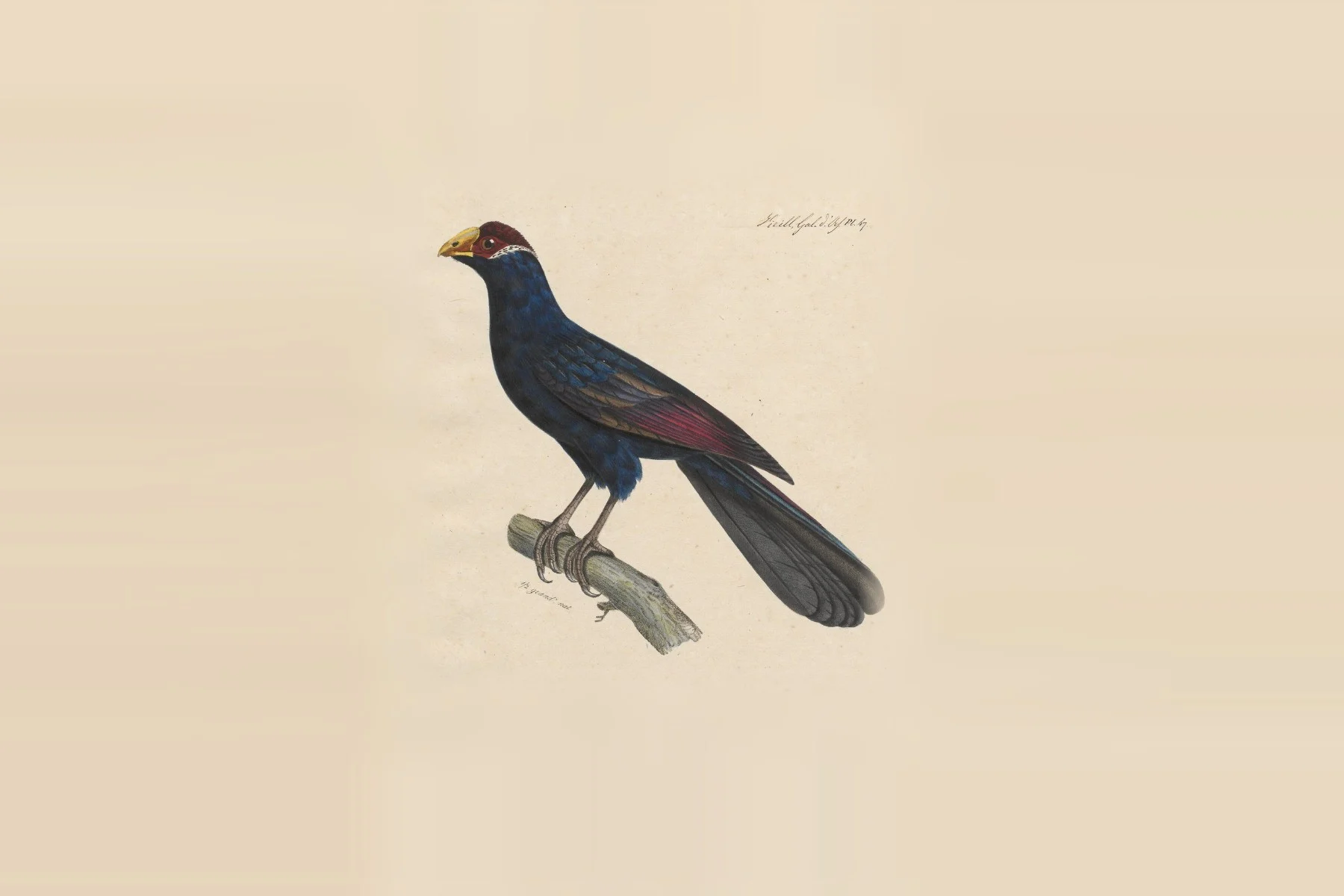
Turacos are found only in Africa, and most of them are green birds that live in the canopy and are far easier to hear than to see. A perched turaco is a green bird in a green tree. Then it takes off, the wings flash crimson, and the whole fuss makes sense at once. That flash is the moment birders remember, and it is why the family has a following out of all proportion to the number of people who have had a good look at a perched bird.
The family, Musophagidae, also holds the go-away-birds and plantain-eaters, grey and brown birds of open woodland that are far easier to see, the family’s extroverts. This guide concentrates on the forest turacos, the ones that need planning, and runs from south to north and west.
At a glance
| Turaco | Country | Where it is reliable (source) | Stay |
|---|---|---|---|
| Knysna | South Africa | Ebb and Flow, Wilderness (GoBirding) | In Toto Retreat, Pumula Lodge |
| Livingstone’s | South Africa, Tanzania | iGwalagwala trail, St Lucia (GoBirding) | Udzungwa Forest Lodge |
| Purple-crested | South Africa to Tanzania | Punda Maria bird bath, Kruger (GoBirding) | Lidiko Lodge, Mbizane Escarpment Retreat |
| Schalow’s | Zambia, Zimbabwe, Tanzania | Endoro, Ngorongoro highlands (Birding Ecotours) | Chundu Island |
| Rwenzori | Uganda, Rwanda | Mgahinga, Volcanoes (Birding Ecotours, listings) | Bisate Lodge, Sabyinyo |
| Ross’s | Uganda, Rwanda, western Kenya | Entebbe and Kibale gardens (listings) | Karibu Guesthouse, Kibale Lodge |
| Violet and Guinea | The Gambia | Makasutu Forest (Naturetrek) | Mandina Lodge (not yet listed) |
Southern Africa
The Atlas of Southern African Birds, in Tony Oatley’s accounts, treats the long-crested Livingstone’s and Schalow’s turacos as races of the Knysna Turaco. Most current lists split them, so they are listed separately here, and each counts as its own tick.
Knysna Turaco
Oatley calls it an indicator species of southern Afromontane forest, an obligate fruit-eater that spends most of its time in the canopy and comes down mainly to drink, and whose deep croaking call is part of the sound of the mist forests. It ranges from sea level in the southern Cape to the escarpments of KwaZulu-Natal, the Lebombo Mountains and Mpumalanga. Egg-laying runs mainly from September to January, peaking in November.
The easiest site is the Wilderness section of Garden Route National Park, where GoBirding says the wild bananas and Broom Cluster Fig outside Ebb and Flow reception draw Knysna Turacos. For an obligate fruit-eater, a fig outside reception is a hard offer to refuse. Nature’s Valley is another: GoBirding says walking the village streets can produce it. On the Garden Route, In Toto Retreat in Sedgefield is BirdLife Recommended and its local guide names Knysna Turaco; Pumula Lodge lists 120 species and names it with Narina Trogon and Goliath Heron; and Teniqua Treetops names it with African Fish Eagle. In the Eastern Cape, RiverBend Lodge has hides and a list of 300 species, Knysna Turaco and Narina Trogon among them. For the full route, see Garden Route birding.
In Mpumalanga and Limpopo, Mbizane Escarpment Retreat has a hide and names both Knysna and Purple-crested Turacos, and Tzaneen Country Lodge names the same pair with Crowned Eagle and Black-fronted Bushshrike. See Magoebaskloof birding for the Limpopo forests.
Livingstone’s Turaco
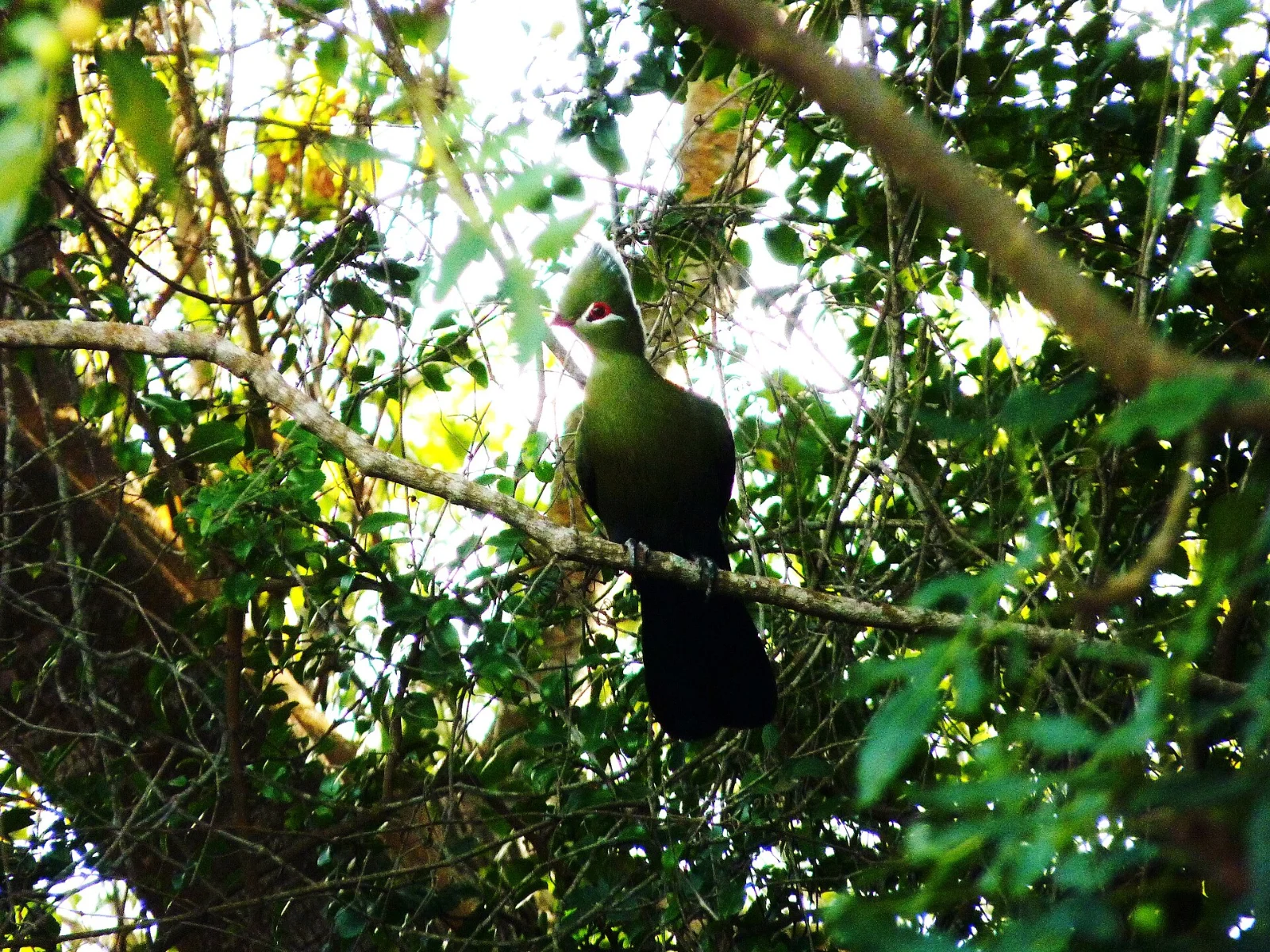
In South Africa, Livingstone’s lives in the coastal dune forests from St Lucia northwards; Oatley’s account notes that a large share of the population is confined to the northern KwaZulu-Natal dunes, and that dune mining on Lake St Lucia’s eastern shores could have wiped it out. GoBirding names it as a key species on the iGwalagwala trail at St Lucia, with Green Malkoha and Narina Trogon, a strong supporting cast for one forest trail. The Atlas also places Livingstone’s in Zimbabwe’s Eastern Highlands. Further north, Udzungwa Forest Lodge in Tanzania’s Udzungwa Mountains names Livingstone’s Turaco with Pel’s Fishing Owl and Kilombero Weaver. See Zululand birding for St Lucia.
Purple-crested Turaco
The Purple-crested is the turaco of the warm, wooded east, less tied to evergreen forest than the Knysna. Oatley describes a black bill, no white around the eye and a purplish-blue crest, a fast, rising crowing call, and a bird that drinks and bathes regularly and comes to garden bird baths. It is common in riverine forest and termite-mound thickets and in the parks of Durban and Harare, and rarely goes much above 1,300 m.
That bird-bath habit is its weak spot, and the birder’s opening. In Kruger, GoBirding says Purple-crested Turaco comes to the small bird bath below the picnic site at Punda Maria in the heat of the day, which is when a bath is the sensible place to be. In Durban, GoBirding lists it at Pigeon Valley. Lidiko Lodge in KwaZulu-Natal names it with Trumpeter Hornbill and Woodland Kingfisher, and in Tanzania, Simbamwenni Lodge and Camping in the Uluguru Mountains lists 112 species including Purple-crested Turaco.
Schalow’s Turaco
Oatley’s account describes Schalow’s as the long-crested turaco of riparian forest in the Caprivi and northern Botswana, and the race with the most restless feet. On the Zambezi above Victoria Falls, Chundu Island in Zimbabwe’s Zambezi National Park names Schalow’s Turaco with African Finfoot and Pel’s Fishing Owl. In northern Zambia, Birding Ecotours lists both Schalow’s and Ross’s Turacos among the targets at Mutinondo Wilderness. In Tanzania, its 2024 group found Schalow’s on the Elephant Caves Trail at Endoro in the Ngorongoro highlands, walked with a local guide; the Ngorongoro Conservation Area Authority charges US$17.70 a head for the trail.
Grey Go-away-bird
The open-woodland member of the family in southern Africa, and far easier to see than the forest turacos, whatever its name suggests. In Namibia, Ongava Lodge and Anderssons at Ongava, on the edge of Etosha, both have hides and name it among their specials.
Uganda and Rwanda
The Albertine Rift is the richest turaco country a visitor can reach easily, with 5 species in a single trip, which is a great deal of crimson wing.
Rwenzori Turaco
The montane specialist of the bamboo and high forest. In Uganda most tours look for it in Mgahinga Gorilla National Park. Birding Ecotours spent a full day on the slopes of Mount Sabyinyo, an extinct volcano of about 3,700 m, with a local guide and armed rangers in July 2023; the turacos did not show until the walk back down through the bamboo, when a pair called and flew past. Give it the whole day, because the bird may well use all of it. Uganda Wildlife Authority charges US$40 entry to Mgahinga plus US$40 for a birding walk. Across the border in Rwanda’s Volcanoes National Park, Bisate Lodge and Sabyinyo both have a bird guide on staff and name Rwenzori Turaco.
Black-billed Turaco
On the same trip, Birding Ecotours found Black-billed Turaco on the Ruhija school track in Bwindi, with Stripe-breasted Tit and Grauer’s Warbler. Ruhija Gorilla Lodge is at Ruhija, and names African Green Broadbill and Grauer’s Swamp Warbler.
Ross’s Turaco
The easiest of the Ugandan species, because it is happy to come into gardens. Karibu Guesthouse in Entebbe lists 50 species and names Ross’s Turaco with Eastern Grey Plantain-eater and Black-headed Gonolek, which makes it a first or last night of any Uganda trip. Kibale Lodge near Fort Portal names it too, and in Kigali, Nature Kigali lists it with Bat Hawk and Cinnamon-chested Bee-eater. In Kenya, Birdquest’s 2025 group saw Ross’s Turaco in the garden of the Rondo Retreat at Kakamega, which is not yet in the directory. Ross’s also wanders, sometimes a very long way: the Namibia birding guide records a vagrant at Taranga Safari Lodge on the Kavango River since at least 2023.
Great Blue Turaco
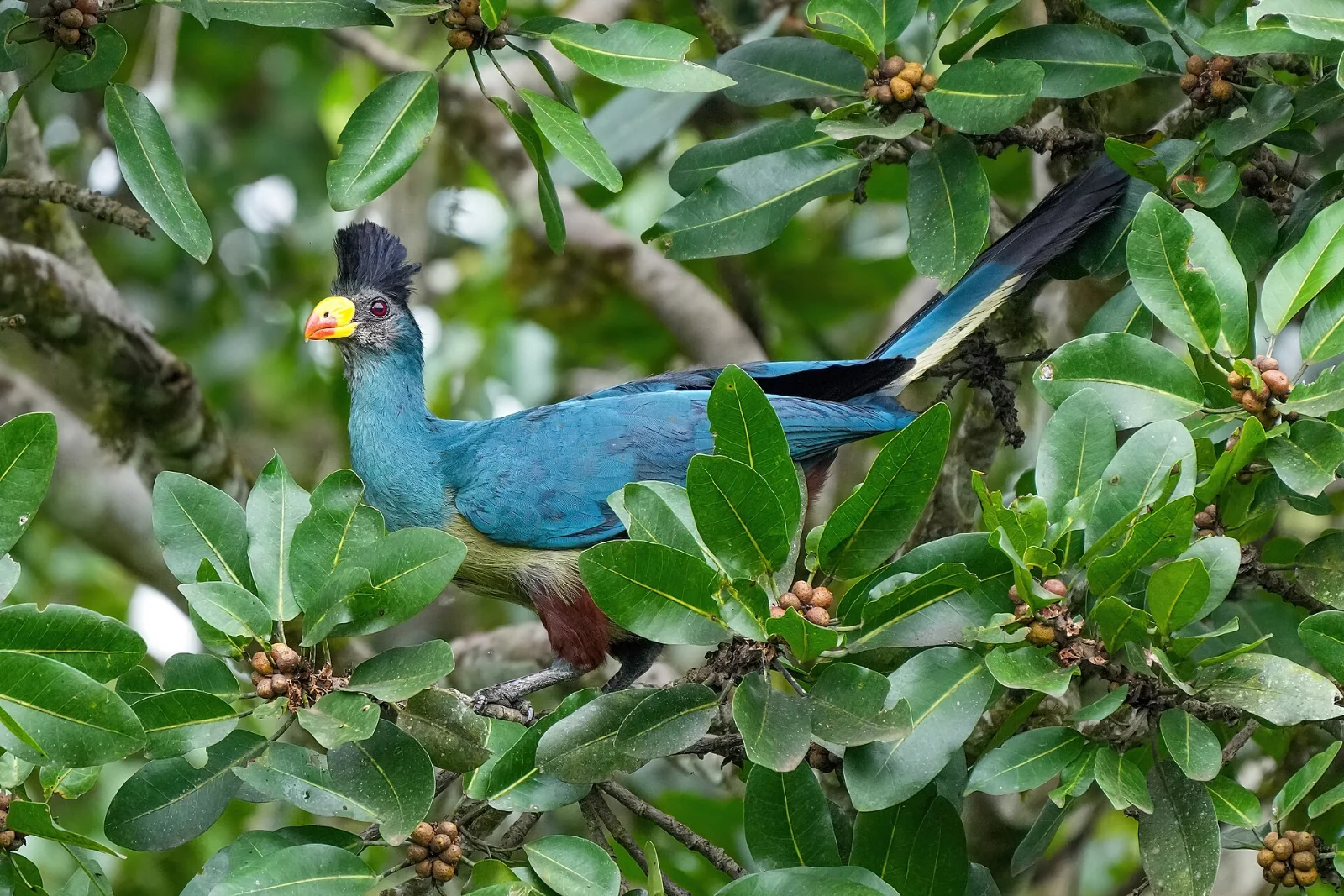
The largest of the family, which does not stop it hiding. At Kakamega Forest in western Kenya, Birdquest’s 2025 group heard Great Blue Turaco calling from the tall trees before it showed. For the forest days, see the Uganda birding guide and the Kenya birding guide.
White-crested Turaco
The savanna-woodland turaco of north-western Uganda. Birding Ecotours found it in Murchison Falls National Park, where Nile Safari Lodge names Shoebill, Grey Crowned Crane and Abyssinian Ground Hornbill, a list that rather upstages the turaco.
Ethiopia
Ethiopia adds 2 more, one of them with a prince in its name. In November 2025, a Naturetrek group saw Prince Ruspoli’s Turaco at close range early in the morning at Meta Gafersa, about 80 km east of their base in the Yabelo area in the south. Birdquest’s Classic Ethiopia tour finds White-cheeked Turaco in the acacia and fig forest at Lake Langano in the Rift Valley. See the Ethiopia birding guide. The directory has no Ethiopian listings yet.
The Gambia
The Gambia is the place to see the West African turacos without a long expedition. The African Bird Club lists Guinea Turaco at the coastal forest sites, among them Abuko Nature Reserve, Brufut Woods and the Pirang-Bonto and Farasuto forests. In December 2025 a Naturetrek group based at Mandina Lodge, beside Makasutu Forest, had scope views of Violet Turaco on its first afternoon walk, and on a later morning found a single tree holding all 3 Gambian members of the family, Western Plantain-eater, Violet Turaco and the localised Guinea Turaco, feeding on flowers: the full national set without moving the scope. Mandina Lodge is not yet in the directory; the listed coastal lodges are covered in The Gambia birding guide.
How to find a forest turaco
Listen first, look second. Turacos call loudly from the canopy, and the call gives the species away long before the bird is in view. Then watch for movement in the crown of a fruiting tree: Oatley’s accounts describe both southern species as fruit-eaters that gather at fruiting trees, where they sometimes squabble and sometimes feed together. In southern Africa the Purple-crested comes down to drink, so a bird bath or a forest pool in the heat of the day is worth sitting beside. Expect to see the red in the wings only in flight; a perched turaco shows almost none of it, which is the family’s best trick.
Where to stay
The places in this guide, with what each offers a birder:
| Place to stay | Where | For birders | From |
|---|---|---|---|
| In Toto Retreat | Sedgefield, South Africa | BirdLife Recommended, local guide names Knysna Turaco | Ask the lodge |
| Pumula Lodge | Knysna, South Africa | 120 species, Knysna Turaco, Narina Trogon, Goliath Heron | Ask the lodge |
| Teniqua Treetops | Sedgefield, South Africa | Knysna Turaco, African Fish Eagle | R1,950 per suite self-catering |
| RiverBend Lodge | Addo, South Africa | Hide, 300 species, Knysna Turaco, Narina Trogon | R5,800 pp B&B |
| Mbizane Escarpment Retreat | Schoemanskloof, South Africa | Hide, Knysna and Purple-crested Turacos | R3,800 per tent |
| Tzaneen Country Lodge | Tzaneen, South Africa | Knysna and Purple-crested Turacos, Crowned Eagle | Ask the lodge |
| Udzungwa Forest Lodge | Udzungwa Mountains, Tanzania | Livingstone’s Turaco, Pel’s Fishing Owl, Kilombero Weaver | Ask the lodge |
| Lidiko Lodge | St Lucia, South Africa | Purple-crested Turaco, Trumpeter Hornbill, Woodland Kingfisher | Ask the lodge |
| Simbamwenni Lodge and Camping | Uluguru Mountains, Tanzania | 112 species, Purple-crested Turaco, guided mountain walks | TSh 30,000 pp camping |
| Chundu Island | Zambezi National Park, Zimbabwe | Schalow’s Turaco, African Finfoot, Pel’s Fishing Owl | US$520 pp sharing FB |
| Ongava Lodge | Ongava Game Reserve, Namibia | Hide, Grey Go-away-bird | N$11,800 pp sharing FB |
| Anderssons at Ongava | Ongava Game Reserve, Namibia | Hide, Grey Go-away-bird | N$23,400 pp sharing all-inclusive |
| Bisate Lodge | Volcanoes National Park, Rwanda | Bird guide on staff, Rwenzori Turaco | US$2,723 pp all-inclusive |
| Sabyinyo | Volcanoes National Park, Rwanda | Bird guide on staff, Rwenzori Turaco | US$1,613 pp all-inclusive |
| Ruhija Gorilla Lodge | Ruhija, Bwindi, Uganda | African Green Broadbill, Grauer’s Swamp Warbler | US$180 per cottage FB |
| Karibu Guesthouse | Entebbe, Uganda | 50 species, Ross’s Turaco, Black-headed Gonolek | US$195 per single room B&B |
| Kibale Lodge | Fort Portal, Uganda | 100 species, Ross’s Turaco, guided birding walks | US$990 pp sharing all-inclusive |
| Nature Kigali | Kigali, Rwanda | 50 species, Ross’s Turaco, Bat Hawk | Ask the lodge |
| Nile Safari Lodge | Murchison Falls, Uganda | Shoebill, Grey Crowned Crane, Abyssinian Ground Hornbill | US$998 per banda FB |
Turaco taxonomy is still debated, and lodge lists change. Facts were checked on 13 November 2026 with the Atlas of Southern African Birds, BirdLife South Africa’s GoBirding guides, the African Bird Club, the Uganda Wildlife Authority and Ngorongoro tariffs as quoted in earlier Birding Dispatch guides, trip reports from Birding Ecotours, Birdquest and Naturetrek, and the Birding Dispatch listings. Confirm recent sightings with the lodge or a local guide.
More from the Journal
 Woodpeckers of Southern Africa, Including the One That Doesn’t Need TreesSouthern Africa's woodpeckers, from the Cardinal in every bushveld tree to the Ground Woodpecker that lives on treeless mountain slopes and eats almost nothing but ants.
 Where to See a Taita Falcon: the Strijdom Tunnel, the Blyde Cliffs and the Batoka GorgeA stocky falcon smaller than a pigeon, a handful of cliffs and surveys that keep coming back empty. Where it still nests, how to look, and the 2 roosts beside its cliffs.
 Where to See a Southern Bald Ibis: the Breeding Cliffs, Dullstroom, Wakkerstroom and LesothoA red-capped grassland ibis that nests on cliffs over waterfalls and feeds on burnt veld and maize stubble. The colonies you can watch, the fields to scan, and where to stay.
The Pigeon Post
Every Thursday: 1 bird, 1 place to go and 1 place to stay, by email. Sign up and get our printable checklist of the 163 endemics of southern Africa.