
Where to See a Secretarybird
The raptor that walks to work and stamps on its lunch needs open country, mostly outside parks. Where the odds are best, from the Kgalagadi to the Karoo, and how to find one.
A Secretarybird is a raptor that lives like a stork and hunts like a bouncer. It stands 125 to 150 cm tall, walks its territory on long pink legs and kills snakes, rodents and grasshoppers by stamping on them. BirdLife South Africa, which made it Bird of the Year in 2019, says those legs carry it up to 30 km a day while it hunts, which is a longer walk than most birders manage on a whole trip.
That way of life ties it to one kind of country: open grassland, dwarf shrubland, savanna and open woodland, where it can see prey and walk freely. A 2014 study of atlas data by Hofmeyr, Symes and Underhill found that the species avoids forest, thicket, dense woodland and rocky, mountainous ground. Look for flat or rolling country with short grass and a few small trees: somewhere a bird that commutes on foot can see where it is going.
A bird in decline
The Secretarybird was moved from Near Threatened to Vulnerable in 2011 and to Endangered in 2020 on the global IUCN Red List. The stated reason is severe decline across its African range, driven by habitat loss and degradation, disturbance, hunting and capture for trade. That is 2 steps up the wrong ladder in under a decade.
In South Africa the picture is less certain. The 2014 study compared the first Southern African Bird Atlas Project (SABAP1, 1987 to 1992) with the second (SABAP2, from 2007) and found lower reporting rates across much of the country, with a widespread decrease in Kruger National Park. A later paper in Bird Conservation International, using SABAP2 and road-count data, did not find an alarming trend within South Africa and argued that Vulnerable is the right regional listing. The same paper cites road counts in Botswana that fell by 78% between the early 1990s and 2015 to 2016.
The threats are the ones a walking bird meets in farmland. BirdLife South Africa lists the loss of natural grassland to crops, plantations, settlements and bush encroachment, plus collisions with power lines and fences, and roads. Its Secretarybird Project, running since 2011, tracks young birds by satellite and keeps records of more than 300 nest sites. Its conservation brochure notes that only about 4.6% of tracking locations fall inside formally protected areas.
So search beyond the parks; the bird clearly does. Reserves give the easiest views, but most South African Secretarybirds live on private farmland, where a slow drive on gravel roads through grassland can find one as readily as a game drive.
Know what you are looking at
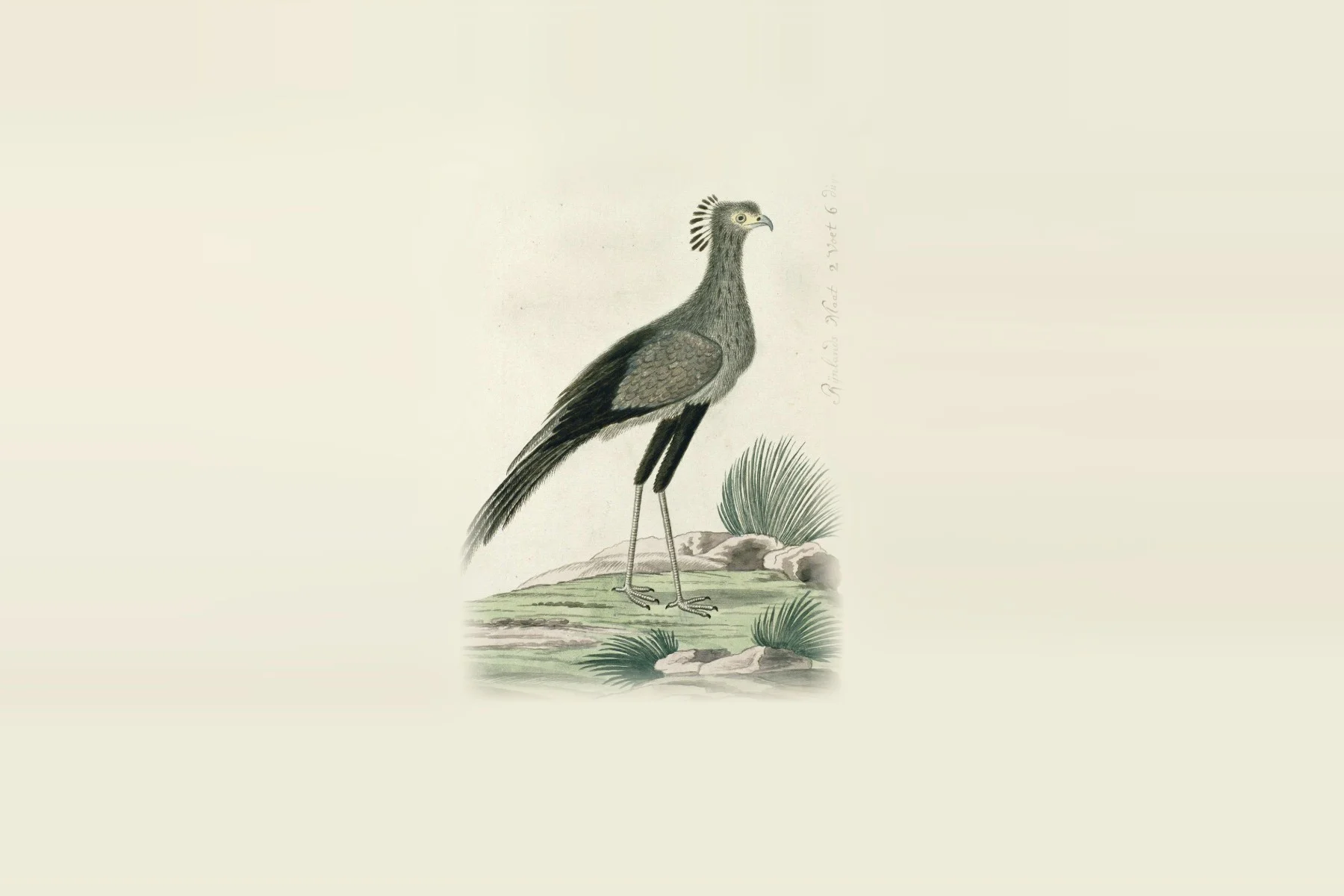
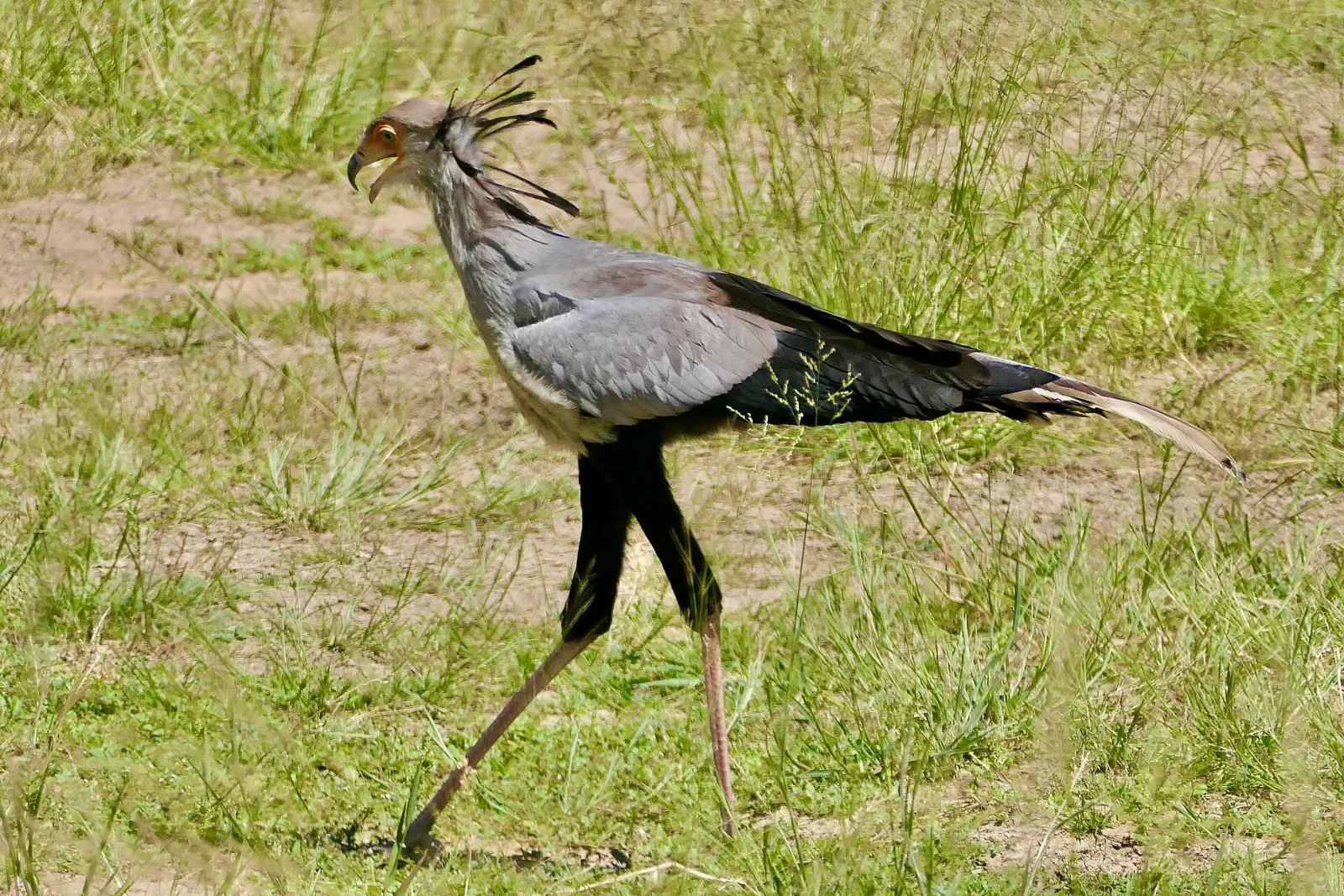
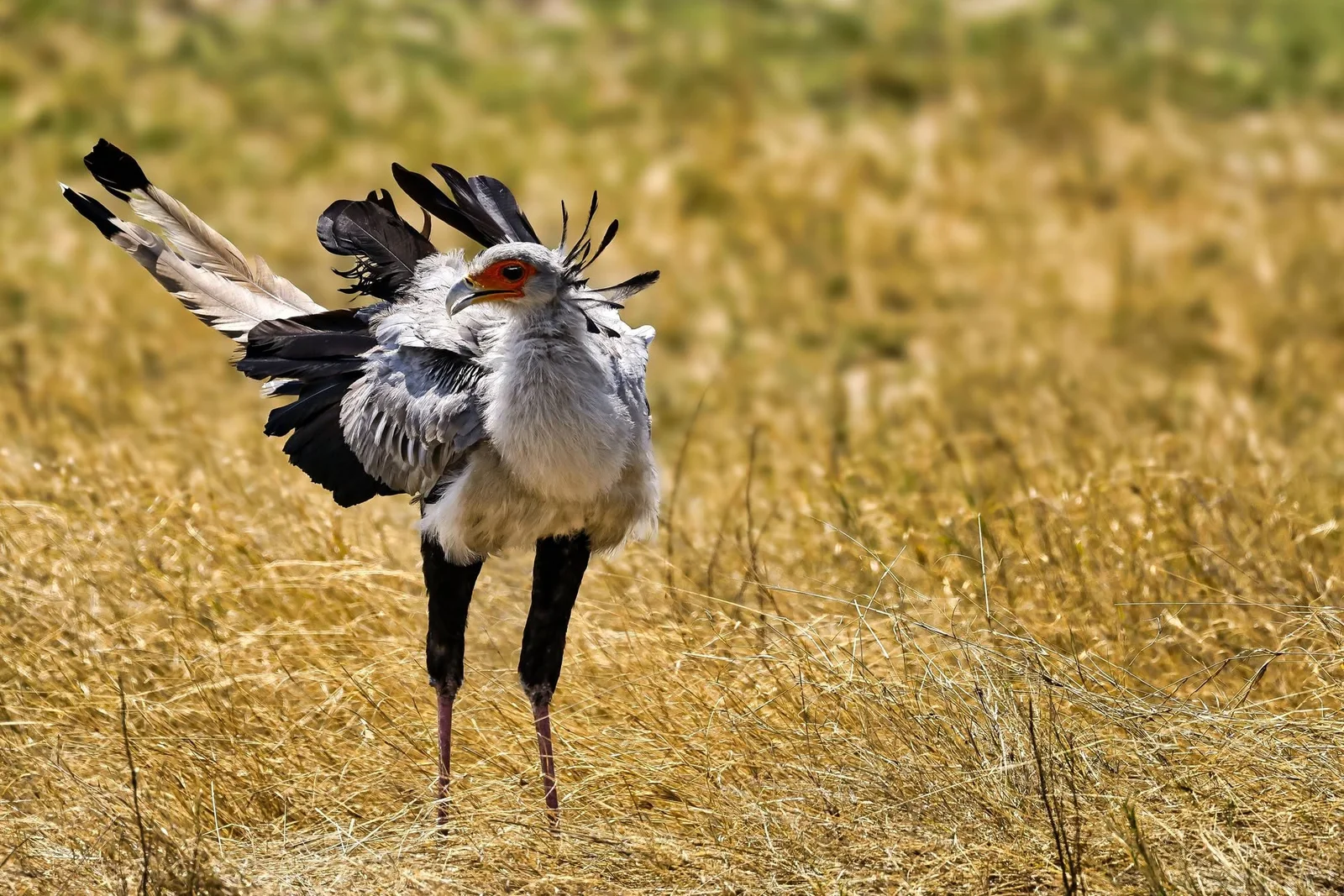
At a distance a Secretarybird can be mistaken for a crane or a stork, until it turns and reveals the face of an eagle wearing eyeliner. Look for the pale grey body, black thighs, the long black-tipped crest feathers on the back of the head, and the bare orange-red face. In flight, the 2 long central tail feathers and the trailing legs make it look longer than any eagle, like a raptor towing its own luggage.
BirdLife’s Bird of the Year factsheet gives a weight of 2.3 to 4.27 kg. Pairs are monogamous and territorial. The nest is a large saucer of sticks on top of a small, dense, flat-topped tree, about 3 to 6 m off the ground, and pairs use the same nest for several years, a flat on the top floor with no lift. They lay 1 to 3 eggs and incubate for 42 to 46 days. Breeding can happen in any month, but the 2014 study found a peak from late winter to early summer, and BirdLife links it to rainfall.
Where the odds are best
| Place | Country | Habitat | Places to stay |
|---|---|---|---|
| Kgalagadi Transfrontier Park | South Africa, Botswana | Dry riverbeds, camel thorn, dunes | Kieliekrankie, !Xaus Lodge |
| Madikwe Game Reserve | South Africa | Open plains, acacia woodland | 4 Madikwe Safari Lodge camps |
| Nieu-Bethesda and the Karoo | South Africa | Karoo veld, recovering grassland | Aasvogelkrans |
| Steenkampsberg and Eastern Free State | South Africa | Highveld grassland | Greystone, Doornkop, Moolmanshoek |
| West Coast | South Africa | Strandveld and farmland | Farr Out, Retreat Guest Farm |
| Makgadikgadi and Nata | Botswana | Grassland and pans | Eselbe Camp |
| Maasai Mara | Kenya | Open grassland | Oltukai Mara Camp |
Kgalagadi Transfrontier Park
The Kgalagadi has open riverbeds, and GoBirding, BirdLife South Africa’s site guide, says Secretarybirds breed in the big camel thorns between Twee Rivieren and Nossob, alongside White-backed Vultures, Martial Eagles and Verreaux’s Eagle-Owls. Scan the grassy floors of the Auob and Nossob riverbeds early in the morning, and check the flat crowns of isolated thorn trees for a nest. A tall grey bird standing on a riverbed with nothing else around is hard to overlook, though the heat haze will try.
Kieliekrankie Wilderness Camp is a SANParks camp on a red dune 50 km from Twee Rivieren, with self-catering cabins for 2 from R2,146 a night, plus the daily conservation fee (R662 for international adults from 1 November 2026). Children under 12 are not allowed. !Xaus Lodge, owned by the ‡Khomani San and Mier communities, overlooks a pan in the dunes west of the Auob, with 260 species on its list. The rack rate is R7,820 per person sharing a night, full board with game drives, until 28 February 2027.
Madikwe Game Reserve
Madikwe, in North West province near the Botswana border, mixes open plains with acacia woodland, which suits a bird that hunts in the open and nests in small trees, roughly the Secretarybird’s entire wish list. Madikwe Safari Lodge gives about 350 species for the reserve, names Secretarybird with Kori Bustard and Cape Vulture, and says game drives can be shaped around birders. It runs 4 camps, each listed in the directory: Dithaba Camp, from R20,000 per person sharing a night in mid-season 2026, Kopano Camp, from R18,000, Lelapa Camp and Elela Villa. All are fully inclusive, and the reserve is malaria-free.
The Karoo around Nieu-Bethesda
GoBirding says several pairs of Secretarybird nest in the Nieu-Bethesda district, north of Graaff-Reinet, among about 280 species that include Blue and Northern Black Korhaans and Kori and Ludwig’s Bustards. Most of the land is private, so bird from the public gravel roads and stay outside the fences; the Secretarybirds ignore the fences, but you should not. Aasvogelkrans Farm Cottages & Camping, 6 km from Nieu-Bethesda, is BirdLife Recommended and is the stay GoBirding names for the area. Hoopoe Cottage costs R1,760 a night for 2, self-catering, and the farm recommends a high-clearance vehicle for the last 2 km.
Further west, the Klein Karoo’s Lategansvlei and Kruisrivier loop, about 58 km of gravel off the R62 towards Calitzdorp, has Secretarybird on a list of 233 species. The Klein Karoo guide covers it, and the Karoo guide has more stays.
The Highveld grasslands
On the Steenkampsberg plateau around Dullstroom, GoBirding’s Greater Lakenvlei route lists Secretarybird and Denham’s Bustard in grassland where all 3 South African cranes feed, which makes for a lot of tall birds in one view. Greystone Lodge, off the R540 between Dullstroom and Belfast, names Secretarybird among the 94 species on its sightings list, with self-catering chalets from R1,200 a night on weekdays in 2026. South towards Carolina, Doornkop Fish & Wildlife Reserve is BirdLife Recommended and names Secretarybird, Blue Crane and Southern Bald Ibis on a checklist of more than 200 species. The Dullstroom guide covers the plateau.
In the Eastern Free State, Moolmanshoek Private Game Reserve, on the R70 between Ficksburg and Rosendal, has recorded more than 250 species in its grassland, wetland and sandstone hills, and names Secretarybird with Bearded Vulture and Southern Bald Ibis. Bed and breakfast is from about R1,500 per person a night.
Close to Pretoria, Rietvlei Nature Reserve is a day trip, no long weekend required. GoBirding says Secretarybird has bred in the reserve’s grassland, and the adult entry fee is R64.
The West Coast
The 2014 study found that in the Western Cape, at least 50% of Secretarybirds recorded on road counts were in transformed landscapes such as wheat fields and pasture, unlike in the rest of the country. So drive the farmland north of Cape Town slowly; out here a Secretarybird in a wheat field is not lost, just local. In Paternoster, Farr Out Guest House names Secretarybird among the 225 species it gives for the area, and its 2026 winter rate started at R820 per person sharing, room only. Inland on the Piketberg range, Retreat Guest Farm has Secretarybird on a farm checklist compiled by 2 long-staying guests.
The Richtersveld
SANParks’ checklist for the |Ai-|Ais/Richtersveld Transfrontier Park has 211 species, Secretarybird among them, on sandy plains between the mountains and the Orange River. It is a 4×4-only park, which the Secretarybird, on foot as usual, does not need to worry about. De Hoop Campsite on the river starts at R386 a site, and Gannakouriep Wilderness Camp has canvas cabins from R1,141 for 2. See the Namaqualand and Richtersveld guide before you go.
Beyond South Africa
BirdLife International’s Important Bird Area account for the Makgadikgadi Pans in Botswana lists important populations of Secretarybird, Kori Bustard and Ostrich. Eselbe Camp Backpackers, 2 km north of Nata, names Secretarybird and Ostrich among more than 150 species for the pans and recommends the rainy season.
In Zimbabwe, Matetsi Victoria Falls, on a private reserve on the upper Zambezi, recorded Secretarybird among 178 species on its Birding Big Day in November. Rates start at US$1,150 per person sharing a night, fully inclusive, from 1 October to 15 December 2026.
In Kenya’s Maasai Mara, Oltukai Mara Camp names Secretarybird among more than 400 species for the area and books guided birding drives and walks around a guest’s target species. Single tents start at US$250 a night in low season.
In Namibia, the tour company Field Guides recorded Secretarybird in Etosha in late 2025, striding about as usual; the Etosha guide lists stays.
How to find one
- Drive slowly in the first 3 hours of light. Secretarybirds walk and hunt through the morning, and a tall grey bird moving steadily through short grass is easy to pick out at walking pace, which is its pace too.
- Scan the tops of small, isolated trees. A flat crown of sticks on a lone thorn tree may be a nest, and the birds also roost on treetops. Watch from the road and do not approach a nest.
- Look after rain and after fire. Short, fresh grass makes prey easier to see and catch. In arid areas, the 2014 study notes, the birds move around when not breeding, so a dry year may empty a district that held them the year before.
- Check the fence lines. On farmland the birds often walk along fences and verges. BirdLife South Africa asks people who find a Secretarybird caught on a fence to report it, along with any nest they find.
- Record what you see. SABAP2 atlas cards, eBird checklists and BirdLife’s own reporting form all feed the data that showed the decline.
When to go
Secretarybirds are present all year in most of their range, so timing is more about conditions than season. The bird keeps office hours; the grass sets the calendar. In the summer rainfall areas, the months after good rains, roughly November to April, bring fresh grass, more prey and more breeding activity, and Madikwe Safari Lodge and Eselbe Camp both point to that season. In winter the short, dry grass can make a tall bird easier to see. In the Kgalagadi and the Karoo, follow the rain and check recent eBird lists.
Where to stay
The places in this guide, with what each offers a birder:
| Place to stay | Where | For birders | From |
|---|---|---|---|
| Kieliekrankie Wilderness Camp | 50 km from Twee Rivieren, Kgalagadi | 272-species park list, Kori Bustard, Secretarybird | R2,146 a cabin for 2, self-catering |
| !Xaus Lodge | West of the Auob, Kgalagadi | 260-species list, pan in the dunes | R7,820 pp sharing, full board with drives |
| Madikwe Dithaba Camp | Madikwe, North West | About 350 species, drives shaped around birders | R20,000 pp sharing, fully inclusive (mid-season) |
| Madikwe Kopano Camp | Madikwe, North West | About 350 species, drives shaped around birders | R18,000 pp sharing, fully inclusive |
| Madikwe Lelapa Camp | Madikwe, North West | About 350 species, drives shaped around birders | R16,000 pp sharing, fully inclusive |
| Madikwe Elela Villa | Madikwe, North West | Private villa, drives shaped around birders | R88,000 per villa for up to 6 |
| Aasvogelkrans Farm Cottages & Camping | Near Nieu-Bethesda, Eastern Cape | BirdLife Recommended, the stay GoBirding names here | R1,760 a cottage for 2, self-catering |
| Greystone Lodge | Between Dullstroom and Belfast, Mpumalanga | Secretarybird on a 94-species sightings list | R1,200 a chalet (weekdays) |
| Doornkop Fish & Wildlife Reserve | Near Carolina, Mpumalanga | BirdLife Recommended, 200+ species checklist | R1,068 a chalet (4-night midweek stay) |
| Moolmanshoek Private Game Reserve | Ficksburg to Rosendal, Free State | 250+ species, Bearded Vulture, Southern Bald Ibis | About R1,500 pp B&B |
| Farr Out Guest House | Paternoster, Western Cape | 225 species, Secretarybird, veranda feeders | R820 pp sharing, room only (expired winter 2026 rate) |
| Retreat Guest Farm | Piket-Bo-Berg, Western Cape | Farm checklist with Secretarybird | R2,500 per cottage, self-catering (midweek) |
| De Hoop Campsite | Orange River, Richtersveld | Riverside camping, 211-species park checklist | R386 per site, camping |
| Gannakouriep Wilderness Camp | Richtersveld, Northern Cape | Canvas cabins, 211-species park checklist | R1,141 a cabin for 2 |
| Eselbe Camp Backpackers | Nata, Botswana | 150+ species, Secretarybird, Ostrich | Ask the lodge |
| Matetsi Victoria Falls | Upper Zambezi, Zimbabwe | Secretarybird among 178 species on Birding Big Day | US$1,150 pp sharing, fully inclusive |
| Oltukai Mara Camp | Maasai Mara, Kenya | Guided birding drives and walks, 400+ species | US$250 per single tent (low season) |
Status and rates change. Facts were checked on 13 November 2026 against BirdLife South Africa, BirdLife International, SANParks, GoBirding, 2 peer-reviewed papers on South African Secretarybird data, and each place’s own website as summarised on its Birding Dispatch listing.
More from the Journal
 Woodpeckers of Southern Africa, Including the One That Doesn’t Need TreesSouthern Africa's woodpeckers, from the Cardinal in every bushveld tree to the Ground Woodpecker that lives on treeless mountain slopes and eats almost nothing but ants.
 Where to See a Taita Falcon: the Strijdom Tunnel, the Blyde Cliffs and the Batoka GorgeA stocky falcon smaller than a pigeon, a handful of cliffs and surveys that keep coming back empty. Where it still nests, how to look, and the 2 roosts beside its cliffs.
 Where to See a Southern Bald Ibis: the Breeding Cliffs, Dullstroom, Wakkerstroom and LesothoA red-capped grassland ibis that nests on cliffs over waterfalls and feeds on burnt veld and maize stubble. The colonies you can watch, the fields to scan, and where to stay.
The Pigeon Post
Every Thursday: 1 bird, 1 place to go and 1 place to stay, by email. Sign up and get our printable checklist of the 163 endemics of southern Africa.