
Etosha for Birders: Waterholes, the Pan After Rain and Where to Stay
Sandgrouse and larks at Okaukuejo, Bare-cheeked Babbler at Halali, Blue Cranes on the Andoni Plains, flamingos on the pan when the big rains oblige, and the camps and private reserves on every side.
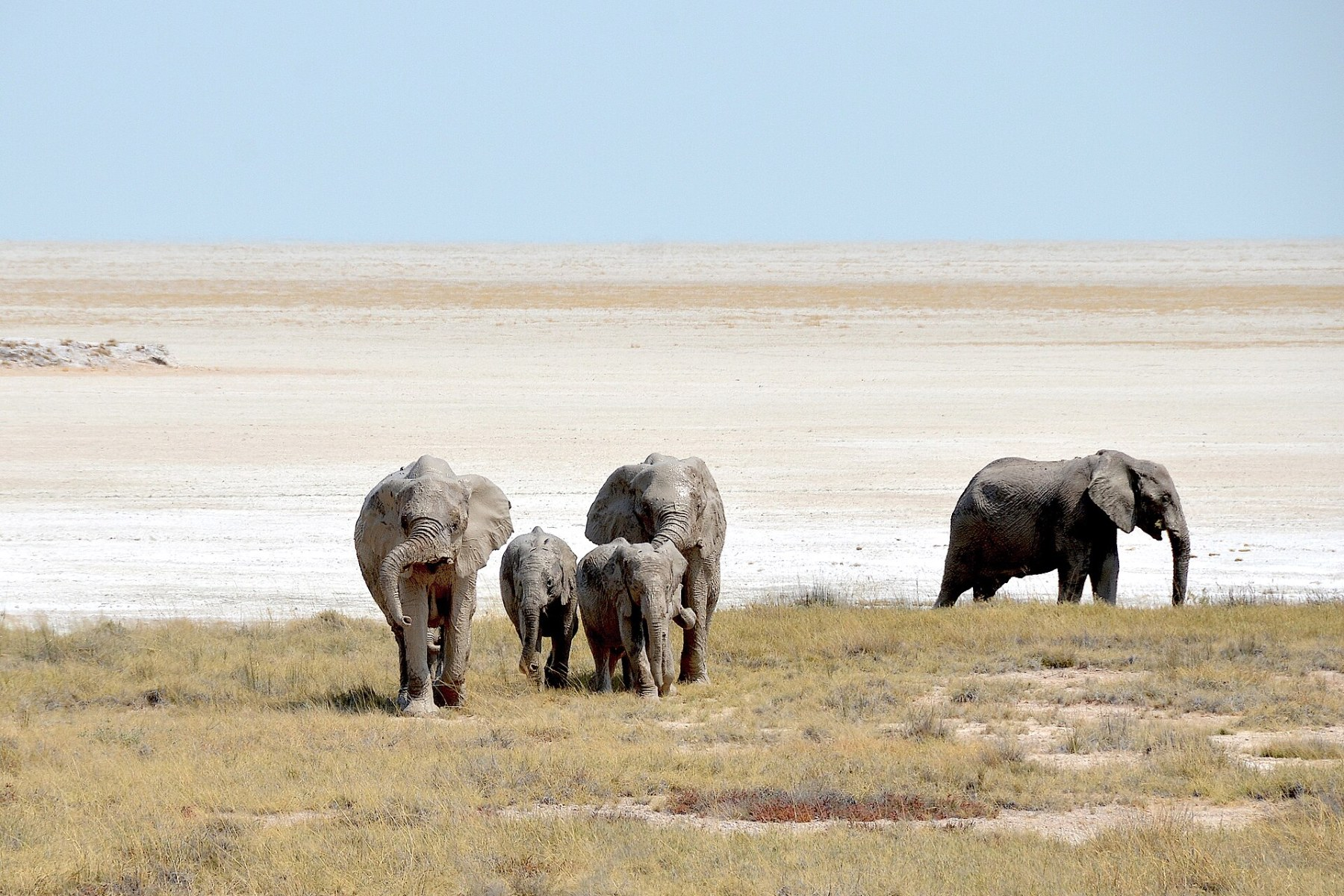
Etosha is a park built around a dry lake, an odd thing to build a bird park around until it rains. BirdLife International’s Important Bird Area account describes the Etosha Pan as a salt pan of about 4,760 km², almost a quarter of the park, and puts the park list at 340 species or more. For most of the year the pan is white and empty, and the birds come to the waterholes along its edge. In the years when heavy rain floods it, the same pan becomes 1 of only 2 regular flamingo breeding sites in southern Africa.
Birding here is a matter of where you sit, and for how long. The waterholes beside the state camps are floodlit and open to anyone staying the night; the private reserves on the southern, western and eastern boundaries add guides, hides, walking and night drives that the national park does not allow.
At a glance
| Place | Side of the park | What it offers birders | From (per night) |
|---|---|---|---|
| Ongava Lodge | South, opposite Ombika Gate | Guided birding outings, photographic hide | N$11,800 pp, full board |
| Anderssons at Ongava | South | Underground hide at water level, birding outings | N$23,400 pp, fully inclusive |
| Safarihoek | West, Etosha Heights | 2-storey waterhole hide, walks, night drives | NAD 4,926 pp, dinner, bed and breakfast |
| Etosha Mountain Lodge | South-west, Etosha Heights | Shared 2-level photographic hide | NAD 3,736 pp, dinner, bed and breakfast |
| Safari House | West, Etosha Heights | Private garden hide, about 320 species | NAD 31,131 per house |
| Onguma Bush Camp | East, near Namutoni | Treetop hide, Onkolo hide, 300+ species | N$3,060 pp, dinner, bed and breakfast |
The waterholes and what comes to drink
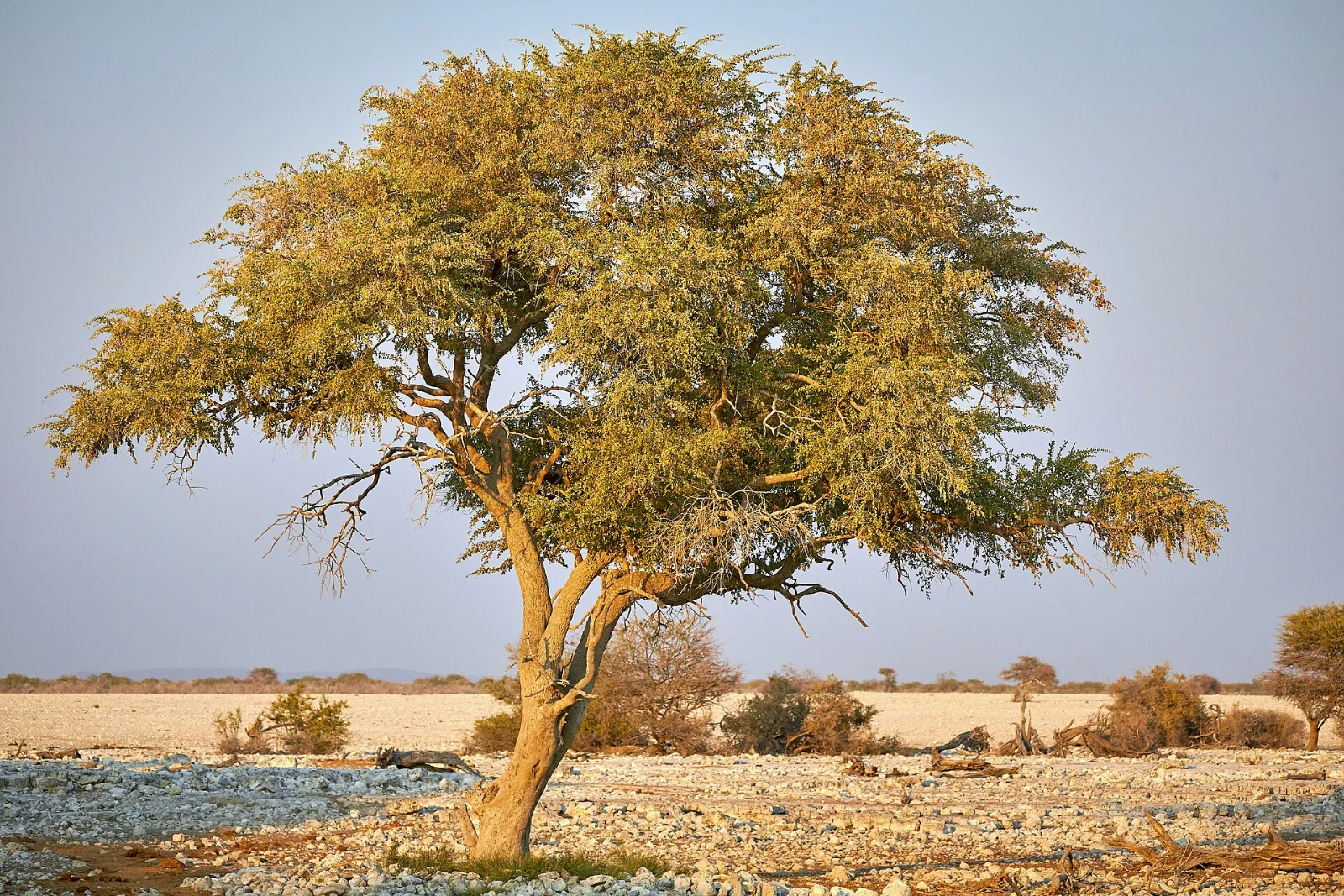
The state camps inside the park, run by Namibia Wildlife Resorts, each sit beside a waterhole. At Okaukuejo, in the south-west, the waterhole is floodlit after dark. A Birding Ecotours group in November 2025 watched Rufous-cheeked Nightjar there after dinner, and a Field Guides tour in the same month also recorded the species in Etosha. A lone leadwood tree stands over the water, and raptors and crows use it as a waiting room before they come down to drink.
Sandgrouse are the waterhole birds to wait for. BirdLife lists Burchell’s Sandgrouse among the species that qualify Etosha as an Important Bird Area, and the Internet Bird Collection holds a recording of many Double-banded Sandgrouse calling at the Okaukuejo waterhole. Double-banded Sandgrouse drink around dusk, so take a seat on the viewing wall before sunset rather than after dinner; the sandgrouse do not wait for dessert.
At Halali, in the middle of the park, the camp waterhole is called Moringa. Halali is also the place for Bare-cheeked Babbler, a near-endemic and the main target for birders in the park. Both the 2023 and 2025 Birding Ecotours groups found it on a walk around the camp grounds, the 2023 group “with some added effort”, a phrase that covers a lot of birding, together with Violet Wood Hoopoe and Carp’s Tit. The camp is fenced, so walking is allowed.
In the far west, Olifantsrus is a campsite with 10 sites and a 2-storey hide over a floodlit waterhole, reached on a wooden walkway from inside the fence. Info-Namibia lists camping at N$510 per person a night for the 2025/26 season, and the gates open at sunrise and close at sunset. The photographers at Kruger-2-Kalahari point out that the hide faces north and the upper level looks down on the water, so it suits watching more than photography.
The plains and the larks
Between the waterholes, the open grassland around Okaukuejo holds the lark list. In November 2025, Birding Ecotours found Pink-billed, Spike-heeled and Red-capped Larks, Double-banded Courser and Pygmy Falcon on the plains north and south of the camp. Field Guides, on a tour from 28 October to 16 November 2025 that crossed the park from the centre to the east, added Kori Bustard, Secretarybird, White-headed Vulture, Red-necked Falcon, Grey-backed Sparrow-Lark and Bare-cheeked Babbler.
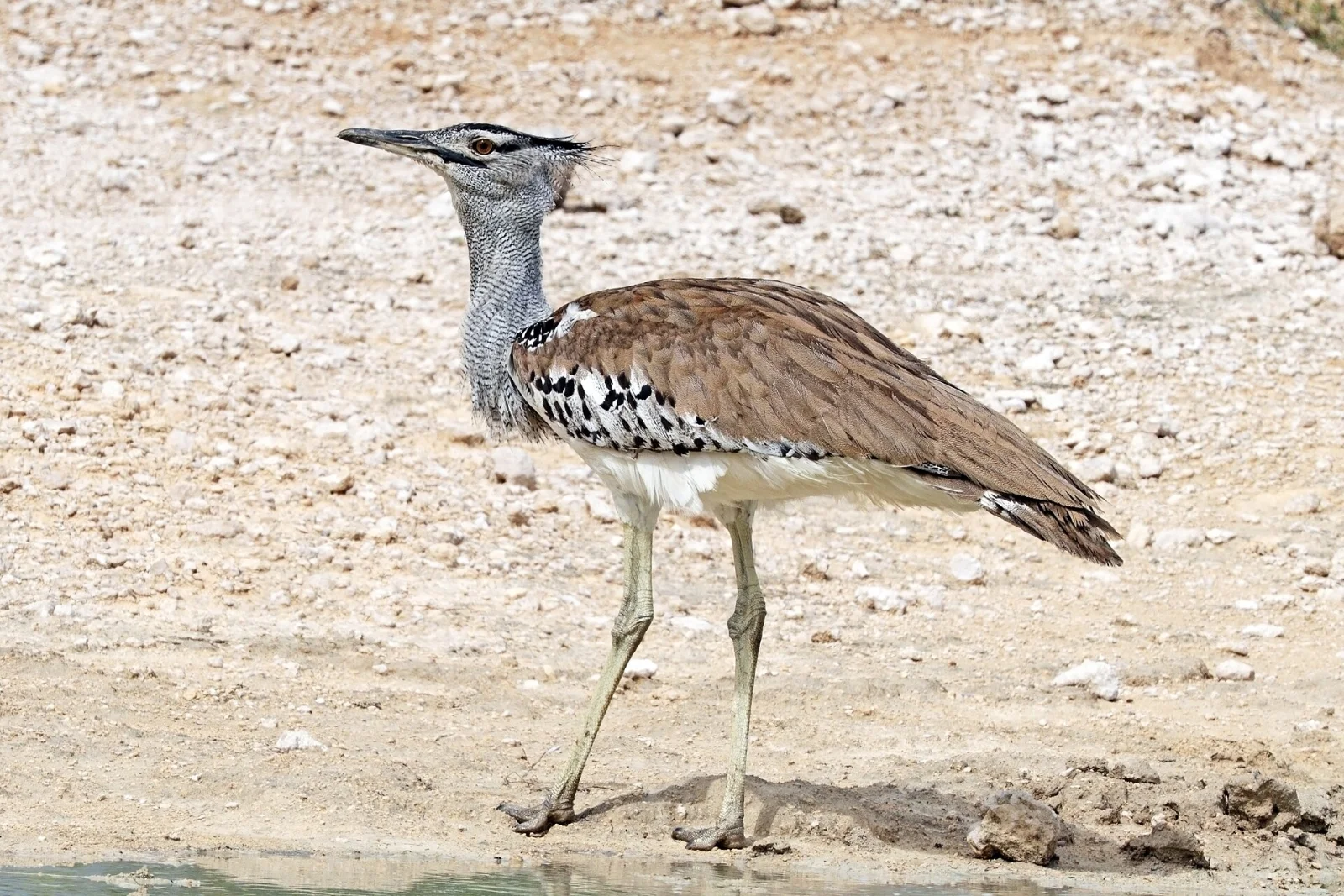
Kori Bustards walk the grassland in plain view, with no apparent interest in hiding. The plains are also where to look for raptors: BirdLife’s IBA account counts 46 raptor species in the park.
The east: Namutoni, Andoni and the cranes
Namutoni, the camp at the eastern gate, is the base for the Andoni Plains to the north, open grassland with a busy waterhole. In November 2025 Birding Ecotours saw South African Shelduck, Chestnut-banded Plover and several Blue Cranes there. Etosha’s cranes are an isolated population, the only one that breeds outside South Africa according to BirdLife. Writing in Travel News Namibia in 2018, Ann and Mike Scott of the Namibia Crane Working Group put the Namibian count at 80 in 1988 and 32 in 2017, and said the birds breed in Etosha from about November to April and gather at Andoni from August.
Just outside the eastern boundary, Black-faced Babbler turned up in the grounds of Mokuti Lodge for the 2023 Birding Ecotours group, a reminder to bird the car park too.
The pan after rain
Flamingo breeding at Etosha is the event a birder hopes to be in Namibia for, and it does not happen every year. In the September 2019 issue of Lanioturdus, the journal of the Namibia Bird Club, Ann Scott and co-authors summarise the pattern from Namibia’s red data book: Greater and Lesser Flamingos breed in large mixed colonies on raised islands in the flooded pan, and laying is triggered by extensive flooding. Greater Flamingos usually start laying once annual rainfall passes 400 mm, typically in February and March but as early as November and as late as May; Lesser Flamingos lay mainly in May and June. Breeding success is low, because the water recedes, food runs short and predators reach the colonies. BirdLife’s IBA account says up to 1.1 million flamingos have been recorded in exceptionally wet years.
Treat a flamingo year as a bonus rather than a plan: it depends entirely on the rains, and the flamingos do not publish a timetable.
Where to stay
Ongava, on the southern boundary
Ongava Game Reserve sits opposite Etosha’s Ombika Gate, close to Okaukuejo, and both of its listed lodges have hides and offer guided birding outings on the reserve. The reserve gives a count of more than 350 species and names Rosy-faced Lovebird, Grey Go-away-bird and Spotted Eagle-Owl.
Ongava Lodge has 14 rock-and-thatch chalets on a hilltop and a viewing and photographic hide, from N$11,800 per person sharing a night, full board, in 2026. Anderssons at Ongava has 9 stone suites near a waterhole and an underground hide at the level of the water, which puts the lens at the height of drinking birds, eye to eye with whatever is thirsty. Rates start at N$23,400 per person sharing, fully inclusive, from 11 January 2026 to 10 January 2027, plus a mandatory N$1,200 conservation fee per person a day. The minimum age for the hide is 11.
Etosha Heights, on the western boundary
Etosha Heights Private Reserve runs along the south-western and western boundary, and traversing here can go off-road and on foot, neither of which the national park allows. Safarihoek has a 2-storey hide at its waterhole and lists birding with guided walks, game drives and night drives. It is open all year and malaria-free, from NAD 4,926 per person sharing a night, dinner, bed and breakfast, on its 2026 green-season rate for 8 nights or more, plus a reserve fee of NAD 650 per guest a night. Etosha Mountain Lodge has 9 chalets and guest access to a reserve hide on 2 levels over a natural waterhole, from NAD 3,736 per person sharing, dinner, bed and breakfast, on the same 8-night green-season basis; its operator names no bird species. Safari House is an exclusive-use 4-bedroom house with its own hide at the end of the garden. Its operator, Natural Selection, gives about 320 species for the reserve and names White-backed and Lappet-faced Vultures. It costs from NAD 31,131 for the whole house a night, fully inclusive, on the 2026 green-season rate for 8 nights or more.
Onguma, on the eastern boundary
Onguma Bush Camp has 18 rooms facing a waterhole in the Onguma Nature Reserve, with the turn-off just before Namutoni. There is a treetop hide above the camp waterhole, and guests can use the reserve’s Onkolo photographic hide. The fact sheet gives more than 300 species and points to the Namibian summer for birding. Rates start at N$3,060 per person sharing, dinner, bed and breakfast, from 1 November 2026 to 31 October 2027. This is the base for Namutoni, the Andoni Plains and Fischer’s Pan.
Inside the park
None of the Namibia Wildlife Resorts camps is in the directory yet. Okaukuejo, Halali and Namutoni are the 3 to split a stay between, for the larks, the babbler and the cranes in turn. Olifantsrus suits campers heading for the remote west.
The places in this guide, with what each offers a birder:
| Place to stay | Where | For birders | From |
|---|---|---|---|
| Ongava Lodge | Ongava Game Reserve, south of Etosha | Viewing and photographic hide, guided birding outings | N$11,800 pp full board |
| Anderssons at Ongava | Ongava Game Reserve, south of Etosha | Underground hide at water level, guided birding outings | N$23,400 pp fully inclusive |
| Safarihoek | Etosha Heights, western boundary | 2-storey waterhole hide, guided walks, night drives | NAD 4,926 pp DB&B (8+ nights) |
| Etosha Mountain Lodge | Etosha Heights, south-western boundary | Shared 2-level hide over a natural waterhole | NAD 3,736 pp DB&B (8+ nights) |
| Safari House | Etosha Heights, western boundary | Private garden hide, about 320 species, vultures | NAD 31,131 per house (8+ nights) |
| Onguma Bush Camp | Onguma Nature Reserve, near Namutoni | Treetop hide, Onkolo hide, 300+ species | N$3,060 pp DB&B |
Fees, gates and when to go
The Ministry of Environment, Forestry and Tourism raised park fees from 1 April 2026. At Etosha, foreign adults pay N$280 a day, SADC nationals N$180 and Namibians N$60, and a vehicle with up to 10 seats costs N$60 a day. The fee is paid at the first gate and runs for 24 hours. The private reserves charge their own conservation or reserve fees on top of the room rate. Park gates follow sunrise and sunset, and the times change through the year, so check at the gate on arrival.
November is the month the birding tours choose. The pan is normally dry, so birds and game stay close to the waterholes; the Blue Cranes are back at Andoni; and the first summer migrants are in. The green season runs from about November to April. February is one of the wettest months, with migrants and breeding birds at their peak, but wildlife spreads out and some gravel roads turn muddy or flood. A flamingo year depends on that rain. The dry months from May to October are best for game at the waterholes, and park campsites can sell out months ahead between June and October.
Give Etosha at least 3 nights and move east as you go: Okaukuejo or Ongava for the waterhole and the larks, Halali for the babbler, and Namutoni or Onguma for Andoni and its cranes.
Fees, rates and road conditions change, especially in the rains. Facts were checked on 13 November 2026 with each listing on Birding Dispatch, BirdLife International’s Etosha IBA account, Birding Ecotours and Field Guides trip reports, Lanioturdus, Travel News Namibia, Info-Namibia and the Windhoek Observer’s report on the 2026 park fees. Confirm fees and gate times with the Ministry or Namibia Wildlife Resorts before you go.
More from the Journal
 Namib-Naukluft and Sossusvlei for Birders: Dune Lark, Desert Raptors and the Naukluft SpecialsA lark that lives on the dunes and nowhere else, Lappet-faced Vultures nesting in the desert, coursers on the gravel plains and the northern specials around the Naukluft cliffs, in one of Africa's largest parks.
 Lake Baringo and Lake Bogoria Birding: The Owl Walks, the Cliffs and the FlamingosA local guide who knows where every nightjar and eagle-owl slept last night, thorn scrub full of hornbills, a Goliath Heron colony on a rock, and the flamingo lake next door that keeps rising.
 Akagera Birding: Rwanda’s Savanna, Lakes and Papyrus, and the Shoebill ChancesRed-faced Barbet in the southern woodland, Papyrus Gonolek and Carruthers's Cisticola in the swamps, a lake of hippos and lapwings, and a Shoebill that hides in the wetlands more than it shows.
The Pigeon Post
Every Thursday: 1 bird, 1 place to go and 1 place to stay, by email. Sign up and get our printable checklist of the 163 endemics of southern Africa.