
Cuckoos of Southern Africa: the Summer Callers, the Brood Parasites and Their Hosts
Southern Africa's cuckoos sing all summer and raise none of their own chicks. Who calls what, which birds they trick into doing the parenting, and where to hear them.
A female Red-chested Cuckoo can slip into another bird’s nest, remove one of its eggs and lay one of her own in less than 5 seconds. That is faster than most people find their car keys. Iziko Museums’ Biodiversity Explorer, which follows the 2005 edition of Roberts, records the trick, and adds that the hosts know exactly what she is up to: she is mobbed and attacked so often that getting to the nest is the hard part.
That is the cuckoo business model in one paragraph. Biodiversity Explorer lists 15 cuckoo species indigenous to southern Africa, from the familiar Red-chested and Diederik to the Thick-billed and the Barred Long-tailed, and most of the ones a visiting birder meets lay their eggs in other birds’ nests and leave the rest to the foster parents. They are among the loudest birds of the southern African summer, and among the hardest to see once they stop calling.
The cuckoos at a glance
| Cuckoo | Its usual hosts | Notes |
|---|---|---|
| Red-chested | Robin-chats, thrushes, Cape Wagtail | The Piet-my-vrou of the eastern half of the region |
| Diederik | Bishops, weavers, sparrows | Named after its call |
| Klaas’s | Sunbirds, batises, Bar-throated Apalis | Lays all year, peaks October to January |
| Jacobin | Mostly bulbuls | Ranges from India and Arabia to southern Africa |
| Levaillant’s | Almost only babblers | Secretive, in thick undergrowth |
| Black | Shrikes and boubous | Mostly Laniarius species |
| African | Fork-tailed Drongo only | The male distracts, the female lays |
| Great Spotted | Crows and starlings | Savanna and grassland |
Red-chested Cuckoo, the voice of the summer
Its Afrikaans name is Piet-my-vrou, which is what it sounds like, over and over, from a treetop nobody can quite pin down. Biodiversity Explorer says it is mainly a bird of the eastern half of southern Africa: common in eastern Botswana, Zimbabwe, Mozambique, Eswatini and eastern and southern South Africa, in Afromontane forest, closed woodland, miombo, savanna thickets, mature gardens and parks. It is well represented in protected areas and is not threatened.
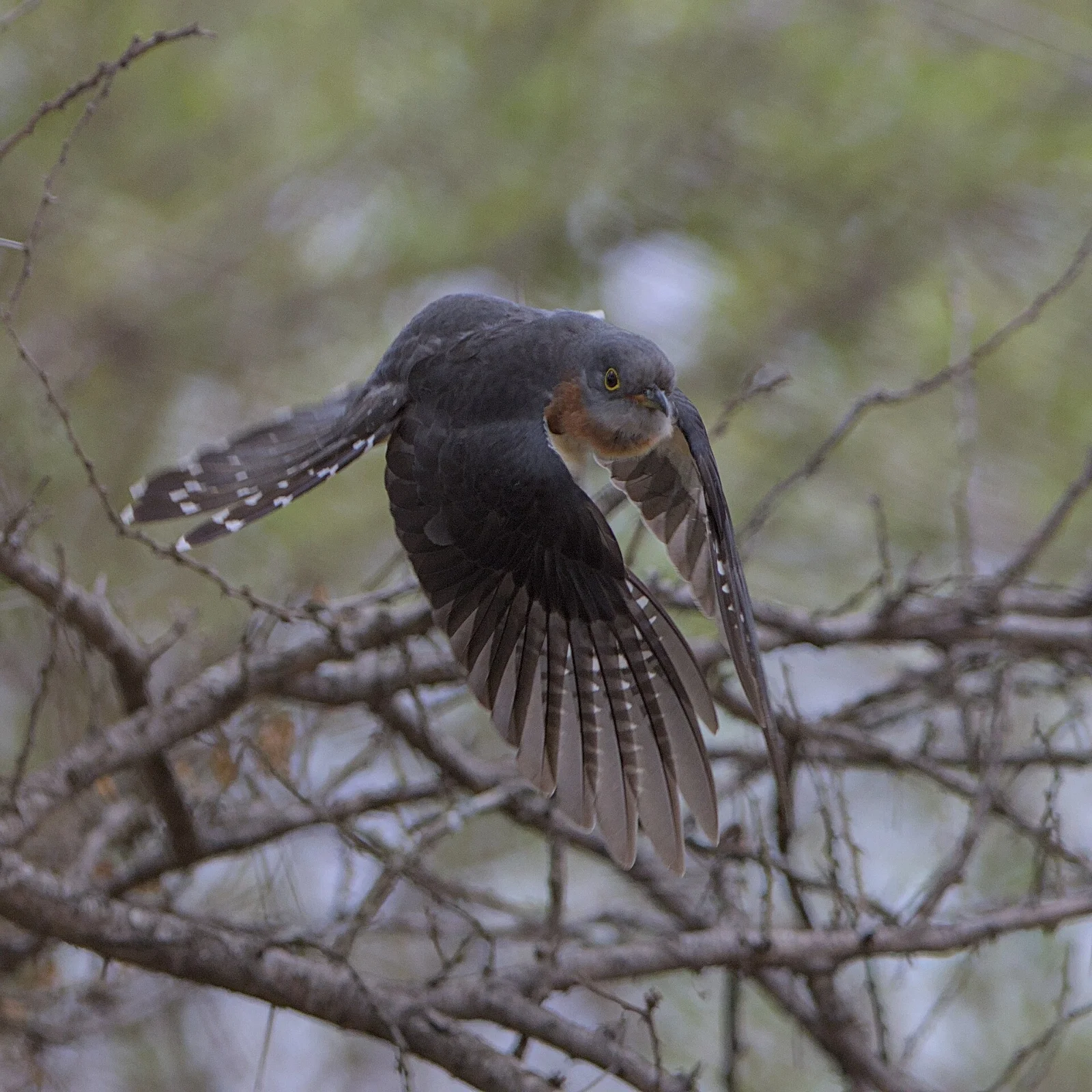
It eats invertebrates, mostly hairy caterpillars, foraging in the canopy, which helps explain why so many people know the call and so few know the bird. Its egg-laying season runs from October to January. Biodiversity Explorer names the Cape Robin-Chat as its most common host, the Cape Wagtail second and the White-throated Robin-Chat third, with a list that also includes the White-starred Robin, Chorister Robin-Chat, Cape Rock Thrush and Olive Thrush. In one observation, a single female laid 20 eggs in one breeding season.
When the cuckoo chick is about 2 days old it evicts the host’s own eggs and nestlings. It stays in the nest for 17 to 21 days and then depends on its foster parents for 20 to 25 days more. The guide to learning bird calls has the memory phrases birders use for this and the other loud ones.
Diederik Cuckoo and the weavers
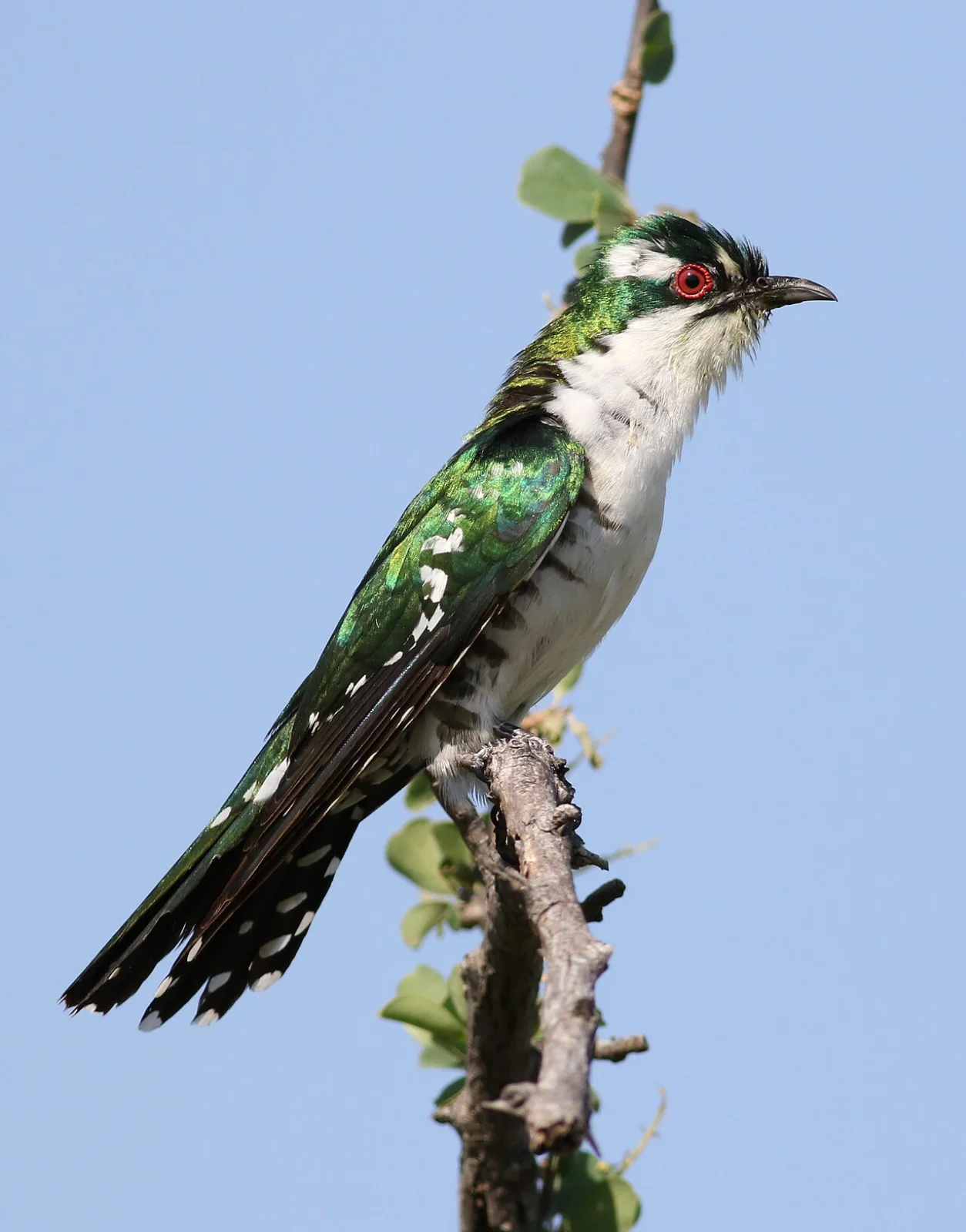
The Diederik Cuckoo is one of the small, glossy green cuckoos, and its call, which Biodiversity Explorer renders as “dee-dee-dee-dee-deederik”, gave it its name in Afrikaans and English alike. It is common across large parts of southern Africa, at forest edges, in mesic savanna, closed woodland, semi-arid shrubland, parks and gardens, and its range seems to have expanded.
Its hosts are the seed-eaters with woven or domed nests. Biodiversity Explorer lists the Southern Red Bishop as the most common host, the Southern Masked Weaver second and the Cape Sparrow third, with Cape, Village, Spectacled and other weavers further down. Egg-laying runs from October to March. The female waits for the host to leave, inspects the nest, throws out or eats the eggs already there and lays 1 of her own, rarely 2, and she lays 20 to 24 eggs over a breeding season of 10 to 12 weeks.
The weavers do not take this lying down. Biodiversity Explorer records a male Diederik mobbed and killed by Southern Masked Weavers, and females that got stuck in nest entrances and were pecked to death by Lesser Masked Weavers. Within 3 days of hatching, the cuckoo chick eats any eggs or chicks that arrived after its mother left. Anyone with a weaver colony in the garden has a front-row seat; the weavers guide covers the hosts.
Klaas’s and African Emerald Cuckoos
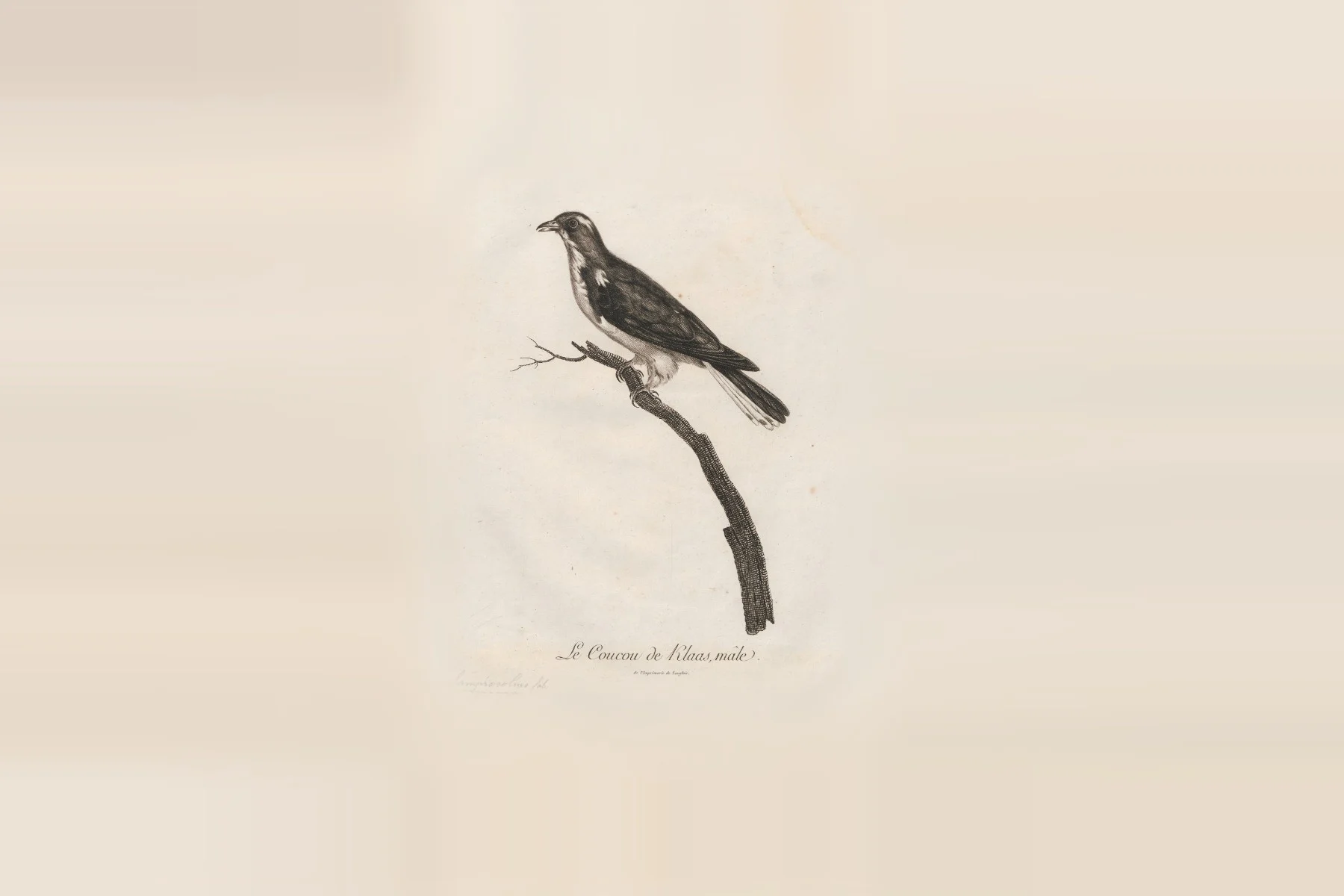
Klaas’s Cuckoo is the other small green one, and the subject of the engraving from around 1800 at the top of this page, titled “Le Coucou de Klaas”. Biodiversity Explorer calls it fairly common across sub-Saharan Africa, absent only from true desert; in southern Africa it is found in central and northern Namibia, northern and eastern Botswana, Zimbabwe, Mozambique, Eswatini and southern and eastern South Africa. It prefers open broad-leaved woodland such as miombo and mopane, but also uses acacia thickets, forest edges, gardens and the alien trees around farmsteads.
It specialises in butterflies and caterpillars, and its host list reads like a sunbird field guide: Amethyst, Scarlet-chested, Malachite, Collared, Greater Double-collared, White-bellied, Dusky and Marico Sunbirds, plus Cape, Chinspot and Pririt Batis and the Bar-throated Apalis. It lays roughly 24 eggs a season, 1 per nest, and egg-laying runs all year with a peak from October to January. The chick hatches after 11 to 12 days and evicts everything else in the nest. Our sunbirds guide has the birds doing the unpaid childcare.
The African Emerald Cuckoo is the forest relative, and several of the forest roosts in the directory name it, from the sand forest at Lake St Lucia to the Woodbush forest at Haenertsburg.
The big, noisy ones
The larger cuckoos have narrower tastes. Biodiversity Explorer says the Jacobin Cuckoo, found from India and Arabia south to southern Africa, lays mainly in bulbul nests, about 25 eggs in a season; the chick fledges at about 17 days and is independent at about 33. Levaillant’s Cuckoo parasitises babblers almost exclusively, for reasons nobody understands, and lays with teamwork: the male distracts the babblers while the female sneaks in. Unlike many cuckoo chicks, its young often live peacefully alongside the host’s nestlings.
The Black Cuckoo, common in thick forest and acacia woodland, lays almost only in the nests of shrikes and boubous, mostly the Laniarius species, and a female can lay around 22 eggs in a season. The African Cuckoo uses the Fork-tailed Drongo and nothing else, and here too the male draws the hosts off while the female lays. The Great Spotted Cuckoo, in savanna and grassland, picks on crows and starlings, can lay up to 6 eggs in a day, and its chicks do not always kill their nest-mates, though they will peck them.
When and where to listen
The egg-laying seasons above tell the story: the Red-chested lays from October to January and the Diederik from October to March, so the region’s cuckoos are loudest from early summer. BirdLife South Africa’s GoBirding guide to Golden Gate Highlands National Park says Red-chested and Klaas’s Cuckoos are often seen, and heard, around Glen Reenen in summer. The summer migrants guide has the rest of the season’s arrivals.
The quickest way to find a calling cuckoo is to learn the call first, then wait for the bird to move between perches. The places below each name a cuckoo on their own sites or bird lists.
Where to stay
Places in the directory that name a cuckoo, with what each offers a birder:
| Place to stay | Where | For birders | From |
|---|---|---|---|
| Cathedral Peak Hotel | Cathedral Peak, KwaZulu-Natal | Tuesday bird walk; Red-chested Cuckoo; 200+ species | R1,760 per adult, full board, seniors’ offer (2026) |
| Malkoha Lake St. Lucia | Kwa-Nibela Peninsula, Hluhluwe | BirdLife Recommended; African Emerald Cuckoo; guided walks | Ask the lodge |
| Royal Jozini Private Game Reserve | Lake Jozini, Eswatini | BirdLife Recommended; own site guide; African Emerald Cuckoo | Ask the lodge |
| Verkijken Farm | Haenertsburg, Limpopo | BirdLife Recommended; Woodbush forest; African Emerald Cuckoo | Ask the lodge |
| Magoebaskloof Getaway | Magoebaskloof, Limpopo | Forest birds; Black Cuckoo named | R800 per self-catering log cabin |
| Abelana Game Reserve | Near Phalaborwa, Limpopo | BirdLife Recommended; Thick-billed Cuckoo named | R3,800 pp sharing, Safari Camp (2026) |
| Pafuri Camp | Makuleke, northern Kruger | BirdLife Recommended; Thick-billed Cuckoo named | R8,450 pp sharing, fully inclusive (2026/27) |
| Liz at Lancaster | Craighall Park, Johannesburg | BirdLife Recommended; Madagascar Cuckoo named; guide arranged | R600 pp sharing, room only |
| Chinaka Game Lodge | Vivo, Limpopo | 42-species list with Red-chested Cuckoo | Ask the lodge |
| Matetsi Victoria Falls | Victoria Falls, Zimbabwe | Guides on staff; 178 species; Jacobin Cuckoo | USD 1,150 pp sharing, fully inclusive (2026) |
Cuckoo calls carry further than the birds show themselves, so plan on hearing more than you see. Facts were checked on 15 November 2026 with Iziko Museums’ Biodiversity Explorer, BirdLife South Africa’s GoBirding site guides and the Birding Dispatch listings. Rates change each season; check with the place before you book.
More from the Journal
 Woodpeckers of Southern Africa, Including the One That Doesn’t Need TreesSouthern Africa's woodpeckers, from the Cardinal in every bushveld tree to the Ground Woodpecker that lives on treeless mountain slopes and eats almost nothing but ants.
 Where to See a Taita Falcon: the Strijdom Tunnel, the Blyde Cliffs and the Batoka GorgeA stocky falcon smaller than a pigeon, a handful of cliffs and surveys that keep coming back empty. Where it still nests, how to look, and the 2 roosts beside its cliffs.
 Where to See a Southern Bald Ibis: the Breeding Cliffs, Dullstroom, Wakkerstroom and LesothoA red-capped grassland ibis that nests on cliffs over waterfalls and feeds on burnt veld and maize stubble. The colonies you can watch, the fields to scan, and where to stay.
The Pigeon Post
Every Thursday: 1 bird, 1 place to go and 1 place to stay, by email. Sign up and get our printable checklist of the 163 endemics of southern Africa.