
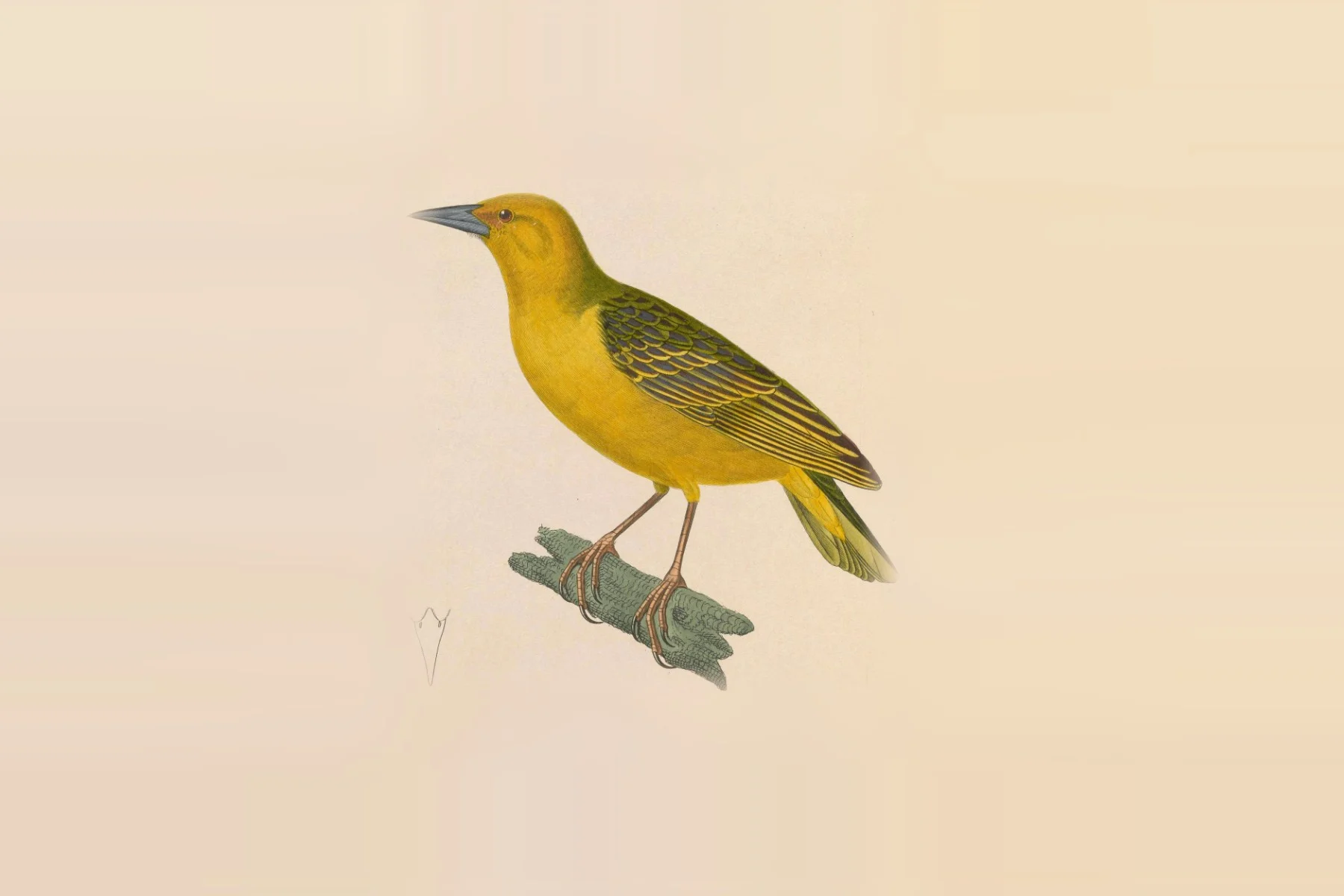
Weavers of Southern Africa and Their Nests: How to Tell Them Apart by What They Build
In weaver society the males build and the females inspect: the common weavers, the nests they make, the coastal and forest specials, and where to stay among the colonies.
A male Village Weaver builds 3 to 5 nests in a season, each taking him 9 to 15 hours. When a female arrives he displays, raising his mantle feathers and chasing her, until she goes in to inspect. If she judges the structure secure, they mate, he adds a short entrance tunnel, and she lines it. That nest is never used again. Each one is a single-use masterpiece.
That is the pattern for most of southern Africa’s weavers, and it is why the nests are such a good way into the family. The males build and the females choose, and each species has its own design. It is the property market, with feathers. BirdLife South Africa’s 2026 checklist has 12 weavers on the South African list, from the widespread Southern Masked Weaver to the Sociable Weaver of the Kalahari, plus the sparrow-weavers and the Red-billed Quelea in the same family. Iziko Museums’ Biodiversity Explorer, which follows the 2005 edition of Roberts, is the source for most of the nest details here.
The nests at a glance
| Weaver | The nest | Notes |
|---|---|---|
| Southern Masked | Kidney-shaped, big entrance underneath | Built by the male alone; the region’s most widespread weaver; lays July to March |
| Village | Kidney-shaped; short tunnel added once a female accepts it | 3 to 5 nests per male, 9 to 15 hours each; each nest used once |
| Cape | Waterproof, woven from broad strips of grass or reed; vertical tunnel added once accepted | Endemic to South Africa, Lesotho and Eswatini; breeds August to October in the Western Cape |
| Lesser Masked | Thin-walled, with a downward-pointing entrance tunnel | Kidney-shaped like its relatives |
| Spectacled | Retort-shaped, tunnel usually 10 to 20 cm, sometimes 60 cm | Monogamous, but a male may build several nests |
| Dark-backed | Retort-shaped, long tunnel at a slight angle | The only weaver of its genus that lives inside true forest |
| Thick-billed | A cup first, then a dome with a side entrance, slung between reeds | Females reject nests built in trees |
| Red-headed | Upside-down bottle with the entrance at the base | Made of leaf midribs, twigs, grass stems and tendrils |
| Yellow | Round, with no entrance tunnel | Coastal plain from Port Elizabeth north-east |
| Southern Brown-throated | Untidy oval, entrance at the bottom, hung on reeds over water | Up to about 12 nests per male; KwaZulu-Natal coast |
How a nest gets chosen
Start with the Southern Masked Weaver. Biodiversity Explorer says the nest is built solely by the male, and that if a female accepts it she lines the inside with leaves, grass heads and feathers. Males are polygynous and may mate with up to about 12 females in a season, living in colonies of 1 to 9 males. Egg-laying runs from July to March, peaking from September to February. The Atlas of Southern African Birds calls it the region’s most widespread weaver, and notes that it has spread into grassland by hanging its nests from barbed-wire fences, which is resourceful, if not pretty.
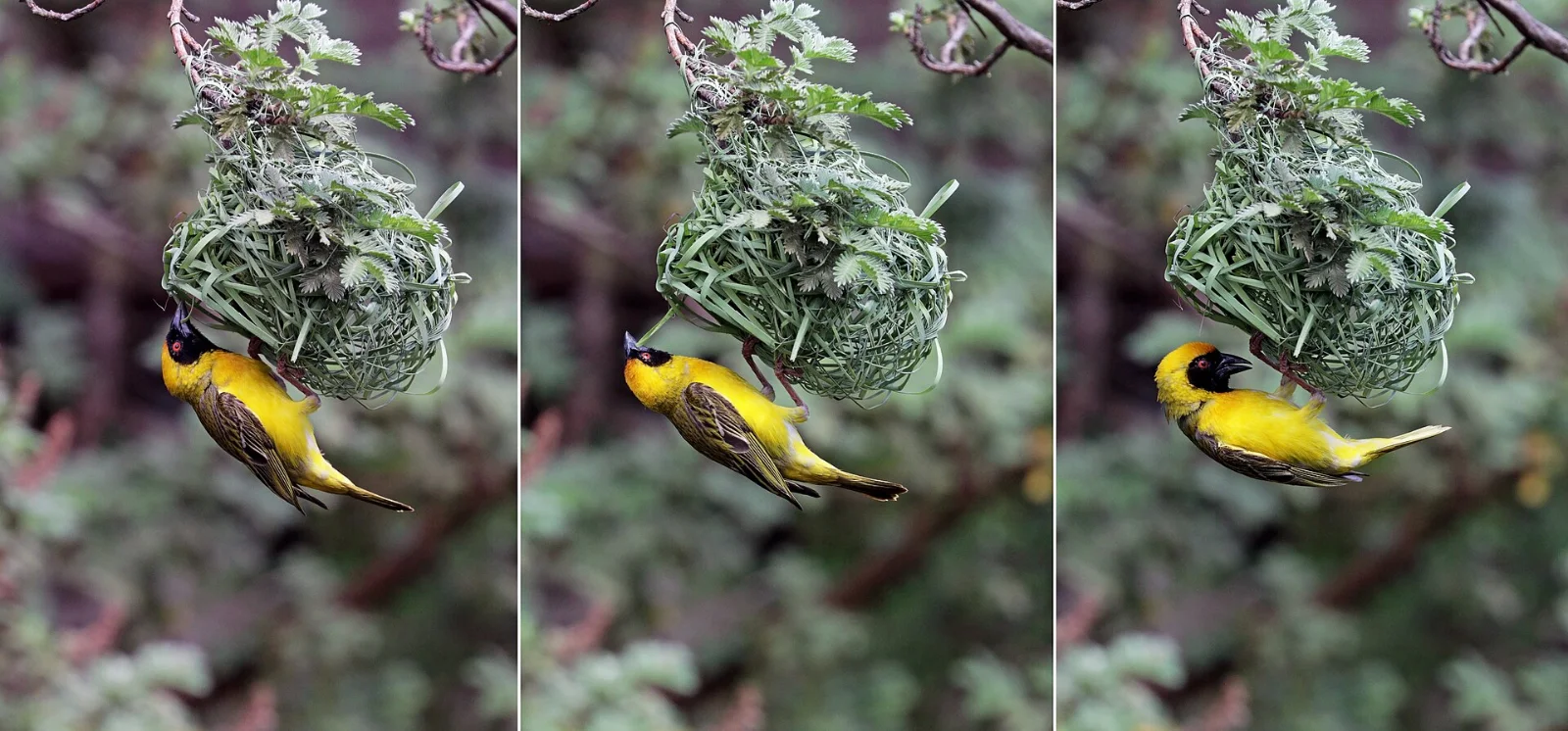
Cape Weaver females test a nest by pulling at the material inside, like a buyer kicking the tyres. If it passes, the female crouches ready to mate, and the male then adds a vertical entrance tunnel at the base. The Cape Weaver is endemic to South Africa, Lesotho and Eswatini, and BirdLife South Africa lists it as a near-endemic.
The Thick-billed Weaver shows how particular females can be, and how little arguing helps. The male builds a cup first and weaves a dome over it, slung between reed or bulrush stems. He sometimes builds in a tree beside the marsh, but Biodiversity Explorer says the female always rejects those. Always. He keeps trying.
The specials
The Spectacled Weaver’s nest is the most distinctive: a retort with an exceptionally long vertical entrance tunnel, usually 10 to 20 cm, sometimes 60 cm. The Atlas adds that a male may build several close together, even though the species is monogamous. A one-partner bird, with a row of houses.
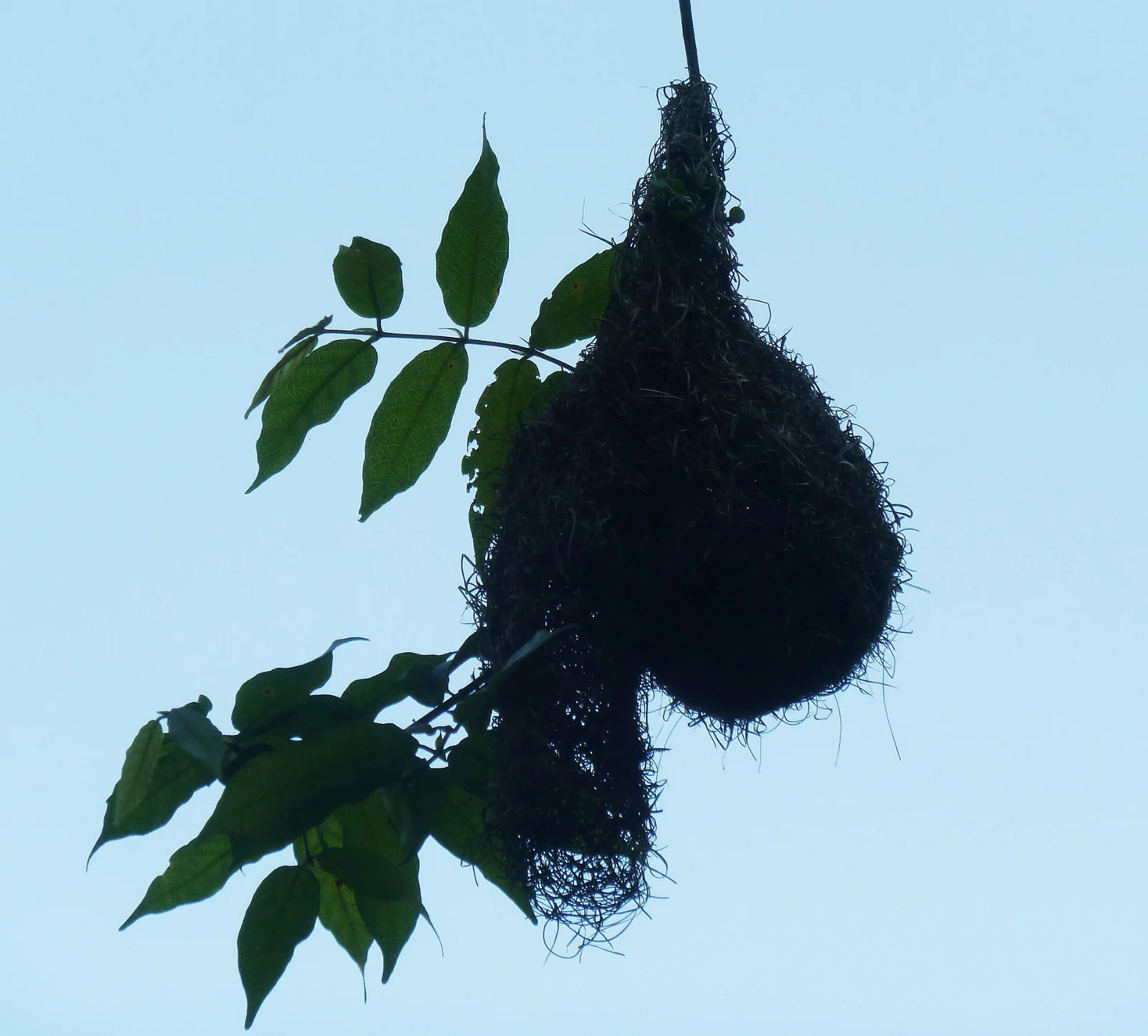
The Dark-backed Weaver, called the Forest Weaver in the Atlas, is the only southern African weaver of its genus that prefers the interior of true forest. Its nest starts as a simple ring, extended into a retort with a long tunnel at a slight angle at the base, built in 7 to 9 days, a fair turnaround for a forest builder.
On the KwaZulu-Natal coast, 2 more are worth a special trip, both of them prolific builders. The Southern Brown-throated Weaver lives in permanent swamps and rivers with papyrus and reedbeds, and the male may build about 12 untidy oval nests in a season, hung on reeds over water. The Yellow Weaver, listed as Yellow (Eastern Golden) Weaver by BirdLife South Africa, is a bird of the tropical coastal plain from Port Elizabeth north-east, and the male builds several round nests that lack an entrance tunnel. Lake St Lucia and the pans of Zululand sit in that coastal belt; see Zululand birding.
The African (Holub’s) Golden Weaver, common in eastern South Africa, builds 1 to 5 untidy, bulky kidney-shaped nests of coarse grass.
The communal builders
The Sociable Weaver works as a team, and the result is less a nest than a block of flats. Its communal nest can be about 7 m long, weigh at least a tonne and be more than 100 years old, and SANParks says the Kgalagadi’s Pygmy Falcons are often seen around the colonies, preying on the weavers. The Sociable Weaver nests guide covers the Kalahari colonies.
The Red-billed Buffalo Weaver builds a huge, bulky mass of thorny twigs divided into separate lodges, each with egg chambers. The White-browed Sparrow-weaver builds an untidy grass retort with 2 entrances, one of which the breeding pair close. The Red-billed Quelea, a weaver too, is the most abundant wild bird on the planet, with an estimated 1.5 billion birds, and its breeding colonies can be several kilometres across. That is a lot of very small houses.
Old nests have second lives, and the property market has tenants. Biodiversity Explorer says the Red-headed Finch usually lays its eggs in an old nest of another bird, such as a Ploceus weaver, a Red-billed Buffalo Weaver, a Cape Sparrow or a Sociable Weaver. Queleas, meanwhile, are hunted at the water: Biodiversity Explorer lists Lanner and Peregrine Falcons among the predators that take adults while they drink.
When and where to look
Late spring and summer, when the building season is in full swing. Southern Masked Weavers lay from July to March, with a peak from September to February, and Cape Weavers in the Western Cape lay from August to October. For weavers at home, attracting birds to your garden covers feeders and planting.
Several places to stay make the watching easy. At Kwendalo, near Plettenberg Bay, an 8-person hide looks over a tributary of the Rietvlei and a smaller blind over a pond with a heronry, and Cape Weaver is on the farm’s 127-species list. Fynbos Ridge Country House, also near Plettenberg Bay, puts out feeding trays and birdbaths across its grounds. On the KwaZulu-Natal coast, Malkoha Lake St. Lucia, on the Kwa-Nibela Peninsula, runs guided birding walks, floodplain drives and canoe trips, and gives more than 400 species for the area. In the Kalahari, the Sociable Weavers come with the territory at !Xaus Lodge and Tswalu, apartment blocks and all.
Further inland, Doornkop Fish & Wildlife Reserve in the Carolina district of Mpumalanga names Cape Weaver on a published list of more than 200 species, alongside Southern Bald Ibis and Blue Crane. On the Kgomo-Kgomo floodplain north of Pretoria, Zaagkuilsdrift has 3 hides over the floodplain edge, a sanctuary wetland and a water-level photography spot. In Zimbabwe, Matetsi Victoria Falls recorded 178 species, White-browed Sparrow-weaver among them, on its Birding Big Day.
Where to stay
Places in the directory with weavers on their lists, or hides and guides in good weaver country:
| Place to stay | Where | For birders | From |
|---|---|---|---|
| Kwendalo | Plettenberg Bay, Western Cape | BirdLife Recommended; 2 hides; Cape Weaver on its 127-species list | Ask the lodge |
| Fynbos Ridge Country House | Plettenberg Bay, Western Cape | Feeding trays and birdbaths; Cape Weaver named | R3,300 per night |
| Doornkop Fish & Wildlife Reserve | Carolina district, Mpumalanga | BirdLife Recommended; 200+ species; Cape Weaver named | R1,068 per chalet, 4-night midweek stay |
| Malkoha Lake St. Lucia | Kwa-Nibela Peninsula, Hluhluwe | BirdLife Recommended; guided floodplain and canoe birding | Ask the lodge |
| Zaagkuilsdrift Bird Sanctuary & Lodge | Near Pienaarsrivier, Limpopo | BirdLife Recommended; 3 hides on the floodplain | Ask the lodge |
| !Xaus Lodge | Kgalagadi Transfrontier Park | 260 species; Sociable Weaver | R7,820 pp sharing, full board |
| Tswalu Kalahari Reserve | Near Van Zylsrus, Northern Cape | Private guide; Sociable Weaver, White-browed Sparrow-weaver | R46,400 pp sharing, Motse (2026) |
| Matetsi Victoria Falls | Victoria Falls, Zimbabwe | Guide on staff; 178 species; White-browed Sparrow-weaver | US$1,150 pp sharing, fully inclusive |
Breeding seasons vary with rain, and the nest descriptions follow Roberts (2005) as summarised by Iziko Museums. Facts were checked on 14 November 2026 with Iziko’s Biodiversity Explorer, the Atlas of Southern African Birds, BirdLife South Africa, SANParks and the Birding Dispatch listings. Watch active colonies from a distance and leave the nests alone.
More from the Journal
 Woodpeckers of Southern Africa, Including the One That Doesn’t Need TreesSouthern Africa's woodpeckers, from the Cardinal in every bushveld tree to the Ground Woodpecker that lives on treeless mountain slopes and eats almost nothing but ants.
 Where to See a Taita Falcon: the Strijdom Tunnel, the Blyde Cliffs and the Batoka GorgeA stocky falcon smaller than a pigeon, a handful of cliffs and surveys that keep coming back empty. Where it still nests, how to look, and the 2 roosts beside its cliffs.
 Where to See a Southern Bald Ibis: the Breeding Cliffs, Dullstroom, Wakkerstroom and LesothoA red-capped grassland ibis that nests on cliffs over waterfalls and feeds on burnt veld and maize stubble. The colonies you can watch, the fields to scan, and where to stay.
The Pigeon Post
Every Thursday: 1 bird, 1 place to go and 1 place to stay, by email. Sign up and get our printable checklist of the 163 endemics of southern Africa.