
Sunbirds of Southern Africa and Where to See Them
How to tell the commonest southern African sunbirds apart, which flowers bring them in, and where to see them, from the fynbos of Kirstenbosch to Kruger's rest camps.
Sunbirds are Africa’s answer to hummingbirds: small, fast nectar-feeders with long, curved bills, and males that flash metallic green, violet and red in good light, like small, cross jewellery. They are also among the easiest birds to watch, because they come to flowers in gardens, botanical gardens and rest camps, and they return to the same plants all day, as if on a shift roster.
Southern Africa has around 20 sunbird species. This guide covers the ones a visitor is most likely to see, how to tell the males apart, and where to look. The females, mostly, will have to forgive us.
The short answer
Find the flowers and you find the sunbirds. In the Western Cape, go to fynbos in flower, and Kirstenbosch National Botanical Garden in Cape Town is the classic place for the Orange-breasted, Malachite and Southern Double-collared Sunbirds. In Kruger and the bushveld, check flowering aloes, creepers and trees in the rest camps, where Scarlet-chested, Amethyst, Marico and Collared Sunbirds are regular. Watch the males, because the females of most species are plain grey-brown and much harder to identify, which is how they like it.
At a glance
| Sunbird | Male in one line | Where |
|---|---|---|
| Malachite | Metallic green all over, long tail streamers | Fynbos, mountain grassland, gardens |
| Orange-breasted | Green head, violet band, orange breast, long tail | Fynbos only (Western and Eastern Cape) |
| Southern Double-collared | Green head, narrow blue line, thin red breast band | Cape gardens and fynbos, east to KwaZulu-Natal |
| Greater Double-collared | Like the Southern but bigger, with a broad red band | Eastern forests and gardens |
| Scarlet-chested | Velvet black-brown with a scarlet chest | Bushveld, Kruger camps |
| Amethyst | Black-looking, violet throat and shoulders | Woodland and gardens in the east |
| Marico | Green head, blue and maroon breast bands, black belly | Thornveld, northern bushveld |
| Collared | Tiny, green above, yellow below, short bill | Forest edges, riverine bush |
How to identify them
Start with the male. Most sunbird males are brightly coloured and iridescent, while the females are drab olive or grey-brown and are best identified by the male they are with: known, in other words, by the company they keep. Iridescent colours change with the light, so a green bird can turn black when a cloud passes. Look for patterns rather than exact shades: the colour and width of the breast band, the length of the tail and the size of the bird.
Some males also moult into a duller non-breeding (eclipse) plumage outside the breeding season. A Malachite Sunbird male in eclipse can look patchy green and brown, but he usually keeps his long tail feathers, which helps. He is between outfits, not in disguise.
The fynbos sunbirds
Orange-breasted Sunbird. This is the one to come for. It is endemic to the fynbos of south-western South Africa and closely tied to tubular-flowered heaths (Erica), with which it appears to have co-evolved. A University of Cape Town study found that Orange-breasted Sunbirds pollinate at least 67 Erica species in the Cape, which makes each bird a very busy, very small gardener. The male has an iridescent green head, a violet chest band, an orange breast and a long, pointed tail.
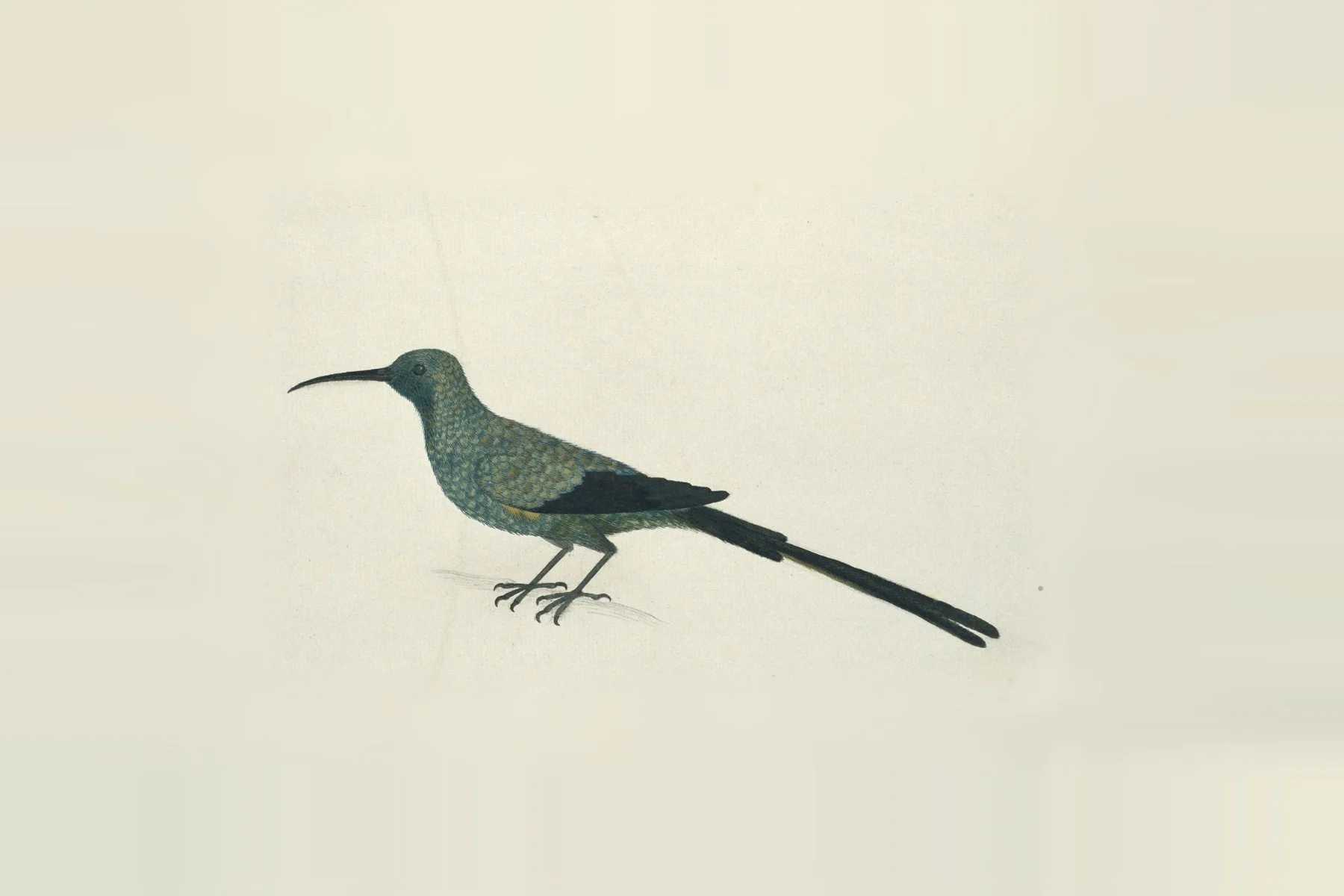
Malachite Sunbird. A large, all-green sunbird with long central tail feathers, often perched high on a protea or a bush to sing and guard its flowers, like a shopkeeper standing in the doorway. It ranges well beyond the fynbos into mountain grassland.
Southern Double-collared Sunbird. Small and common in Cape gardens, with a green head and back, a narrow blue line and a thin red band across the breast. Its larger relative, the Greater Double-collared, has a much broader red band and lives further east.
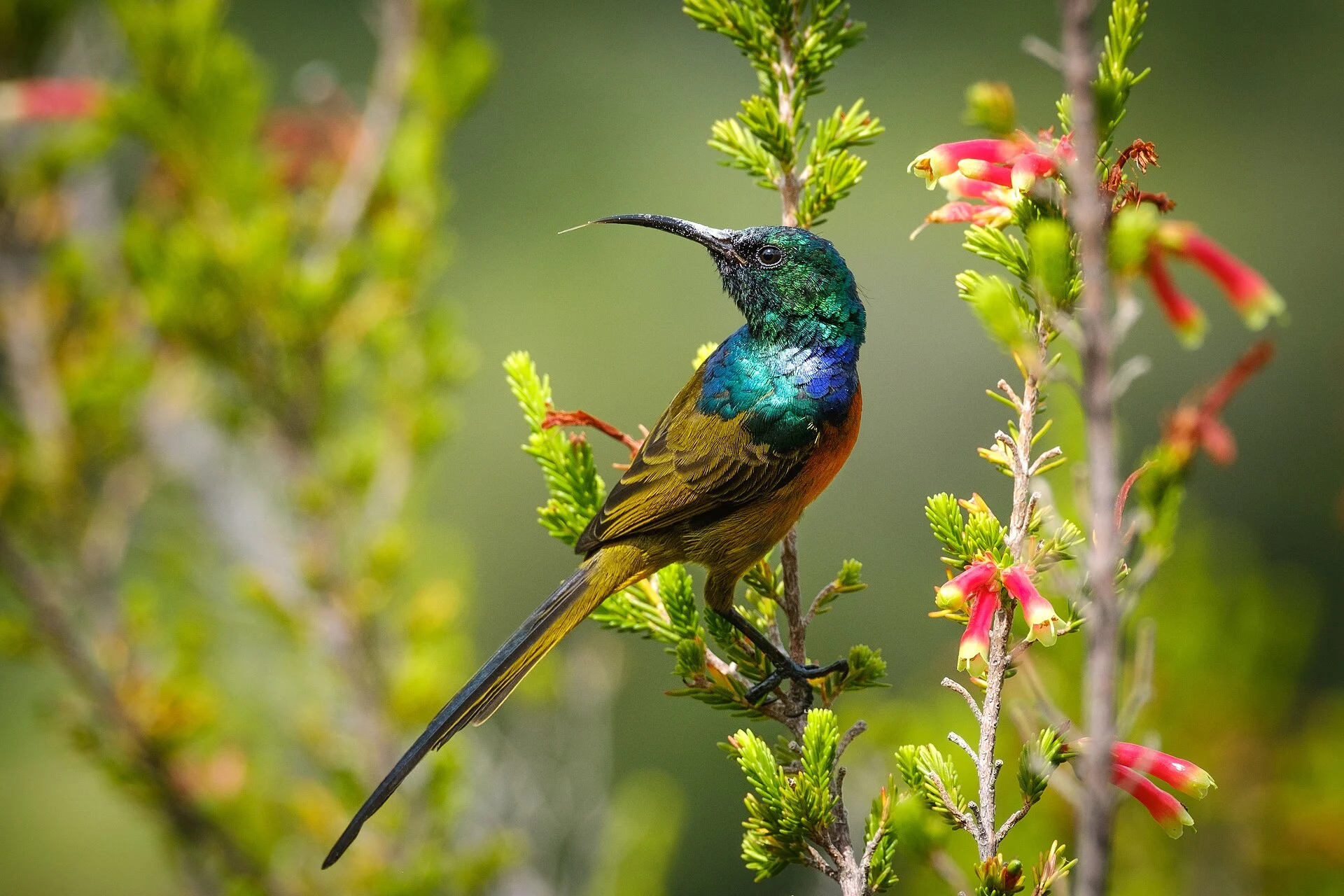
Where to see them. Kirstenbosch National Botanical Garden on the slopes of Table Mountain is the easiest place: walk the fynbos and protea beds and the paths above the garden. Any fynbos reserve in flower, from the Cape Peninsula to the Overberg, will also have them. Sunbirds hold territories around good flowers, so once you find a feeding bird, wait and it will come back. It has nowhere better to be.
The bushveld sunbirds
In Kruger and the eastern bushveld the cast changes, though the show is much the same. SANParks’ camp-by-camp birding notes name sunbirds as part of the everyday camp birdlife:
- Berg-en-Dal: the Scarlet-chested Sunbird is particularly prominent.
- Crocodile Bridge: Scarlet-chested Sunbird in camp.
- Skukuza: Collared Sunbird on a walk along the river.
- Olifants: the many aloes in camp act as a magnet for sunbirds when they are in flower.
- Pretoriuskop: several sunbird species in camp, with the Scarlet-chested among them.
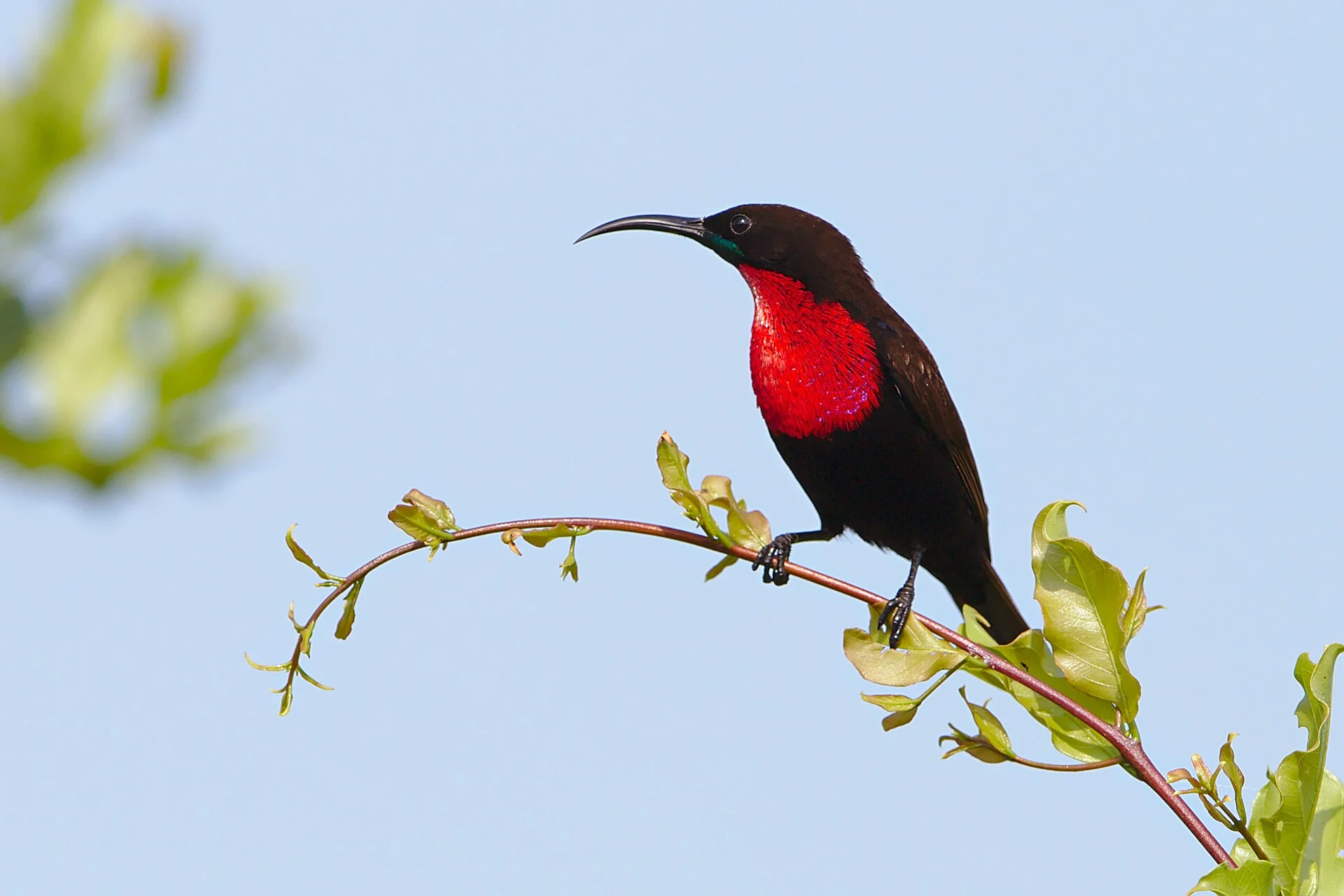
Scarlet-chested Sunbird. The male is unmistakable: velvety black-brown with a glowing scarlet chest and an iridescent green crown and throat. It is common in bushveld camps and gardens.
Amethyst Sunbird. Looks black at a distance, but in the light the male shows a violet throat and shoulders and a green crown. Wait for the sun to find him.
Marico Sunbird. A bird of thornveld, with a green head and back, a narrow blue band and a broader maroon band across the breast, and a black belly.
Collared Sunbird. Tiny and short-billed, green above and yellow below, usually in thick riverine bush and forest edges, where it feeds on insects as well as nectar.
When to go
Sunbirds are with you all year, but the flowers decide where they are. The birds just follow the menu. In the bushveld and much of the summer-rainfall north and east, flowering aloes in the dry winter months, roughly May to August, pull sunbirds into camps and gardens, and you can watch several species at the same plant. In the Cape, something is flowering in the fynbos in every month, and the Ericas and proteas keep the fynbos sunbirds busy through the year.
The verdict
For the fynbos specials, spend a morning at Kirstenbosch and watch the Erica and protea beds; the Orange-breasted Sunbird is the prize and it lives nowhere else. In Kruger, stop at the flowering aloes and trees in Berg-en-Dal, Olifants and Pretoriuskop, and let the sunbirds come to you. Concentrate on the males, learn the breast bands, and you will name most of the sunbirds you see. The females you can blame on the light.
Where to stay
Places to stay in the directory near the sites in this guide, with what each offers a birder:
| Place to stay | Where | For birders | From |
|---|---|---|---|
| Avian Leisure | Simon’s Town, Cape Peninsula | Garden feeders, Orange-breasted Sunbird, Cape Sugarbird | Ask the lodge |
| Lark House | Glencairn, Cape Peninsula | BirdLife Recommended, birder host, Orange-breasted Sunbird | Ask the lodge |
| Twitchers SA | Onrus, near Hermanus | BirdLife Recommended, feeders, Orange-breasted Sunbird | Ask the lodge |
| Phillipskop Mountain Reserve | Above Stanford, Overberg | Amethyst and Southern Double-collared Sunbirds, Cape Sugarbird | R2,100 per chalet for 2, self-catering |
| Kambaku River Lodge | Crocodile River, near Malelane Gate | BirdLife Recommended, hide facing Kruger, 240 species | R7,590 for 2, room only |
| Zinkwazibush | Marloth Park, opposite Kruger | Eastern Nicator, African Fish Eagle | Ask the lodge |
| Plains Camp @ Rhino Walking Safaris | Concession near Skukuza, Kruger | BirdLife Recommended, tailor-made birding safaris | R9,830 pp sharing, full board and activities |
| Nkambeni Safari Camp | Near Numbi Gate, Kruger | Guided walks for birdwatching | Ask the lodge |
Ranges and flowering times vary from year to year. Facts were checked on 9 November 2026 with SANParks’ camp-by-camp birding notes for Kruger, the University of Cape Town FitzPatrick Institute and published species accounts. Confirm garden opening times with SANBI and park rules with SANParks.
More from the Journal
 Woodpeckers of Southern Africa, Including the One That Doesn’t Need TreesSouthern Africa's woodpeckers, from the Cardinal in every bushveld tree to the Ground Woodpecker that lives on treeless mountain slopes and eats almost nothing but ants.
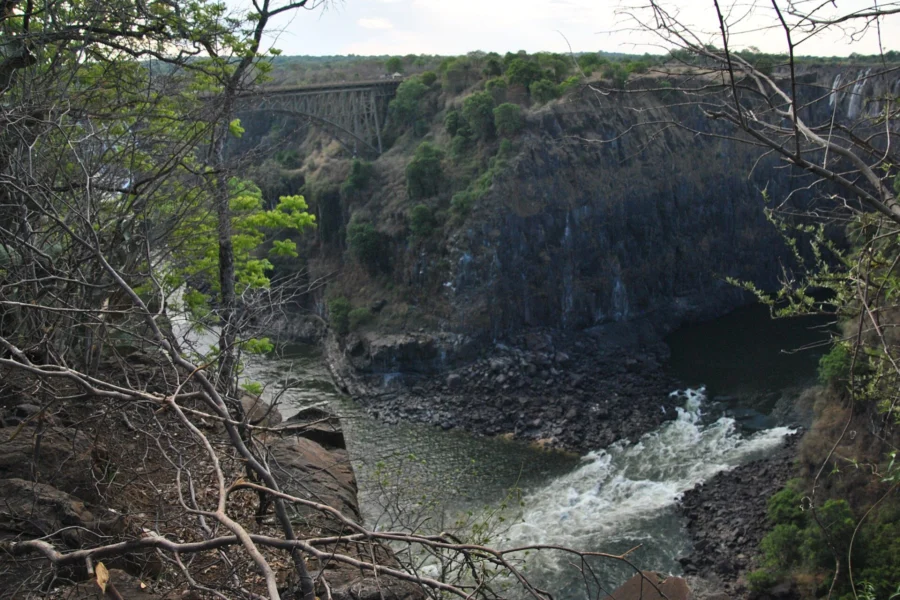 Where to See a Taita Falcon: the Strijdom Tunnel, the Blyde Cliffs and the Batoka GorgeA stocky falcon smaller than a pigeon, a handful of cliffs and surveys that keep coming back empty. Where it still nests, how to look, and the 2 roosts beside its cliffs.
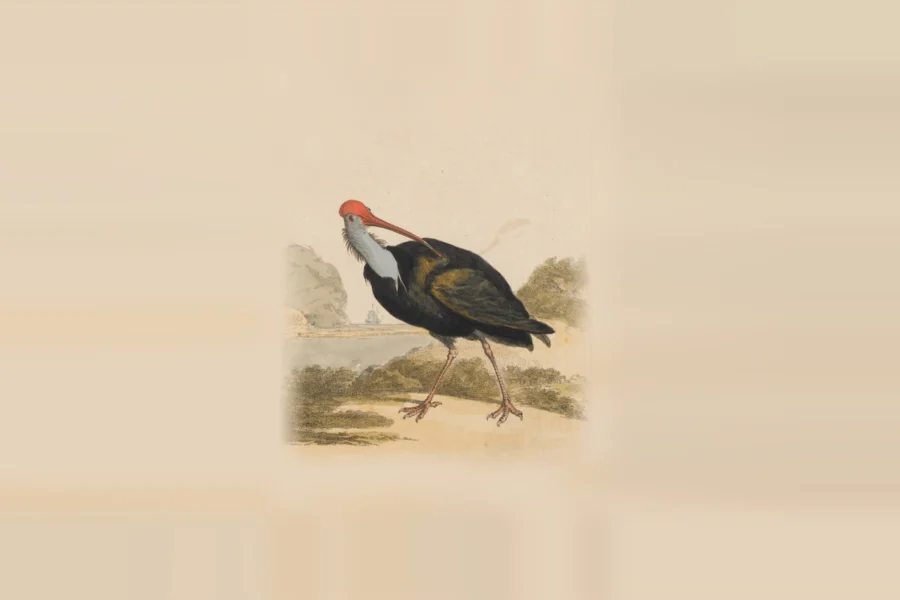 Where to See a Southern Bald Ibis: the Breeding Cliffs, Dullstroom, Wakkerstroom and LesothoA red-capped grassland ibis that nests on cliffs over waterfalls and feeds on burnt veld and maize stubble. The colonies you can watch, the fields to scan, and where to stay.
The Pigeon Post
Every Thursday: 1 bird, 1 place to go and 1 place to stay, by email. Sign up and get our printable checklist of the 163 endemics of southern Africa.