
Where to See Flamingos in Africa: Greater and Lesser, Site by Site
Two flamingos, two diets, one habit of vanishing to wherever the water is. The 3 breeding pans, the coastal lagoons, what happened at Kamfers Dam, Kenya's falling counts and stays beside the water.
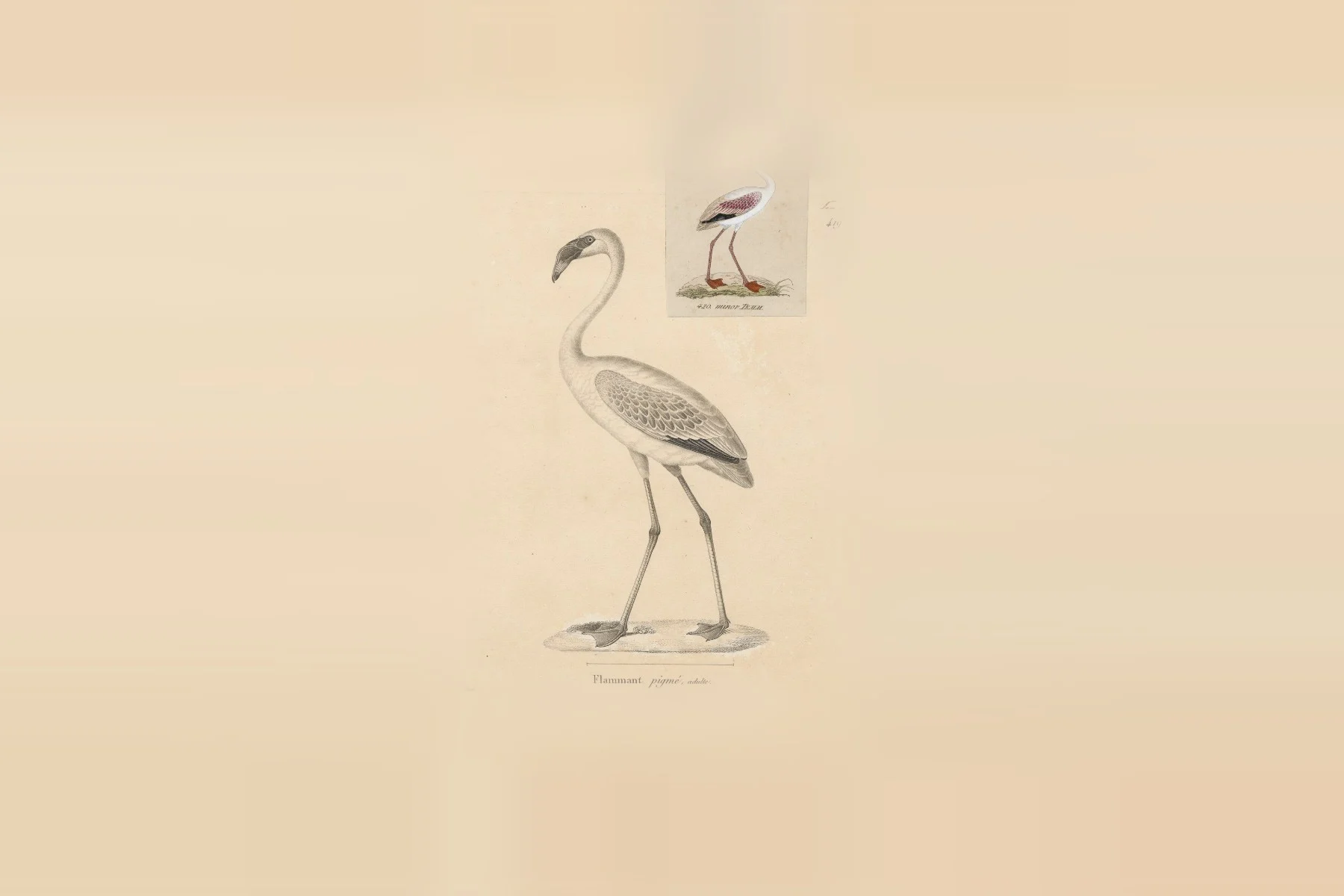
Africa has 2 flamingos, and they live by different rules, mostly about what goes on the menu. The Greater Flamingo filters small invertebrates, crustaceans and fly larvae, from water about 70 to 130 cm deep. The Lesser Flamingo feeds mainly on microscopic blue-green algae that bloom in saltier, more alkaline water, which is why it turns up on soda lakes and salt pans where the Greater is scarce. It is a bird that eats soup made of algae, upside down, standing in water too salty for most of its neighbours. The Atlas of Southern African Birds, in accounts by Tony Williams and Carlos Velásquez, adds that Lessers feed at night more often than Greaters, because they need calm water, and that the Greater breeds earlier and at less saline sites.
Both are wanderers. They breed on remote pans after rain, then move to coastal lagoons, salt works and sewage works when the pans dry out. The Atlas describes Greater Flamingos flying from the Namibian coast to Etosha Pan, about 500 km inland, overnight at 50 to 60 km/h. So the question for a birder is less “where do flamingos live” than “where are they this month”. A pink bird that commutes 500 km overnight does not do fixed addresses.
At a glance
| Place | Country | Best time (source) | Stay nearby |
|---|---|---|---|
| Walvis Bay and Sandwich Harbour | Namibia | Most of the year; Greater numbers lowest late February to March (Atlas) | Lagoon Loge (not yet listed) |
| Etosha Pan | Namibia | Breeding only in big rain years, February to June (Namibia Bird Club) | Ongava Lodge, Onguma Bush Camp |
| Sua Pan and Nata | Botswana | When the pans hold water after rain (Botswana Tourism) | Nata Lodge |
| Lake Natron | Tanzania | Breeding site for about 75% of the world’s Lessers (EAZA) | Not yet listed |
| Nakuru, Elementaita, Bogoria | Kenya | Year round, numbers down sharply in 2025 (The Standard) | Loldia House, The Pelican Lodge |
| Berg River and Rocherpan | South Africa | Both species, depending on water levels (CapeNature) | Rocherpan Nature Reserve, Quagga River Lodge |
The breeding pans
Lesser Flamingos are fussy breeders, and fussy is putting it kindly. Reuters, reporting in 2025, counted only 3 active African breeding sites: a soda lake in Tanzania and 2 salt pans, in Namibia and Botswana. The Atlas names the pans as Etosha and Sua Pan in the Makgadikgadi, 960 km apart, and says they are probably alternative sites for the same southern African population. Breeding needs food and nesting conditions to hold for about 4 months, which, the Atlas notes, seldom happens, and chick mortality is high.
When it does happen, the numbers are huge, and whole pans turn pink. The Atlas records 1 million Lesser Flamingos at Etosha in 1971 and 1.5 million at the Makgadikgadi in November 1974, both in very wet years, and 50,000 Lesser Flamingo nests at the south end of Sua Pan in 1988.
Etosha
In the September 2019 issue of Lanioturdus, the journal of the Namibia Bird Club, Ann Scott and co-authors summarise the Etosha pattern: both species breed in large mixed colonies on raised islands in the flooded pan, and laying is triggered by extensive flooding. Greater Flamingos usually start once the season’s rain passes 400 mm, typically in February and March; Lessers lay mainly in May and June. Most years the pan is dry, and the flamingos do not show up for the season. The private reserves on the park’s edge make the best bases for a flamingo year, among them Ongava Lodge and Anderssons at Ongava near Okaukuejo, and Onguma Bush Camp on the eastern side near Namutoni. For the park itself, see Etosha birding.
Sua Pan and Nata
On the eastern side of the Makgadikgadi, the Botswana Tourism Organisation says thousands of flamingos, pelicans, ducks and geese gather at Nata Bird Sanctuary when the pans hold water. Nata Lodge, about 10 km south of Nata village on the main road, runs a guided drive into the sanctuary and gives a count of 165 species for it. It has 22 chalets, 10 safari tents and campsites, and it is 310 km from Maun. Eselbe Camp Backpackers, also in the Makgadikgadi and Nata area, is the budget option, naming Common Ostrich and Secretarybird, 2 birds that are at least easier to find than a flamingo colony.
Lake Natron
In East Africa, the breeding site is Lake Natron in northern Tanzania, close to the Kenyan border. The European Association of Zoos and Aquaria, launching a Lake Natron project with BirdLife International and Nature Tanzania in February 2026, gives an estimated 75% of the world’s Lesser Flamingos, 2.2 to 3.3 million birds, as nesting at this 1 lake. Soda-ash mining proposals, the latest in 2025, have been withdrawn after campaigning, but the lake still lacks complete, permanent protection. The Atlas describes Lessers nesting on mudflats far out in pans and lakes, out of reach of predators, so the nests are not something to go looking for. The flamingos chose the spot precisely so that nobody would. No Natron camp is in the directory yet.
What happened at Kamfers Dam
For a time the best flamingo site in South Africa was a sewage-fed pan 6 km north of Kimberley. Flamingos have never been snobs about where they eat. BirdLife South Africa’s Important Bird Area account says Kamfers Dam regularly held more than 20,000 birds and probably the largest permanent Lesser Flamingo population in southern Africa: 81,664 Lessers were counted in 2006. That year Ekapa Mining built an S-shaped breeding island, and Kamfers Dam became the first Lesser Flamingo breeding site in South Africa. Between 2007 and 2011, about 24,000 Lesser and 100 Greater Flamingo chicks hatched there. The island flooded from November 2009 and was submerged by January 2011.
The birds kept coming for a while. Reuters, in a report carried by Business Day in May 2025, quoted the Ekapa Group’s wetlands specialist: 71,000 flamingos were on the dam in 2020, with up to 5,000 chicks a season. Since then about 36 megalitres a day of untreated sewage from a broken treatment works has poisoned the water. The flamingos had missed 3 or 4 breeding seasons, and when Reuters visited in May 2025 there were none. A landowner on the dam won a court order in April 2025 compelling the municipality to fix the plant, which the municipality said needed R106 million it did not have. Check recent reports before driving to Kimberley for flamingos. This part of the story has no punchline.
The southern African coast
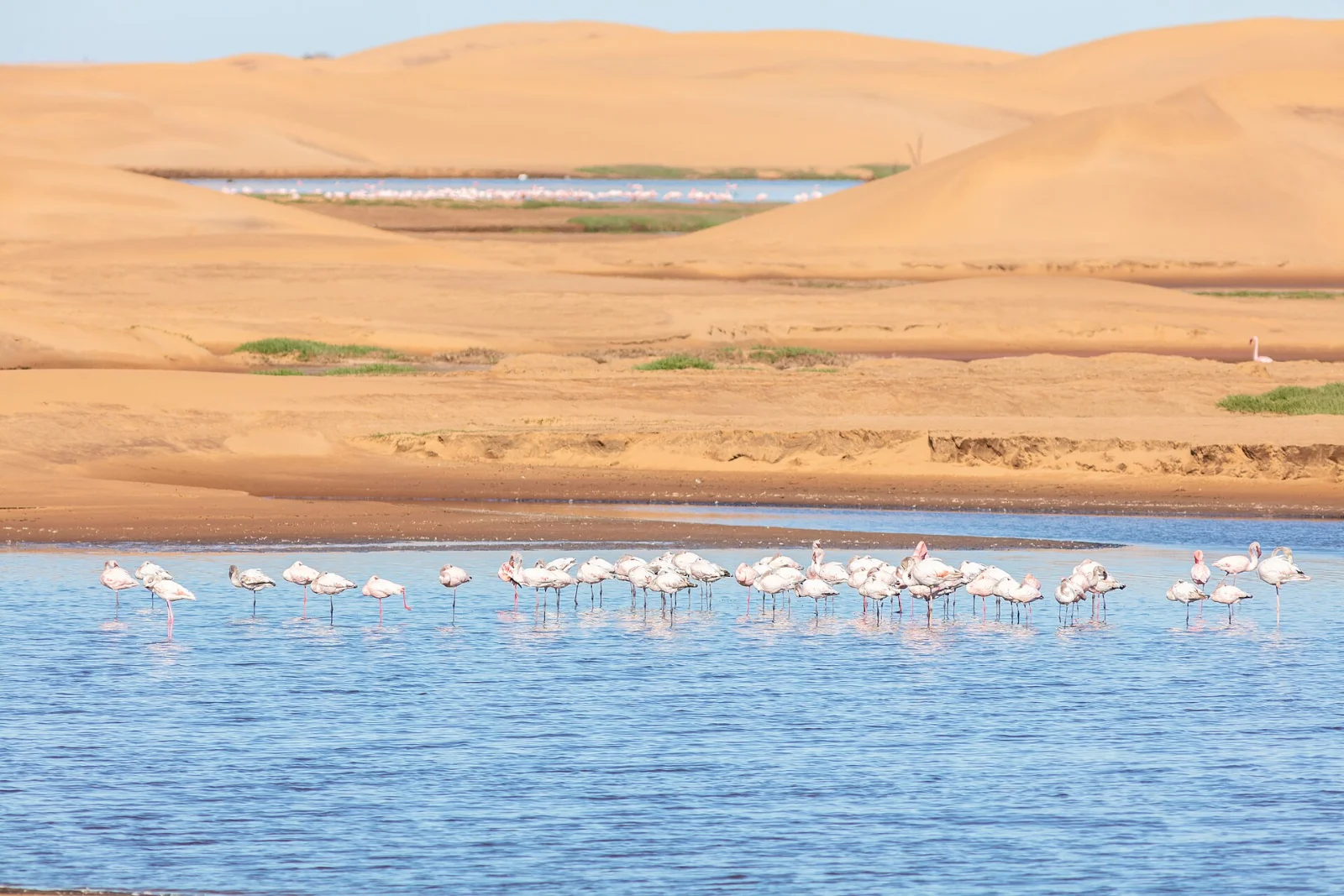
When the inland pans dry, most flamingos go to the coast, like everyone else on holiday. The Key Biodiversity Areas account for Walvis Bay, drawn from BirdLife’s Important Bird Area directory, says 80 to 90% of the subregion’s flamingos winter at Walvis Bay or Sandwich Harbour, many on the salt works evaporation ponds. The lagoon promenade puts them close to the road, so the flamingos can be watched without leaving the car. Sandwich Harbour 4×4 runs a half-day wetlands birding tour from Walvis Bay at N$2,900 an adult in 2026. The Walvis Bay birding guide covers the lagoon, the salt works and the boat and 4×4 trips.
In South Africa, the Atlas lists the Berg River estuary and Langebaan Lagoon as principal non-breeding sites for Lesser Flamingo. At Velddrif, Quagga River Lodge has 5 self-catering chalets on the Berg River and publishes its own guide to the lower estuary, profiling Greater Flamingo with African Black Oystercatcher, Pied Avocet and Cape Teal; it says more than 200 species have been recorded between Velddrif and the river mouth at Laaiplek. About 25 km to the north, CapeNature’s Rocherpan Nature Reserve has 8 self-catering cabins and 3 hides on a seasonal vlei, records 183 species depending on water levels, and names Greater and Lesser Flamingo with Great White Pelican. Cabins are from R1,430 a night for 2, off peak. For Langebaan’s Seeberg hide, see West Coast National Park birding.
Along the south coast, Lekkerwater Beach Lodge in De Hoop Nature Reserve names Lesser Flamingo with Cape Vulture and Caspian Tern. The Atlas records a Greater Flamingo breeding event near Bredasdorp in 1960, with 1,600 adults and 350 young. On the Garden Route, In Toto Retreat, BirdLife Recommended and on The Island in Sedgefield, points guests to hides around the Wilderness Lakes, and its local guide names both flamingos.
In KwaZulu-Natal, the Atlas singles out Lake St Lucia as 1 of the few places where Greater Flamingos concentrate, and records 4,000 young raised there from 6,000 nests in 1972. Makakatana Bay Lodge, on the lake shore in iSimangaliso, has a bird guide on staff.
Close to Johannesburg, for the birder who cannot get to the coast, GoBirding says Lesser Flamingo moves into Marievale, on the Blesbokspruit, when the water drops in late winter; see birding near Johannesburg.
The Kenyan Rift lakes
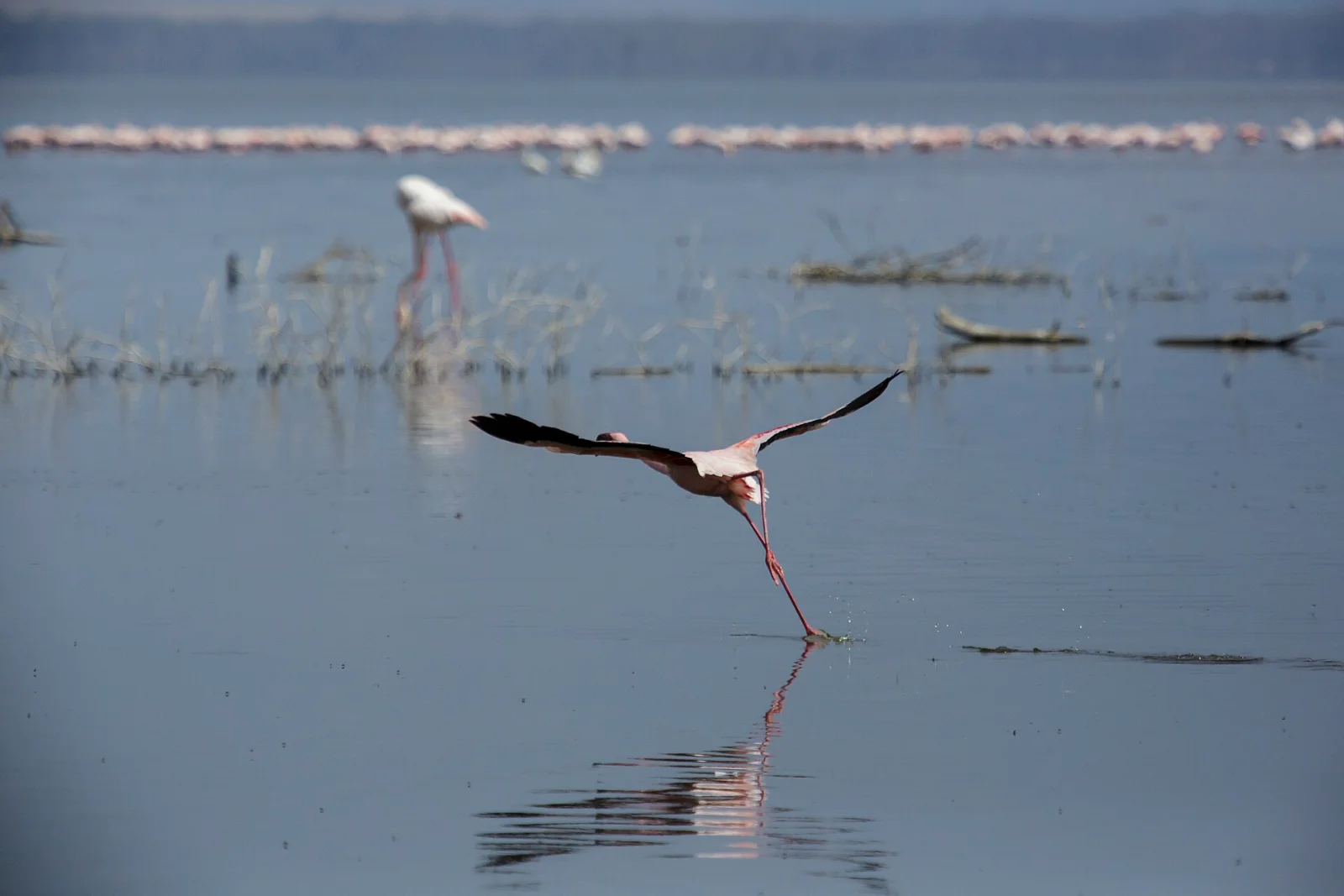
Lake Nakuru’s pink shoreline is the image most people carry of Kenya, and the numbers have collapsed. In May 2026 The Standard reported that Lakes Nakuru, Bogoria and Elementaita have all kept rising, diluting the salty water and the bacteria Lesser Flamingos feed on. Quoting the National Wildlife Census 2025 Technical Report, it gave Lesser Flamingos at Elementaita falling from more than 202,000 to 1,476 in 3 years, and all waterbirds at Bogoria falling from 54,711 in 2024 to 21,903 in 2025. Treat a big flamingo flock in Kenya as a bonus, not a promise.
The directory has 3 bases on these lakes. The Pelican Lodge is on the shore of Lake Elementaita, about 2 hours from Nairobi, with flamingos and pelicans feeding in the shallows in front of it, 6 lakeside cottages and 46 rooms. On the same lake, Lake Elmenteita Serena Camp has a bird guide on staff and names Great White Pelican. On Lake Naivasha, Loldia House names Lesser Flamingo, runs guided drives to Lake Nakuru and Lake Elementaita, and serves an early breakfast for the Nakuru outing; the 2027 rate is from US$437 per person sharing in April and May, full board, with Nakuru park fees of US$90 per entry on top.
Elsewhere
Flamingos turn up well away from these sites, wanderers that they are. Zambezi Mubala Lodge on the Zambezi east of Katima Mulilo names Lesser Flamingo among the birds on its 3-hour boat cruise. In Tanzania, Birding Ecotours found flocks of both species on the Ngorongoro Crater floor in 2024; Gibb’s Farm near Karatu, with a bird guide on staff, is a base for the crater.
Watching flamingos well
Flamingos are easy to see and easy to disturb, which is an awkward combination in a bird with legs that long. The Atlas accounts list low-flying aircraft among the main threats at breeding and feeding sites, along with power lines, fences across pans and pollution. Keep to the roads and paths at the edge of the water, use the hides where they exist, and do not push a flock to make it fly for a photograph.
The 2 species often share a pan, and the Atlas says competition between them is minimal: the Lesser filters smaller food, needs calmer water and feeds more at night. A mixed flock on the West Coast or at Walvis Bay is the easiest place to compare them side by side: 2 flamingos at one table, ordering different dishes.
Where to stay
The places in this guide, with what each offers a birder:
| Place to stay | Where | For birders | From |
|---|---|---|---|
| Ongava Lodge | Ongava Game Reserve, Namibia | Hide, guided birding outings, near Okaukuejo | N$11,800 pp sharing FB |
| Anderssons at Ongava | Ongava Game Reserve, Namibia | Water-level hide, guided birding outings | N$23,400 pp sharing all-inclusive |
| Onguma Bush Camp | Onguma, eastern Etosha, Namibia | Treetop hide on waterhole, Onkolo hide, near Namutoni | N$3,060 pp sharing DB&B |
| Nata Lodge | Nata, Botswana | Guided drive into Nata Bird Sanctuary, 165 species | Ask the lodge |
| Eselbe Camp Backpackers | Nata, Botswana | Common Ostrich, Secretarybird, seasonal canoe trips to pans | Ask the lodge |
| Quagga River Lodge | Velddrif, South Africa | Own estuary bird guide, Greater Flamingo, 200+ species | Ask the lodge |
| Rocherpan Nature Reserve | Near Velddrif, South Africa | 3 hides, Greater and Lesser Flamingo, 183 species | R1,430 per cabin for 2 |
| Lekkerwater Beach Lodge | De Hoop, South Africa | Lesser Flamingo, Cape Vulture, Caspian Tern | R7,700 pp sharing all-inclusive |
| In Toto Retreat | Sedgefield, South Africa | BirdLife Recommended, hides nearby, guide names both flamingos | Ask the lodge |
| Makakatana Bay Lodge | Lake St Lucia, South Africa | Bird guide on staff, early-morning wetlands outing | R10,880 pp sharing all-inclusive |
| The Pelican Lodge | Lake Elementaita, Kenya | Flamingos and pelicans in the shallows, 400+ species | Ask the lodge |
| Lake Elmenteita Serena Camp | Lake Elementaita, Kenya | Bird guide on staff, Great White Pelican | US$405 per tent |
| Loldia House | Lake Naivasha, Kenya | Lesser Flamingo, drives to Nakuru, early breakfast | US$437 pp sharing FB |
| Zambezi Mubala Lodge | Near Katima Mulilo, Namibia | Lesser Flamingo on 3-hour boat cruise | N$3,541 pp sharing B&B |
| Gibb’s Farm | Karatu, Tanzania | Bird guide on staff, 200 species, Ngorongoro Crater base | US$518 pp sharing FB |
Flamingo numbers swing with rainfall and water quality from year to year. Facts were checked on 13 November 2026 with the Atlas of Southern African Birds, BirdLife South Africa’s Kamfers Dam IBA account, Reuters via Business Day, EAZA, The Standard, Lanioturdus, the Botswana Tourism Organisation, CapeNature and the Birding Dispatch listings. Check recent reports before travelling for a flamingo spectacle.
More from the Journal
 Woodpeckers of Southern Africa, Including the One That Doesn’t Need TreesSouthern Africa's woodpeckers, from the Cardinal in every bushveld tree to the Ground Woodpecker that lives on treeless mountain slopes and eats almost nothing but ants.
 Where to See a Taita Falcon: the Strijdom Tunnel, the Blyde Cliffs and the Batoka GorgeA stocky falcon smaller than a pigeon, a handful of cliffs and surveys that keep coming back empty. Where it still nests, how to look, and the 2 roosts beside its cliffs.
 Where to See a Southern Bald Ibis: the Breeding Cliffs, Dullstroom, Wakkerstroom and LesothoA red-capped grassland ibis that nests on cliffs over waterfalls and feeds on burnt veld and maize stubble. The colonies you can watch, the fields to scan, and where to stay.
The Pigeon Post
Every Thursday: 1 bird, 1 place to go and 1 place to stay, by email. Sign up and get our printable checklist of the 163 endemics of southern Africa.