
Walvis Bay and Sandwich Harbour: Flamingos, Waders and Where to Stay
Over 100,000 birds in a desert with 15 mm of rain: the lagoon, the salt works and Sandwich Harbour, the specials, the best months, 2026 trip prices and where to stay.
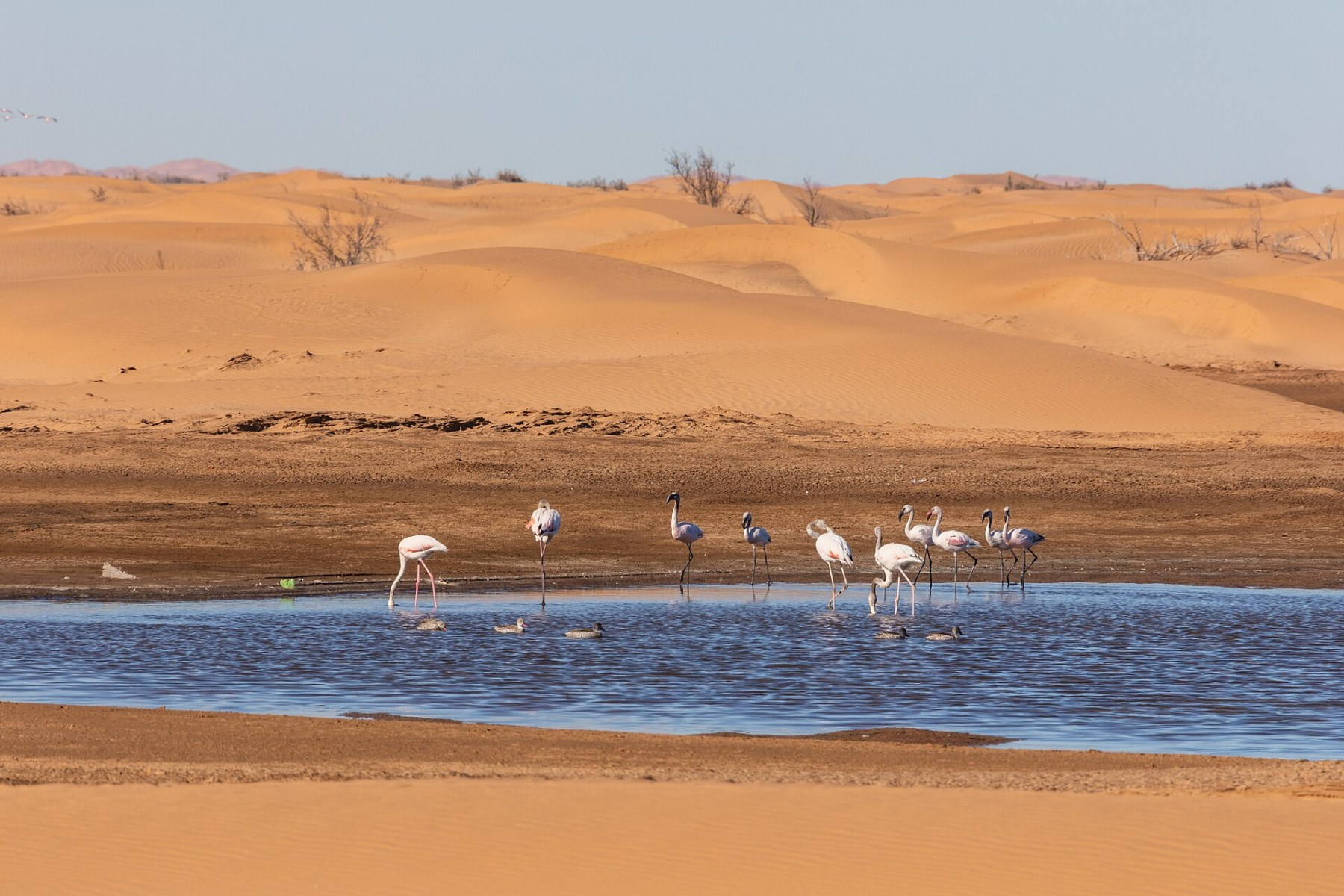
Walvis Bay sits on the Kuiseb River delta, about halfway down the Namib coast, in a desert that gets about 15 mm of rain a year. It is an odd place to find one of Africa’s great wetlands, and the birds do not seem to mind. The Key Biodiversity Areas factsheet for the site, drawn from BirdLife’s Important Bird Area directory, calls it the most important coastal wetland in southern Africa by numbers and species of birds, and probably among the 3 most important on the African coast. It regularly holds over 100,000 birds in summer, with a maximum count of 162,000, and about 50,000 in winter.
About 55 km to the south, Sandwich Harbour is bigger again. Its factsheet calls it the most important wetland for waterbirds in southern Africa, with counts above 300,000 birds in some years. At times the 2 sites together hold half of all the birds counted in southern Africa during the African waterfowl counts. Both are Ramsar sites, designated on 23 August 1995 as numbers 742 and 743.
Most of the birds are easy. Flamingos feed beside the promenade, and the salt works can be birded from a car with the heater on. The specials need a little more care, and Sandwich Harbour needs a 4×4, a guide and a low tide.
At a glance
| Site | What it is | Birds to look for | Getting in |
|---|---|---|---|
| Walvis Bay lagoon and promenade | Tidal lagoon, mudflats, town edge | Greater and Lesser Flamingos, Great White Pelican, Pied Avocet | Walk or drive the lagoon road |
| Pelican Point | 10 km sand-spit sheltering the bay | Terns, cormorants, waders on the bay side | Drive or join a boat or 4×4 trip |
| Salt works | Evaporation ponds south of the lagoon | Chestnut-banded Plover, Black-necked Grebe, Curlew Sandpiper, flamingos | Public road past the pans |
| Sandwich Harbour | Lagoon and mudflats in the Namib-Naukluft Park | Flamingos, Cape Cormorant, Palaearctic waders in their tens of thousands | Guided 4×4, tide permitting |
The lagoon and Pelican Point
The natural wetland lies south and west of the town: the lagoon, its intertidal mudflats and the eastern half of Pelican Point, a north to south sand-spit about 10 km long that keeps the Atlantic swells out of the bay. The factsheet notes that the spit grows by about 22 m a year, so Pelican Point is getting longer while you watch it, if slowly, which cuts the tidal sweep and lets wind-blown sand from the Kuiseb Delta build up in the lagoon.
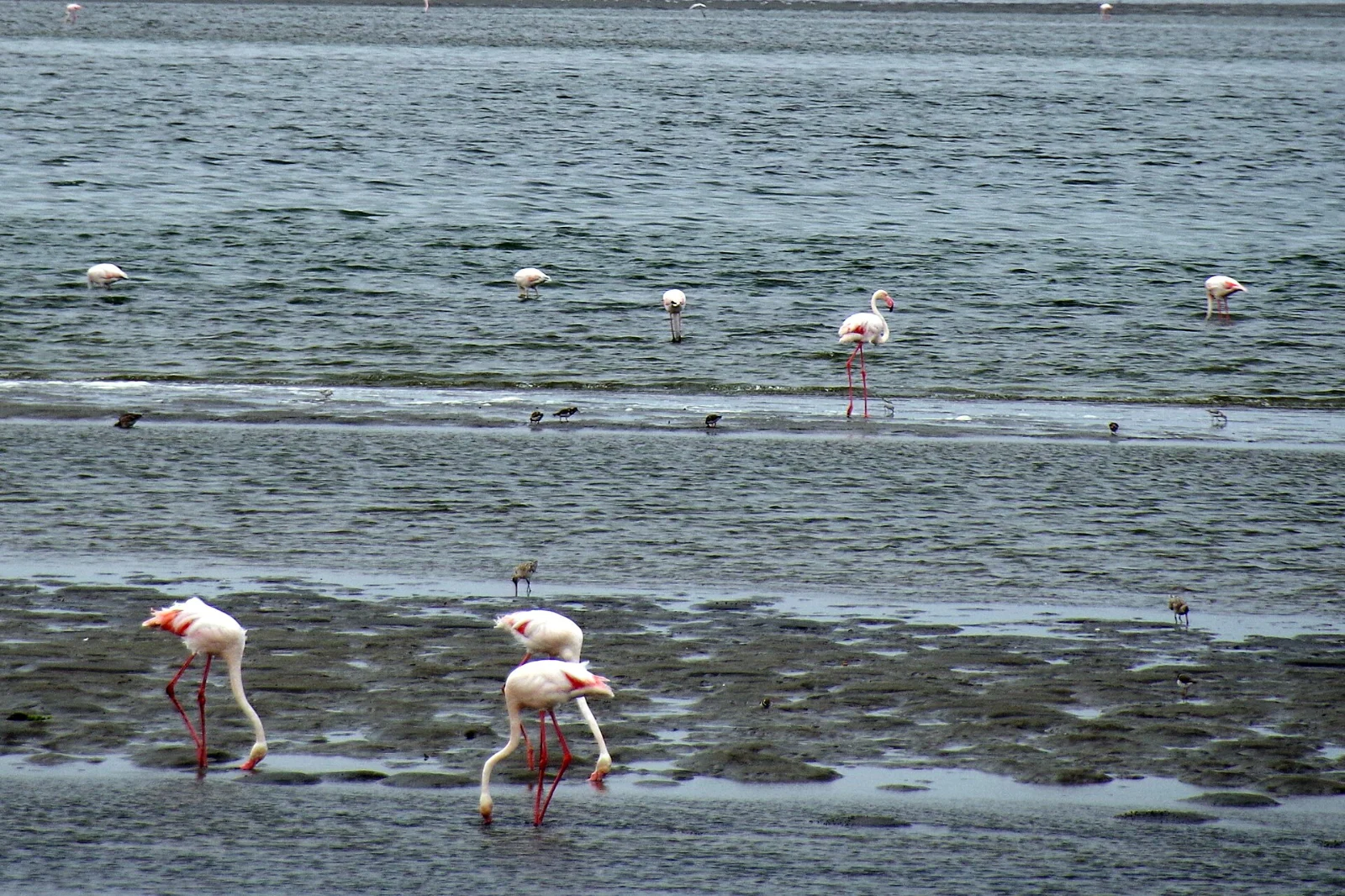
The lagoon is where most visitors see their first flamingos, often before they have finished their coffee. The factsheet says the bay draws tourists because about 100,000 birds, mainly flamingos, feed close to public areas, and the Ramsar summary lists sandbars used as roosts and mudflats exposed at low tide. Work the lagoon road on a falling tide, when the mudflats open and the waders spread out to feed. eBird groups the promenade side of town as the “Walvis Bay–Lagoon Promenade” hotspot, from Lover’s Hill along to the marina.
On the open water, look for Great White Pelican, Great Crested and Black-necked Grebes and Cape Cormorant. African Oystercatcher works the shore, and the factsheet names Grey Plover, White-fronted Plover, Ruddy Turnstone and Sanderling among the common species. Large shares of the southern African populations of Red Knot, Bar-tailed Godwit, Eurasian Curlew and Common Whimbrel also use the site.
The salt works
At the southern end of the lagoon, a salt works replaced large areas of naturally flooded saltpan. The factsheet is blunt about the trade-off, and the birds have voted with their feet: the works destroyed natural pans and may add to siltation, but its ponds give large areas of permanently shallow water at a range of salinities found nowhere else on this coast. The artificial part of the wetland regularly holds more than half the birds at Walvis Bay, and the flamingos use the evaporation ponds most of all.
This is also the place for Chestnut-banded Plover. The Walvis Bay factsheet puts about 60% of the world population on the site, and the Sandwich Harbour factsheet puts up to 40% there, which makes the 2 wetlands the stronghold for the species. Look for small, pale plovers with a thin rufous breast band on the drier pan edges and walls, among White-fronted Plovers, which are doing their best to look the same. eBird lists the pans as “Walvis Bay–Salt Pans (D1986)”, after the gravel road that runs past them, and a separate “Walvis Bay–Bird Paradise” hotspot covers the bird sanctuary on the edge of town.
Sandwich Harbour
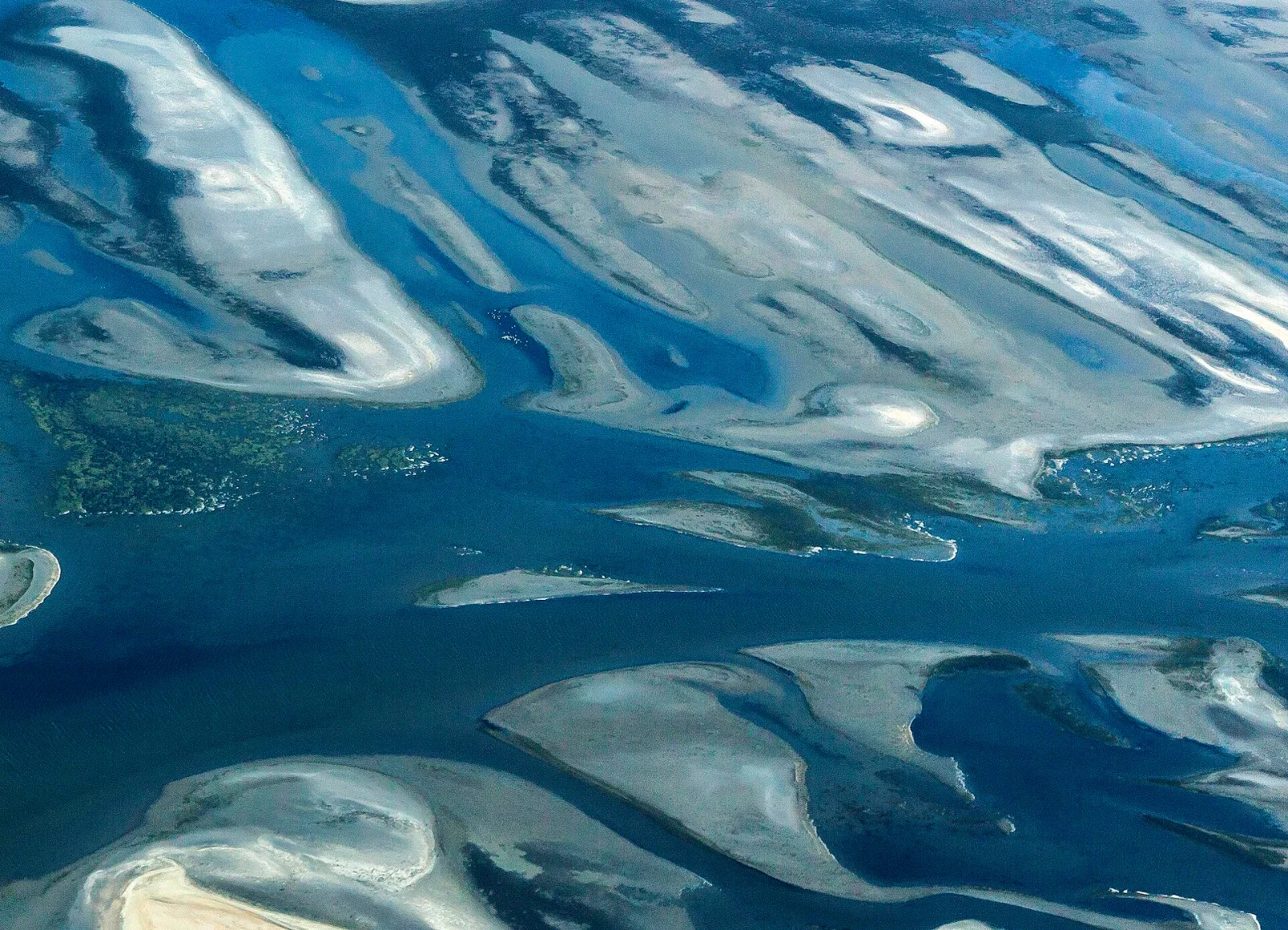
Sandwich Harbour lies inside the Namib-Naukluft Park, where dunes run straight down to the sea. The factsheet describes 2 parts. The northern freshwater wetland, fed by an aquifer under the dunes, was about 2 km² in the early 1970s and is now a thin strip of reedbed; it has traditionally held the most species, up to 51 kinds of wetland bird. The southern mudflats cover about 20 km², flood daily on the tide, and hold by far the most birds, mainly terns, sandpipers, flamingos and cormorants.
The numbers are the reason to go, and they are hard to take in. Shorebirds here reach densities above 7,000 birds per km², among the highest recorded anywhere, and the largest counts were 238,000 birds in January 1998 and 316,000 in January 2001. Curlew Sandpiper and Little Stint run into the tens of thousands, alongside massive numbers of Cape Cormorants, both flamingos and Common Terns. A non-breeding colony of about 10,000 Cape fur seals lies on the beach west of the mudflats, and Brown Hyena visits the wetland, which is not a sentence many wetlands can claim.
The one conservation problem the factsheet names is low flying by tour aircraft, which flush the flamingos and cormorants several times a day. Height restrictions of 1,000 m are now set. On the ground, the drive in follows the beach below the dunes, so the tide decides the day, and it does not take bookings. Sandwich Harbour 4×4 says it drives right to the lagoon only “if weather and tides allow”, and otherwise stops at lookouts above it and lets guests walk.
The specials
Damara Tern is the bird most visitors come for: a small tern that nests in the desert, which is not what terns are supposed to do. BirdLife South Africa’s 2025 Red Data assessment puts maximum densities in the Walvis Bay region, with numbers falling away to the north and south, and gives a global estimate of 773 pairs in 2021 to 2022, 715 of them in Namibia. They breed mainly from November to March, laying a single egg on gravel plains and salt pans, and forage over shallow water, often in bays or salt works. Off-road driving is the main threat: vehicles crush eggs and chicks and cause adults to desert, and BirdLife records that a colony near Walvis Bay was lost to housing. Keep to marked tracks, and do not walk onto open gravel where small terns are calling and diving.
Chestnut-banded Plover is easiest at the salt works, as above. Flamingos are everywhere, and in pink quantities: the factsheet says 80 to 90% of the subregion’s flamingos winter at Walvis Bay or Sandwich Harbour, and both Greater and Lesser are present. Sandwich Harbour 4×4’s birding page adds Pied Avocet, Cape Teal and Black-necked Grebe to the intra-African visitors, and lists Hartlaub’s Gull and Caspian and Swift Terns among the residents to check.
The Palaearctic waders and terns are the summer show. The factsheet says about 90% of the birds using Walvis Bay in summer are non-breeding migrants from the Palaearctic and elsewhere in Africa, and that 16 species occur in numbers above 1% of their flyway population. Thousands of Curlew Sandpipers, Little Stints, Common Terns and Arctic Terns are joined by most of southern Africa’s Black Terns. For a few months, the Namib coast is very busy for a desert.
The 2 desert larks, Dune Lark at Rooibank and Gray’s Lark on the gravel plains, are covered in the Namibia birding guide. Both fit into a morning from Walvis Bay, and neither needs a tide table.
When to go
Go between November and March. Walvis Bay holds about twice as many birds in summer as in winter, the Palaearctic waders and terns are in, and Damara Terns are breeding. January is the month of the record Sandwich Harbour counts. Winter, from May to August, still holds about 50,000 birds at Walvis Bay and over 20,000 at Sandwich Harbour, so the flamingos and plovers are there all year.
Fog is common on this coast, and mornings can be cold even in summer. Sandwich Harbour 4×4 tells its guests to bring something warm for the early start. It is a desert, but not that kind of desert in the morning.
Guided trips and 2026 prices
Sandwich Harbour 4×4, at the Walvis Bay Waterfront, runs a half-day Walvis Wetlands Birding trip to the salt pans, the bird sanctuary and the lagoon with trained birding guides. It leaves at 08:15 and 12:45 for about 4 hours. The 2026 rate is N$2,900 per adult and N$2,000 per child under 12, for at least 2 people, and the company asks for bookings well ahead so it can arrange a guide. It says more than 150 species have been recorded in the area.
Its half-day Sandwich Harbour 4×4 Scenic Excursion stops at the lagoon for flamingos, crosses the Kuiseb Delta, and drives the beach to Sandwich Harbour when the tide allows. It runs 08:30 to 12:30 and 13:00 to 17:00, at N$3,095 per adult and N$2,195 per child aged 4 to 12 in 2026, minimum 2 people. Both prices run from 1 January to 31 December 2026 and exclude hotel transfers. The company runs full-day and sunset photography trips as well.
The scenic trip is built around dunes and oysters as much as birds, so tell the operator when booking that you want time at the mudflats with a scope, or the oysters will win. Self-drivers need a Namib-Naukluft Park permit for Sandwich Harbour; confirm the current rules and fee with the Ministry of Environment, Forestry and Tourism before going.
Where to stay
No Birding Dispatch listing sits on the coast yet. In Walvis Bay, Lagoon Loge is an 8-room guest house on the lagoon, with a balcony or veranda facing the water from each room, and a Birding Ecotours group stayed on the lagoon there in November 2023. Rooms that face the lagoon put flamingos in view over breakfast, which is a hard view to beat with toast.
Inland, 2 listed stays in the Erongo Mountains suit the next leg of the trip, where the birds change completely. Hohenstein Lodge lies at the foot of the Hohenstein, 25 km from Usakos, with a bush hide by a bird bath 1 km from reception on 1 of the reserve’s marked routes, and feeders. It is dinner, bed and breakfast from N$2,300 per person sharing in the low season from December 2026 to February 2027. Erongo Rocks Farmhouse and Camping on the D2315 has campsites and a pre-pitched tent among granite boulders, a bird hide and marked trails, and names Rosy-faced Lovebird, Monteiro’s Hornbill and Hartlaub’s Spurfowl. A coast and Erongo pairing covers the wetland birds and the escarpment near-endemics in a few days.
The places in this guide, with what each offers a birder:
| Place to stay | Where | For birders | From |
|---|---|---|---|
| Hohenstein Lodge | Erongo Mountains, near Usakos, Namibia | Bush hide by a bird bath, feeders, marked routes | N$2,300 pp sharing DB&B (low season) |
| Erongo Rocks Farmhouse and Camping | Erongo Mountains, Namibia | Bird hide, trails, Rosy-faced Lovebird, Hartlaub’s Spurfowl | Ask the lodge |
Tide, access and prices change. Facts were checked on 13 November 2026 with the Key Biodiversity Areas factsheets for Walvis Bay and Sandwich Harbour, the Ramsar site record for Walvis Bay, BirdLife South Africa’s 2025 Red Data assessment for Damara Tern, Sandwich Harbour 4×4’s own trip pages and the Birding Dispatch listings. Confirm tide times, permits and prices before you go.
More from the Journal
 Namib-Naukluft and Sossusvlei for Birders: Dune Lark, Desert Raptors and the Naukluft SpecialsA lark that lives on the dunes and nowhere else, Lappet-faced Vultures nesting in the desert, coursers on the gravel plains and the northern specials around the Naukluft cliffs, in one of Africa's largest parks.
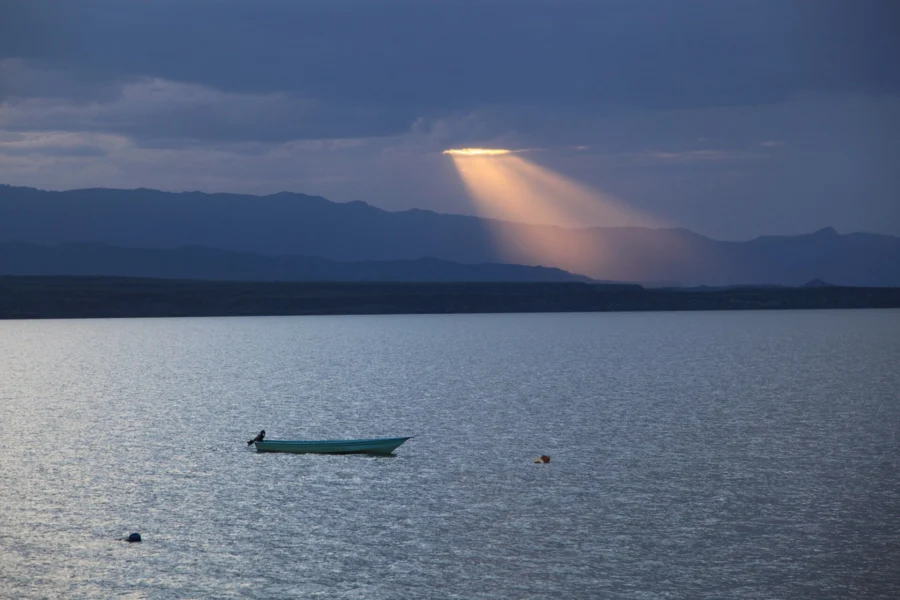 Lake Baringo and Lake Bogoria Birding: The Owl Walks, the Cliffs and the FlamingosA local guide who knows where every nightjar and eagle-owl slept last night, thorn scrub full of hornbills, a Goliath Heron colony on a rock, and the flamingo lake next door that keeps rising.
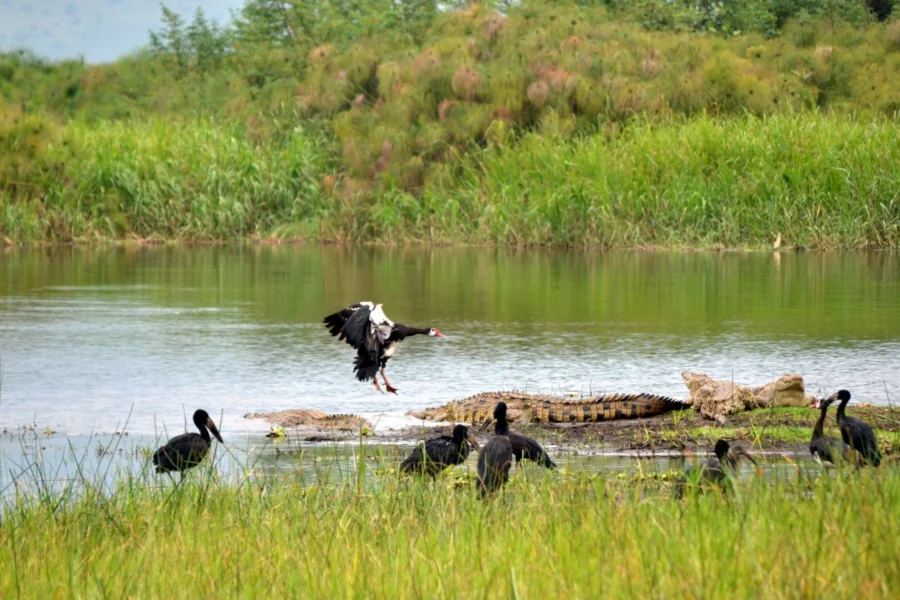 Akagera Birding: Rwanda’s Savanna, Lakes and Papyrus, and the Shoebill ChancesRed-faced Barbet in the southern woodland, Papyrus Gonolek and Carruthers's Cisticola in the swamps, a lake of hippos and lapwings, and a Shoebill that hides in the wetlands more than it shows.
The Pigeon Post
Every Thursday: 1 bird, 1 place to go and 1 place to stay, by email. Sign up and get our printable checklist of the 163 endemics of southern Africa.