
Where to See a Crab-plover: Bazaruto, Mida Creek, Zanzibar, Mafia and the Odd One at Kosi Bay
A black-and-white shorebird with a bill like pliers, the only member of its family. Where it winters on the East African and Mozambique coasts, how to time the tide, and where to stay.
On the first morning of Birdquest’s 2025 Kenya Specialities tour, the group drove out of Watamu to Mida Creek and found plenty of Crab-plovers, which the report calls an important “family tick” for some of the group. That is birder’s shorthand for a very particular itch: the Crab-plover is the only species in its genus and the only member of its family, Dromadidae, so a birder trying to see every bird family on Earth has exactly one bird to find here. There is no second chance with a cousin.
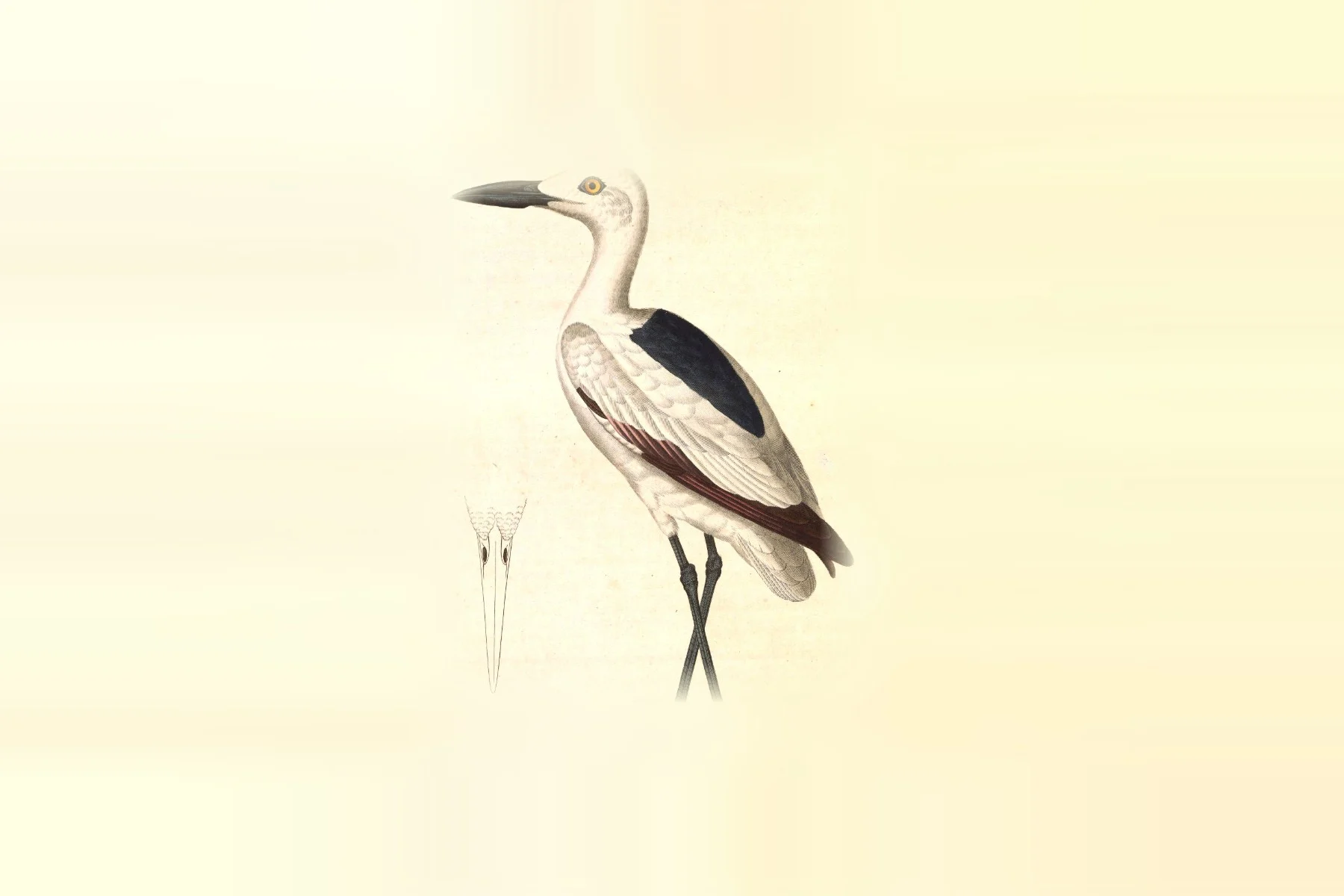
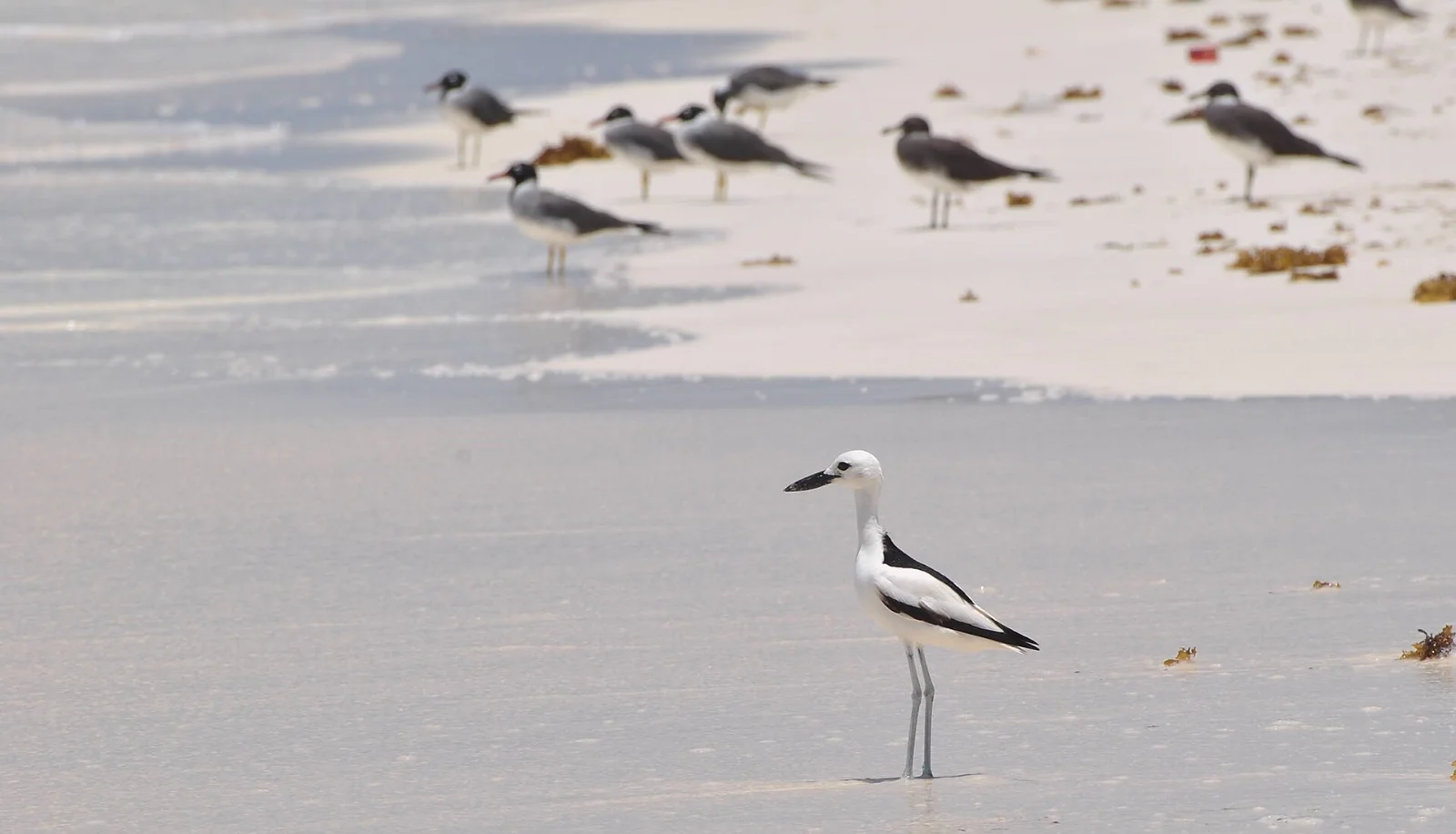
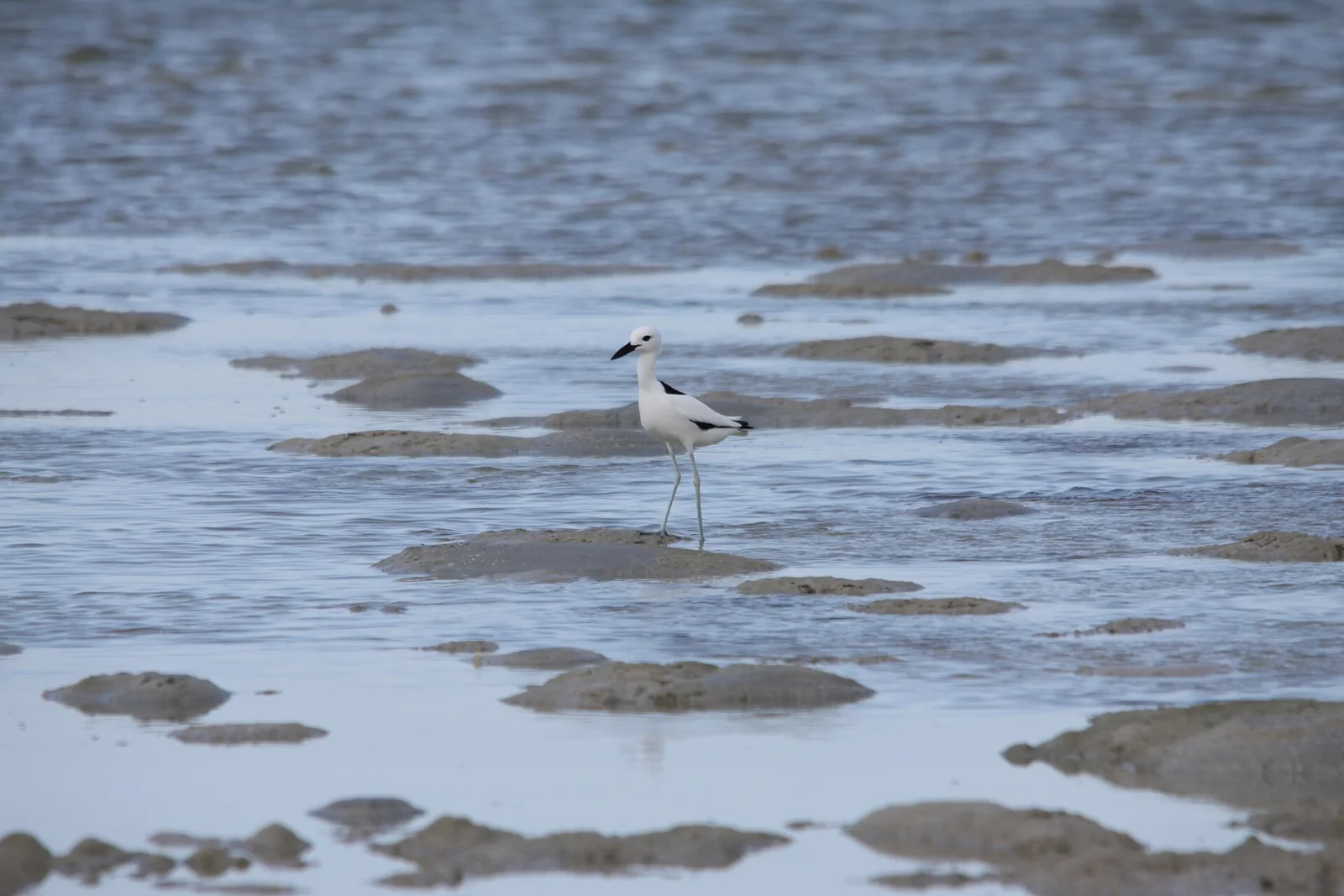
It is an easy bird to recognise once you are on the right beach. It looks like a plover that has been to the gym: long bluish-grey legs, pied black-and-white plumage, an upright stance and a heavy black bill built for one job, which is crabs. Outside the breeding season the head is streaked grey, and young birds keep a grey back for their first year, according to the species account on Wikipedia, which draws on the standard shorebird guides.
For birders in southern Africa, the snag is geography. Crab-plovers breed around the Arabian Sea, the Gulf of Oman, the Persian Gulf, the Red Sea and Somalia from April to July, then spread down the Indian Ocean coasts from August. So the bird is a winter visitor to the East African coast and, as the sources below show, a reliable one in southern Mozambique.
The sites at a glance
| Where | What the sources say | How to look | Where to stay |
|---|---|---|---|
| The Sanctuary, San Sebastian Peninsula, Mozambique | Large numbers reliably occur | Private boat to the sandbanks | Anantara Bazaruto Island Resort (Bazaruto) |
| Mida Creek, Watamu, Kenya | Plenty seen in 2025 | Boardwalk, local guides, boat | Turtle Bay Beach Club |
| Chumbe Island, off Zanzibar | Named by the island’s lodge | Bird hide, shore walks | Chumbe Island Coral Park Eco-bungalows |
| Mafia Island, Tanzania | Named by the island’s resort | Guided walks and boat trips | Basecamp Mafia Island |
| Kosi Bay, KwaZulu-Natal | The odd one from the mangroves, with luck | Estuary mouth in summer | None listed nearby |
A wader that lives in a burrow
Wader chicks usually leave the nest on foot soon after they hatch. The Crab-plover breaks that rule and a few others. It nests in colonies, some as large as 1,500 pairs, in burrows dug into sandy banks, and lays a single white egg, occasionally 2, which is large for the size of the bird. The burrow does the incubating as much as the parents do: the sand warms in the sun, and the adults can leave the nest unattended for as long as 58 hours. Underground central heating, on a tropical beach, was an inspired idea.
The chicks are odd too. Unlike the young of nearly every other wader, they cannot walk properly when they hatch and are fed in the burrow for several days.
Crab-plovers are sociable and noisy, feeding in groups by day, at night and especially at dawn and dusk. The usual call is a fast, repeated “ka”, and flocks travel in lines or V shapes. The species is rated Least Concern.
Mozambique: the Bazaruto sandbanks
For a birder starting from South Africa, the closest reliable Crab-plovers are on the Mozambique coast at Vilankulos. Birding Ecotours’ Crab-plover tour, which next runs from 5 to 17 December 2027 at US$9,823 per person sharing, spends 3 nights on the San Sebastian Peninsula, reached by boat from Vilankulos. The peninsula gives access to the southern end of the Bazaruto Archipelago and to a protected area known as The Sanctuary, which the company calls one of the ultimate shorebird hotspots in southern Africa.
The method is a private boat and the sandbanks. According to the tour notes, large numbers of Crab-plovers reliably occur there, alongside small numbers of Saunders’s Tern, and big flocks of Greater and Tibetan Sand Plovers, Eurasian Whimbrel, Bar-tailed Godwit, Ruddy Turnstone, Sanderling, Terek Sandpiper and Lesser Crested Tern. Eurasian Oystercatcher and Gull-billed Tern, rarities in southern African terms, turn up regularly. Indian Humpback Dolphins sometimes surface between the sandbanks, a fair distraction from counting godwits.
Anantara Bazaruto Island Resort, on Bazaruto Island itself, offers bird watching as one of its own leisure experiences and gives more than 180 species for the island, across coastal lakes, tidal pools, beaches and mangroves. Its listing does not name the Crab-plover, so ask before you book what the guides can show you on the flats. Our Mozambique birding guide covers the rest of the country, from Panda to Gorongosa.
Kenya: Mida Creek and Watamu
Mida Creek is a tidal inlet in Kilifi County on Kenya’s north coast, and BirdLife International describes it as an important passage and wintering ground for waders from the north. It is an Important Bird Area, and a suspended boardwalk runs through the mangroves to the open water.
The local Site Support Group, the Mida Creek Conservation and Awareness Group, offers tour guiding and boat rides, and runs waterbird counts with A Rocha Kenya in January and June each year; visitors can join the counts for a fee, which is about the best way there is to see a lot of waders with people who know them. BirdLife gives September to May as the season for the Palearctic waders on the creek. Birdquest’s 2025 group based itself in Watamu and combined Mida Creek with Arabuko-Sokoke for Sokoke Scops Owl and Sokoke Pipit, a fine double act for one trip.
Turtle Bay Beach Club at Watamu runs bird safaris and packages with Spinetail Safaris, a local team of trained guides. It lists 4 Important Bird Areas within 10 km, including Mida Creek, puts the count within 30 km at over 450 species, and names the Crab-plover among its birds. The Kenya birding guide has the forest, the coast and the rest of the country.
Tanzania: Zanzibar and Mafia
Off Zanzibar, Chumbe Island Coral Park has 7 solar-powered eco-bungalows between the beach and the coral rag forest, a bird hide and a list of more than 80 species. It names the Crab-plover with Roseate Tern, Mangrove Kingfisher and Dimorphic Egret, and guests can look for waders along the shore. Rates start at US$280 per person a night, full board with boat transfers.
Further south, Basecamp Mafia Island, a beachfront eco-resort, offers birdwatching walks, boat trips and guided birding packages of several days, hands out printed checklists and gives 246 species for the island. It names the Crab-plover and the African Skimmer, which makes for a very satisfying pair of oddly shaped bills, and gives October to March as the time for migrants.
South Africa: the odd one at Kosi Bay
In South Africa the Crab-plover is a bird of luck rather than planning. BirdLife South Africa’s GoBirding guide to Kosi Bay Nature Reserve, in the far north-east of KwaZulu-Natal, says the summer months are best for waders at the estuary mouth, and that, if one is lucky, the odd Crab-plover may reveal itself from the mangroves. The same estuary is one of the most reliable sites in the country for Mangrove Kingfisher, so the trip is rarely wasted.
The practicalities matter here: the guide notes that the Kosi mouth is only reachable with a high-clearance 4×4, and the reserve gates open from 06:00 to 18:00. The Kosi Bay and Maputaland coast guide covers the rest of the area, from the Raphia palms to the sand forest.
How to find one
Go between October and April: every source above points to the southern summer.
Then think about the tide. The birds feed on the flats and gather on sandbanks and beaches, so a falling or rising tide, when the mud is opening up or the flocks are being pushed in, gives the best views from a boardwalk or boat. Look for a stocky white bird among the sand plovers with a black back and a bill visibly too big for its face. If it is busy with a crab, it is almost certainly the right bird.
Last, keep your distance. Shorebirds on a high-tide roost have nowhere else to go.
Where to stay
The places in this guide on the Crab-plover coasts:
| Place to stay | Where | For birders | From |
|---|---|---|---|
| Anantara Bazaruto Island Resort | Bazaruto Island, Mozambique | Own bird watching outings, 180+ species for the island | Ask the lodge |
| Turtle Bay Beach Club | Watamu, Kenya | Spinetail Safaris guides, Mida Creek nearby, Crab-plover named | Ask the lodge |
| Chumbe Island Coral Park Eco-bungalows | Chumbe Island, off Zanzibar | Bird hide, 80+ species, Crab-plover named | US$280 pp, full board |
| Basecamp Mafia Island | Mafia Island, Tanzania | Guided walks and boat trips, 246 species, checklists | US$810 pp for 4 nights, B&B and 6 dives (Jul 2026 to Apr 2027) |
Shorebirds move with the tides and the seasons, and rates change each season. Facts were checked on 15 November 2026 with Birdquest’s 2025 Kenya Specialities report, BirdLife International, Birding Ecotours, BirdLife South Africa’s GoBirding guide to Kosi Bay, the Crab-plover species account on Wikipedia and each place’s listing on Birding Dispatch.
More from the Journal
 Woodpeckers of Southern Africa, Including the One That Doesn’t Need TreesSouthern Africa's woodpeckers, from the Cardinal in every bushveld tree to the Ground Woodpecker that lives on treeless mountain slopes and eats almost nothing but ants.
 Where to See a Taita Falcon: the Strijdom Tunnel, the Blyde Cliffs and the Batoka GorgeA stocky falcon smaller than a pigeon, a handful of cliffs and surveys that keep coming back empty. Where it still nests, how to look, and the 2 roosts beside its cliffs.
 Where to See a Southern Bald Ibis: the Breeding Cliffs, Dullstroom, Wakkerstroom and LesothoA red-capped grassland ibis that nests on cliffs over waterfalls and feeds on burnt veld and maize stubble. The colonies you can watch, the fields to scan, and where to stay.
The Pigeon Post
Every Thursday: 1 bird, 1 place to go and 1 place to stay, by email. Sign up and get our printable checklist of the 163 endemics of southern Africa.