
Sociable Weaver Nests: How They Work and Where to See the Biggest
The communal nests of the Kalahari and Namibia, what lives in them besides the weavers, the camel thorns and telephone poles that carry them, and the places to stay with colonies on the property.
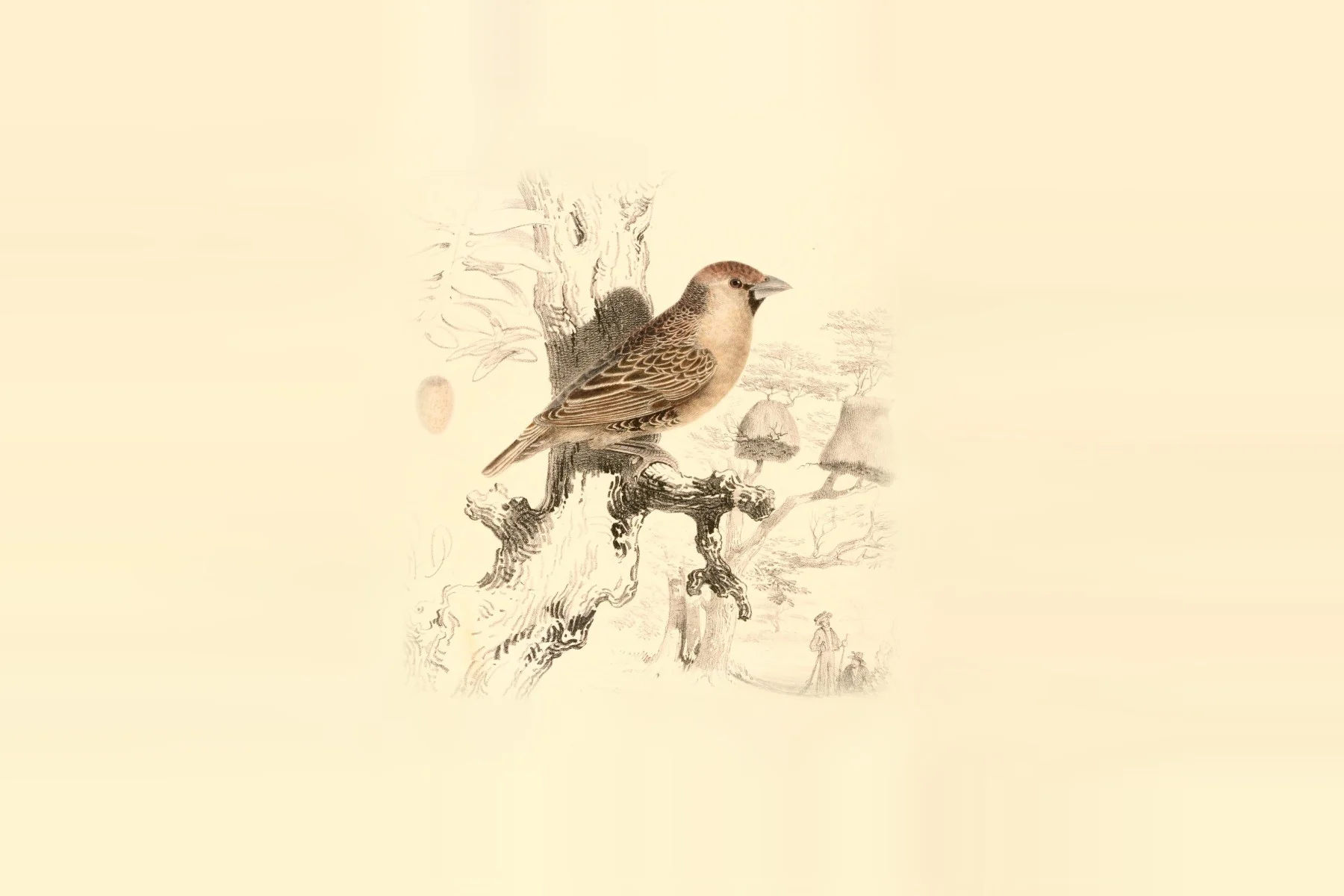
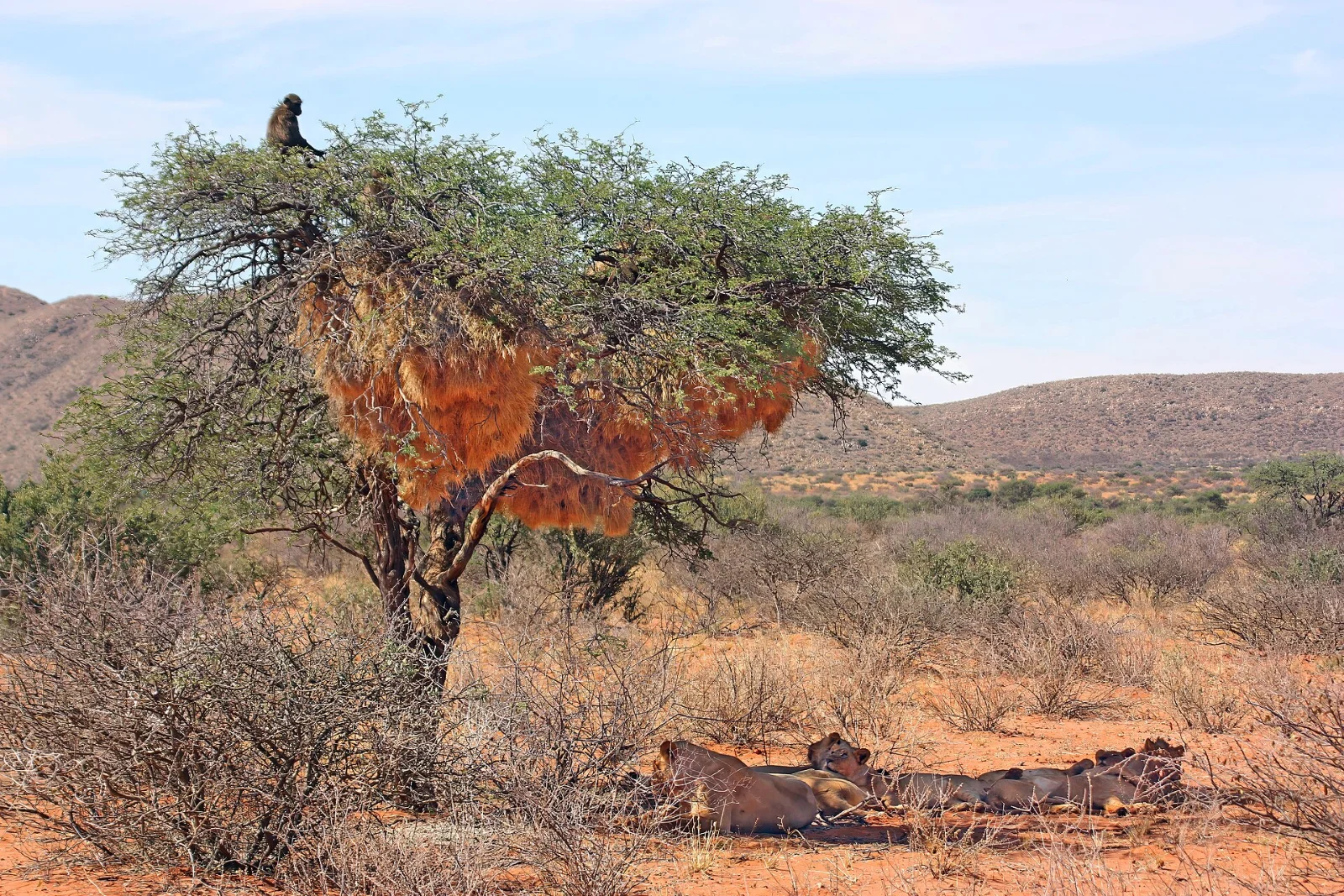
From a distance a Sociable Weaver colony looks like a haystack caught in a tree. Up close it is a thatched roof of dry grass, sometimes several metres across, with dozens of round entrance holes on the underside. Each hole leads to a chamber, and each chamber belongs to a pair or a small family. The birds that built it are small, brown and easy to overlook. The nest is not. It is the bird world’s apartment block, built by committee, with the committee living inside.
Sociable Weavers are endemic to southern Africa, and their range is centred on the northern part of South Africa’s Northern Cape and southern Namibia, according to the Atlas of Southern African Birds account by John Mendelsohn and Mark Anderson. The Atlas found the strongest association with Southern Kalahari vegetation, where reporting rates were more than 3 times those in any other habitat. Colonies hold from 2 to 500 birds. National Geographic, reporting on a 2016 study at a research site in Namibia, put the biggest nests at a ton or more and up to 6 m wide: a great deal of grass for a bird you could hold in one hand.
At a glance
| Place | Country | Nests on (source) | Stay |
|---|---|---|---|
| Kgalagadi Transfrontier Park | South Africa and Botswana | Camel thorns in the Auob and Nossob riverbeds (Birding Dispatch, SANParks) | !Xaus Lodge, Kieliekrankie Wilderness Camp |
| Tswalu Kalahari Reserve | South Africa | Thousands of nests on the reserve (Tswalu) | Tswalu Kalahari Reserve |
| Augrabies and the Orange River | South Africa | Camel thorns, quiver trees and poles (Atlas) | Tutwa Desert Lodge |
| Southern Namibia | Namibia | Camel thorns around the lodge (Gondwana) | Kalahari Anib Lodge (not yet listed) |
| Etosha | Namibia | Mopane as well as thorn trees (Atlas) | Ongava Lodge, Onguma Bush Camp |
How the nest works
The nest is built and kept up by the whole colony. Tswalu’s research team describes the weavers working on their colonies every day: left alone, the structure becomes shabby and falls apart, but too much building can bring it down too, because the weight strains the branches. Summer thunderstorms often leave partly collapsed colonies behind them, and the weavers start rebuilding almost at once, recycling the old grass. Nobody files an insurance claim.
Not every bird pulls its weight, as anyone who has shared a house will recognise. René van Dijk of the University of Sheffield told National Geographic that only about half the birds, mostly males, work on the shared thatch, the rest concentrating on their own chambers. The 2016 study by Gavin Leighton and Laura Vander Meiden found that birds which neglect the thatch are chased away from the nest by others, and are more cooperative when they come back. Peer pressure, it turns out, works on weavers too.
The chambers are the point. Tswalu’s account, drawing on Anthony Lowney’s doctoral research, says they give a buffered space largely free of the Kalahari’s temperature extremes, hot summer days and cold winter nights. That is why other birds want them, and not all of them ask first.
The lodgers
A big colony is a block of flats with mixed tenants. The Atlas lists Rosy-faced Lovebird and Red-headed Finch breeding in the nest masses, and Ashy Tit and Acacia Pied Barbet using them to roost. Tswalu adds Scaly-feathered Finch, and describes the barbets fighting the weavers for the warm central chambers before sunset, often winning. The builders do not always get the best rooms.
The tenant birders come for is the Pygmy Falcon, Africa’s smallest raptor. Tswalu describes it as fully dependent on weaver colonies for breeding and roosting. The falcons take over chambers permanently and mark the entrances with white droppings, and the weavers never use those chambers again. The relationship is not friendly: the falcons eat mostly reptiles and insects but often take weaver nestlings and fledglings, and a colony with falcons is full of weaver alarm calls. It is a bit like renting the spare room to a lodger who eats the neighbours’ chicks. Scan the underside of every big nest for a white-rimmed entrance hole and the falcon itself on a nearby branch. Its front door is the one with the white paint job.
Larger birds use the top of the nest as a platform. The Atlas lists Verreaux’s Eagle-Owl, White-backed Vulture and Bateleur building their own nests on top of weaver colonies. Mammals use them as well: Tswalu’s camera traps have recorded a family of 4 cheetahs lying on a colony, and leopards using the nests as lookouts. The weavers were not consulted.
What they build on
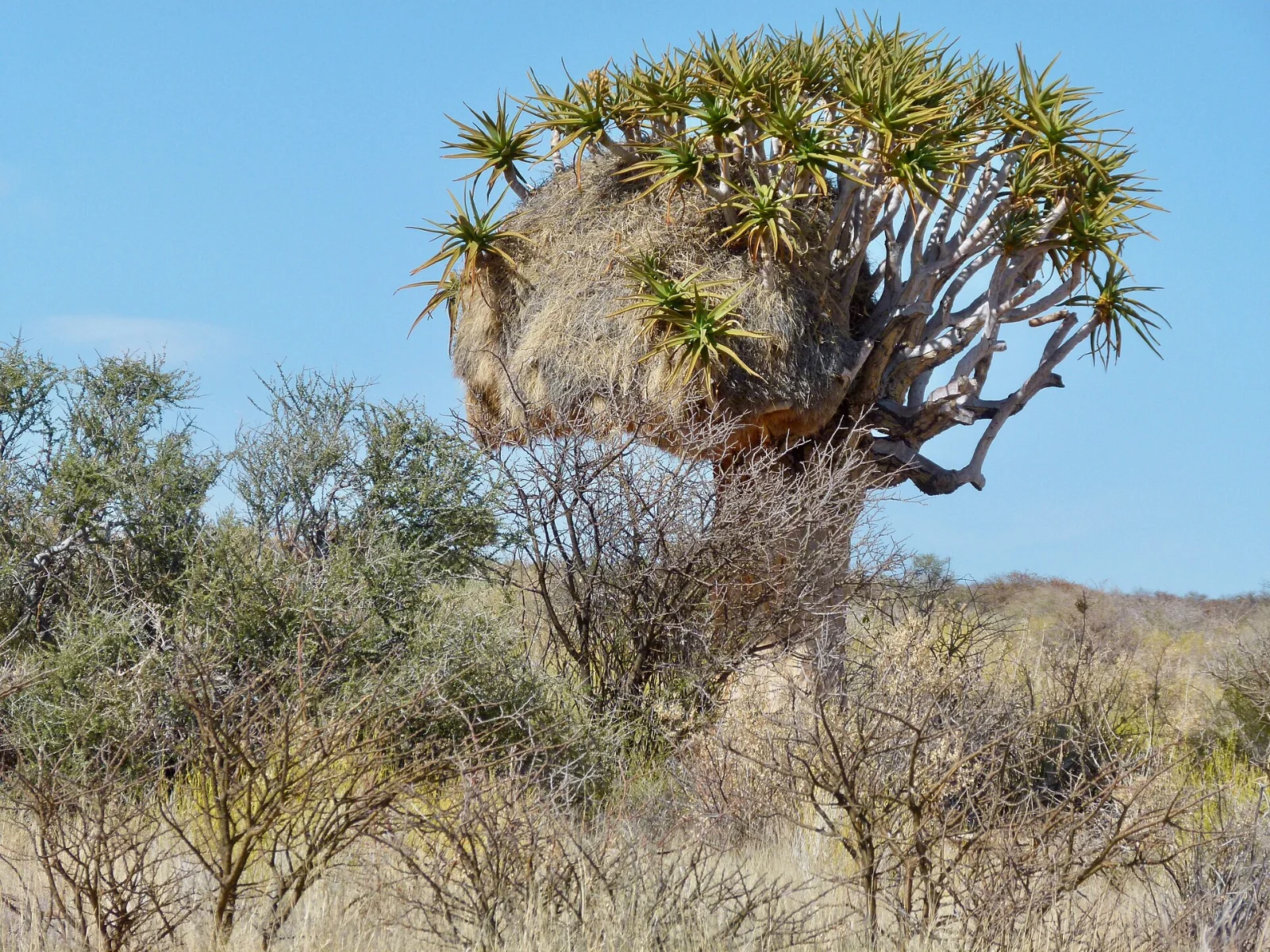
The Atlas says most nests are in 3 trees: camel thorn (Acacia erioloba), shepherd’s tree (Boscia albitrunca) and quiver tree (Aloe dichotoma). The weavers rarely use alien trees. They are less fussy about infrastructure: they also build on telephone poles and electricity pylons, and the Atlas credits these with letting the species spread during the 20th century. Locally they nest on cliff faces, as in the Asbestos Mountains south-west of Griekwastad. The birds need open savanna grassland with big trees, and stiff grasses such as Aristida for building; they avoid dense scrub.
That gives a simple rule for finding the biggest nests: look for the biggest old camel thorns in open country. Big tree, big house. In the Kalahari these line the dry riverbeds.
The Kgalagadi
The Kgalagadi Transfrontier Park is the easiest place in South Africa to spend a day among colonies. Its 2 dry rivers, the Auob and the Nossob, carry the camel thorns, and the roads follow both. In the southern Kalahari part of the park, the Atlas cites Gordon Maclean’s estimate of about 80 Sociable Weavers per square kilometre in a narrow strip of the best habitat. SANParks lists Pygmy Falcon among the park’s commonest raptors, and GoBirding notes it in the thorn trees on the way into Twee Rivieren, with work. Common, in this case, still means Africa’s smallest raptor somewhere in a very large tree. For the full park, see Kgalagadi birding.
Inside the park, !Xaus Lodge, owned by the ‡Khomani San and Mier communities, sits on a red dune above a pan. The lodge gives the park more than 260 bird species and names Sociable Weavers nesting in the camel thorns. Guests drive 64 km up the Auob to the Kamqua picnic site and are collected at 14:30 for a 30 km crossing of the dunes. The rate is R7,820 per person sharing, full board with activities, to 28 February 2027, with a 2-night minimum.
Kieliekrankie Wilderness Camp is the self-catering alternative, a SANParks camp of cabins on a dune 50 km from Twee Rivieren, from R2,146 a night for 2 including the community levy. Bring food, water and firewood; children under 12 are not allowed, so the only squabbling is in the weaver colonies. The SANParks rest camps at Twee Rivieren, Mata-Mata and Nossob are not yet in the directory.
Tswalu
Tswalu Kalahari Reserve, near Van Zylsrus, says it hosts thousands of Sociable Weaver nests, and its research programme has studied them for years. Tswalu Kalahari Reserve gives each party a private guide and tracker, runs guided walks for birders and counts 264 species, Pygmy Falcon, Red-necked Falcon and Sociable Weaver among them. It is expensive: Motse is from R46,400 per adult sharing a night in 2026, fully inclusive. The advantage for a birder is time, which is the one thing a Pygmy Falcon asks for. With a private vehicle, sitting at 1 colony for an hour to wait for the falcons is the guest’s choice, not the group’s.
The Orange River and Augrabies
The Atlas describes a separate subspecies, eremnus, centred on the Orange River valley, so the country around Augrabies has its own population, with its own subspecies name to prove it. Tutwa Desert Lodge, near Augrabies, offers birding and photographic safaris on the Orange River and makes a stop on the way north to the Kgalagadi. The SANParks rest camp at Augrabies Falls is not yet listed.
Namibia
Namibia holds the other half of the range, and most of the subspecies. The Atlas lists 3 subspecies there: socius in the south and north-west of the Northern Cape and southern Namibia, xericus on the Namibian escarpment, and geminus in Etosha and southern Owambo. The Etosha birds also build in mopane trees, so the thorn-tree rule bends a little up north. Breeding differs too: in the south it can happen at any time of year after rain, with up to 4 broods in a row, while in northern Namibia it is concentrated between December and August. The 2016 National Geographic study was carried out at the Brink research site in Namibia.
On the edge of Etosha, Ongava Lodge and Anderssons at Ongava have hides and name Rosy-faced Lovebird, a weaver-nest breeder, among their specials, and Onguma Bush Camp on the eastern side also has a hide. In the south, Gondwana describes large Sociable Weaver nests in the camel thorns around its Kalahari Anib Lodge in the southern Kalahari; the lodge is not yet in the directory.
Visiting a colony
The birds are at their nests all year, the Atlas says, so there is no season to wait for, though the hour before sunset is lively, when the birds come back to roost and the barbets try to move in. Park a little way off rather than right under the tree, switch off the engine, and give it 15 minutes. A colony is a soap opera, and it takes a few minutes to work out who is who. Look for the falcon’s white-marked entrance, for lovebirds in Namibia, and for snakes: Tswalu notes that Cape cobras raid colonies for eggs and chicks.
Do not touch the nest or climb the tree. As Tswalu points out, the branches are already under strain from the weight, and they do not need a birder as well.
Where to stay
The places in this guide, with what each offers a birder:
| Place to stay | Where | For birders | From |
|---|---|---|---|
| !Xaus Lodge | Dunes off the Auob, Kgalagadi | 260+ species, Sociable Weavers in the camel thorns | R7,820 pp full board |
| Kieliekrankie Wilderness Camp | Dune Road, 50 km from Twee Rivieren | Park list of 272 species, Kori Bustard, Secretarybird | R2,146 a cabin for 2, self-catering |
| Tswalu Kalahari Reserve | Near Van Zylsrus, Northern Cape | Thousands of weaver nests, private guide, 264 species | R46,400 pp fully inclusive (Motse) |
| Tutwa Desert Lodge | Near Augrabies, Northern Cape | Birding safaris on the Orange River | Ask the lodge |
| Ongava Lodge | Ongava Game Reserve, south of Etosha | Photographic hide, Rosy-faced Lovebird | N$11,800 pp full board |
| Anderssons at Ongava | Ongava Game Reserve, south of Etosha | Underground hide at water level, Rosy-faced Lovebird | N$23,400 pp fully inclusive |
| Onguma Bush Camp | Onguma Nature Reserve, east of Etosha | Treetop hide at the camp waterhole | N$3,060 pp DB&B |
Nests collapse and are rebuilt, and lodge rates change. Facts were checked on 13 November 2026 with the Atlas of Southern African Birds, Tswalu’s research blog, National Geographic, SANParks, GoBirding, Gondwana and the Birding Dispatch listings. Confirm access and conditions with the park or lodge before you go.
More from the Journal
 Woodpeckers of Southern Africa, Including the One That Doesn’t Need TreesSouthern Africa's woodpeckers, from the Cardinal in every bushveld tree to the Ground Woodpecker that lives on treeless mountain slopes and eats almost nothing but ants.
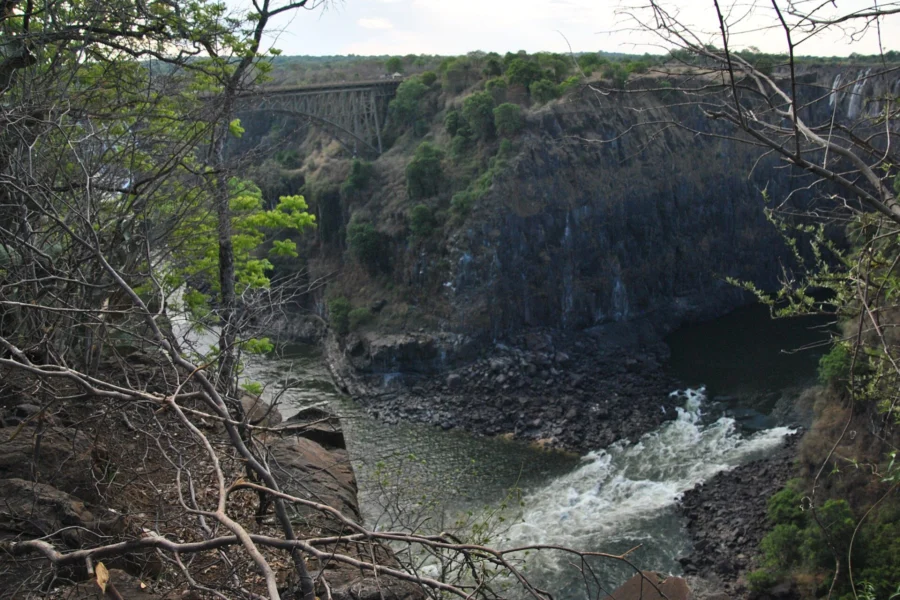 Where to See a Taita Falcon: the Strijdom Tunnel, the Blyde Cliffs and the Batoka GorgeA stocky falcon smaller than a pigeon, a handful of cliffs and surveys that keep coming back empty. Where it still nests, how to look, and the 2 roosts beside its cliffs.
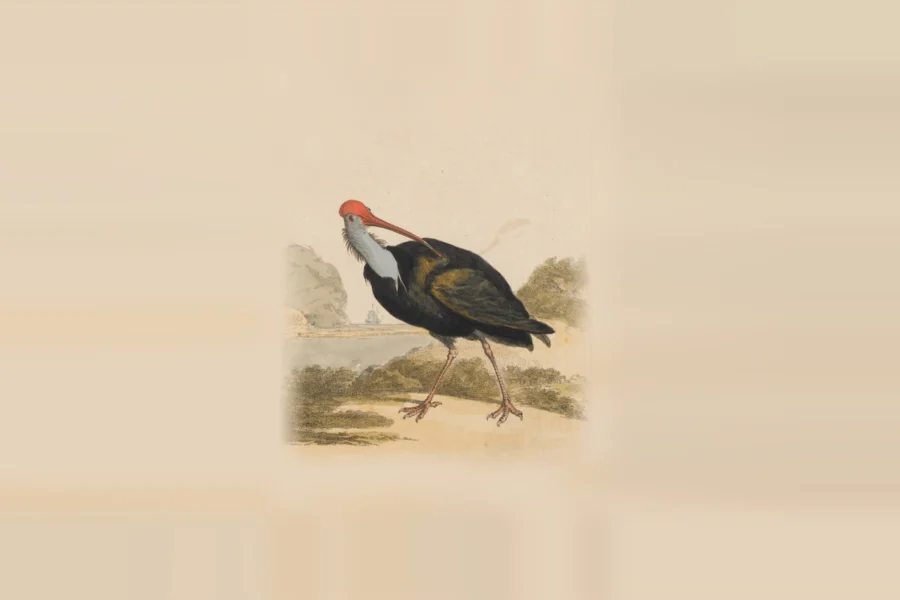 Where to See a Southern Bald Ibis: the Breeding Cliffs, Dullstroom, Wakkerstroom and LesothoA red-capped grassland ibis that nests on cliffs over waterfalls and feeds on burnt veld and maize stubble. The colonies you can watch, the fields to scan, and where to stay.
The Pigeon Post
Every Thursday: 1 bird, 1 place to go and 1 place to stay, by email. Sign up and get our printable checklist of the 163 endemics of southern Africa.