
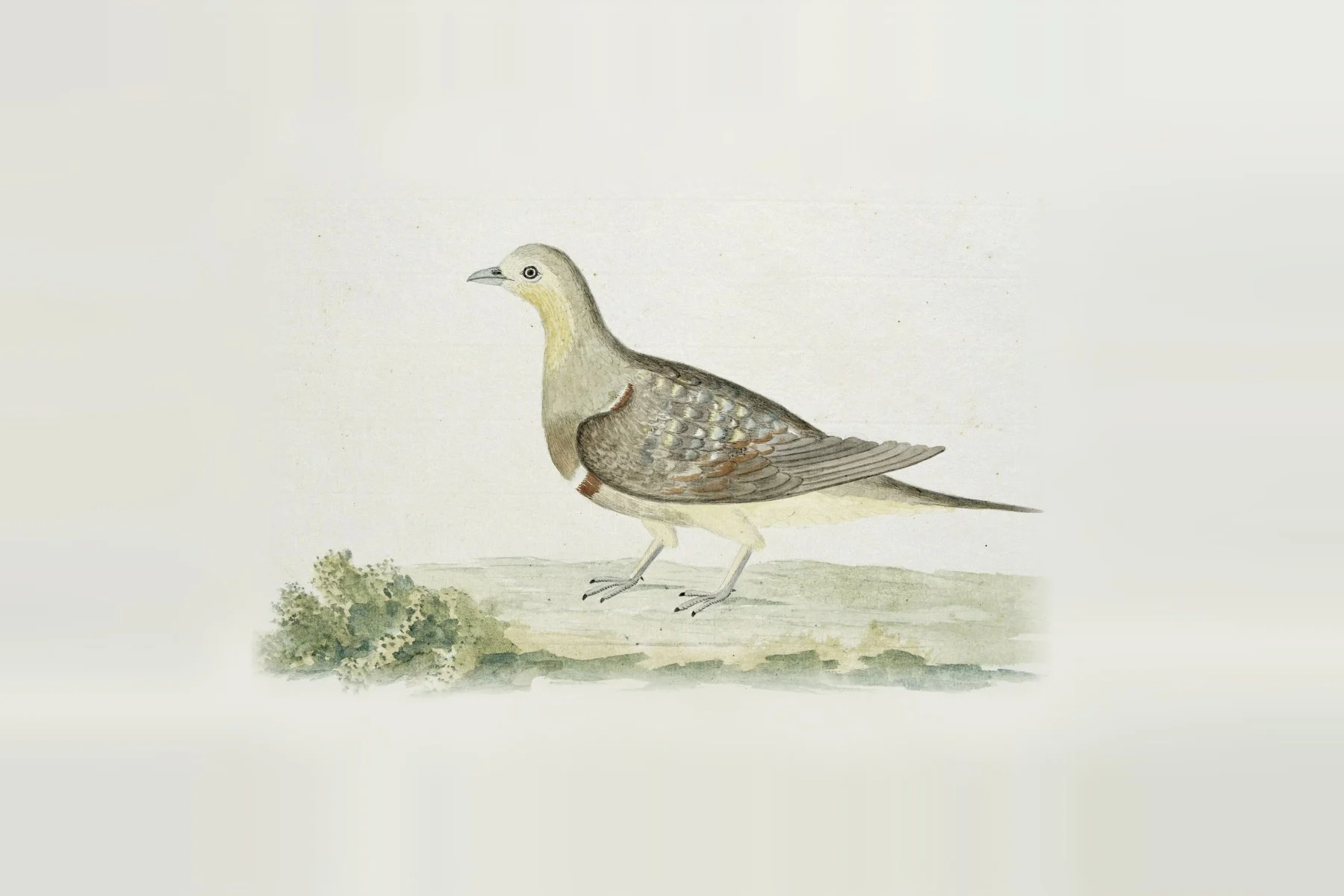
Sandgrouse and Waterhole Birding: the Drinking Times, the Kgalagadi, Etosha and the Kalahari
Sandgrouse keep a timetable at the water, and the falcons know it. When each of the 4 species drinks, how the males carry water to their chicks, and the waterholes and hides to sit at.
A male sandgrouse can hold about 25 ml of water in his belly feathers after 5 minutes of dipping and fluffing at a waterhole, and he can fly more than 20 km back to the nest with enough left for his chicks to drink. He is, in effect, a flying sponge on the school run. A 2023 study at MIT, by Lorna Gibson and Jochen Mueller, worked out how the feathers do it. The behaviour itself was first reported in 1896 by E. G. B. Meade-Waldo, who bred the birds in captivity, and proved in the wild in 1967 by Tom Cade and Gordon Maclean, who watched them at waterholes.
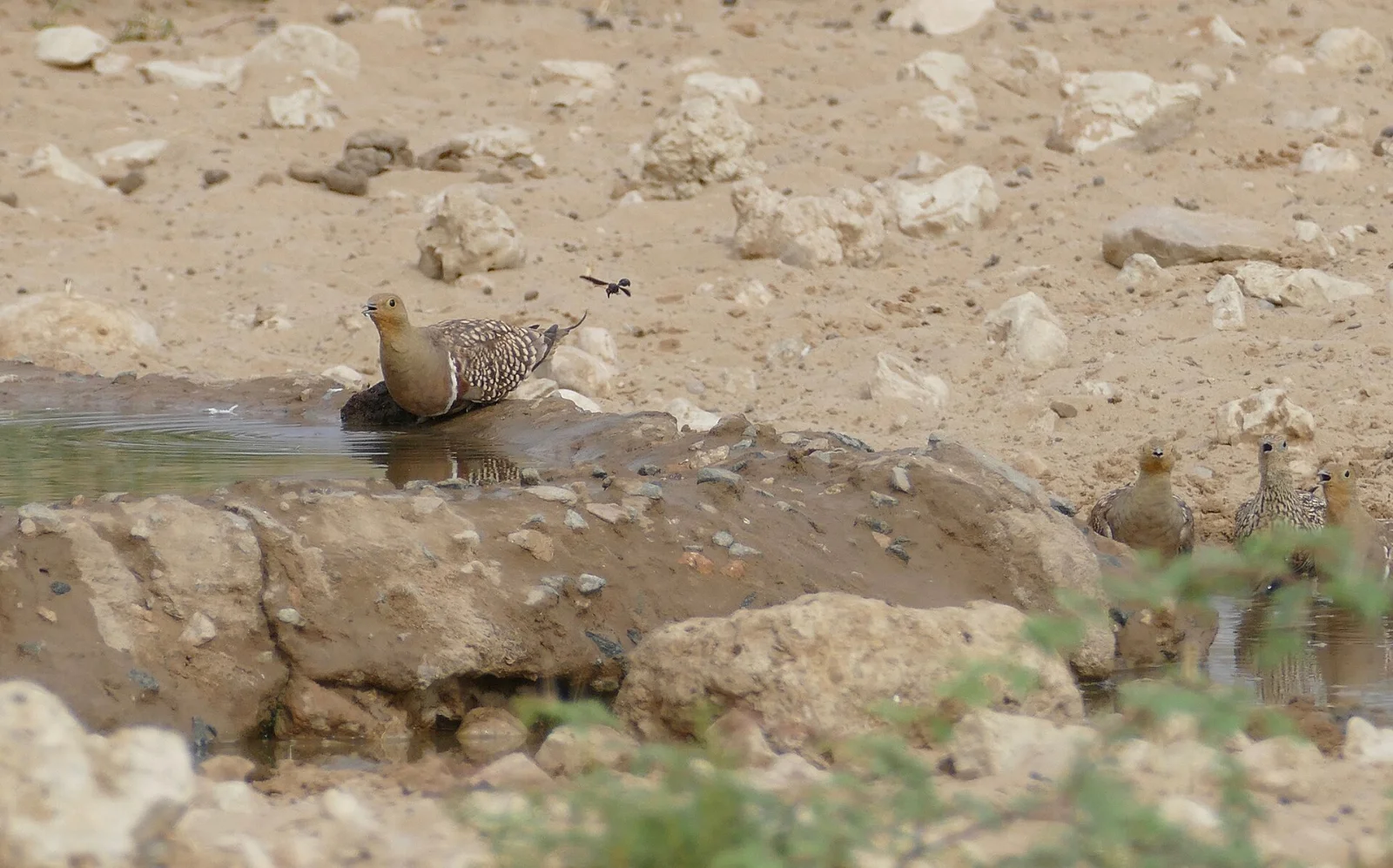
It is the best-known thing about sandgrouse. For a birder, their timetable is more useful. Each species comes to drink at its own time of day, as if the waterhole ran a booking system, and a waterhole in the Kgalagadi or Etosha at the right hour can fill with them.
The 4 sandgrouse and when they drink
BirdLife South Africa’s 2026 checklist lists 4 sandgrouse: Burchell’s, Double-banded, Namaqua and Yellow-throated, the last as Near Threatened in South Africa.
| Sandgrouse | When it drinks | Habitat | Where to look |
|---|---|---|---|
| Namaqua | Early morning, often in dozens or hundreds | Stone and gravel desert, open semi-desert | Kgalagadi, the Karoo, Etosha |
| Burchell’s | 2 to 3 hours after sunrise, up to an hour after the Namaqua | Kalahari sands | Kgalagadi, Etosha |
| Yellow-throated | Mornings, sometimes with Burchell’s | Grassland on black clay, near water | Morning water near black clay grassland |
| Double-banded | At dusk, and almost silent at the water | Mopane woodland | Halali in Etosha; Augrabies |
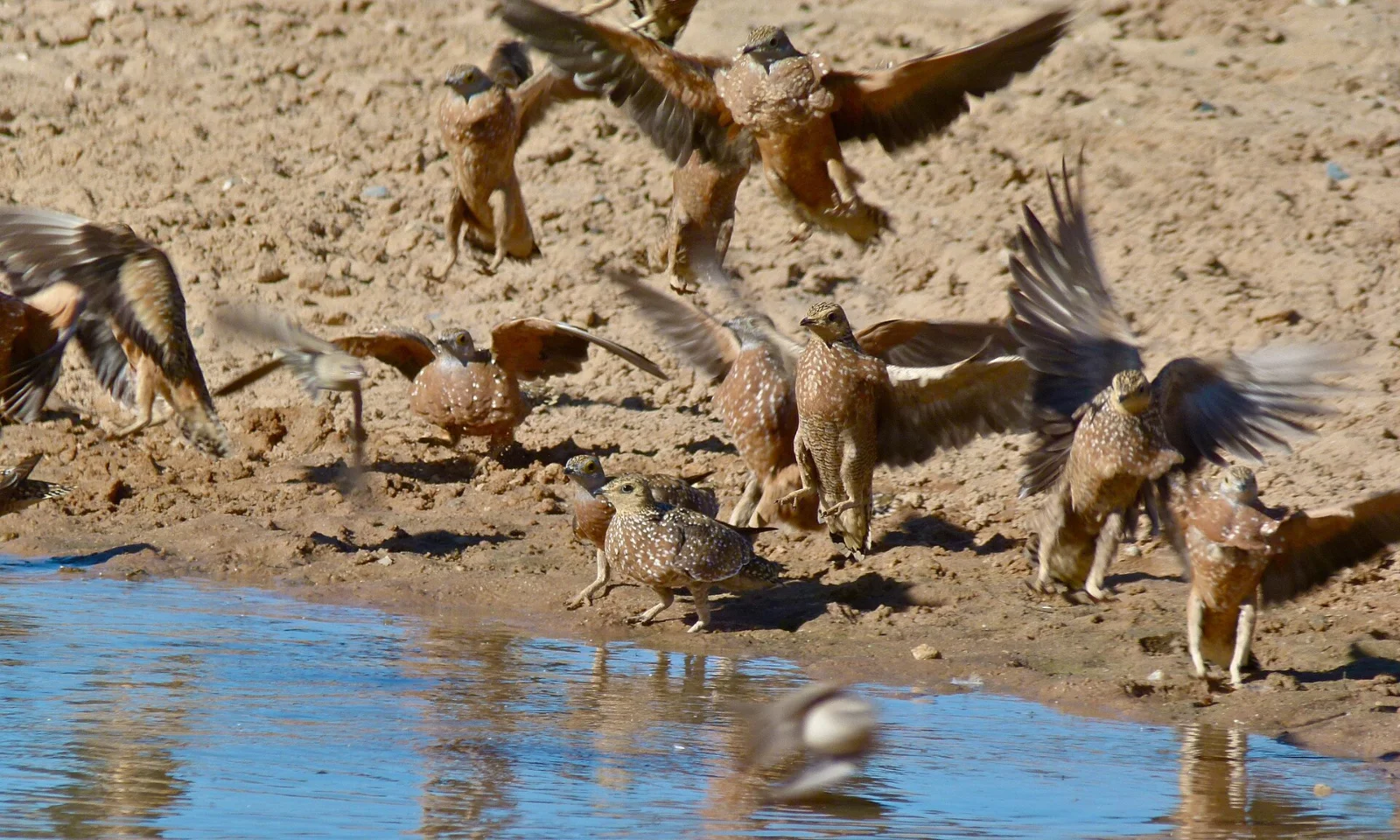
The Atlas of Southern African Birds describes the Namaqua Sandgrouse as dependent on, and faithful to, good-quality drinking water, and says its habit of gathering in big flocks at traditional sites has long attracted hunters. Burchell’s Sandgrouse comes to drink 2 to 3 hours after sunrise, usually in flocks of up to 50, and often up to an hour later than the Namaqua; it is an abundant breeding bird in the Kalahari Gemsbok National Park, the South African side of today’s Kgalagadi. Biodiversity Explorer adds that Burchell’s has spread into drier country thanks to farm boreholes. The Yellow-throated sometimes goes to water with Burchell’s in the morning and prefers black clay soils near water.
The Double-banded Sandgrouse breaks the pattern. It drinks at dusk and is virtually silent at the water, the quiet one who slips in after the crowd has gone home, so it draws far less attention than the day-drinkers; the Atlas says it has a clear preference for mopane woodland.
The water run
Biodiversity Explorer says the male Namaqua Sandgrouse makes daily trips to a waterhole to soak his belly feathers, and the young drink from them until they are about 2 months old. So while there are chicks, the same males come back to the water every day. For about 2 months, father is the tap.
The hunters at the water
Where sandgrouse gather, falcons follow. A bird that drinks at the same place at the same time every day is, from a falcon’s point of view, a published menu. Biodiversity Explorer notes that Lanner Falcons often hunt in pairs, which lets them take large or elusive prey, and illustrates a pair feeding on a Burchell’s Sandgrouse. It lists Lanner and Peregrine Falcons among the predators of Red-billed Queleas, including birds taken while drinking. SANParks calls the Kgalagadi a haven for birders, especially those interested in birds of prey, and the Kgalagadi birding guide lists the raptors of the Nossob and Auob.
Other birds use the same water. Namaqua Doves feed on the ground, especially on gravel and road edges, and Biodiversity Explorer lists Peregrine and Red-necked Falcons among their predators. In Etosha, Faansie Peacock’s report on a December 2022 trip describes huge swarms of Red-billed Queleas at Okaukuejo and a male Greater Painted-snipe at Rietfontein waterhole.
Where to sit
The Kgalagadi. SANParks lists hides at the waterholes in Mata-Mata and Nossob camps, and waterholes at the Bitterpan, Grootkolk, Kieliekrankie, Urikaruus, Gharagab and Kalahari Tent wilderness camps. No travelling is allowed in the park after dark, so a camp with its own waterhole is the way to watch the dusk shift. From a rest camp, the morning drinking hours, from first light until about 3 hours after sunrise, are the time to be parked at a waterhole along the Nossob or Auob, flask in hand.
Etosha. The same 2022 trip report describes an African Wild Cat chasing Double-banded Sandgrouse as they came in to drink after sunset at Halali, and Namaqua Sandgrouse on the plains. On the private reserves around the park, Ongava has a viewing and photographic hide, Anderssons at Ongava an underground hide at water level, Onguma Bush Camp a treetop hide over its waterhole, and Etosha Mountain Lodge and Safarihoek share or have hides at waterholes on Etosha Heights. The Etosha birding guide covers the camps inside the park.
The Kalahari and the Karoo. At !Xaus Lodge in the Kgalagadi, every chalet deck faces the waterhole on the pan. Tswalu Kalahari Reserve has water pans among its habitats and assigns each party a guide. On the Tankwa edge, Inverdoorn names Namaqua Sandgrouse among its birds, and near Augrabies, Plato Lodge mentions the odd visit from Double-banded Sandgrouse.
What else to expect. The sandgrouse are not the only ones who know where the water is, and the places around these waterholes keep long lists. SANParks publishes a 272-species checklist for the Kgalagadi and a guide to birding its dry riverbeds and main camps. Tswalu counts 264 species across red dunes, water pans, rocky hills and grassy plains, and names Pygmy Falcon and Red-necked Falcon among them. Ongava gives more than 350 species for its reserve south of Etosha, Onguma more than 300 for its reserve on the eastern side, and Natural Selection about 320 for Etosha Heights. Inverdoorn gives at least 180 species for the Tankwa Karoo and names Tractrac Chat and Rufous-eared Warbler alongside the Namaqua Sandgrouse. In Limpopo, Chinaka Game Lodge suggests watching from its deck as birds come in to drink at the waterhole, and its own list runs from Kori Bustard and Bateleur to 4 species of vulture.
A waterhole morning
Arrive as early as the gates allow and stay until mid-morning. The Namaqua come first and the Burchell’s up to an hour later; watch the sky for Lanner Falcons, which hunt them. Then come back in the last light for the Double-banded, which slip in silently as it gets dark. It makes for a long day of sitting very still, which is most of what waterhole birding is.
At the water
A few habits help. Arrive and settle before the birds are due, and switch the engine off. Keep voices down and movements small: birds coming in to drink are easily flushed, and a door or a raised arm can send a whole flock back up, thirsty and unimpressed. Leave space at the edge of the water, and if other vehicles are already there, take the next gap.
Where to stay
Places in the directory with their own waterholes, hides, or sandgrouse on their lists:
| Place to stay | Where | For birders | From |
|---|---|---|---|
| Kieliekrankie Wilderness Camp | Dune Road, Kgalagadi | Own waterhole; 272-species park list | R2,146 per cabin for 2, self-catering |
| !Xaus Lodge | Kgalagadi Transfrontier Park | Every chalet deck faces the pan waterhole; 260 species | R7,820 pp sharing, full board |
| Tswalu Kalahari Reserve | Near Van Zylsrus, Northern Cape | Water pans; private guide; 264 species | R46,400 pp sharing, Motse (2026) |
| Inverdoorn Private Game Reserve | Near Ceres, Tankwa edge | Ranger birding drives; Namaqua Sandgrouse | R4,425 pp sharing (2026) |
| Plato Lodge | Augrabies, Northern Cape | Occasional Double-banded Sandgrouse; Verreaux’s Eagle | Ask the lodge |
| Onguma Bush Camp | Onguma, east of Etosha | Treetop hide over the camp waterhole | N$3,060 pp sharing DB&B |
| Anderssons at Ongava | Ongava, south of Etosha | Underground hide at water level | N$23,400 pp sharing, fully inclusive |
| Ongava Lodge | Ongava, south of Etosha | Viewing and photographic hide; guided birding | N$11,800 pp sharing, full board (2026) |
| Etosha Mountain Lodge | Etosha Heights, Namibia | Shared 2-level hide at a natural waterhole | NAD 3,736 pp sharing DB&B (8+ nights) |
| Safarihoek | Etosha Heights, Namibia | 2-storey waterhole hide; night drives | NAD 4,926 pp sharing DB&B (8+ nights) |
| Chinaka Game Lodge | Vivo, Limpopo | Deck over the waterhole; own bird list | Ask the lodge |
Drinking times shift with season and heat, and the Atlas descriptions come from fieldwork of the 1970s to the 1990s. Facts were checked on 14 November 2026 with the Atlas of Southern African Birds, BirdLife South Africa, SANParks, MIT News, Iziko’s Biodiversity Explorer, Faansie Peacock’s trip report and the Birding Dispatch listings. Check gate times in the Kgalagadi before you plan a waterhole session, and stay in your vehicle.
More from the Journal
 Woodpeckers of Southern Africa, Including the One That Doesn’t Need TreesSouthern Africa's woodpeckers, from the Cardinal in every bushveld tree to the Ground Woodpecker that lives on treeless mountain slopes and eats almost nothing but ants.
 Where to See a Taita Falcon: the Strijdom Tunnel, the Blyde Cliffs and the Batoka GorgeA stocky falcon smaller than a pigeon, a handful of cliffs and surveys that keep coming back empty. Where it still nests, how to look, and the 2 roosts beside its cliffs.
 Where to See a Southern Bald Ibis: the Breeding Cliffs, Dullstroom, Wakkerstroom and LesothoA red-capped grassland ibis that nests on cliffs over waterfalls and feeds on burnt veld and maize stubble. The colonies you can watch, the fields to scan, and where to stay.
The Pigeon Post
Every Thursday: 1 bird, 1 place to go and 1 place to stay, by email. Sign up and get our printable checklist of the 163 endemics of southern Africa.