
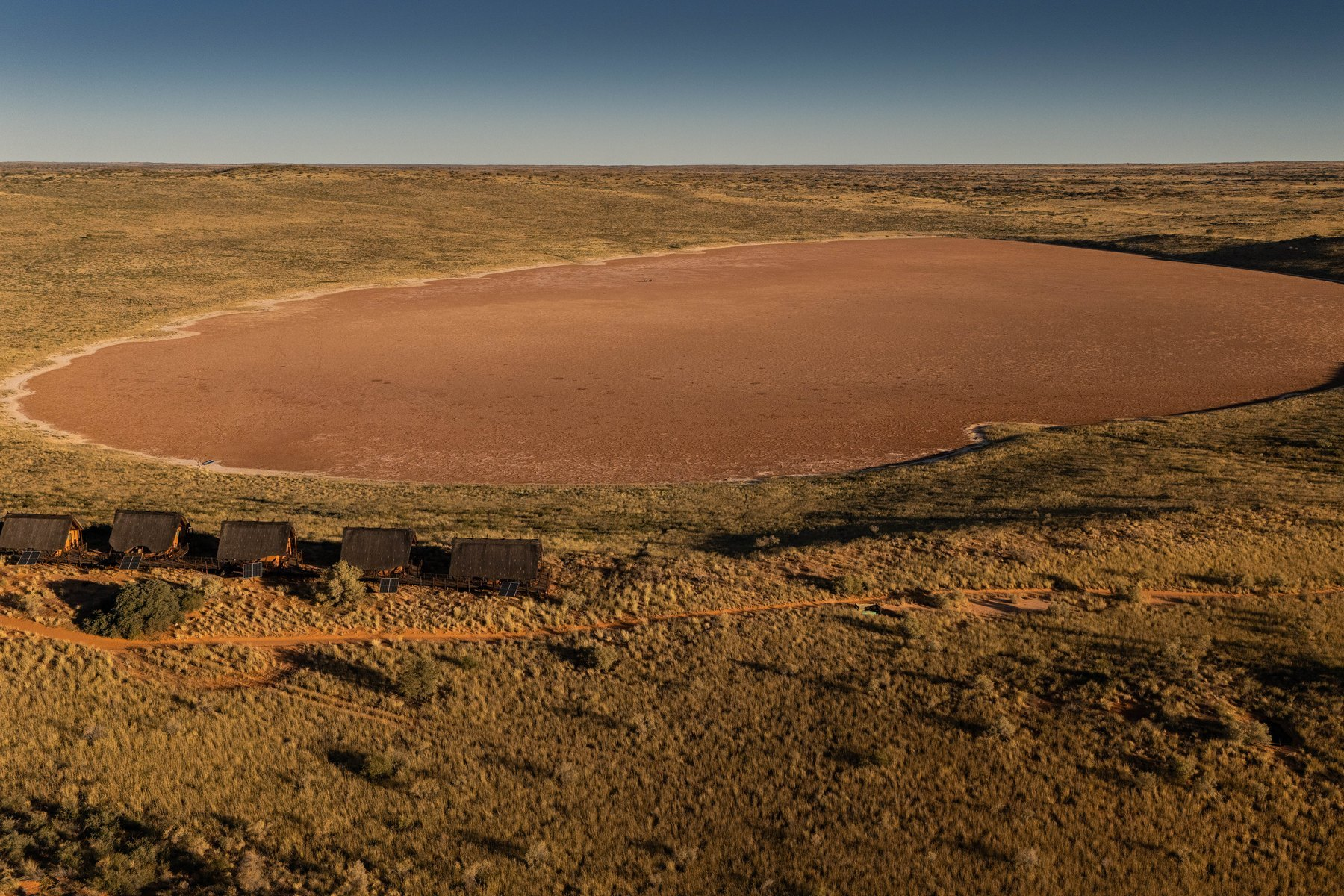
Kgalagadi Birding: Raptors, Sandgrouse and the Waterholes
Where to park and wait in the Kgalagadi Transfrontier Park: the waterholes, the raptor list along the Nossob and Auob, the camps that suit birders, and the best months.
SANParks puts the Kgalagadi Transfrontier Park’s bird list at about 280 species, and only about 92 of them are resident. The rest are nomads, migrants and vagrants, which makes the checklist read more like a guest book: by SANParks’ count about 17, 50 and 121 respectively. That shapes every trip here. In a dry winter the list is short but the birds are concentrated at the water; after good summer rain the riverbeds fill with storks, larks and seedeaters, and the raptor numbers climb.
The park’s 2 dry rivers, the Auob and the Nossob, carry most of the birding. Their camel thorn trees give nest sites and shade in a landscape that has little of either, and the roads follow both rivers, as sensibly as the birds do.
At a glance
| Spot | Where | What to look for (source) | When |
|---|---|---|---|
| Rooiputs and Kij Kij waterholes | Lower Nossob | Namaqua and Burchell’s Sandgrouse (GoBirding) | Whenever there is water |
| 13th Borehole | Auob, towards Mata Mata | Lanner Falcon and Gabar Goshawk hunting finches (GoBirding) | When finch and quelea flocks drink |
| Nossob hide | Nossob camp | Raptors drinking, Rufous-cheeked Nightjar under the lights (GoBirding) | Hot days, evenings |
| Twee Rivieren camp | Park entrance | Owls, thornveld birds (GoBirding) | After dark for owls |
The raptors
SANParks rates the Nossob riverbed as one of the best places in South Africa to see raptors, especially in summer, when large numbers of migrant eagles, kites and falcons move through. Its resident eagles are Martial, Tawny, Bateleur, Black-chested Snake Eagle and the less common Brown Snake Eagle. The migrants are Steppe, Wahlberg’s, Booted and Lesser Spotted Eagles, Black and Yellow-billed Kites, Steppe Buzzard, Montagu’s and Pallid Harriers, Eurasian Hobby and several kestrels.
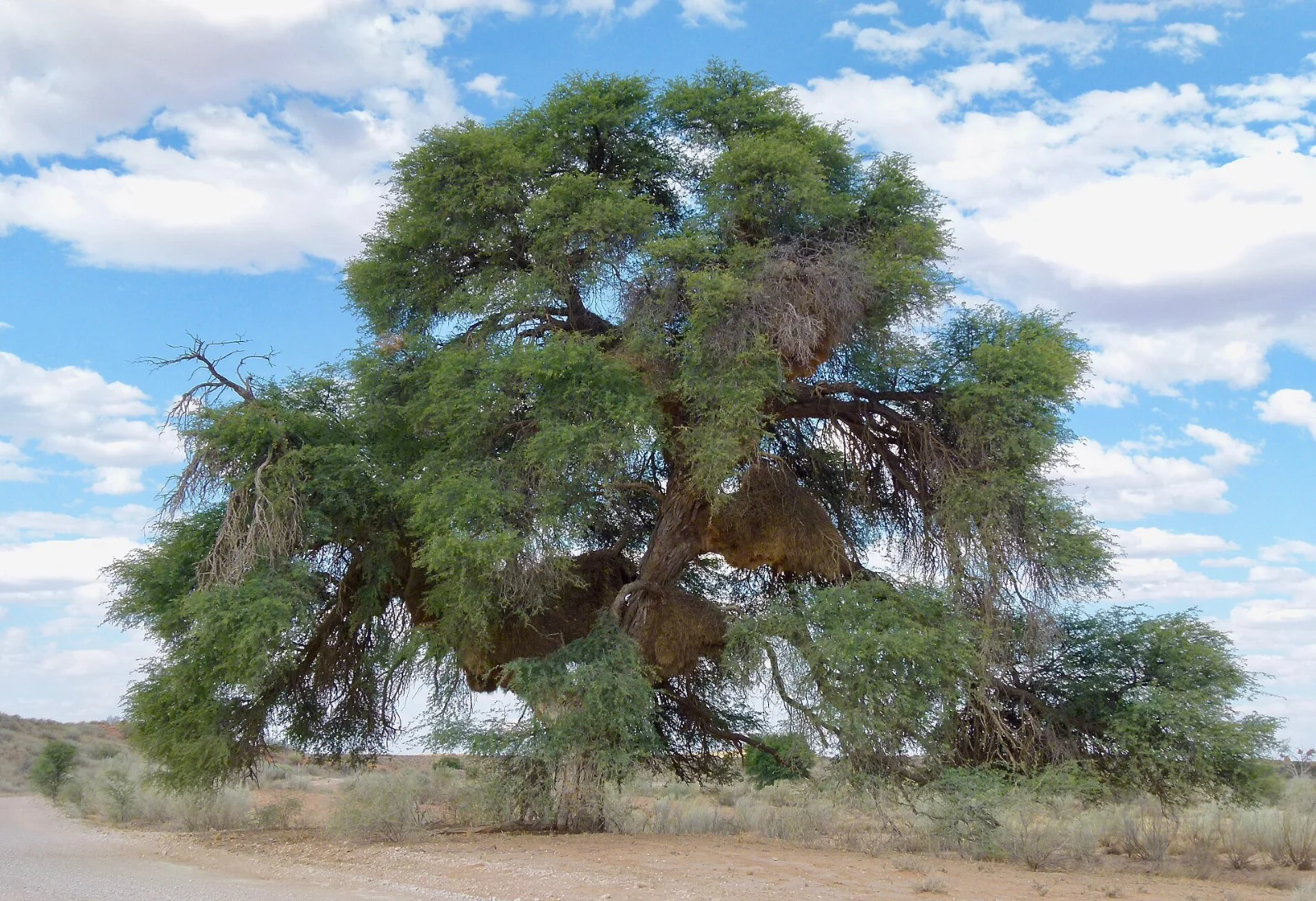
Across the park, SANParks names Tawny Eagle, Black-chested Snake Eagle, Bateleur, White-backed and Lappet-faced Vultures, Pale Chanting Goshawk, Gabar Goshawk, Pygmy Falcon and Greater Kestrel as the commonest raptors, with Martial Eagle and Red-necked Falcon less common. GoBirding adds that White-backed Vultures, Martial Eagles, Secretarybirds and Verreaux’s Eagle-Owls breed in the big camel thorns between Twee Rivieren and Nossob.
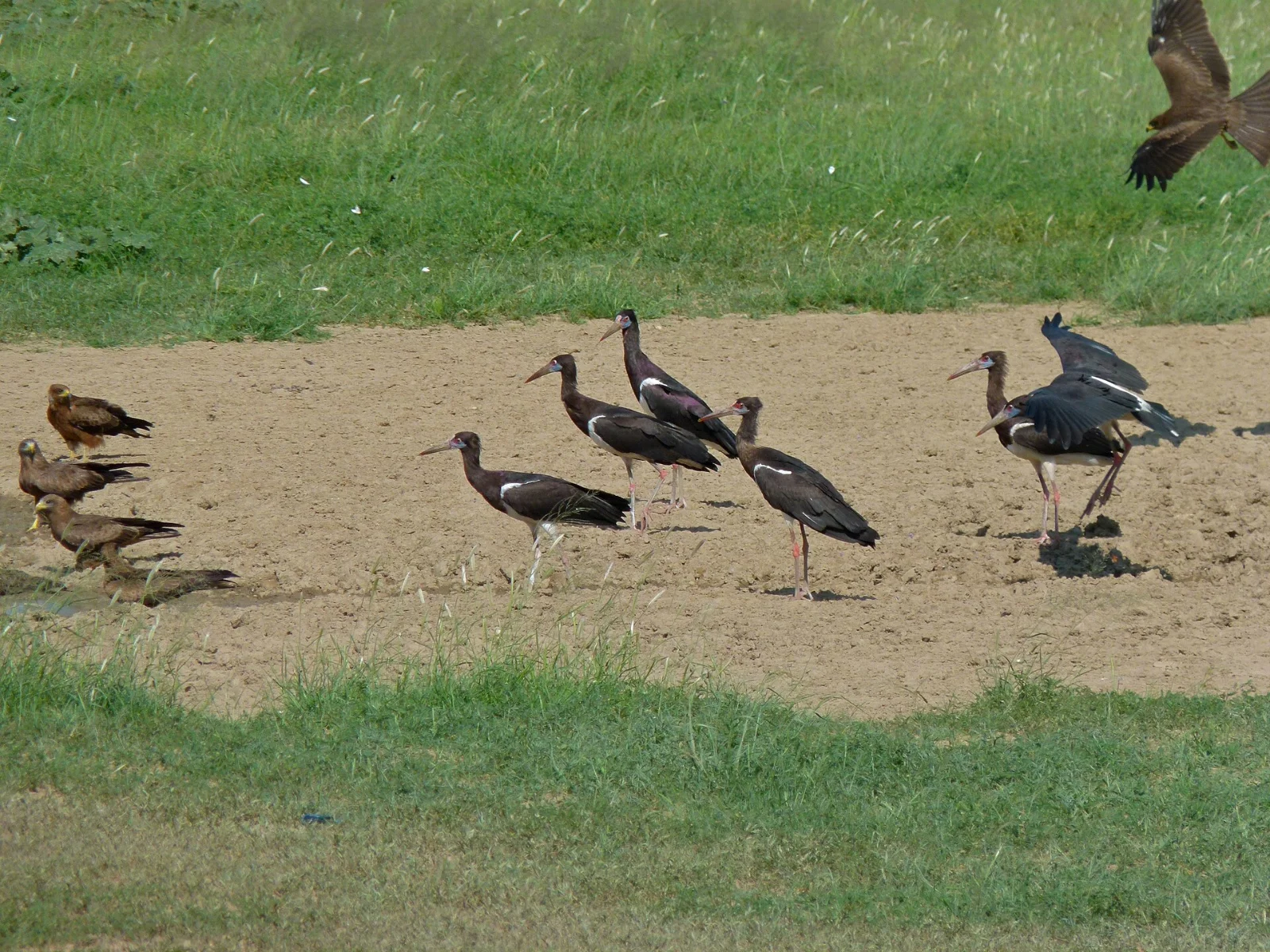
The Lanner on this article’s plate is easiest at the water. GoBirding says the 13th Borehole on the Auob is always worth time, because Gabar Goshawk and Lanner Falcon hunt the flocks of Red-headed Finch and Red-billed Quelea that come down to drink. For a finch, it is the most dangerous drink in the park.
The waterholes to sit at
Water is the draw in a dry park, and the best birding is often from a parked car with the engine off and a flask on the dashboard. On the lower Nossob, between Twee Rivieren and Nossob camp, GoBirding singles out the small waterholes at Rooiputs and Kij Kij: good for game, and visited by Namaqua and Burchell’s Sandgrouse and the odd waterbird, none of them easy to find elsewhere in this arid country.
Nossob camp has a well-lit hide. When there is water, GoBirding calls it a great place to watch raptors come in to drink on a hot day; after dark, Rufous-cheeked Nightjar hunts insects under the lights, having worked out what the lights are for, and Southern White-faced Owl, Western Barn Owl and Spotted Eagle-Owl are often in camp. Mata Mata also has a hide in camp for game and the odd waterbird.
When the rivers flow or hold pools, the list changes, and a desert park starts producing waders. GoBirding lists Little Grebe, Red-billed and Cape Teal, Little Stint, Wood and Curlew Sandpipers, Ruff and occasionally Greater Painted Snipe, and rank grass can hold African Crake, Striped Crake and Lesser Moorhen.
The camps for birders
At Twee Rivieren, the thorn trees on the way in hold White-browed Sparrow-Weaver, Crimson-breasted Shrike, Pririt Batis and Yellow Canary, and with work Swallow-tailed Bee-eater, Kalahari Scrub Robin, Ashy Tit and Pygmy Falcon. After dark, walk the fenced campsite for Western Barn Owl, African Scops Owl, Pearl-spotted Owlet, Spotted Eagle-Owl and Southern White-faced Owl; learn the calls first, because in the dark that is all you get. A night drive from camp can add Verreaux’s Eagle-Owl and, in summer, Rufous-cheeked Nightjar.
Nossob is the place for Great Sparrow, which frequents the campsite and nearby waterholes, as well as Southern Pied Babbler, Burchell’s Starling and Long-billed Crombec. It has turned up vagrants such as Great Reed Warbler and Buff-spotted Flufftail, so search it well after big storms, when lost birds have a way of turning up. Mata Mata, on the Namibian border, has the tallest trees, with Golden-tailed and Cardinal Woodpeckers, Ashy Tit and, in summer, African, Black, Great Spotted, Diderick and Jacobin Cuckoos.
Riverbeds and dune roads
On the Auob, SANParks says Verreaux’s Eagle-Owl can be found in dense camel thorns, especially along the short loop roads on the northern part of the riverbed; Purple Roller, Capped Wheatear and Striped Kingfisher are also here. Kori Bustard is common along both rivers, and Ludwig’s Bustard fairly common in summer.
The 2 dune roads, 55 km and 35 km long, cross open grassland. SANParks lists Ant-eating Chat, Rufous-eared Warbler, Chat Flycatcher and Eastern Clapper, Spike-heeled and Fawn-coloured Larks there, with Grey-backed and Black-eared Sparrowlarks, Pink-billed and Stark’s Larks after good summer rain. Watch the verges for sandgrouse, and look for Northern Black and Red-crested Korhaans and the easily missed Double-banded Courser, which is roughly the colour of the ground it stands on.
The best months
The wet season, November to March, brings the migrants: the summer eagles, harriers and kites, the storks, and shrikes and cuckoos in the camps. SANParks says winter is the time for Fairy Flycatcher and Dusky Sunbird, which move into the park, and Burchell’s Starling at Nossob is mainly a winter bird. Larks, sparrowlarks and seedeaters peak after good rains. For raptors on the Nossob, go between December and March in a year with decent rain. Summer days are hot, so drive early and late and sit at water through the middle of the day, which is what the birds are doing too.
Fees and getting there
From 1 November 2026 to 31 October 2027, SANParks’ daily conservation fee for the Kgalagadi is R134 for South African adults, R283 for SADC nationals and R662 for international adults; Wild Card holders pay nothing. Twee Rivieren Gate is 260 km from Upington on tar, according to !Xaus Lodge, and SANParks recommends a high-clearance vehicle for the park.
Where to stay
| Place to stay | Where | For birders | From |
|---|---|---|---|
| !Xaus Lodge | Dunes off the Auob, Kgalagadi | 260 species, guided drives, walk with San trackers | R7,820 pp full board |
| Kieliekrankie Wilderness Camp | Dune Road, 50 km from Twee Rivieren | Own waterhole, park list of 272 species | R2,146 a cabin for 2, self-catering |
| Tswalu Kalahari Reserve | Near Van Zylsrus, Northern Cape | Private guide, guided walks, 264 species, Pygmy Falcon | R46,400 pp fully inclusive (Motse) |
| Tutwa Desert Lodge | Near Augrabies, Northern Cape | Birding safaris on the Orange River | Ask the lodge |
Inside the park, !Xaus Lodge is owned by the ‡Khomani San and Mier communities and sits on a red dune above a pan, with every chalet deck facing the waterhole. Birding is on the activity list with game drives and a morning walk with San trackers. The rack rate is R7,820 per person sharing, full board with activities, to 28 February 2027, with a SADC rate of R4,390; there is a 2-night minimum, and the conservation fee is extra. Guests drive 64 km up the Auob to Kamqua picnic site, where the lodge collects them at 14:30 for the 30 km crossing of the dunes.
Kieliekrankie Wilderness Camp is a SANParks camp of self-catering cabins on a dune 50 km from Twee Rivieren, from R2,146 a night for 2 including the community levy. Bring food, drinking water and firewood, and note that children under 12 are not allowed.
Outside the park, Tswalu Kalahari Reserve near Van Zylsrus gives each party a private guide and tracker, runs guided walks for birders and counts 264 species, among them Pygmy Falcon, Red-necked Falcon and Sociable Weaver. Motse is from R46,400 per adult sharing a night in 2026, fully inclusive. On the way up from the south, Tutwa Desert Lodge near Augrabies offers birding and photographic safaris on the Orange River.
For owls to target on night walks in camp, see owls you can find without a guide, and for the Botswana side of the Kalahari, the Botswana birding guide.
Water at the boreholes, road conditions and rates change. Facts were checked on 13 November 2026 with SANParks’ Kgalagadi birds and birding pages, BirdLife South Africa’s GoBirding guide to the park, SANParks’ 2026/27 conservation fee schedule and the Birding Dispatch listings. Confirm bookings and conditions with SANParks before you go.
More from the Journal
 Namib-Naukluft and Sossusvlei for Birders: Dune Lark, Desert Raptors and the Naukluft SpecialsA lark that lives on the dunes and nowhere else, Lappet-faced Vultures nesting in the desert, coursers on the gravel plains and the northern specials around the Naukluft cliffs, in one of Africa's largest parks.
 Lake Baringo and Lake Bogoria Birding: The Owl Walks, the Cliffs and the FlamingosA local guide who knows where every nightjar and eagle-owl slept last night, thorn scrub full of hornbills, a Goliath Heron colony on a rock, and the flamingo lake next door that keeps rising.
 Akagera Birding: Rwanda’s Savanna, Lakes and Papyrus, and the Shoebill ChancesRed-faced Barbet in the southern woodland, Papyrus Gonolek and Carruthers's Cisticola in the swamps, a lake of hippos and lapwings, and a Shoebill that hides in the wetlands more than it shows.
The Pigeon Post
Every Thursday: 1 bird, 1 place to go and 1 place to stay, by email. Sign up and get our printable checklist of the 163 endemics of southern Africa.