
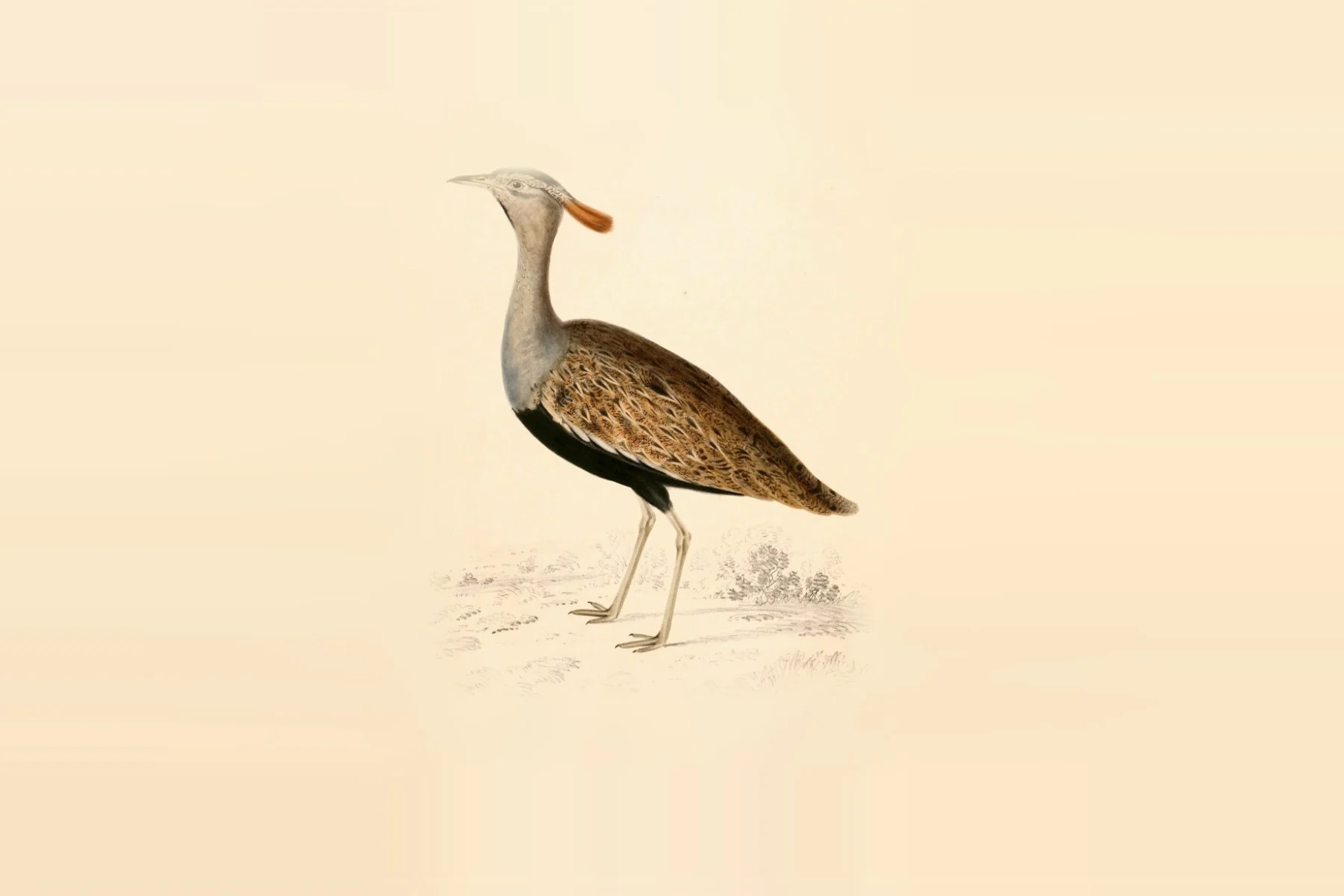
Bustards and Korhaans: Where to See Them in Southern Africa
From the Kori Bustard of the Kalahari riverbeds to the Blue Korhaan of the highveld grasslands: South Africa's 10 bustards and korhaans, how to find each, and the farms and reserves where they live.
Between 4,000 and 11,900 Ludwig’s Bustards are killed every year on high-voltage power lines, according to a 2011 study in Bird Conservation International. The same work supported moving the species from Least Concern to Endangered, and a later survey in the Karoo, published in Ibis in 2018, found that bustards made up 87% of the 679 birds found dead under power lines there: 69% Ludwig’s Bustards and 18% other bustards.
Most of them are birds of open plains and grassland, with the Red-crested Korhaan the woodland exception. BirdLife South Africa’s 2026 checklist lists 10 of them in South Africa: 4 bustards (Black-bellied, Denham’s, Kori and Ludwig’s) and 6 korhaans (Blue, Karoo, Northern Black, Red-crested, Southern Black and White-bellied). The checklist keeps the southern African name korhaan for the 6 smaller species, and lists the White-bellied as “Korhaan (Bustard)”, giving both names, which settles the question by politely not settling it.
The 10 at a glance
Status is South Africa’s regional listing, then the global one, from the BirdLife South Africa checklist (EN Endangered, VU Vulnerable, NT Near Threatened; no entry means neither is threatened).
| Species | Status | Habitat | A good place to look |
|---|---|---|---|
| Kori Bustard | NT, NT | Open plains and dry riverbeds | Nossob valley, Kgalagadi |
| Ludwig’s Bustard | EN, EN | Open plains of the Karoo and Namib | The Karoo |
| Denham’s Bustard | VU, NT | High-rainfall grassland; pasture and wheat fields in the Western Cape | Overberg coastal plain |
| Black-bellied Bustard | Tall, dense grass in wetter regions | Coastal grassland, Wild Coast | |
| Blue Korhaan | VU, NT | Highveld grassland | Wakkerstroom |
| Karoo Korhaan | NT, LC | Dwarf shrubland of the Karoo plains | Karoo farms |
| Southern Black Korhaan | VU, VU | Western, Eastern and Northern Cape | The Western Cape |
| Northern Black Korhaan | Open plains | Kgalagadi, Etosha | |
| Red-crested Korhaan | Woodland | Kruger | |
| White-bellied Korhaan | VU, LC | Tall, fairly dense grassland | Listen for its call in tall grass |
The big bustards
Start with the Kori Bustard. Iziko Museums’ Biodiversity Explorer describes the male’s display, usually early or late in the day, when he struts with his head cocked, bill open and neck inflated, giving a booming call to several females at once. Subtlety is not the plan. The Atlas of Southern African Birds names its strongholds in Botswana: the Nossob valley in what is now the Kgalagadi, Deception Valley in the Central Kalahari, Nxai Pan and the Savuti Depression. It is regionally Near Threatened, and the 2018 Karoo survey found it the second most common power-line casualty after Ludwig’s Bustard.
Kori Bustards share their plains with other birds in an unexpected way: on the Savuti Plains in Botswana, the Atlas notes, Southern Carmine Bee-eaters regularly perch on their backs, treating a bustard as a perch with legs.
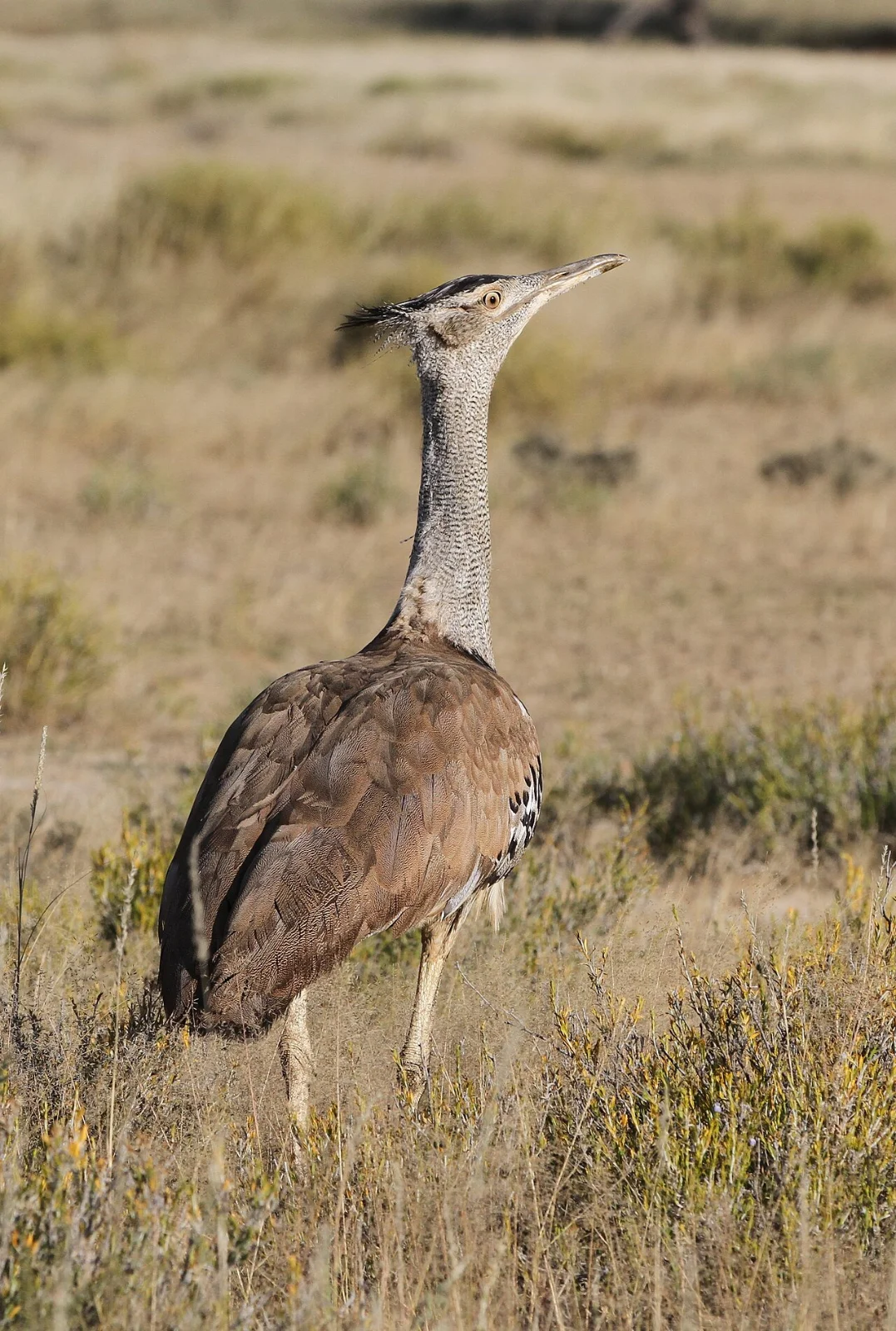
Ludwig’s Bustard lives on the open plains of the arid Namib, the Namibian escarpment and the semi-arid Karoo, where the 2018 survey counted its power-line deaths.
Denham’s Bustard breeds in high-rainfall grassland at fairly high altitudes and, in the south-western Cape, in a mosaic of coastal fynbos, pastures and wheat fields. The Atlas gives about 950 birds on the coastal plain between Bot River and Mossel Bay, put the southern population at under 5,000, and lists overhead transmission lines and fence entanglement among the threats. Breeding runs from September to March, peaking in October in the south-western Cape.
Elsewhere the Atlas gives fewer than 300 birds in the old Transvaal, 100 to 200 in the Eastern Cape and about 20 in Eswatini, plus a small isolated breeding population on the grasslands of the Waterberg Plateau. In winter many move downhill, from the highest grasslands to lower grassland and woodland, and some of the KwaZulu-Natal and Free State birds go all the way to the coastal grasslands of northern KwaZulu-Natal. Breeding peaks a little later the further north and east you go: November in the Eastern Cape, December in KwaZulu-Natal and the old Transvaal.
The Black-bellied Bustard prefers tall, fairly dense grass in regions with more than about 600 mm of rain a year, and the Atlas notes a striking aerial display by the males that is rarely performed, which makes it a show with very few tickets.
The korhaans
Blue Korhaan. The Atlas calls it virtually endemic to South Africa, reaching only marginally into western Lesotho, and BirdLife South Africa lists it as Vulnerable in South Africa. Its call is like the Karoo Korhaan’s, which helps only if you know the Karoo Korhaan’s. Wakkerstroom is the easiest place: Faansie Peacock’s December 2025 trip post notes Blue Korhaan in the fields there, and 3 of the village’s guest houses name it. The Wakkerstroom larks guide covers the village.
Karoo Korhaan. A bird of the dwarf shrublands on the open plains of the Karoo, and a noisy one, with loud and frequent calls, so it tends to announce itself. Karoo Secret Farm Stay, near Aberdeen, names it along its own signposted Lark Route, and Inverdoorn, on the edge of the Tankwa, names it with Kori Bustard. The Karoo birding guide has more farms.
Southern and Northern Black Korhaans. Biodiversity Explorer says the Southern Black Korhaan is endemic to South Africa, in the Western, Eastern and Northern Cape, and BirdLife South Africa lists it as Vulnerable both in South Africa and globally. Its northern counterpart replaces it further north, and the Atlas says the 2 meet and hybridise only in the Fish River valley just south of Cradock. The Northern Black Korhaan displays with exaggerated, undulating flights and chases, and the male shows off his white breast patches, in case anyone missed the flying. A February 2023 trip report by Faansie Peacock found it on the plains of Etosha in December 2022.
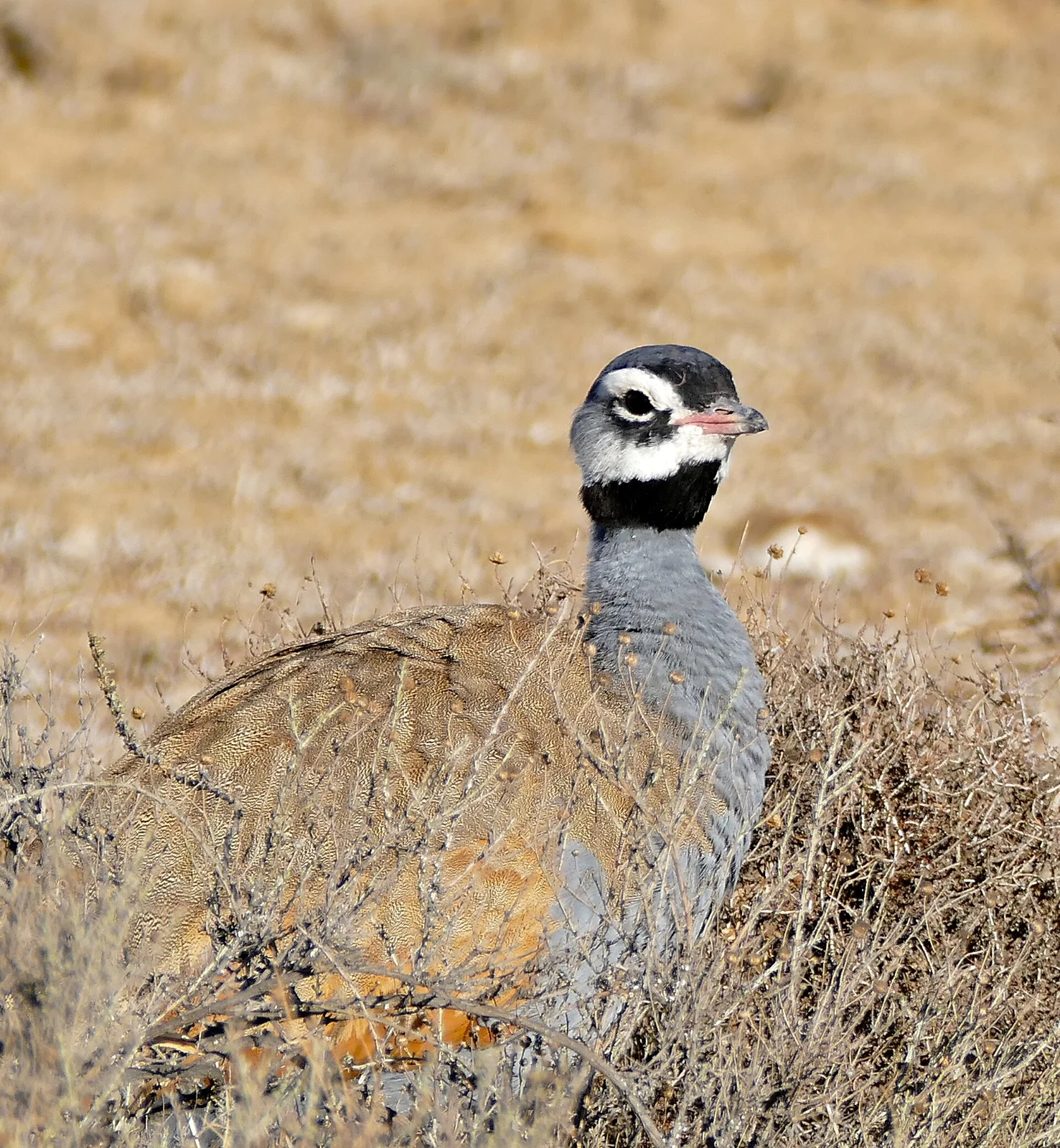
Red-crested Korhaan. Biodiversity Explorer calls it the most woodland-dependent of the bustards and korhaans, the family member that chose trees over open plains, and the Atlas notes the males’ eye-catching aerial display. In Kruger, Bernard Dupont photographed a male and a female beside the S131 west of Letaba.
White-bellied Korhaan. The Atlas places it in tall, fairly dense grassland in open or lightly wooded country, and describes far-carrying, frequent calls, so the ears tend to find it before the eyes. BirdLife South Africa lists it as Vulnerable in South Africa.
Where to look
The Kgalagadi. The Atlas names the Nossob valley as a Kori Bustard stronghold, and SANParks names it among the park’s birds. Kieliekrankie Wilderness Camp, on the Dune Road, has its own waterhole. See the Kgalagadi birding guide.
The Karoo. Ludwig’s Bustard, Karoo Korhaan and Kori Bustard all live here, which makes the Karoo the place for a bustard hat-trick. Aasvogelkrans, a farm near Nieu-Bethesda with a 116-species list, names Ludwig’s and Kori Bustards and Blue Korhaan, and Ufumene Game Lodge, near Alicedale, names Ludwig’s Bustard and Southern Black Korhaan.
The highveld grasslands. Around Wakkerstroom, Forellenhof Guest Farm names both Blue Korhaan and Denham’s Bustard and puts guests in touch with community bird guides.
The bushveld and Kruger. Plains Camp, in Kruger, names Kori Bustard among the big birds of its birding safaris; Madikwe Dithaba Camp names it for Madikwe; and Chinaka Game Lodge in Limpopo has both Kori Bustard and Red-crested Korhaan on its own list.
Denham’s Bustards breed from September to March, and Kori Bustards display early in the morning or late in the afternoon, so spring and summer, at the start and end of the day, are the times to be out, which means early alarms.
Where to stay
Places in the directory that name bustards or korhaans:
| Place to stay | Where | For birders | From |
|---|---|---|---|
| Kieliekrankie Wilderness Camp | Dune Road, Kgalagadi | Own waterhole; Kori Bustard; 272-species park list | R2,146 per cabin for 2, self-catering |
| Karoo Secret Farm Stay | Near Aberdeen, Eastern Cape | BirdLife Recommended; Lark Route; Kori Bustard, Karoo Korhaan | Ask the lodge |
| Aasvogelkrans Farm Cottages & Camping | Near Nieu-Bethesda, Eastern Cape | 116-species list; Ludwig’s and Kori Bustards, Blue Korhaan | R1,760 for 2, self-catering |
| Inverdoorn Private Game Reserve | Near Ceres, Tankwa edge | Ranger birding drives; Kori Bustard, Karoo Korhaan | R4,425 pp sharing (2026) |
| Ufumene Game Lodge | Near Alicedale, Eastern Cape | Ludwig’s Bustard, Southern Black Korhaan | Ask the lodge |
| Forellenhof Guest Farm | Wakkerstroom, Mpumalanga | BirdLife Recommended; Blue Korhaan, Denham’s Bustard | Ask the lodge |
| The Wetlands Country House & Sheds | Wakkerstroom, Mpumalanga | BirdLife Recommended; Blue Korhaan; local guide contacts | Ask the lodge |
| DeKotzenhof | Wakkerstroom, Mpumalanga | Walk to 4 wetland hides; Blue Korhaan | Ask the lodge |
| Chinaka Game Lodge | Vivo, Limpopo | Own list with Kori Bustard and Red-crested Korhaan | Ask the lodge |
| Plains Camp @ Rhino Walking Safaris | Kruger National Park | BirdLife Recommended; birding safaris; Kori Bustard | R9,830 pp sharing, full board |
| Madikwe Dithaba Camp | Madikwe Game Reserve, North West | Kori Bustard, Secretarybird named | R20,000 pp sharing (2026) |
| GweGwe Beach Lodge | Mkambati, Wild Coast | Coastal grassland; Black-bellied Bustard named | R3,825 pp, SADC guests (2026) |
Power-line figures come from the 2011 and 2018 studies cited, and range descriptions from the Atlas fieldwork of the 1980s and 1990s. Facts were checked on 14 November 2026 with BirdLife South Africa, the Atlas of Southern African Birds, Iziko’s Biodiversity Explorer, SANParks, the studies named and the Birding Dispatch listings. Keep to roads and farm tracks: nesting bustards and korhaans sit tight on the ground.
More from the Journal
 Woodpeckers of Southern Africa, Including the One That Doesn’t Need TreesSouthern Africa's woodpeckers, from the Cardinal in every bushveld tree to the Ground Woodpecker that lives on treeless mountain slopes and eats almost nothing but ants.
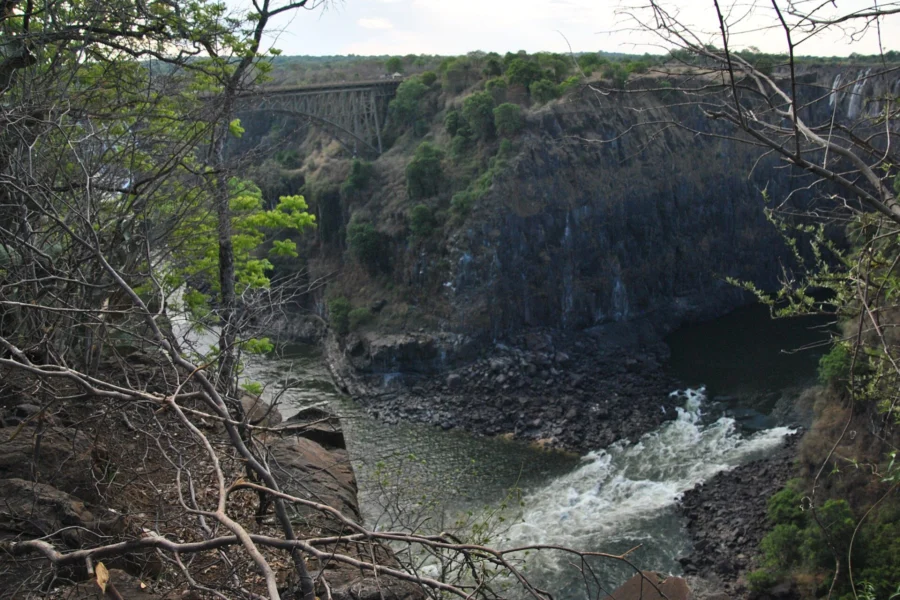 Where to See a Taita Falcon: the Strijdom Tunnel, the Blyde Cliffs and the Batoka GorgeA stocky falcon smaller than a pigeon, a handful of cliffs and surveys that keep coming back empty. Where it still nests, how to look, and the 2 roosts beside its cliffs.
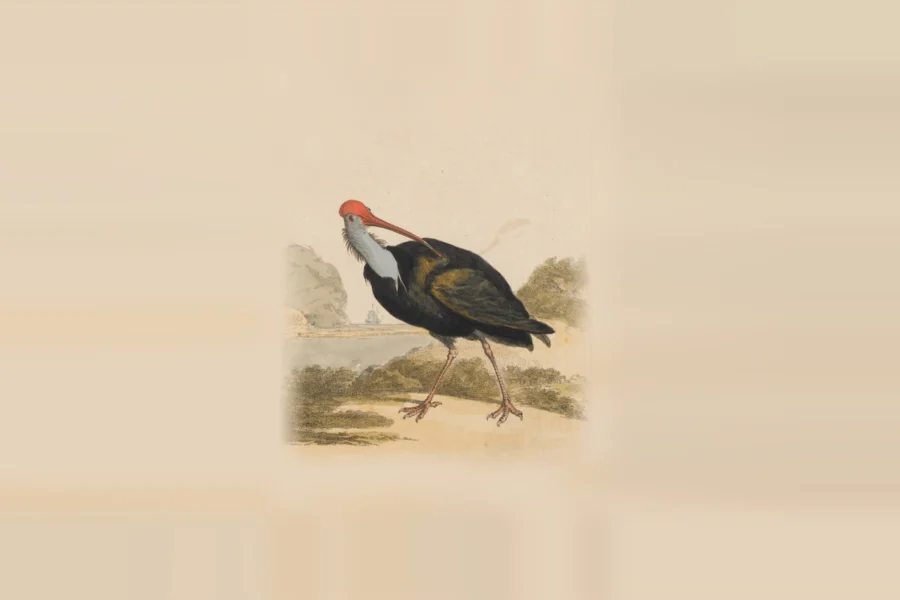 Where to See a Southern Bald Ibis: the Breeding Cliffs, Dullstroom, Wakkerstroom and LesothoA red-capped grassland ibis that nests on cliffs over waterfalls and feeds on burnt veld and maize stubble. The colonies you can watch, the fields to scan, and where to stay.
The Pigeon Post
Every Thursday: 1 bird, 1 place to go and 1 place to stay, by email. Sign up and get our printable checklist of the 163 endemics of southern Africa.