
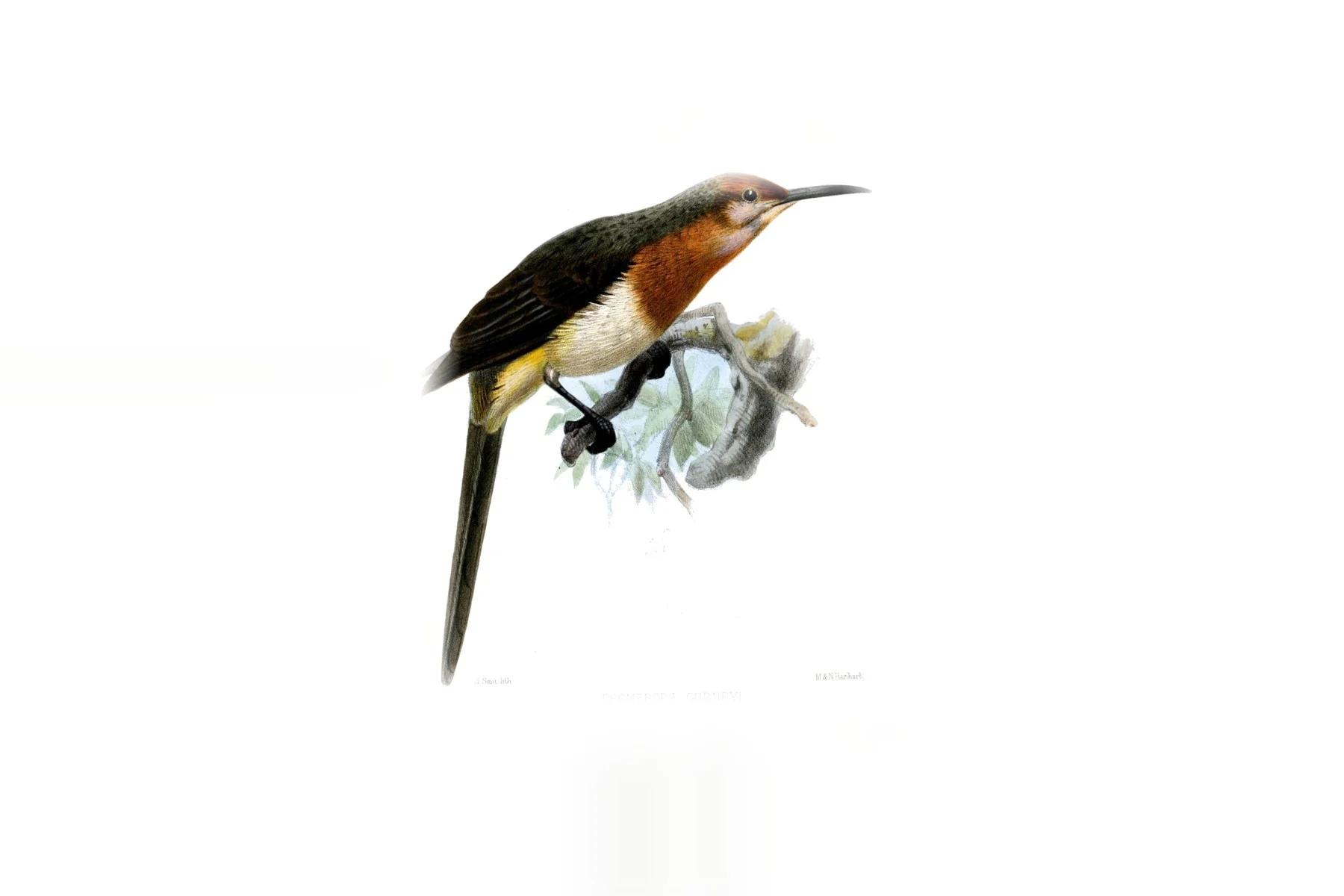
Sugarbirds and Protea Birding: Cape and Gurney’s Sugarbird and Where to Find Them
A bird that visits around 300 flowers a day, and once tried to drink from coloured clothes pegs. Southern Africa's 2 sugarbirds, the protea birds around them and the best sites.
A Cape Sugarbird can visit around 300 flowers a day. Iziko Museums’ Biodiversity Explorer counts that as one reason it is a major pollinator of the protea family, and adds a detail that says a lot about the bird’s priorities: one was seen trying to drink nectar from coloured clothes pegs. Anything bright and flower-shaped is worth a look.
Southern Africa has 2 sugarbirds, both found nowhere else: the Cape Sugarbird of the fynbos and Gurney’s Sugarbird of the eastern mountains. Both live by proteas, and both come with a supporting cast of sunbirds and canaries that share their flowers. This guide covers where to find them and when.
The 2 sugarbirds at a glance
| Cape Sugarbird | Gurney’s Sugarbird | |
|---|---|---|
| Range | Fynbos of the Western Cape, into the Eastern Cape | Zimbabwe’s Eastern Highlands, Limpopo, Mpumalanga; western KwaZulu-Natal, Lesotho, far eastern Eastern Cape |
| Habitat | Fynbos with proteas | Montane slopes with aloes, proteas and strelitzias |
| Key plant | Protea, Leucospermum, Mimetes | Silver Protea |
| Breeding | Mainly March to August, peak March to June | Tracks protea flowering |
| Best sites | Kirstenbosch, the Cape fynbos | Golden Gate, Kaapschehoop, the Drakensberg |
Cape Sugarbird
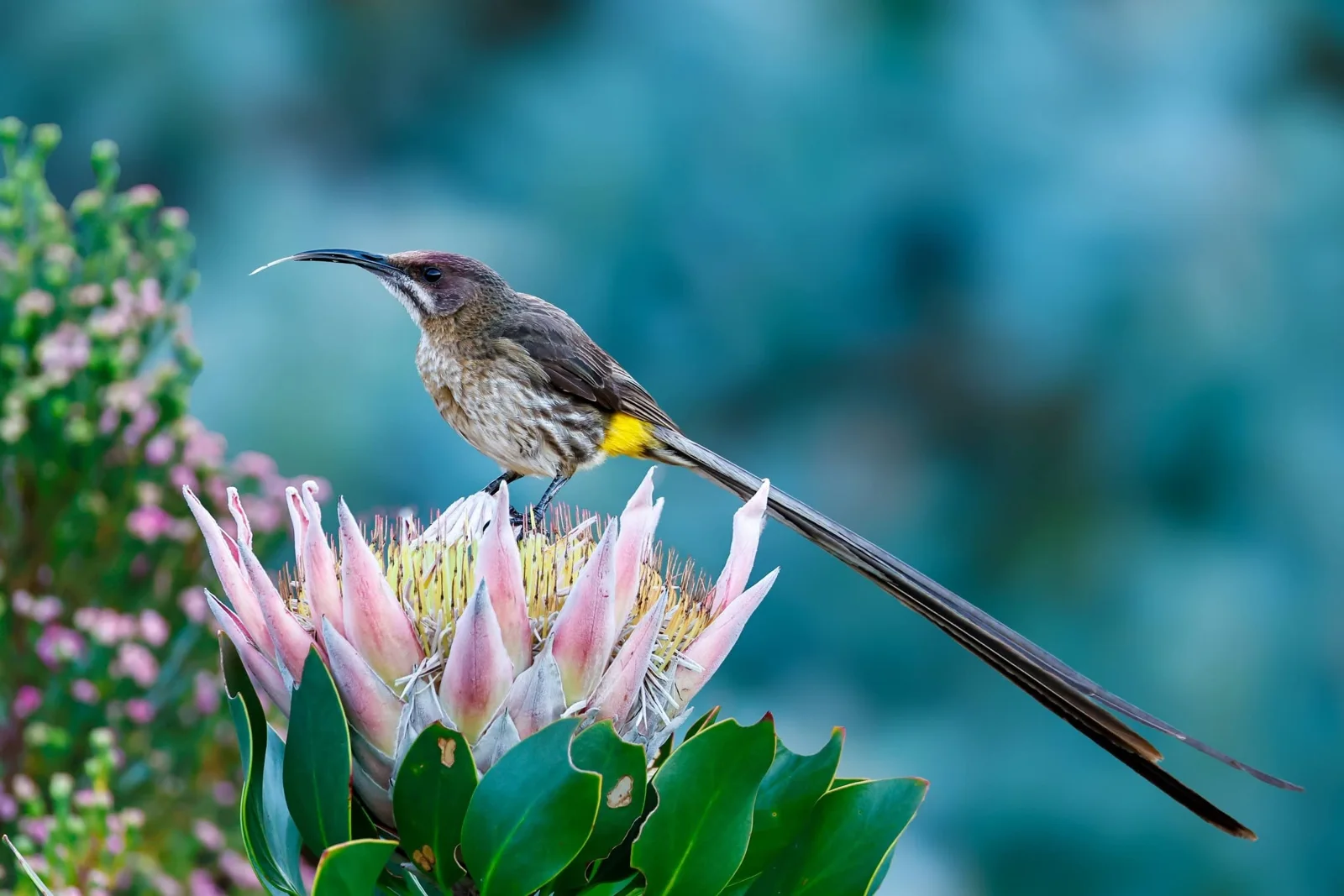
Biodiversity Explorer describes the Cape Sugarbird as endemic to the fynbos biome of the Western Cape, extending into the Eastern Cape, and highly dependent on proteas for both nectar and nest sites. It feeds mainly on the nectar of Protea, Leucospermum and Mimetes, takes nectar from other plants as well, and hawks insects in the air.
It breeds through autumn and winter, on the proteas’ timetable rather than the calendar’s. Egg-laying runs mainly from March to August, peaking from March to June, to match the flowering of the proteas. The pair is monogamous, and the male defends his territory hard against other males and against predators such as fiscals and boubous. The female incubates 1 or 2 eggs alone, and if a predator comes close she drops to the ground with drooping wings as if injured, to lead it away.
BirdLife South Africa’s GoBirding guide to Kirstenbosch says Cape Sugarbird and Orange-breasted Sunbird can be seen there through most of the year, and that the Fynbos and Erica Gardens, most easily reached from the Rycroft Gate, which is on the level of the fynbos garden, are an excellent place to look. The Cape Peninsula birding guide has the rest of the peninsula’s sites.
Gurney’s Sugarbird
Gurney’s Sugarbird is the eastern one, and endemic to southern Africa. Biodiversity Explorer places it in Zimbabwe’s Eastern Highlands and Limpopo, extending into Mpumalanga, with a separate population in western KwaZulu-Natal, Lesotho and the far east of the Eastern Cape. It prefers montane habitats with aloes, proteas and strelitzias, uses protea farms too, and its distribution is strongly linked to that of the Silver Protea.
It moves with the flowers. GoBirding’s guide to Kaapschehoop in Mpumalanga says Gurney’s Sugarbirds arrive there in winter and can be found among the aloes, which flower from May to early August and also draw Malachite Sunbirds. At Golden Gate Highlands National Park, GoBirding points to the viewpoint at Protea Corner, off the R712, where a grove of proteas usually has Gurney’s Sugarbird, Malachite Sunbird and Greater Double-collared Sunbird in attendance, especially in full bloom. The Free State birding guide covers the park.
Several places to stay sit in Gurney’s country. In the southern Drakensberg, Cedar Garden B&B at Underberg names it with Drakensberg Rockjumper and Barratt’s Warbler, and The Cavern, near Bergville, names it among its montane forest and grassland birds. Around Dullstroom, Santa Fishing Estate and Stonecutters Lodge both name it, and Stonecutters has protea bushes on the property. In Zimbabwe, Heaven Lodge at Chimanimani names it in protea heathland.
The rest of the protea crowd
A protea stand in flower is a restaurant with several regulars. The Orange-breasted Sunbird is endemic to the fynbos of the Western and Eastern Cape, preferring dense stands of protea and erica, and Biodiversity Explorer records nectar from 66 erica species in its diet. It also uses coastal renosterveld and gardens with enough nectar plants such as aloes.
The Protea Canary, which Biodiversity Explorer lists as Protea Seedeater, is endemic to the Western Cape and the western Eastern Cape. It favours mountain fynbos, the edges of forest patches, riverside shrubs in fynbos, and the Karoo and renosterveld border where Waboom proteas grow, and lays from August to October. It is less flashy than the sugarbirds and sunbirds, so it is usually the last of the protea birds on a list. The fynbos endemics guide covers the full set.
How to find them
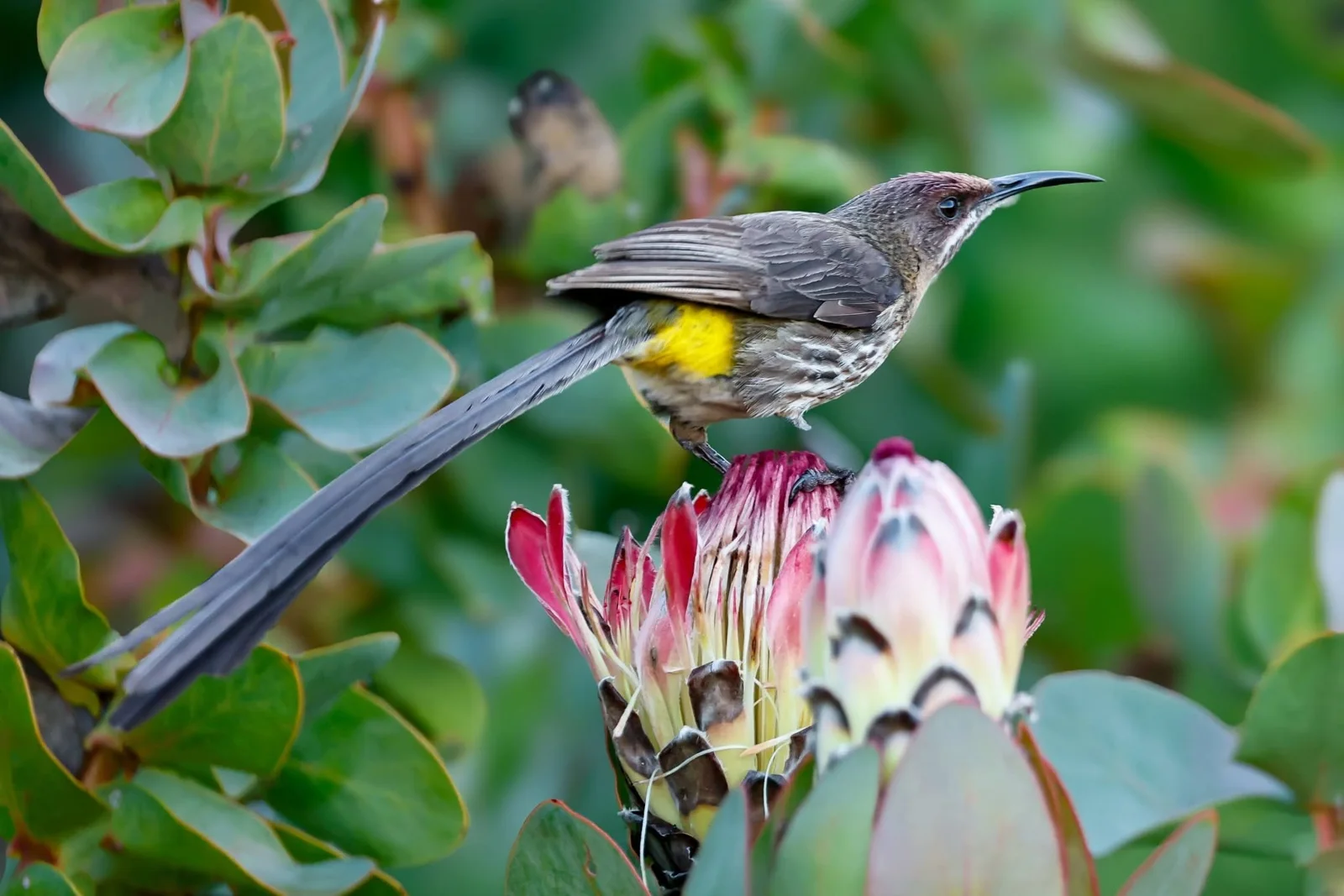
Find the flowering proteas and wait. Cape Sugarbirds perch on the tallest flower heads to sing and display, so a slow walk through a protea stand in flower usually turns one up. In the Cape, winter and early spring are when the proteas are in flower and the sugarbirds are breeding, from March to August. For Gurney’s, go where the aloes and proteas are flowering: Kaapschehoop in winter, and Golden Gate’s Protea Corner when the grove is in full bloom.
Where to stay
Places in the directory that name a sugarbird:
| Place to stay | Where | For birders | From |
|---|---|---|---|
| Avian Leisure | Simon’s Town, Cape Peninsula | BirdLife Recommended; Cape Sugarbird, Orange-breasted Sunbird | Ask the lodge |
| Lark House | Glencairn Heights, Cape Town | BirdLife Recommended; Cape Sugarbird, Cape Siskin | Ask the lodge |
| Twitchers SA | Hermanus area, Western Cape | BirdLife Recommended; Cape Sugarbird, Protea Canary, Cape Rockjumper | Ask the lodge |
| Farm 215 Nature Retreat | Near Gansbaai, Western Cape | Fynbos; Cape Sugarbird and Blue Crane | Ask the lodge |
| Gourikwa Reserve | Gouritsmond, Western Cape | BirdLife Recommended; Cape Sugarbird, Orange-breasted Sunbird | Ask the lodge |
| Gondwana Game Reserve | Near Mossel Bay, Western Cape | Cape Sugarbird photographed on a protea | Ask the lodge |
| Potkook Mountain Experience | Piketberg mountains, Western Cape | BirdLife Recommended; Cape Sugarbird, Protea Seedeater | R2,985 pp per day, fully inclusive (2026, groups of 6+) |
| Cedar Garden B&B | Underberg, KwaZulu-Natal | Gurney’s Sugarbird and Drakensberg Rockjumper named | R600 pp sharing, self-catering |
| The Cavern Drakensberg Resort & Spa | Near Bergville, KwaZulu-Natal | Gurney’s Sugarbird named; 204 species | R2,140 pp sharing, full board (2026) |
| Santa Fishing Estate | Dullstroom, Mpumalanga | BirdLife Recommended; Gurney’s Sugarbird, Wattled Crane | Ask the lodge |
| Stonecutters Lodge | Near Dullstroom, Mpumalanga | Protea bushes; Gurney’s Sugarbird named | R1,850 per studio, single, midweek (2026) |
| Heaven Lodge | Chimanimani, Zimbabwe | Protea heathland; Gurney’s Sugarbird | USD 12 pp camping |
Protea flowering shifts with the rains and with fire, so a stand that is full of sugarbirds one year may be quiet the next. Facts were checked on 15 November 2026 with Iziko Museums’ Biodiversity Explorer, BirdLife South Africa’s GoBirding site guides and the Birding Dispatch listings. Rates change each season; check with the place before you book.
More from the Journal
 Woodpeckers of Southern Africa, Including the One That Doesn’t Need TreesSouthern Africa's woodpeckers, from the Cardinal in every bushveld tree to the Ground Woodpecker that lives on treeless mountain slopes and eats almost nothing but ants.
 Where to See a Taita Falcon: the Strijdom Tunnel, the Blyde Cliffs and the Batoka GorgeA stocky falcon smaller than a pigeon, a handful of cliffs and surveys that keep coming back empty. Where it still nests, how to look, and the 2 roosts beside its cliffs.
 Where to See a Southern Bald Ibis: the Breeding Cliffs, Dullstroom, Wakkerstroom and LesothoA red-capped grassland ibis that nests on cliffs over waterfalls and feeds on burnt veld and maize stubble. The colonies you can watch, the fields to scan, and where to stay.
The Pigeon Post
Every Thursday: 1 bird, 1 place to go and 1 place to stay, by email. Sign up and get our printable checklist of the 163 endemics of southern Africa.