
Mountain Zebra and Camdeboo Birding: The Eastern Cape Karoo, Park by Park
Mountain Zebra has Blue Korhaan and no Karoo Korhaan; Camdeboo, 130 km away, has the reverse. The loops, larks, bustards, eagle cliffs and farm stays between Cradock and Graaff-Reinet.
Mountain Zebra National Park has Blue Korhaan and no Karoo Korhaan. Camdeboo National Park, about 130 km away by GoBirding’s reckoning, has Karoo Korhaan and no Blue Korhaan. BirdLife South Africa’s GoBirding guide calls each absence surprising, and between them the 2 parks seem to have divided the korhaans like a pair of neighbours sharing out the garden tools. A birder who visits both gets the full set, plus Kori and Ludwig’s Bustards at either end.
The 2 parks anchor the eastern end of what GoBirding calls the central Karoo birding route: a semi-desert of plains and flat-topped hills that holds more than 400 species, including 10 found only in the Karoo. Most of those birds are nomads that move in after heavy rain. Mountain Zebra sits 16 km from Cradock; Camdeboo almost surrounds Graaff-Reinet. The R61 joins them, and the farm country around Nieu-Bethesda lies off it in between.
Mountain Zebra National Park
The park was proclaimed in 1937 to protect the last Cape Mountain Zebras, and GoBirding says it now covers 28,400 ha, with buffalo, black rhino, cheetah and lion reintroduced. Some 275 bird species have been recorded. Hiking is no longer allowed, so this is birding from the car, with stops only at designated picnic sites and viewpoints. GoBirding recommends at least 2 days to cover the park, though it works as a day trip from Cradock or Graaff-Reinet.
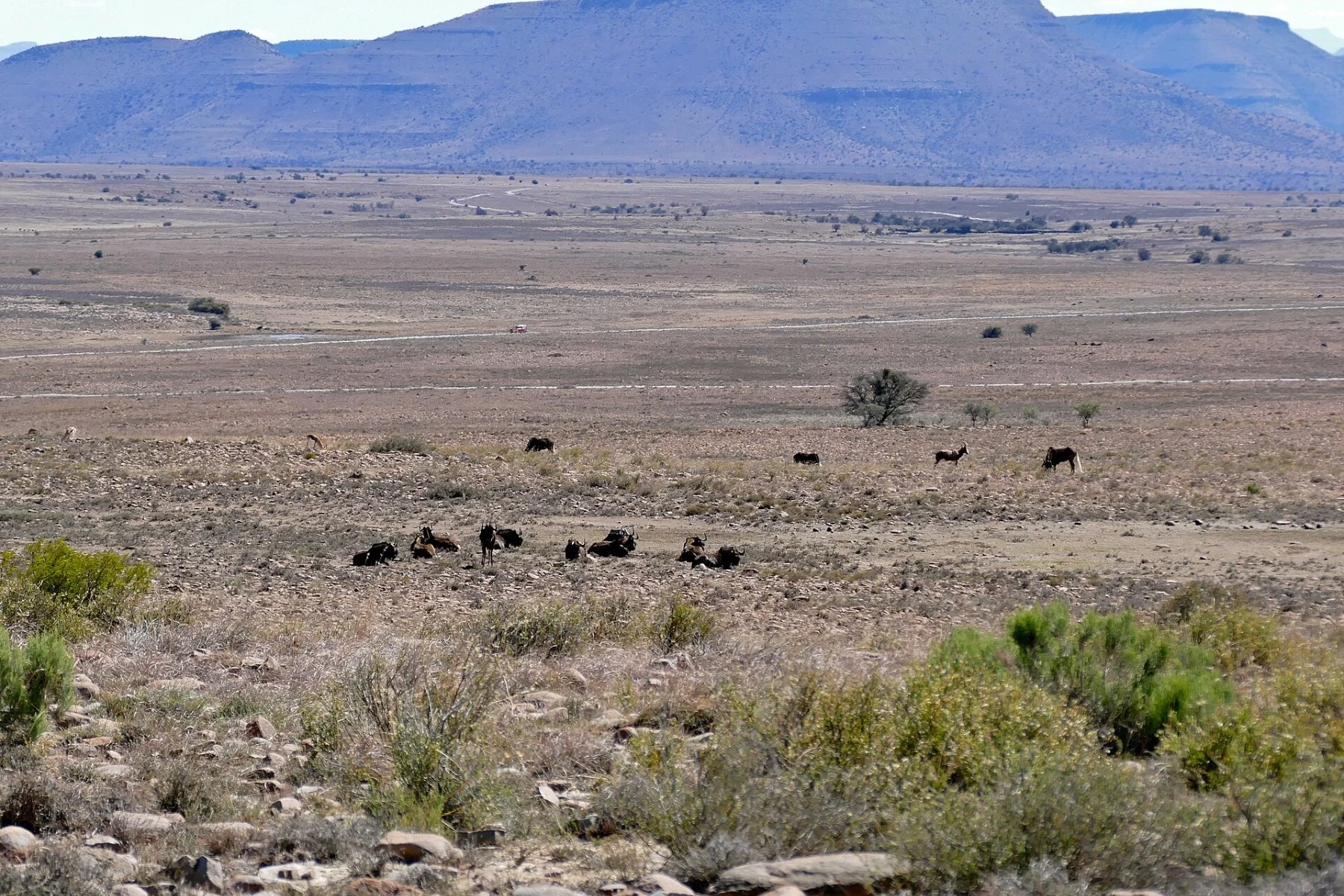
Start before the gate. The entrance is about 1.5 km south of the R61 on good gravel, and the plains on both sides are the place for Northern Black Korhaan, common throughout the park, with Greater Kestrel on the telephone wires. Small drinking pools at the gate draw Red-billed Firefinch, Southern Masked Weaver, Yellow Canary and Red-headed Finch. GoBirding asks visitors to watch for Village Indigobird, a scarce resident, and to view the small dam by the offices, which earns its keep before anyone has paid an entry fee.
The plains: larks, pipits and bustards
The low country is dry Karoo scrub, and GoBirding singles out the Ubejane Loop and the Link Road. Look for Eastern Clapper, Spike-heeled, Melodious and Large-billed Larks, and for both Nicholson’s and African Pipits. Eastern Long-billed Lark occurs too, though GoBirding warns that the birds here look strikingly like Karoo Long-billed Larks. Sickle-winged Chat shares the plains with Familiar Chat, and the 2 need care to separate. Rufous-eared Warbler and Cinnamon-breasted Bunting are common.
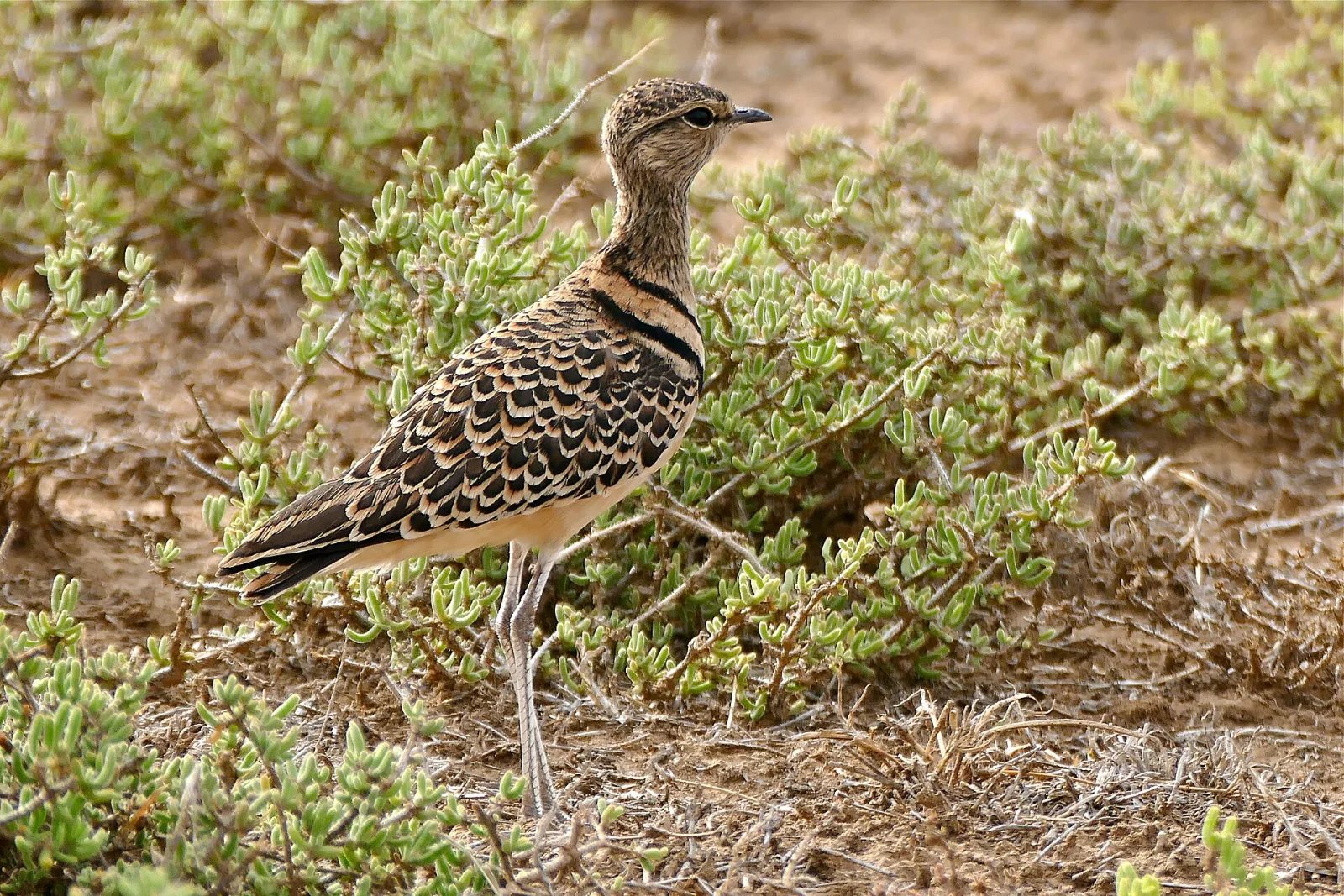
Kori and Ludwig’s Bustards, Northern Black Korhaan and Blue Korhaan can turn up anywhere in the central parts of the park, the Blue Korhaan preferring the grassy stretches of the Link Road. Double-banded Courser is regular throughout, and GoBirding names the lower sections of the Sonnenrust 4×4 trail in the north as best for it. The Juriesdam 4×4 route through the east deserves its own note: Pink-billed Lark and African Quailfinch are common along it and apparently absent from the rest of the park, so the 2 birds have, in effect, chosen a single road and stayed on it.
After the summer rains, when the grasses seed, Lark-like Bunting, Black-headed Canary and Grey-backed Sparrow-Lark move into the grassy areas in what GoBirding calls incredible numbers, with Red-headed Finch and Scaly-feathered Weaver close behind.
The thickets and the high ground
Acacia thicket lines the dry river gullies, above all the Wilgerboomrivier through the centre of the park. GoBirding lists Pririt Batis, Yellow-bellied Eremomela, Acacia Pied Barbet, Grey and Southern Black Tits, African Red-eyed Bulbul, Black-throated Canary, White-browed and Karoo Scrub Robins, Karoo Thrush, Cape White-eye, Chestnut-vented Warbler and Fairy Flycatcher as fairly common here. Common Scimitarbill and Crested Barbet have been confirmed for the park more recently and appear to be spreading; search for both near the Ubejane Loop. Golden-breasted Bunting regularly flushes from the roadside.
The south of the park rises to Bakenkop at 1,957 m and Bankberg at 1,927 m. Drakensberg Rockjumper occurs on those peaks, which are closed to visitors, so it is a bird known to be there rather than one anyone is likely to tick there. The Kranskop Loop climbs as high as visitors may go. Check its ravines and road cuttings for Buff-streaked Chat, Sentinel Rock Thrush, Layard’s Warbler, Ground Woodpecker, Pale-winged Starling, Mountain Wheatear and African Rock Pipit, and listen for Grey-winged Francolin.
Raptors are everywhere. Pale Chanting Goshawk keeps watch from exposed perches, and several pairs of Verreaux’s Eagle nest inside the reserve, often soaring at midday. GoBirding calls Jackal Buzzard, Martial, Booted and African Fish Eagles and Gabar Goshawk fairly common. For Verreaux’s Eagles further afield, see Africa’s big eagles and where to see them.
Camdeboo National Park
Camdeboo, once the Karoo Nature Reserve, covers 14,500 ha in the southern foothills of the Sneeuberg and wraps almost all the way around Graaff-Reinet. GoBirding gives it roughly 250 species. It was ranked an Important Bird Area for 3 reasons: the large Lesser Kestrel roost near the town’s railway station, the Ground Woodpeckers in its kloofs and gorges, and the Blue Crane flocks on the plains. The kestrels, at least, keep a fixed address: by the station.
The plains of the main game-viewing area are good for bustards, and GoBirding says Camdeboo is one of the few places in South Africa where Kori, Ludwig’s and Denham’s Bustards all occur. Karoo Korhaan is usually seen in 2s and 3s on the open, stony ground. Look in the low shrubland for Rufous-eared Warbler, whose habit of dashing across open ground with its tail cocked can make it look, GoBirding notes, like a rodent.
The acacia riverine woodland holds Namaqua Warbler, Layard’s Warbler, Grey Tit, Fairy Flycatcher, Pririt Batis and the sociable Scaly-feathered Weaver. Natural springs are the place to wait for seedeaters, especially Red-billed Firefinch and White-throated and Black-headed Canaries.
The Valley of Desolation and the Nqweba Dam
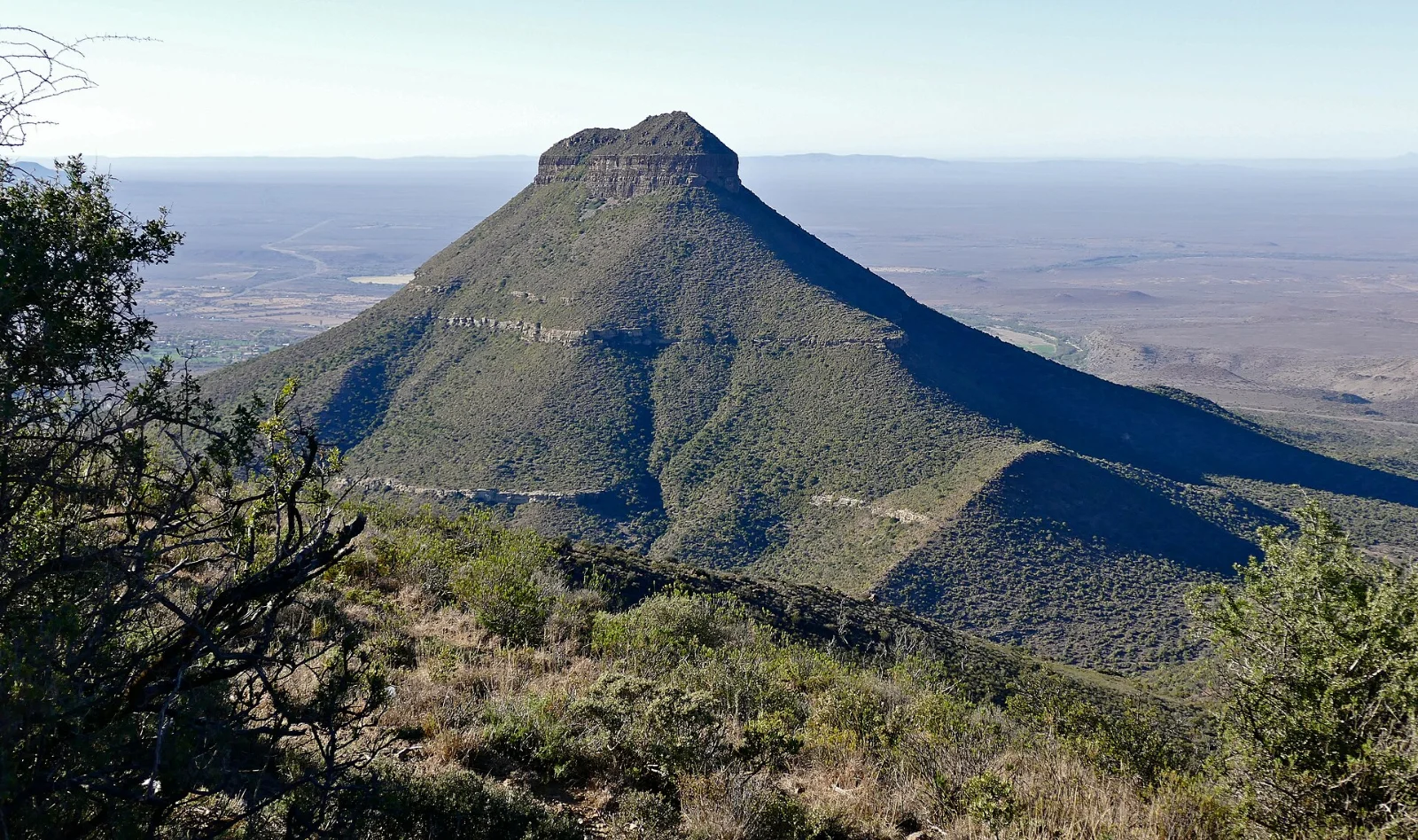
The Valley of Desolation rises to 1,399 m, with Spandaukop at 1,316 m beside it. Pale-winged Starling and Cape Rock Thrush live among the rocks, and several pairs of Verreaux’s Eagle breed here, which makes the viewpoint as good for raptors as it is for the view.
The Nqweba Dam, on the Sundays River, covers 1,000 ha when full. Small flocks of Greater and Lesser Flamingos visit from time to time, Glossy Ibis and Great Crested Grebe are on GoBirding’s list, and the muddy edges hold large numbers of Palearctic waders in summer. Baillon’s Crake and African Grass Owl have occurred historically. For the flamingos’ wider movements, see where to see flamingos.
Nieu-Bethesda, in between
North of Graaff-Reinet, the R61 leaves the N9 about 27 km out of town for Nieu-Bethesda. GoBirding puts the district at about 280 species, with Northern Black and Blue Korhaans common in the grassland and Karoo scrub, Kori and Ludwig’s Bustards recorded regularly and several Secretarybird pairs nesting. After heavy rain, Lark-like Bunting and Grey-backed Sparrow-Lark arrive in numbers. Most of the land is private, so bird from the public gravel roads and stay outside the fences. For the rest of the Karoo, from Karoo National Park to the Tankwa, see birding the Karoo.
Planning a visit
Mountain Zebra is signposted off the R61 between Graaff-Reinet and Cradock. GoBirding gives its gate times as 07:00 to 18:00 from April to September and 07:00 to 18:30 from October to March, and says standard SANParks conservation fees apply and Wild Cards are accepted. The park has a campsite and caravan park, self-catering chalets and a mountain cottage, all self-catering, with a small restaurant and shop at the main rest camp. SANParks runs game drives, night drives, cheetah tracking and walking safaris, and GoBirding notes that SANParks guides know the local birds well. Fuel is available at the rest camp and in Cradock.
Camdeboo’s main gate is 3.8 km out of Graaff-Reinet on the R63 towards Murraysburg. Inside, there are 19 km of gravel roads, 6 picnic sites and 3 hiking trails, from the 1.5 km Crag Lizard Trail to the overnight Driekoppe Trail. Gate times vary month by month: GoBirding gives the game-viewing area as 06:00 to 19:30 in November, January and February, and 07:00 to 17:30 in June. SANParks’ 2026/27 daily conservation fee at Camdeboo is R63 for South Africans, R130 for SADC nationals and R227 for international visitors.
Summer, after rain, is the time for the seedeater irruptions and the waders on the Nqweba Dam. Midday heat flattens the plains, so drive early and late, and give the raptors the middle of the day, when they seem to like it best.
Where to stay
The farm stays in the directory closest to the 2 parks, all BirdLife Recommended or with farm bird lists:
| Place to stay | Where | For birders | From |
|---|---|---|---|
| Aasvogelkrans Farm Cottages & Camping | 6 km from Nieu-Bethesda | BirdLife Recommended, 116-species farm list, Verreaux’s Eagle, Blue Korhaan | R1,760 a night for 2, self-catering |
| Ganora Guest Farm | About 7 km from Nieu-Bethesda | 182-species checklist, Blue Crane and Verreaux’s Eagle nest on the farm | Ask the lodge |
| Karoo Secret Farm Stay | Between Aberdeen and Beaufort West | BirdLife Recommended, signposted Lark Route, Sclater’s Lark | Ask the lodge |
Gate times, fees and road conditions in Karoo parks change, and the birding depends on the rain. Facts were checked on 15 November 2026 with BirdLife South Africa’s GoBirding guides and each listing on Birding Dispatch. Confirm current times and fees with SANParks before you travel.
More from the Journal
 Namib-Naukluft and Sossusvlei for Birders: Dune Lark, Desert Raptors and the Naukluft SpecialsA lark that lives on the dunes and nowhere else, Lappet-faced Vultures nesting in the desert, coursers on the gravel plains and the northern specials around the Naukluft cliffs, in one of Africa's largest parks.
 Lake Baringo and Lake Bogoria Birding: The Owl Walks, the Cliffs and the FlamingosA local guide who knows where every nightjar and eagle-owl slept last night, thorn scrub full of hornbills, a Goliath Heron colony on a rock, and the flamingo lake next door that keeps rising.
 Akagera Birding: Rwanda’s Savanna, Lakes and Papyrus, and the Shoebill ChancesRed-faced Barbet in the southern woodland, Papyrus Gonolek and Carruthers's Cisticola in the swamps, a lake of hippos and lapwings, and a Shoebill that hides in the wetlands more than it shows.
The Pigeon Post
Every Thursday: 1 bird, 1 place to go and 1 place to stay, by email. Sign up and get our printable checklist of the 163 endemics of southern Africa.