
How to Identify Raptors: Shape First, Then Flight, Then Plumage
The brown eagle on the dead tree is rarely the bird you hope it is. A method for southern African raptors, from shape and legs to tails and seasons, and the confusions that catch everyone.
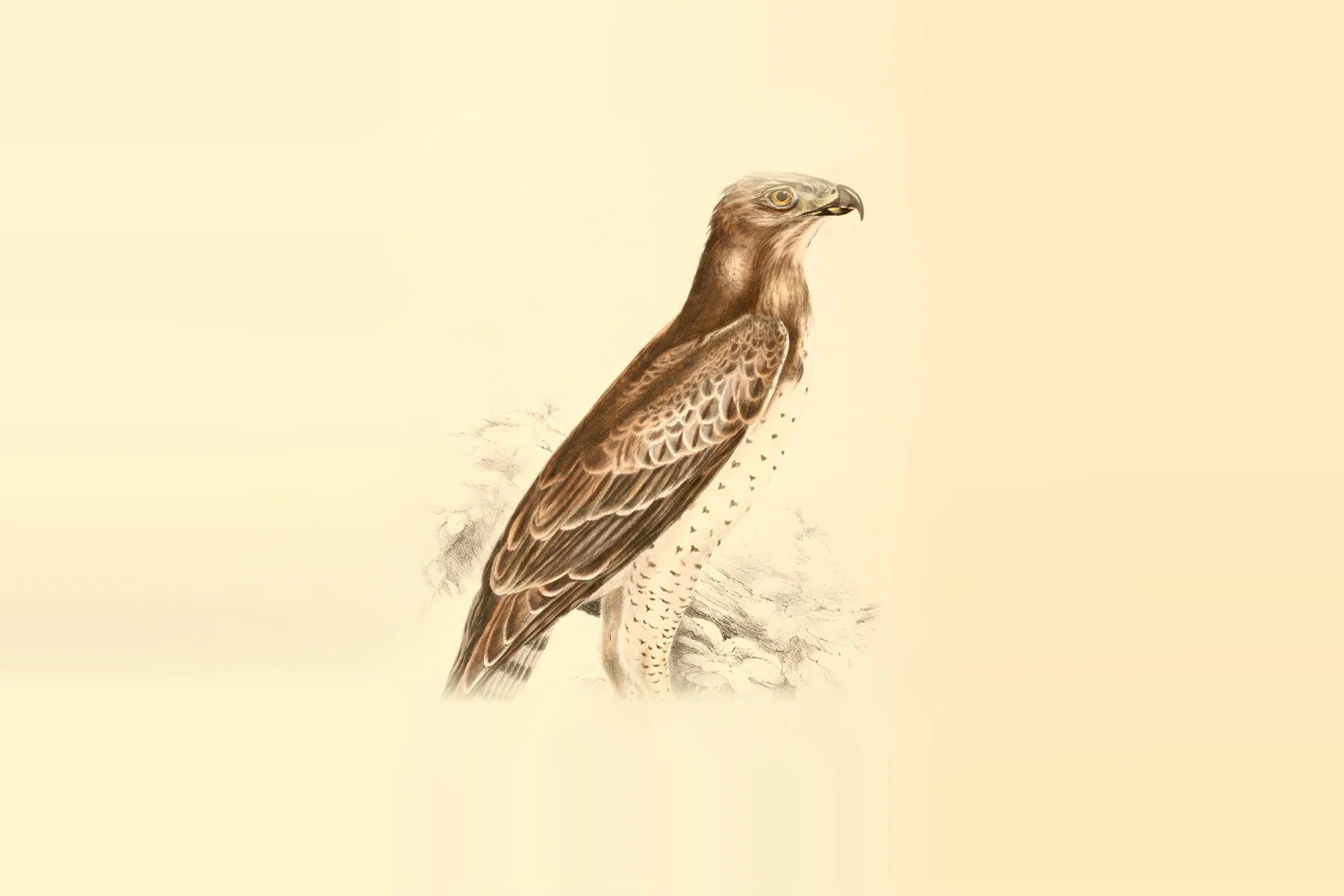
Peter Steyn, quoted in the Kruger Park Birding raptor guide, suggests that the Steppe Buzzard should be called the “fingerprint buzzard”, because no two birds look exactly alike. The same guide describes the bird as anything from light brown to almost black, with whitish secondary feathers, streaked underparts and barred flanks. That is raptor identification in one species: the bird on the pole will not match the picture, and it was never going to.
Happily, colour is the last thing to check, not the first. The guide, on krugerpark.co.za, counts 83 raptor species that occur regularly in southern Africa, about 58 of them common in Kruger. They range from the Lappet-faced Vulture, at up to 7.9 kg with a 2.8 m wingspan, to the Pearl-spotted Owlet at about 65 g. Size, shape, legs, tail and behaviour narrow the field long before plumage needs to.
A note on names. BirdLife South Africa’s 2026 checklist now lists the migrant buzzard as Common Buzzard (Buteo buteo); Biodiversity Explorer still files it as Steppe Buzzard, with Buteo buteo given as the wider species. This guide uses the checklist name, and the old one where a source does.
Start with the group, not the species
Ulrich Oberpreiller and Burger Cillie’s Raptor Identification Guide for Southern Africa sorts birds of prey into 11 groups by body shape rather than by name, and krugerpark.co.za builds its raptor pages on the same groups. Put the bird in a group first and the shortlist shrinks from dozens to a handful.
| Group | What the shape tells you | Examples |
|---|---|---|
| Eagles and hawk-eagles | Large, powerful, legs feathered to the toes | Martial, Tawny, Wahlberg’s, African Hawk Eagle |
| Snake eagles | Medium to large, bare lower legs | Bateleur, Brown and Black-chested Snake Eagles |
| Buzzards | Mostly medium-sized, bare lower legs, hunt from perches | Common Buzzard, Jackal Buzzard |
| Kites | Long wings, expert fliers | Yellow-billed Kite, Black-winged Kite |
| Falcons and kestrels | Smallish, fast; falcons stoop, kestrels hover | Lanner, Peregrine, Amur Falcon, Lesser Kestrel |
| Harriers | Slender, long-winged, over grassland and marsh | Montagu’s, Pallid, African Marsh Harrier |
| Goshawks and sparrowhawks | Short wings for weaving through trees | African Harrier-Hawk, Gabar Goshawk, Shikra |
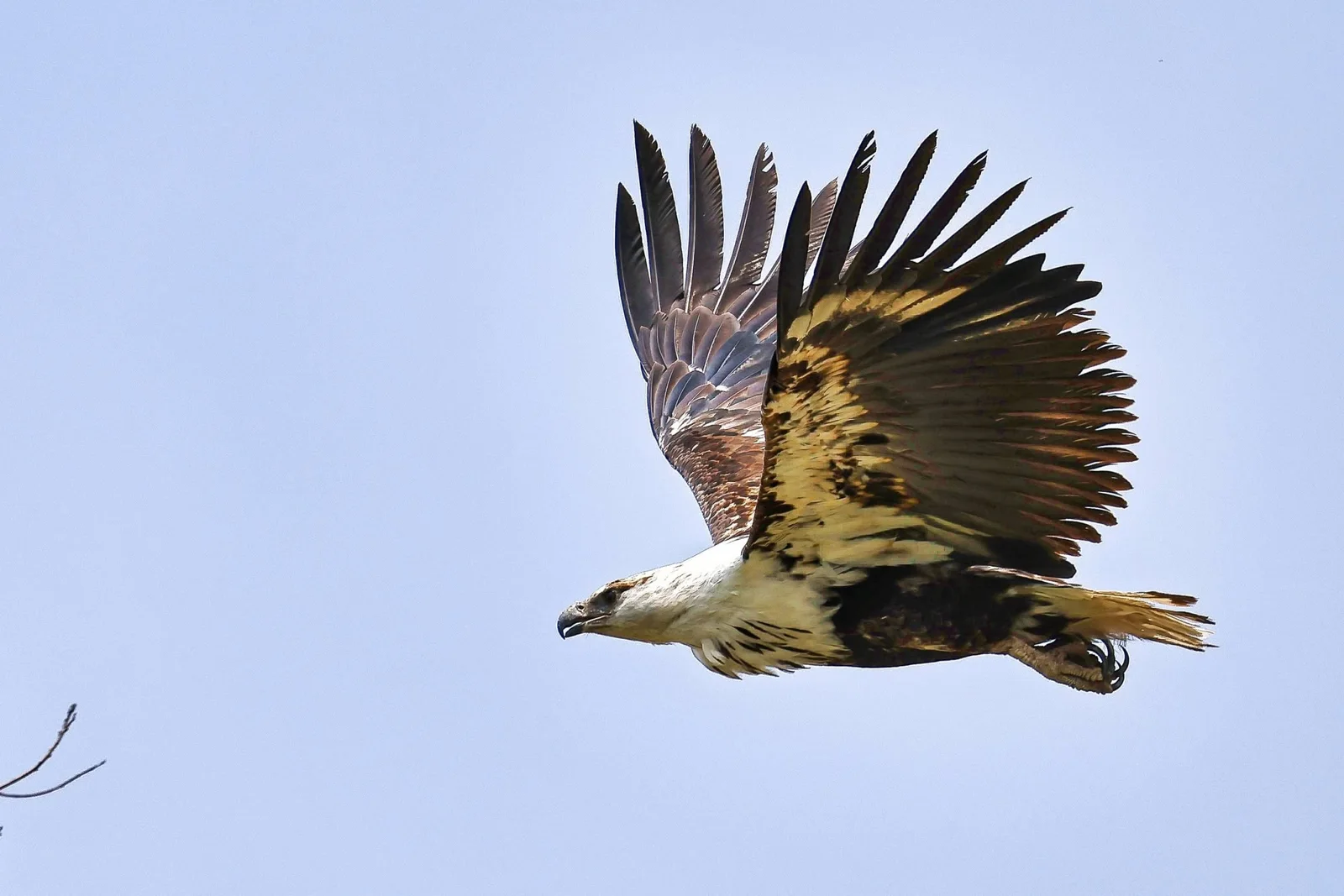
| Fish-eating raptors | Large, near water, take fish at the surface | African Fish Eagle, Osprey |
| Vultures | Robust scavengers | White-backed, Lappet-faced, Cape Vulture |
| Secretarybird | Tall, crested, walks the veld | The only one in its group |
| Owls | Mostly nocturnal | Spotted Eagle-Owl, Pearl-spotted Owlet |
Look at the legs
The single most useful clue on a perched bird is the leg. True eagles have legs feathered all the way down, like trousers; snake eagles and buzzards have bare lower legs. A brown bird with bare whitish legs, a piercing yellow eye and an upright stance is a Brown Snake Eagle, not an eagle of the Tawny kind, and a juvenile Bateleur also has bare legs, with a short tail to match. A brown eagle on unusually thin-looking legs, with the feathering looking only half there, is the Lesser Spotted Eagle’s signature at rest. The trousers come before the face.
Watch how it flies
Each group has its own way of moving, and the guide’s descriptions are worth carrying in your head. Falcons swoop; kestrels hover before they drop. The Black-winged Kite, grey and white with black shoulders, hovers about 10 m above the ground, while Montagu’s Harrier glides on long, narrow wings usually no more than 3 m above the grass. Goshawks and sparrowhawks have short wings that let them weave through a canopy, and usually stay in denser woodland. Buzzards, though strong fliers, spend much of their time on a perch, dropping in a smooth glide when they spot something.
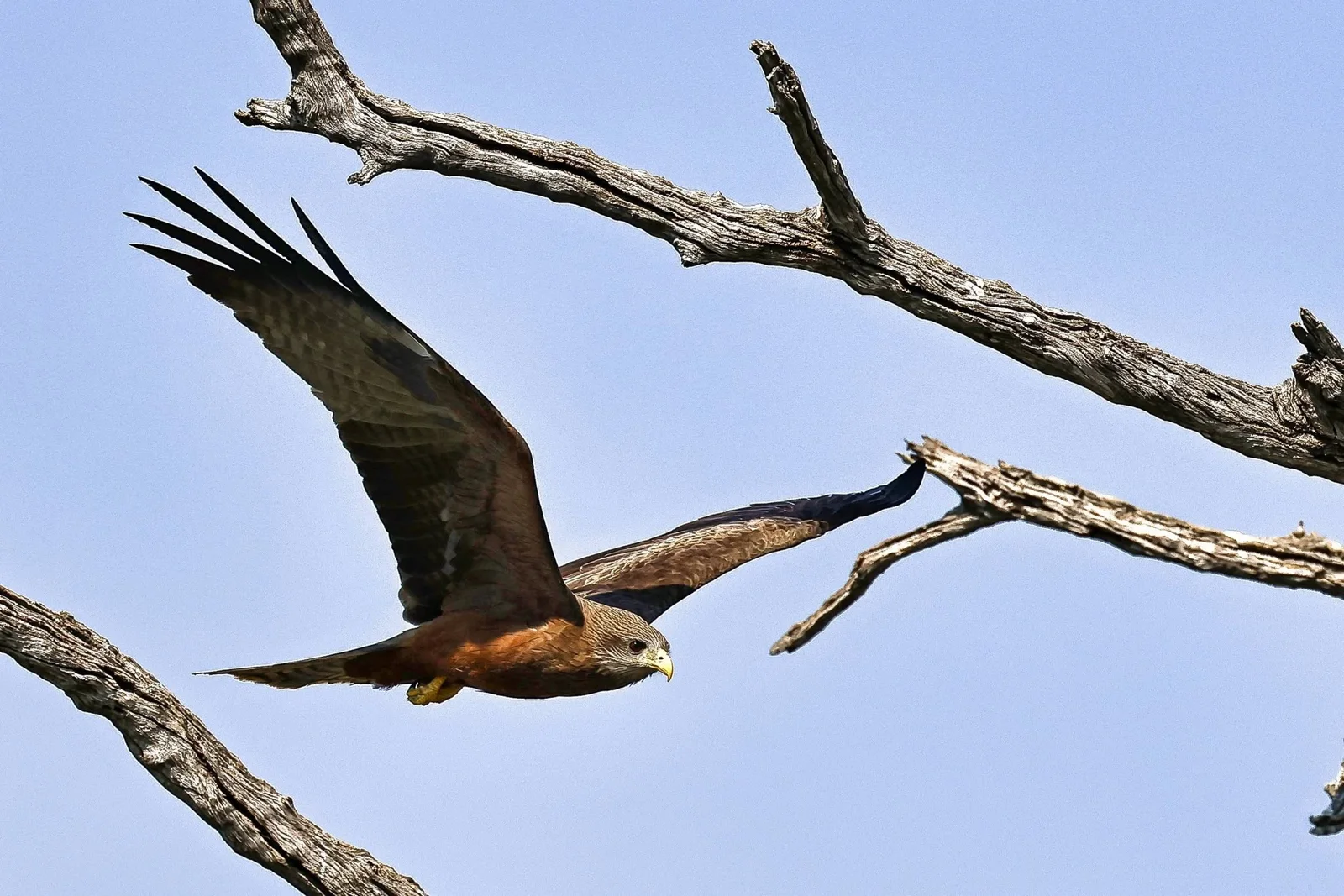
Then look at the tail, which is often the clincher in flight. The Yellow-billed Kite has a V-shaped tail it uses to steer. Wahlberg’s Eagle shows a noticeably narrow, square-ended tail; the Lesser Spotted Eagle a short, rounded one; the Booted Eagle a tail shorter and squarer than Wahlberg’s, plus small white shoulder patches when perched, known as its “landing lights”. The African Crowned Eagle has well-rounded wings and a long barred tail, built for forest work.
Check the calendar
Season rules out more birds than plumage does. Many of the confusing brown raptors are migrants, and the dates in the Kruger guide and Biodiversity Explorer are clear. The Yellow-billed Kite arrives in Kruger from about August and leaves after the last rains, usually in March. Wahlberg’s Eagle arrives in August or September and goes north again in March or April. The Common Buzzard reaches southern Africa from late October into November and leaves in late February and March. Steppe Eagles arrive in late October or early November and leave in late March or early April, and Lesser Spotted Eagles fly south from mid-October. Among the harriers, Montagu’s is here from about September to March and the Pallid from November to February.
So a big, dark eagle with a long yellow gape in July is not a Steppe Eagle, whatever the field guide page says at first glance. Summer is also when the confusions pile up, because termites emerging after rain draw Steppe Eagles, Lesser Spotted Eagles and Yellow-billed Kites to the same feast.
The confusions that catch everyone
Tawny, Steppe and Wahlberg’s Eagles. The Kruger guide counts 7 brownish eagles with yellowish bills that are easily mixed up, and warns that the juveniles of some species are easily taken for adults of another. For the big pair, look at the gape, the yellow fleshy line at the corner of the mouth. On a Tawny Eagle it reaches only to the middle of the eye; on a Steppe Eagle it runs to the back of the eye. The Steppe Eagle is also darker and more uniform, with a noticeably barred tail in adults, and is only here in summer. The Tawny is paler, variable and shaggy, with pale yellow eyes, and is resident. Wahlberg’s is smaller and comes in many shades of brown, but its narrow, square tail gives it away in flight. BirdLife South Africa’s checklist rates the Tawny Eagle Endangered in the region, which makes each one worth a careful look.
Common Buzzard and Jackal Buzzard. The fingerprint buzzard is variable but usually shows whitish secondaries, streaked underparts and barred flanks. The Jackal Buzzard has a distinct rufous chest and tail, black-and-white underwings and a barred belly, and a high yelping call like a black-backed jackal’s. It is more of an escarpment bird than a Lowveld one; in Kruger it is rare enough that the guide doubts it belongs on the park list at all. The checklist adds a third, the Forest Buzzard, which is endemic to South Africa, Lesotho and Eswatini.
Yellow-billed Kite and Black Kite. Yellow-billed Kites are common summer visitors; the Kruger guide calls the Black Kite a rare Eurasian vagrant there. BirdLife South Africa’s checklist treats them as separate species, Milvus aegyptius and Milvus migrans. Start with the bill and the season, and expect the Yellow-billed.
Lanner and Peregrine Falcons. The Lanner has a rufous forehead and crown, grey upperparts and plain creamy to rufous underparts, and looks pinkish below in flight. The Peregrine is smaller and more robust, with a black forehead and crown, dark upperparts and a white chest finely barred with rufous. Studies quoted in the guide put the Peregrine’s diving stoop at anywhere from 160 to 410 km/h, which may explain why it is seen so briefly.
Montagu’s and Pallid Harriers. Both are grey migrant harriers of open country. Montagu’s has a streaked belly and black wingtips; the Pallid has a plain white belly.
A field routine
When a raptor appears, the order of questions matters more than the answers to any one of them.
| In this order | What to note |
|---|---|
| Size and group | Eagle, buzzard, kite, falcon, harrier, goshawk |
| Legs | Feathered to the toes, or bare |
| Behaviour | Perched, soaring, hovering, quartering low, stooping |
| Tail | Forked, square, rounded, long or short |
| Head and bill | Gape length, eye colour, cere, crest |
| Season | Migrant months or resident |
| Plumage | Last, and with care |
Photograph the bird from more than one angle if you can, especially the underwing and tail in flight, and note where and when it was. Our guide to Africa’s big eagles covers the 4 large eagles in detail, the vultures guide the scavengers, and the Kruger birding guide the park where 58 raptor species are common enough to practise on.
No places to stay are named in this guide; any of the Kruger and Greater Kruger roosts in the Kruger guide will give a summer’s worth of brown eagles to argue about.
Plumage varies with age, sex and individual, and some birds stay unidentified. Facts were checked on 15 November 2026 with krugerpark.co.za’s Kruger Park Birding raptor guide, Biodiversity Explorer and BirdLife South Africa’s 2026 checklist.
More from the Journal
 Do You Need a Spotting Scope? When a Scope Helps, What to Look For and Where It MattersA scope turns grey dots on a mudflat into Curlew Sandpipers and Red Knots. When it earns its place in the car, the features that matter, and why 60x fails at noon.
 Your First Birding Safari: What to Expect, From the 05:30 Gate to the Evening ListHow a birding safari day runs, what the guide does, why the vehicle stops for a brown bird when there is an elephant over there, and the other things first-timers find odd.
 How to Log Your Bird Sightings: eBird, BirdLasser or SABAP2?eBird wants short checklists with counts, BirdLasser wants the same bird logged again and again, and SABAP2 wants 2 hours in one square. What each is for, and how to feed all 3.
The Pigeon Post
Every Thursday: 1 bird, 1 place to go and 1 place to stay, by email. Sign up and get our printable checklist of the 163 endemics of southern Africa.