
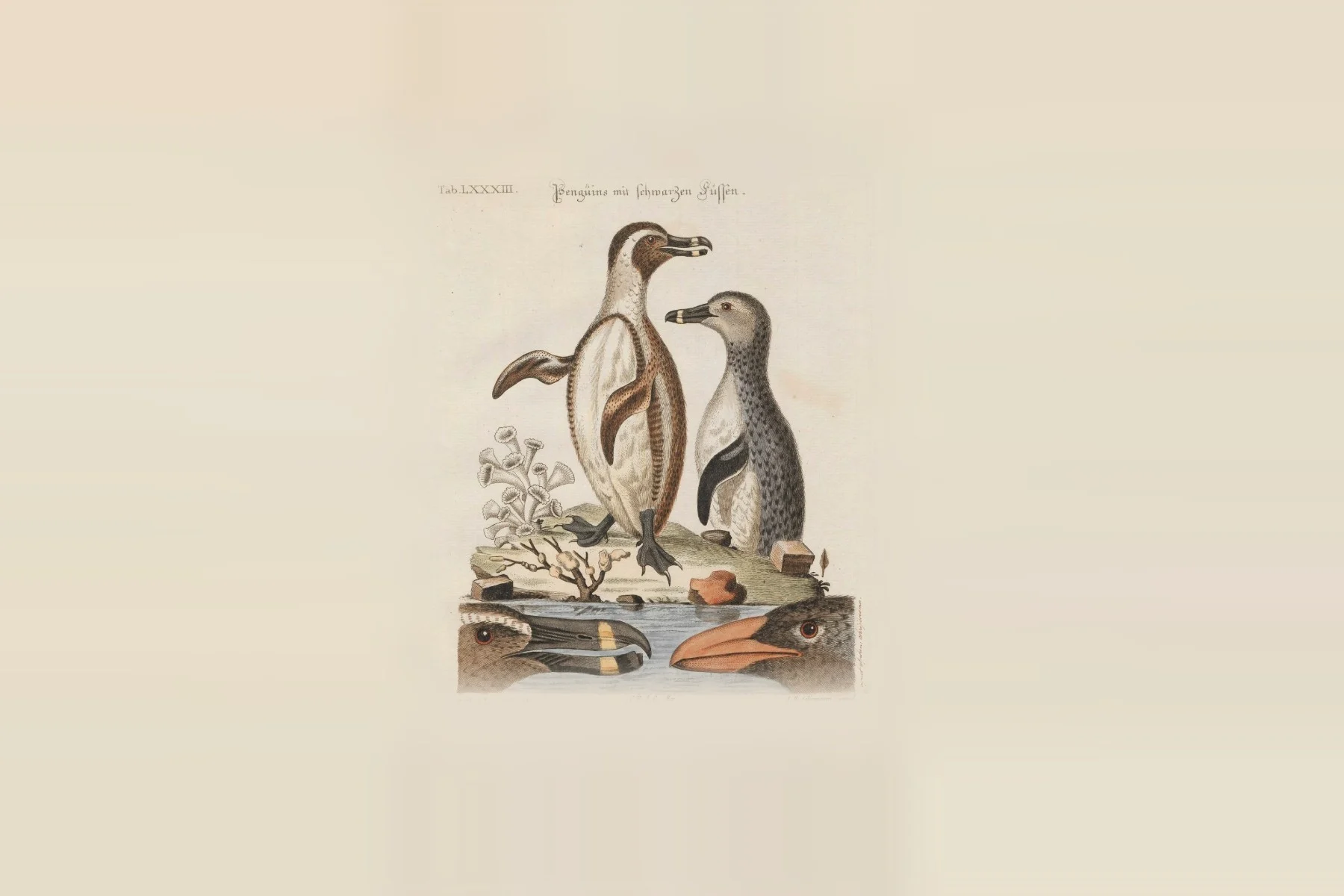
Where to See African Penguins: Boulders, Stony Point and the Islands Behind the Decline
Two mainland colonies near Cape Town where penguins nest a boardwalk away from the beachgoers. Where they are, the 2026 fees, when the birds breed, and why the islands offshore matter more.
In June 2026 the SANParks team that counts the penguins at Boulders, in Simon’s Town, recorded 790 breeding pairs of African Penguins. That was 92 pairs more than in 2025, and SANParks reckons the colony now holds about 2,528 birds, roughly 8 to 9% of South Africa’s whole population, living a short waddle from a suburban beach.
That one good year sits inside a long fall. SANParks says the first full census, in 1956, counted about 150,000 breeding pairs, and that only 26,000 pairs were left in 2009. On 28 October 2024 the IUCN moved the species from Endangered to Critically Endangered, the first of the world’s 18 penguins to reach that category, with fewer than 10,000 breeding pairs left in the wild. SANCCOB, the seabird rescue organisation, puts the loss at 97% of the population.
The sites at a glance
| Site | What you see | Best for | 2026 notes |
|---|---|---|---|
| Boulders, Simon’s Town | 790 pairs, 3 boardwalks and a viewing area | Close views from boardwalks | R282 international adult, R57 South African, from 1 November 2026 |
| Stony Point, Betty’s Bay | Boardwalk through a growing colony | Penguins plus 3 breeding cormorants | Open 08:00 to 16:30, boardwalk closes at 16:00 |
| Bird Island, Lambert’s Bay | A Cape Gannet colony | Gannets, not penguins | CapeNature says it has not yet received penguins |
| De Hoop Nature Reserve | A new colony behind a predator fence | A conservation project to follow | First chicks in 2022 |
Boulders, Simon’s Town
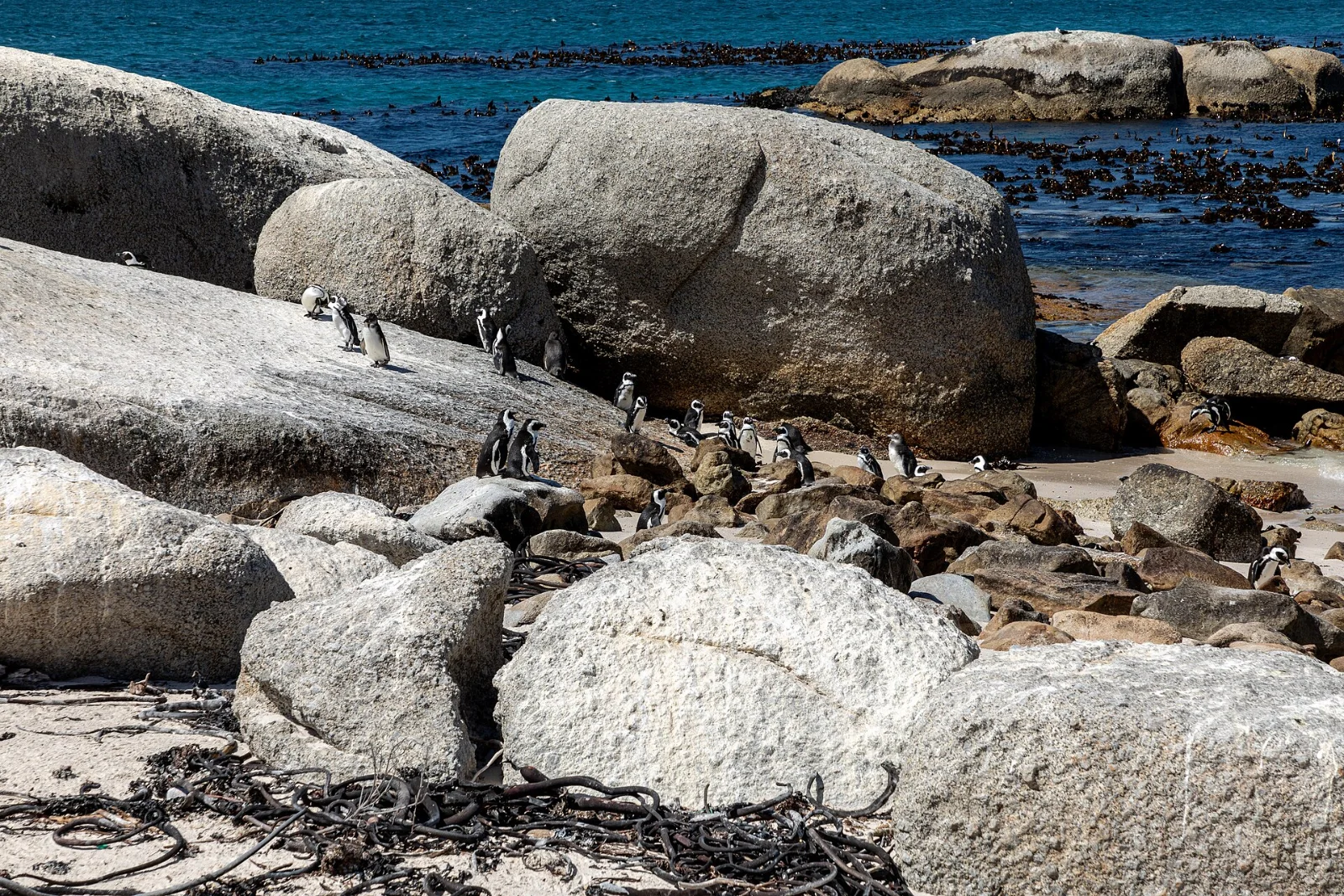
SANParks calls Boulders a popular international tourist destination, and it is a young colony, younger than many of the birders who visit it. SANParks says penguins settled there in 1983, moving in from the island colonies nearby, and numbers grew to 3,900 birds by 2005 before falling to about 2,100 in 2011. The 2026 count suggests the colony has started to recover, though SANParks did not call one good year a turnaround.
The Boulders section of Table Mountain National Park has 3 beaches, 1 penguin viewing area and 3 boardwalks. The boardwalks keep visitors off the nesting ground, and SANParks asks you to stay on them inside the viewing area and never to touch or feed the birds, whose bills are sharp. They look like small waiters; they do not behave like them. Boulders also sits inside a no-take zone of the park’s Marine Protected Area, so nothing may be taken from the water or the rocks.
The daily conservation fee from 1 November 2026 to 31 October 2027 is R282 for international adults and R138 for children aged 2 to 11. SADC nationals pay R118, and South African citizens and residents R57. The gate is cashless, so bring a card. Parking is limited, and SANParks suggests arriving early in the summer months, before the penguins have an audience. For the rest of a Peninsula day, with Cape Point, Kirstenbosch and the Strandfontein pans, see our Cape Peninsula birding guide.
Stony Point, Betty’s Bay
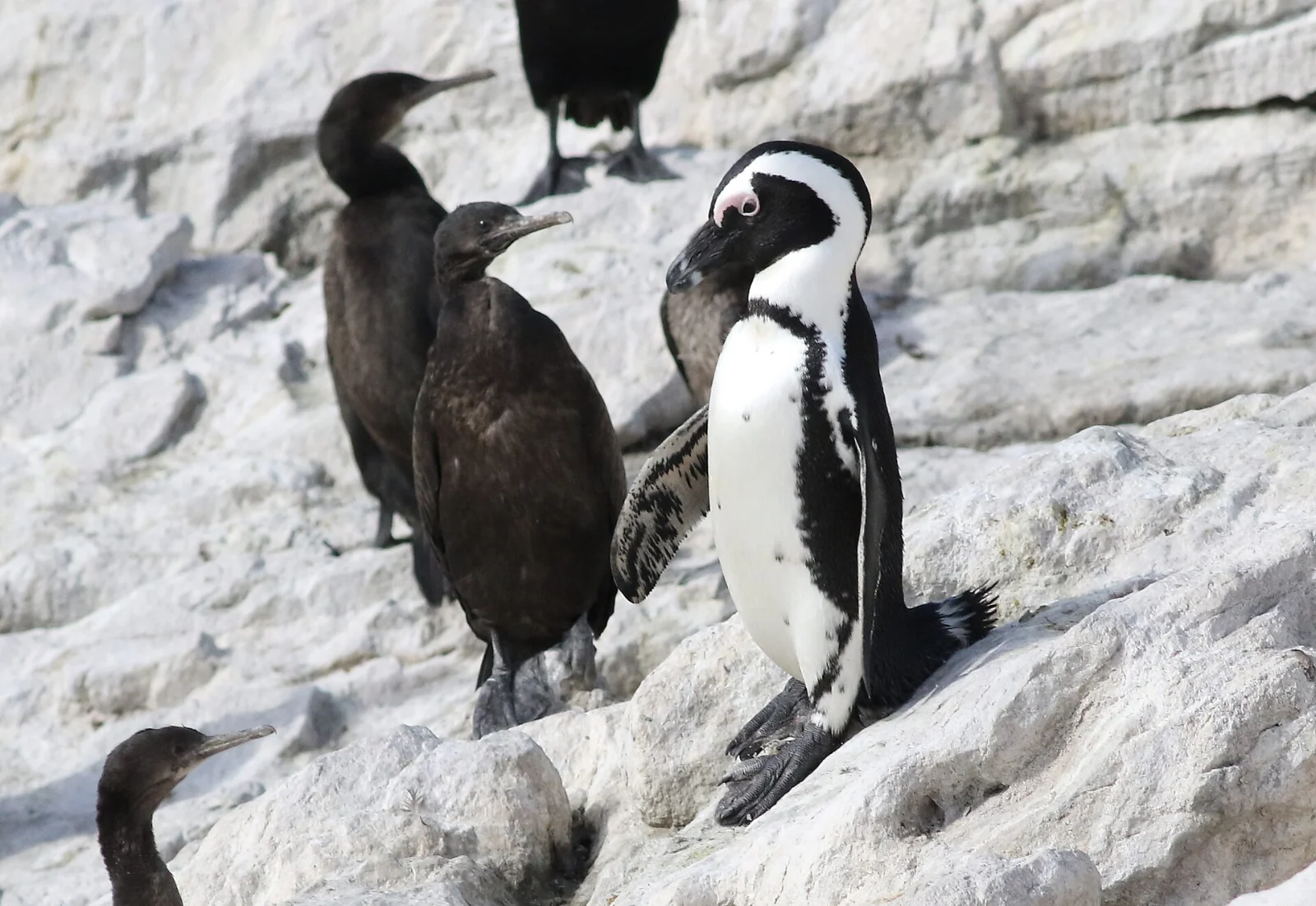
Stony Point is CapeNature’s land colony on the far side of False Bay, in the village of Betty’s Bay in the Overberg. CapeNature calls it the third-largest African Penguin breeding colony in the world and says it has shown a measurable increase in breeding pairs. A boardwalk runs through the colony, so you watch the birds at their burrows without walking among them, and they carry on as if you were not there.
It is also the better site for a birder, because the penguins share the place with a full set of cormorants. CapeNature lists Bank, Cape and Crowned Cormorants breeding on the outer rocks, with White-breasted Cormorants nearby, and Hartlaub’s and Kelp Gulls foraging through the colony. The colony stands on the site of the old Waaygat whaling station, and some of its remains are still there: penguins living on an industrial heritage site.
The reserve is open from 08:00 to 16:30. The last permit is issued at 15:45 and the boardwalk closes at 16:00, so a late-afternoon arrival does not work. The penguins keep office hours, or at least the boardwalk does. CapeNature puts the drive from Cape Town at 70 to 90 minutes, depending on traffic through Somerset West. The Una Eco Venue inside the reserve is a day venue for groups and has no beds. Our guide to places to stay within 2 hours of Cape Town covers the Overberg stays nearby.
When to go
Both colonies hold birds all year, but the breeding season changes what you see, from adults standing about to fluffy chicks in a group. The Iziko Biodiversity Explorer, drawing on the Roberts field guide, gives egg-laying at Stony Point as peaking from February to August. Both parents share incubation for 38 to 41 days, chicks gather in crèches, a penguin playgroup, at about a month old, lose their down at 41 to 45 days and leave the nest at 64 to 86 days. Breeding adults usually forage within 3 km of the colony, which is why food close to the colonies matters so much. In the non-breeding season, with no chick to feed, they may travel about 400 km.
A visit to Stony Point between late summer and winter therefore falls in the main laying months, with birds on nests and, later, downy chicks.
The islands behind the numbers
The 2 mainland colonies are the ones you can walk to, but most African Penguins breed on islands. Roberts gives Dassen Island, off the West Coast, as the largest colony on record, at up to about 21,400 pairs. By the 2024 breeding season, GroundUp reported, Dassen had 2,300 pairs and was the largest colony left. St Croix Island in Algoa Bay, off Gqeberha, had been the biggest before numbers crashed to 1,350 pairs in 2024, and Bird Island in the same bay held 1,650 pairs.
Bird Island at Lambert’s Bay, on the West Coast, is a different story. CapeNature’s page for the reserve says, rather hopefully, that it has not yet received penguins, and today the island is a Cape Gannet colony that you can walk to; see our guide to the seabird colonies at Lambert’s Bay and Bird Island.
Why the numbers keep falling
Food is the main problem. SANCCOB and BirdLife South Africa say the penguins depend on sardines and anchovies, and that commercial purse-seine fishing competes with them for those fish around the breeding islands, made worse by climate change shifting the fish. Hungry adults breed less well, and the young starve.
In 2024 the 2 organisations took the government to court to force larger no-fishing zones around 6 colonies. On 12 March 2025, GroundUp reported, the government, the conservation groups and the pelagic fishing industry settled. The agreement set a 20 km closure around Bird Island in Algoa Bay and around Robben Island, a new closure around St Croix, a closure at Stony Point that applies to all fishing vessels, and kept the existing rules at Dassen and Dyer Island. GroundUp also cited a prediction that without intervention the species could be extinct in the wild by 2035.
There is one project designed to put penguins nearer the fish, rather than waiting for the fish to come back. At De Hoop Nature Reserve, east of Stony Point, penguins bred from 2003 to 2008 until caracal drove them off. CapeNature, BirdLife South Africa and SANCCOB fenced the site against predators and release young penguins there so they return to breed. CapeNature reported the first chicks in 2022, and in September 2023 the same pair was raising 2 more.
Watching without harm
Stay on the boardwalks at both colonies and never feed or touch a penguin. Do not use a flash at a nest; the birds did not ask for a photo shoot. If you find a penguin that is oiled, injured or obviously in trouble, SANParks asks visitors to call SANCCOB on +27 (0)21 557 6155 rather than handle it.
Where to stay
These stays put you within reach of Boulders or Stony Point:
| Place to stay | Where | For birders | From |
|---|---|---|---|
| Avian Leisure | Simon’s Town, Western Cape | Above Boulders Beach, BirdLife Recommended, fynbos garden feeders | Ask the lodge |
| Lark House | Glencairn Heights, False Bay coast | BirdLife Recommended, 90+ species from the decks | Ask the lodge |
| Oudebosch Eco Cabins | Kogelberg Nature Reserve, near Kleinmond | CapeNature cabins near Stony Point, reserve bird checklist | R1,730 a studio for 2, self-catering |
| Benguela Cove Lagoon Wine Estate | Bot River Lagoon, Overberg | BirdLife Recommended, lagoon cruise, Bank Cormorant named | Ask the lodge |
Fees, opening hours and census figures change. Facts were checked on 14 November 2026 with SANParks’ Boulders and Table Mountain National Park fee pages and its June 2026 census release, CapeNature’s Stony Point, Lambert’s Bay Bird Island and De Hoop pages, SANCCOB, GroundUp and each place’s listing on Birding Dispatch. Check the current fee with SANParks or CapeNature before you go.
More from the Journal
 Woodpeckers of Southern Africa, Including the One That Doesn’t Need TreesSouthern Africa's woodpeckers, from the Cardinal in every bushveld tree to the Ground Woodpecker that lives on treeless mountain slopes and eats almost nothing but ants.
 Where to See a Taita Falcon: the Strijdom Tunnel, the Blyde Cliffs and the Batoka GorgeA stocky falcon smaller than a pigeon, a handful of cliffs and surveys that keep coming back empty. Where it still nests, how to look, and the 2 roosts beside its cliffs.
 Where to See a Southern Bald Ibis: the Breeding Cliffs, Dullstroom, Wakkerstroom and LesothoA red-capped grassland ibis that nests on cliffs over waterfalls and feeds on burnt veld and maize stubble. The colonies you can watch, the fields to scan, and where to stay.
The Pigeon Post
Every Thursday: 1 bird, 1 place to go and 1 place to stay, by email. Sign up and get our printable checklist of the 163 endemics of southern Africa.