
Seabird Colonies You Can Walk To: Lambert’s Bay and Bird Island
Bird Island at Lambert's Bay is the only Cape Gannet colony in the world that visitors can walk to. When to go, what the hide shows you, what it costs, and the West Coast and Cederberg stays to base yourself at.
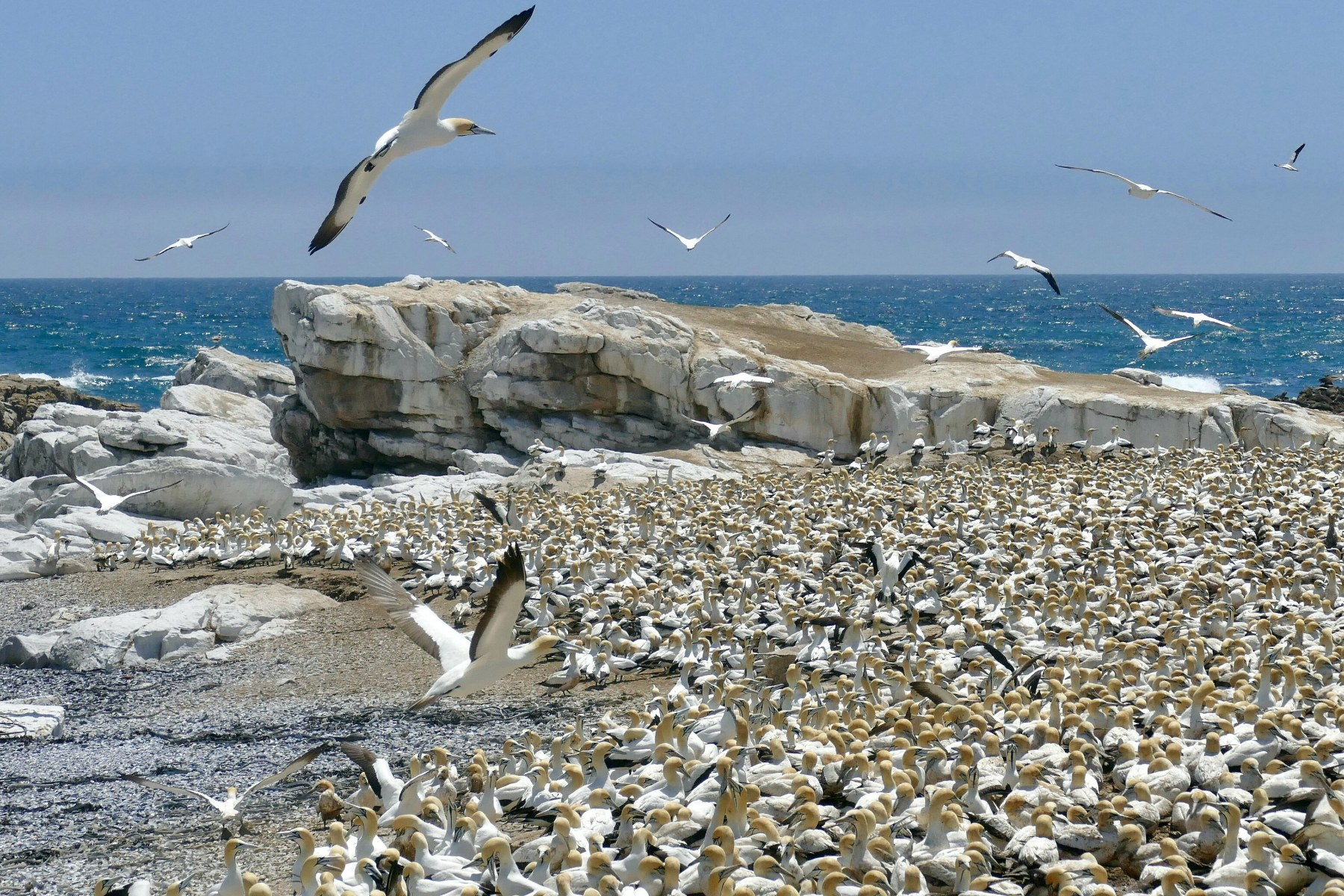
Cape Gannets breed on 6 islands in the world, 3 off Namibia and 3 off South Africa. All but one are out at sea. Bird Island at Lambert’s Bay has been joined to the mainland by a concrete harbour wall since 1959, and CapeNature calls it the only breeding site that the public can reach easily. Park at the harbour, buy a permit at the gate and walk about 100 m along the breakwater, and the colony is in front of you. You will probably smell it a little before that.
The island also has breeding cormorants, roosting terns and seabirds offshore in a blow, the town has a wetland with flamingos, and the Cederberg fynbos lies inland on the road home, for anyone whose list still has room after more than 40,000 gannets.
At a glance
| Stay | Area | What it offers birders | From |
|---|---|---|---|
| Rocherpan Nature Reserve | Coast road, north of Velddrif | 3 hides on the vlei, 183 species | R1,430 a cabin, self-catering |
| de Pakhuys | Cederberg, near Clanwilliam | Birding page; Cape Rockjumper, Protea Canary | Cottages, cabins, camping |
| Enjo Nature Farm | Biedouw Valley, Cederberg | Checklist of 123 species | R140 per adult, camping |
| Kromrivier Cederberg Park | Cederberg | 235 species in the Cederberg IBA | R1,250 a tent for 1 (winter 2027) |
| Mount Ceder | Cederberg | Top 8 bird list, early birding | Villas and tented suites |
| Farr Out Guest House | Paternoster | Feeders at the veranda | R820 pp, room only (winter 2026) |
The island and the hide
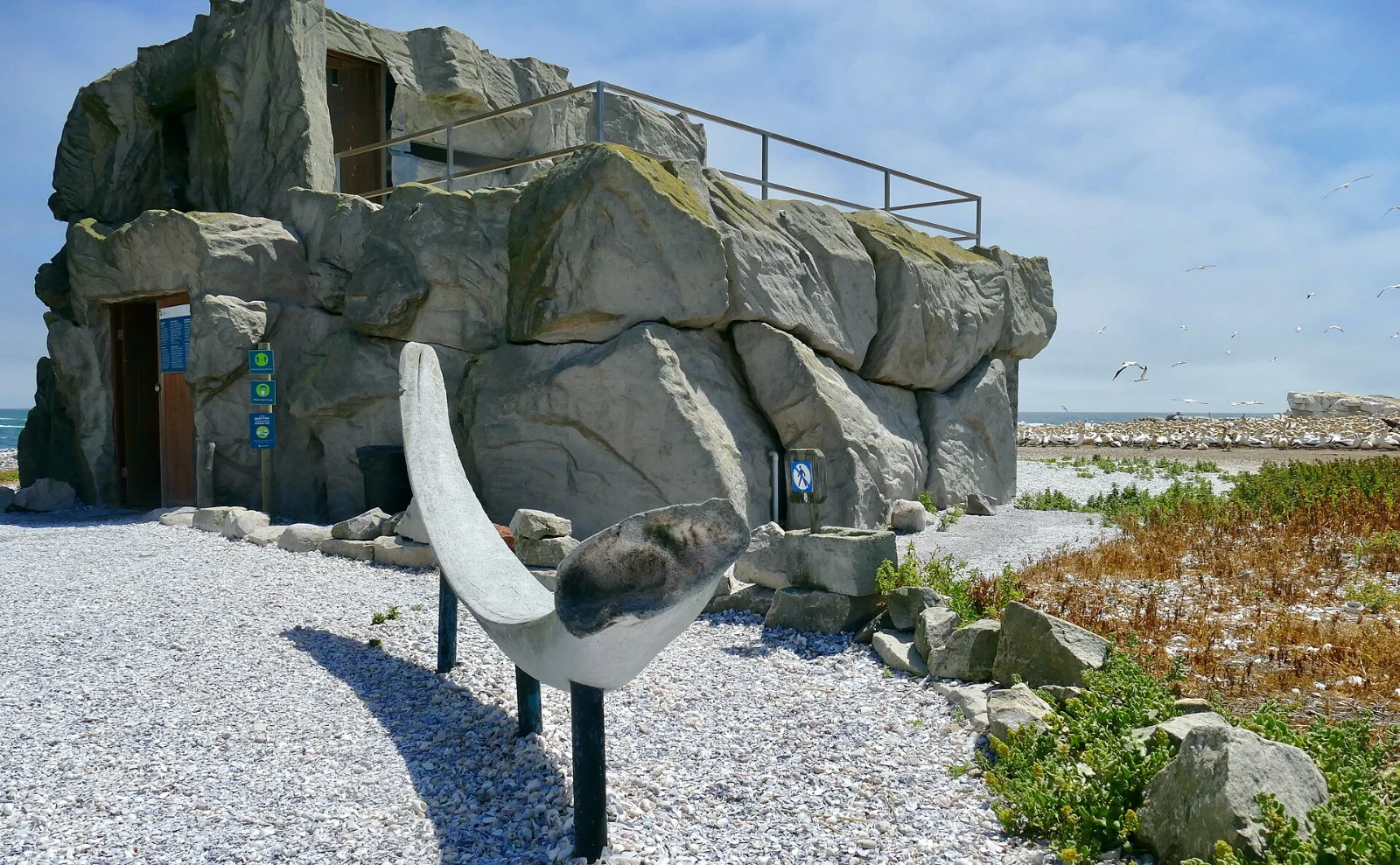
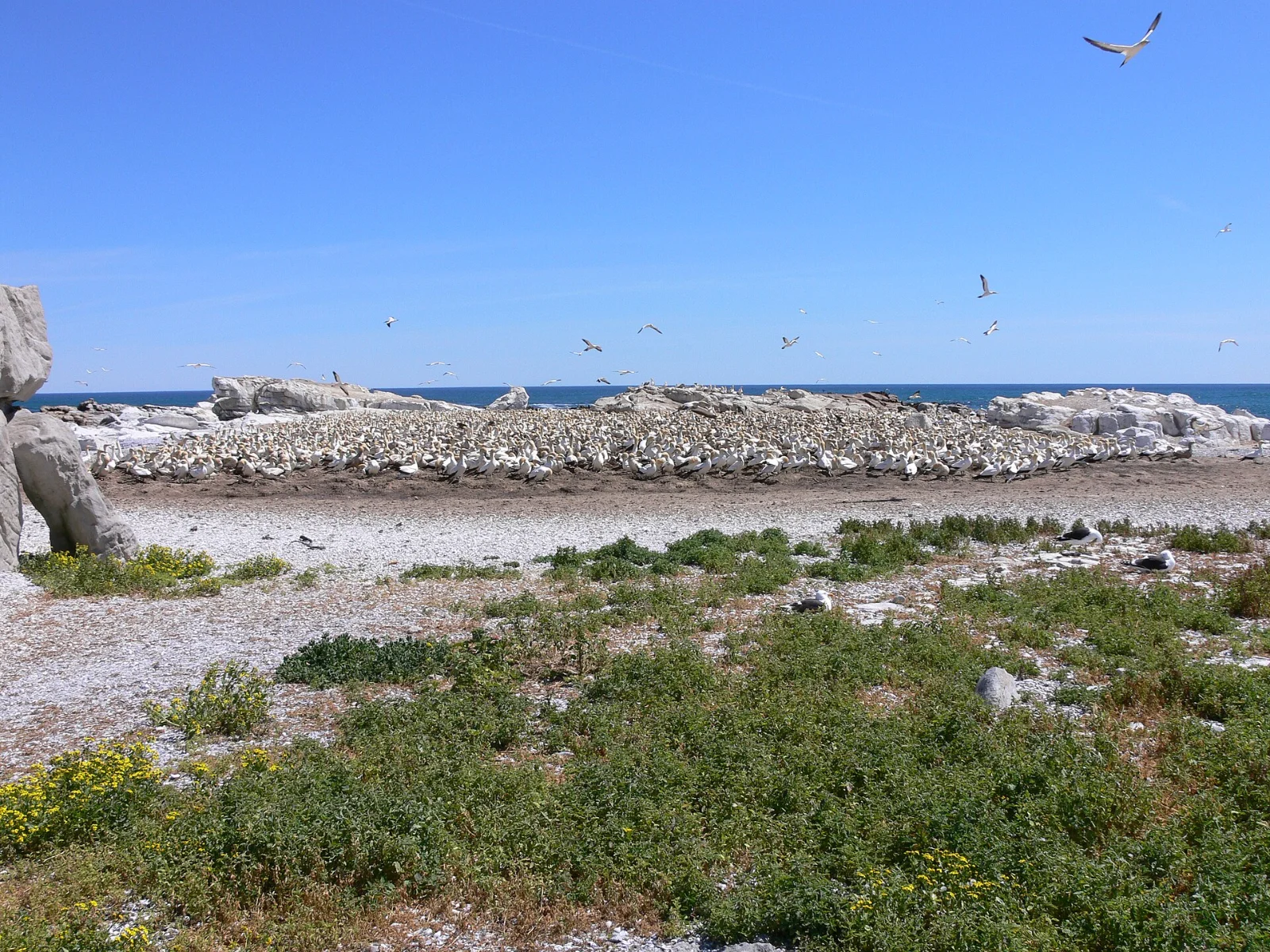
Bird Island covers about 3 ha and rises only 7.6 m above the sea, according to BirdLife International’s Important Bird Area account. The gannets nest as a single dense colony in the centre, packed in tight. Visitors were fenced out of the colony edge in 1974, after people walking there made birds desert their nests, and a viewing facility followed in 1998. Today CapeNature runs a hide and gannet lookout with interpretive signs, and a museum of seal, whale and seabird skeletons known as the Bone Box.
From the hide the birds are close enough to watch the greeting display, in which pairs point their bills skywards and tap them together, and to see the pale blue eye that gives the species its look. Gannets coming in to land circle low over their nest and call several times before dropping in, according to Two Oceans Aquarium staff who joined fieldwork there with the Department of Forestry, Fisheries and the Environment (DFFE) in late 2023. Each pair lays a single egg on a mound of guano and incubates it for about 40 days with its webbed feet which means, in effect, keeping it warm by standing on it.
When to go, and when not to
BirdLife South Africa’s GoBirding page for the island, written by CapeNature ecologist Kevin Shaw, gives the breeding season as September to January, when the birds gather in thousands. The aquarium’s fieldworkers found pairs starting to incubate in October and recommend October and November for a visit. Fledging runs on into late summer: CapeNature had counted 7,647 fledglings by 26 March 2026.
Late autumn is a different picture. Writing in Daily Maverick in July 2026, John Yeld described arriving on 23 May, 8 weeks after CapeNature’s announcement of more than 43,000 gannets, to find somewhere between 30 and 50 birds on the island, and no penguins. The colony empties once the young have left, and more than 40,000 birds can turn into a few dozen. For the spectacle, go between October and January, and treat April to July as a trip for the cormorants, terns and the wetland rather than the gannets.
The weather matters on the day too. CapeNature closes the breakwater when rough seas make the crossing dangerous, so keep a spare morning in hand if the forecast is wild.
A colony that came back
The Lambert’s Bay colony is younger than it looks, and it has already had to start over once. BirdLife’s IBA account says the island was once dominated by African Penguins and that gannets only colonised it in 1912. In the 2004 breeding season, a few Cape fur seals began raiding the colony, and in December 2005, after more adults were killed on land, the whole colony abandoned the island. CapeNature managed the problem seals and in July 2006 set out decoy gannets to lure the birds back. It worked: a crowd of fake neighbours was enough. By 2011 the colony held about 18,000 mature birds, according to SANBI’s Red List assessment.
The recovery has continued. CapeNature reported in March 2026 that numbers had held in the 30,000s for 5 years and had now risen to well into the 40,000s, which it reads as birds from other colonies choosing Bird Island as well as local breeding success. Rangers and DFFE ringed 750 chicks and 250 adults during the 2025/26 season. Cape Gannet is listed as Endangered by the IUCN and Vulnerable on the SANBI Red List, which notes that the South African population breeds at only 3 sites and is exposed to food shortages, oil and seal predation.
The other seabirds on the island
CapeNature’s 2026 count of the island’s other residents runs to Cape, Crowned and White-breasted Cormorants, Common and Greater Crested (Swift) Terns, Hartlaub’s Gull and Kelp Gull. GoBirding adds breeding platforms for cormorants along the eastern edge, tern roosts on the rocks beside the causeway with Sandwich Terns in summer, and Grey-headed Gull. A Cape fur seal colony on the western end is visible from the hide, a reminder that not everyone here is a birdwatcher.
From the upper deck of the hide, GoBirding says, White-chinned Petrels and Sooty Shearwaters can be picked out offshore, with the best chance after strong winds and storms push them closer in. In the evening, large numbers of Cape Cormorants fly in from the sea to roost on the factory roofs, clocking off at the end of a day’s fishing, and Crowned and Cape Cormorants have nested in the Norfolk pines in the town centre.
Penguins are the open question. BirdLife’s IBA account says the old penguin colony dwindled to a handful of breeding birds. CapeNature’s 2026 visitor sheet lists penguins as “coming soon”, and its March 2026 release mentions a single moulting bird in the gannet colony. Do not plan a visit around them; one penguin among more than 40,000 gannets is a long shot.
The island also draws vagrants, some from a very long way off. CapeNature recorded 4 Australasian Gannets and 2 Brown Boobies there between December 2023 and March 2024. For the gannet colony on Malgas Island in Saldanha Bay, which is not open to walkers, see the West Coast National Park guide.
Fees, hours and rules
CapeNature’s reserve page gives the 2026 conservation fee as R60 for adults and R35 for children aged 4 to 17, and GoBirding notes that Wild Cards are accepted. Permits are sold at the entrance gate office, the reserve is cashless, and the gate is open from 08:00 to 18:00, with the last permits sold at 17:30. Permit bookings are on 087 087 8250.
There is no vehicle access and no accommodation on the reserve; park in the harbour area. Pets, alcohol and feeding the birds are not allowed.
Jakkalsvlei, on the edge of town
GoBirding’s second Lambert’s Bay site is Jakkalsvlei, the wetland on the northern edge of town, and it is free, which is the best price a flamingo has ever been offered at. The best view is from the site of the old bird hide, where the parking area and footpath still exist. Depending on water levels it holds large numbers of Greater Flamingos, Egyptian Geese, Cape Teal and small waders, with South African Shelduck on the lower section. At the estuary mouth, closed for most of the year, look for White-fronted Plover tucked in behind the sand berm. The strandveld around the wetland has Bokmakierie, Karoo Scrub Robin, Southern Double-collared Sunbird, Acacia Pied Barbet and Fairy Flycatcher.
Where to stay
GoBirding puts Lambert’s Bay 250 km north of Cape Town, and CapeNature allows no more than 4 hours, by the N7 towards Clanwilliam and the R364 through Graafwater. The alternative is the coast road from Velddrif through Dwarskersbos and Elands Bay. One route passes Rocherpan, the other Clanwilliam and the Cederberg, so the obvious answer is to go up one and come back down the other.
On the coast, Rocherpan Nature Reserve is the stay with the most for birders, and CapeNature lists it as the reserve nearest to Bird Island. It has 8 self-catering cabins beside a seasonal vlei about 25 km north of Velddrif, 3 hides on the water and a reserve list of 183 species, depending on water levels. Great White Pelican, Greater and Lesser Flamingo, Cape Shoveler and African Black Oystercatcher are the birds it names. Cabins start at R1,430 a night for 2 off peak. Yeld stayed there in May 2026 and found tens of thousands of Cape Cormorants on the St Helena Bay beaches.
Further south, Farr Out Guest House in Paternoster has bottle feeders at the veranda and gives 225 species for the area, from R820 per person sharing, room only, in winter 2026. Closer to Cape Town on the R27, !Khwa ttu near Yzerfontein has a bird hide on its Eland’s Trail, and Darling Lodge Guest House in Darling is BirdLife Recommended and serves an early breakfast for birders on request.
Inland, the Cederberg turns a seabird trip into a fynbos trip, swapping guano for proteas. de Pakhuys, a farm near Clanwilliam with cottages, glamping cabins and a campsite, has its own birding page covering the garden, the Brandewyn River, the dams and the fynbos trails, and names Cape Rockjumper, Protea Canary, Cape Siskin, Verreaux’s Eagle and Orange-breasted Sunbird. Enjo Nature Farm is about 65 km, or an hour, from Clanwilliam in the Biedouw Valley, partly on gravel, where fynbos meets Succulent Karoo. Its checklist has 123 species, among them Grey-winged Francolin, Black Harrier, Karoo Chat and Rufous-eared Warbler, and camping starts at R140 per adult a night.
Deeper in the range, Kromrivier Cederberg Park has chalets, tents and campsites on Kromrivier Farm and says 235 species have been recorded in the Cederberg Important Bird Area around it. Tents start at R1,250 a night for 1 guest in winter 2027. Nearby, Mount Ceder has self-catering villas and tented suites, publishes its own Top 8 list of birds on the property, and offers early-morning birding from the villas.
The places in this guide, with what each offers a birder:
| Place to stay | Where | For birders | From |
|---|---|---|---|
| Rocherpan Nature Reserve | North of Velddrif, South Africa | 3 hides on the vlei, 183 species, flamingos | R1,430 per cabin, self-catering |
| de Pakhuys | Cederberg near Clanwilliam, South Africa | Own birding page, Cape Rockjumper, Protea Canary | Ask the lodge |
| Enjo Nature Farm | Biedouw Valley, South Africa | 123-species checklist, Black Harrier, Karoo Chat | R140 per adult, camping |
| Kromrivier Cederberg Park | Cederberg, South Africa | 235 species in the Cederberg IBA | R1,250 per tent, 1 guest |
| Mount Ceder | Cederberg, South Africa | Top 8 bird list, early-morning birding from the villas | Ask the lodge |
| Farr Out Guest House | Paternoster, South Africa | Bottle feeders at the veranda, 225 area species | R820 pp sharing, room only |
| !Khwa ttu | Yzerfontein, South Africa | Bird hide on the Eland’s Trail, bird checklist | Ask the lodge |
| Darling Lodge Guest House | Darling, South Africa | BirdLife Recommended, early breakfast on request | Ask the lodge |
| Avian Leisure | Simon’s Town, South Africa | BirdLife Recommended, above Boulders Beach, African Penguin | Ask the lodge |
Other colonies you can walk to
Bird Island is the only gannet colony on foot, but 2 African Penguin colonies, whose residents also prefer walking, near Cape Town can be visited the same way. At Stony Point Nature Reserve in Betty’s Bay, CapeNature runs a boardwalk through the penguin colony, and Bank, Cape, Crowned and White-breasted Cormorants breed on the rocks beside it. For a bed nearby, see places to stay for birders near Cape Town. At Boulders Beach in Simon’s Town, Avian Leisure has 2 self-catering apartments above the beach and names African Penguin among its birds.
Fees, opening and colony numbers change through the season. Facts were checked on 13 November 2026 against CapeNature’s Bird Island reserve page, its 2026 day visitor info sheet and its news releases of March 2026 and 2024, BirdLife South Africa’s GoBirding pages for Bird Island and Jakkalsvlei, BirdLife International’s IBA account, SANBI’s Red List assessment, a Two Oceans Aquarium fieldwork report and Daily Maverick. Confirm with CapeNature before you travel.
More from the Journal
 Namib-Naukluft and Sossusvlei for Birders: Dune Lark, Desert Raptors and the Naukluft SpecialsA lark that lives on the dunes and nowhere else, Lappet-faced Vultures nesting in the desert, coursers on the gravel plains and the northern specials around the Naukluft cliffs, in one of Africa's largest parks.
 Lake Baringo and Lake Bogoria Birding: The Owl Walks, the Cliffs and the FlamingosA local guide who knows where every nightjar and eagle-owl slept last night, thorn scrub full of hornbills, a Goliath Heron colony on a rock, and the flamingo lake next door that keeps rising.
 Akagera Birding: Rwanda’s Savanna, Lakes and Papyrus, and the Shoebill ChancesRed-faced Barbet in the southern woodland, Papyrus Gonolek and Carruthers's Cisticola in the swamps, a lake of hippos and lapwings, and a Shoebill that hides in the wetlands more than it shows.
The Pigeon Post
Every Thursday: 1 bird, 1 place to go and 1 place to stay, by email. Sign up and get our printable checklist of the 163 endemics of southern Africa.