
Nightjars of Southern Africa: How to Find and Identify Them by Call
Southern Africa's 7 nightjars look alike in a torch beam, so each one has thoughtfully brought its own call. What each sounds like, where and when to listen, and where to stay.
In Zimbabwe, most Pennant-winged Nightjars do not start laying until the October or November full moon, which is a very romantic way to keep a calendar. The male of that species, in breeding dress, trails long pennants from each wing, and the Atlas of Southern African Birds says he is easy to identify. The other 6 nightjars of the region are a different matter: brown, mottled and dressed, by design, as a patch of ground. The same Atlas warns that nightjars are frequently misidentified, in life and even as museum specimens, and that for most species identification is easiest by voice. If even the museum drawers get them wrong, it is fair to lead with the ears.
BirdLife South Africa’s 2026 checklist has all 7 on the South African list: European, Fiery-necked, Freckled, Pennant-winged, Rufous-cheeked, Square-tailed and Swamp. The Atlas species accounts, written in the 1990s, are the base reference here, and the call descriptions below are theirs.
The 7 and their calls
| Nightjar | The call, as the Atlas describes it | When it is here | Habitat |
|---|---|---|---|
| Fiery-necked | A phrase birders write as a short prayer; one of the most characteristic night sounds | All year; some inland birds are summer visitors | Woodland, coastal bush, fynbos; roosts in leaf litter |
| Rufous-cheeked | A long, unvarying trill after 3 or 4 gulping notes | Late August to early April | Dry country, strongest on Kalahari sands |
| Square-tailed | A froglike churr that varies in pitch | All year in the lowveld | Sandy scrub, edges of pans and rivers |
| Swamp | “Chop-chop-chop”, about 4 notes a second | All year | Moist coastal grassland, northern floodplains |
| Freckled | A 2-note “whip-wheeu”, given all year | All year | Bare rocky outcrops |
| European | Usually silent here | Late November to late April | Roosts along tree branches by day |
| Pennant-winged | A cricket-like trill from the male | September to February | Miombo and mopane on stony or sandy ground |
Why the ear does the work
The Atlas notes that all 6 of the region’s breeding nightjars are separated mainly by habitat, so where you hear a bird already narrows the list. The calls do the rest, and nightjars are not shy about using them. Square-tailed and Rufous-cheeked Nightjars both churr or trill for long spells, but the Square-tailed’s call rises and falls in pitch while the Rufous-cheeked’s does not. The Swamp Nightjar’s steady “chop” at about 4 notes a second, given at the edge of a marsh, is diagnostic. The Freckled Nightjar’s 2-note call can be heard in any month, which helps in winter, after the Rufous-cheeked, European and Pennant-winged Nightjars have left and the night has gone noticeably quieter.
A recording app is the fastest way to learn them before a trip; the birding apps and field guides guide compares the options. Night birding has a wider cast, too: the same evenings bring owls, the other shift workers, covered in owls you can find without a guide.
The species
Fiery-necked Nightjar. Its call is, in the Atlas’s words, one of the most characteristic sounds of the night, and birders write it out as a short prayer, which suits a bird calling at that hour. It roosts on the ground where leaf litter is deep, in broadleaved woodland, coastal bush, fynbos and plantations, and the Atlas found it most often in miombo and the Okavango. The lowland race is resident, while the inland race is a partial migrant or summer visitor. Breeding records run from August to January, peaking from September to November.
Rufous-cheeked Nightjar. A summer migrant, with a clear peak from late August to early April, which is a generous definition of summer. It is a dry-country bird, with its stronghold on Kalahari sands; in Chobe National Park it was found in open scrub.
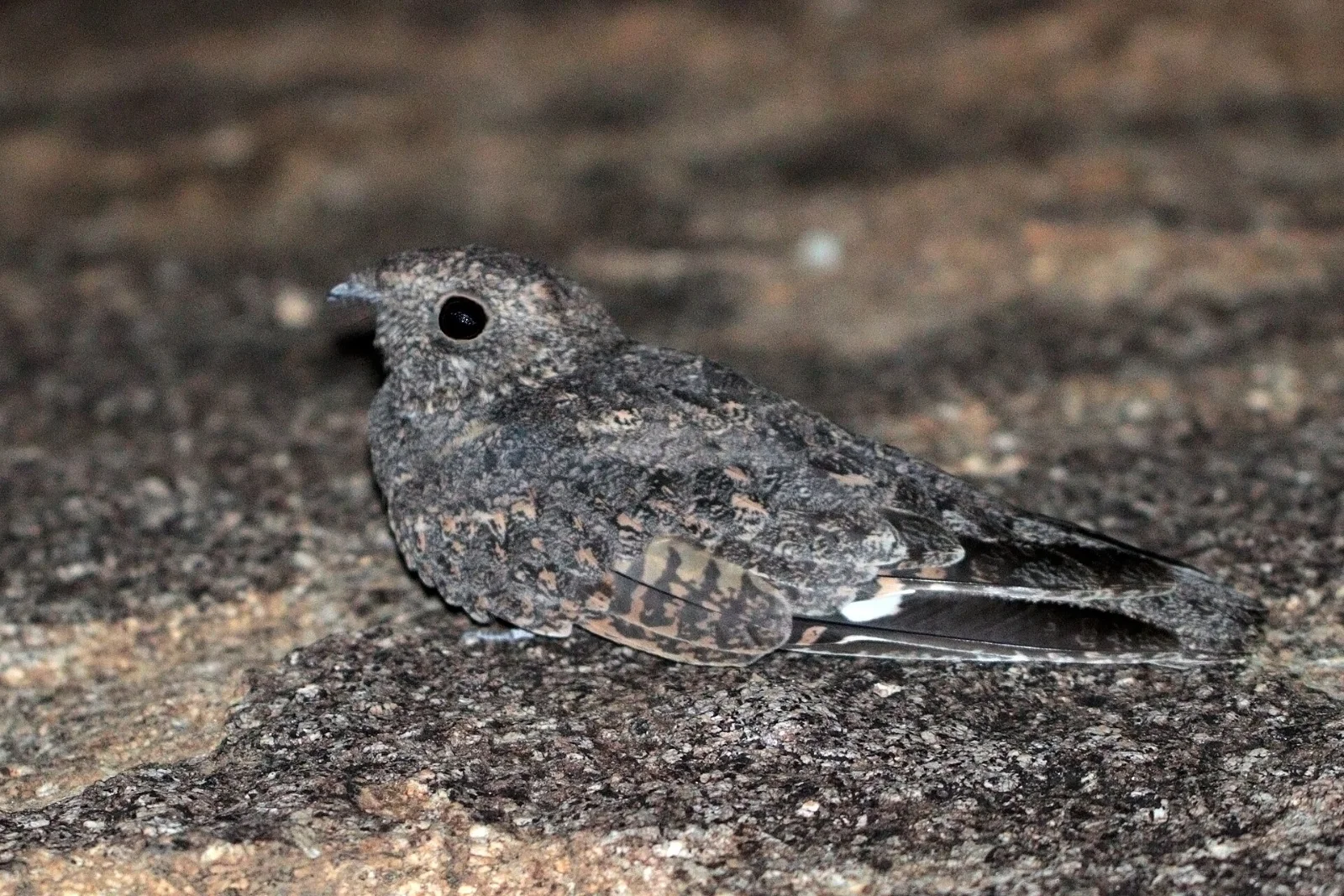
Square-tailed Nightjar. Resident in the lowveld of Eswatini and the old eastern Transvaal, and found in Zimbabwe and Botswana in acacia and mopane scrub on sandy ground and along the edges of pans, rivers and floodplains. The Atlas notes that it often sits on roads at night, where it is frequently killed by traffic. Drive slowly after dark.
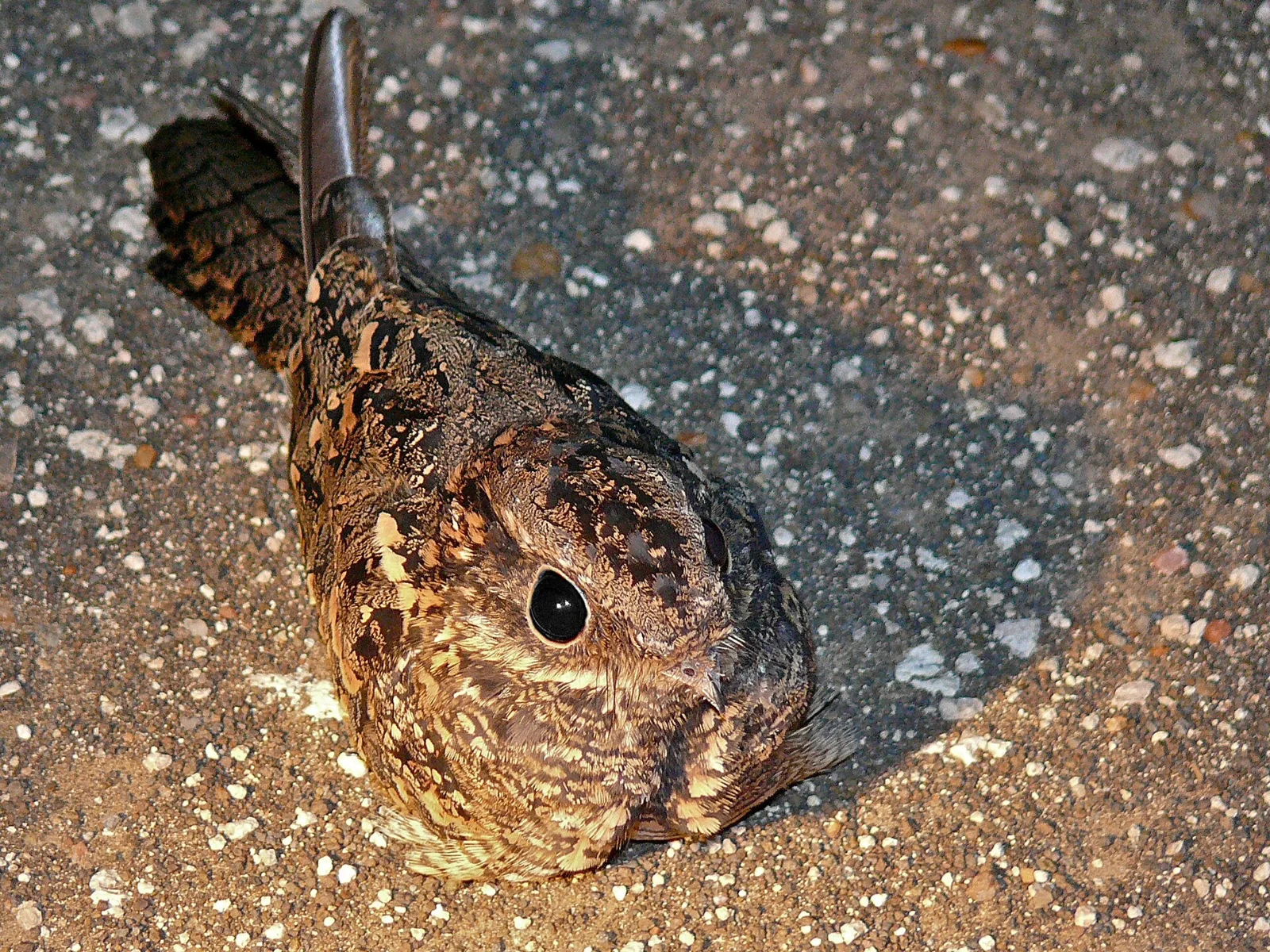
Swamp Nightjar. In KwaZulu-Natal it is confined to moist coastal grassland with clumps of bush or palms; further north it lives on the floodplains of the Okavango, Linyanti and Chobe. It is thought to be resident, though with nightjars, “thought to be” covers a lot of ground. It was listed as vulnerable in South Africa in 1984 because its habitat is fragmented, and BirdLife South Africa’s 2026 checklist still has it as regionally Vulnerable. GweGwe Beach Lodge, in the coastal grassland of Mkambati on the Wild Coast, names it among the reserve’s birds.
Freckled Nightjar. The rock specialist, and very good at being mistaken for one. It chooses bare rocky outcrops and escarpments with wooded slopes, is probably resident, and was most abundant in the Atlas around the Matobo Hills and Kariba. It sometimes roosts on buildings, and the Atlas gives Pretoria as an example: to a Freckled Nightjar, a flat roof is just a rock with plumbing.
European Nightjar. A Palearctic migrant that arrives mainly from late November and has mostly gone by late April. It is usually silent here, a nightjar that has come all this way to say nothing, and roosts by day along a horizontal branch, so most records are of birds flushed in the daytime or seen on roads at night, and many are road casualties.
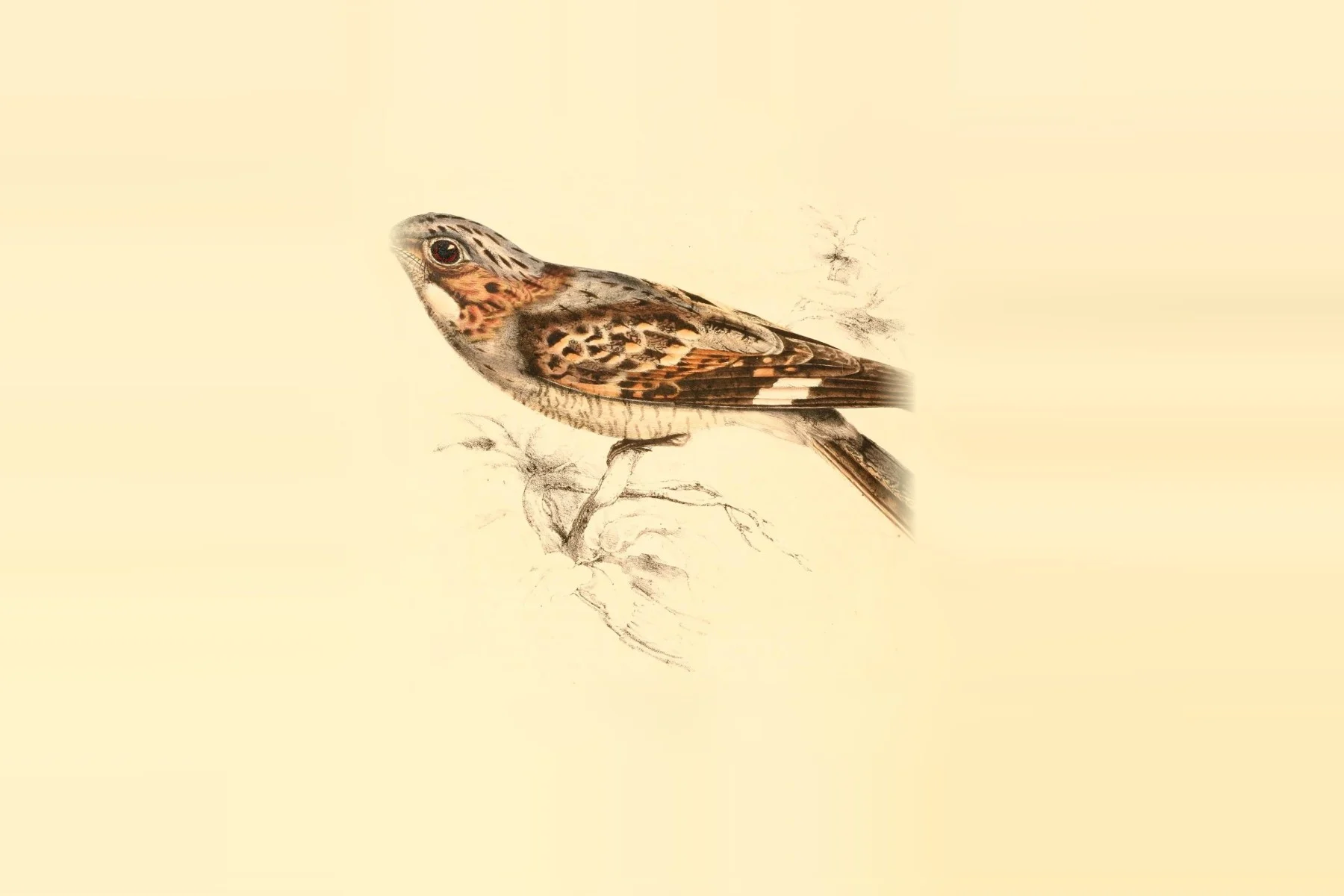
Pennant-winged Nightjar. The most tropical of the region’s nightjars, and a breeding migrant from September to February. It is widespread in Zimbabwe, confined in Namibia to Kavango and the Caprivi, sparse in northern Botswana, thinly spread but locally common in the old Transvaal lowveld, and a vagrant to KwaZulu-Natal and the Eastern Cape. It likes broadleaved woodland with light leaf litter, including miombo, on stony hillsides and sandy ground, and it breeds from September to November. Females lack white in the wings and tail and are hard to separate from other nightjars. The male gets the streamers; the female gets the camouflage.
The Atlas adds that the Pennant-winged is often found close to Fiery-necked Nightjars in miombo, and that it chooses nest sites much like those of the Rufous-cheeked, Fiery-necked and Square-tailed. It is adaptable, nesting in ploughed fields and newly burnt ground, and in Zambia it can be the commonest nightjar locally. Outside the breeding season it migrates north of the equator, a long commute for a bird that only works nights.
Night drives and roads
Nightjars sit on roads at night, which is why so many are seen in headlights and so many are killed; the Atlas says this of both the Square-tailed and the European. A bird on the road gives time for a look, but the call is what settles the identification. The nightjar sits still; the argument in the car does not. In SANParks’ Kgalagadi Transfrontier Park, no travelling is allowed after dark, so in the national parks the options are the parks’ own guided drives or a lodge that runs them. In Kruger, a night drive from Shingwedzi produced the Square-tailed Nightjar above in 2009; the Kruger birding guide covers the camps.
The best months are spring and early summer, when the night shift is fully staffed. From October to December the summer visitors are back and most residents are breeding, and Pennant-winged males are in their breeding plumage.
Where to listen
Each habitat has its own night chorus, and you can work out where you are by who is singing. In miombo and broadleaved woodland, Fiery-necked and, in summer, Pennant-winged Nightjars; on the sandy scrub and pan edges of the lowveld, the Square-tailed; on Kalahari sands, the Rufous-cheeked; on bare rocky outcrops, the Freckled; and in moist coastal grassland or on the northern floodplains, the Swamp Nightjar. Several places in the directory sit in exactly that country. GweGwe Beach Lodge, in Mkambati on the Wild Coast, gives more than 300 species for a reserve of coastal grassland, swamp forest and marshland, and names the Swamp Nightjar. On Lake Malawi, Blue Zebra Island Lodge keeps its own checklist of about 350 species for the Marelli Islands, with Pennant-winged Nightjar on it. In the Western Cape, Barry House on Riverton, near Robertson, has Fiery-necked Nightjar, Spotted Eagle-Owl and Western Barn Owl on its 162-species farm list.
Where to stay
Places in the directory that name nightjars or run night drives:
| Place to stay | Where | For birders | From |
|---|---|---|---|
| GweGwe Beach Lodge | Mkambati, Wild Coast | Names Swamp Nightjar and African Grass Owl | R3,825 pp, SADC guests (2026) |
| Blue Zebra Island Lodge | Marelli Islands, Lake Malawi | Own island checklist; Pennant-winged Nightjar | Ask the lodge |
| Chinguli Campsite | Gonarezhou, Zimbabwe | Runde River; Fiery-necked Nightjar named | US$55 per campsite (local rate) |
| Gonarezhou Exclusive and Wilderness Campsites | Gonarezhou, Zimbabwe | 450+ park species; Fiery-necked Nightjar | US$63 per campsite (local rate) |
| Barry House on Riverton | Robertson, Western Cape | BirdLife Recommended; Fiery-necked Nightjar on farm list | R5,200 per house, self-catering |
| Chinaka Game Lodge | Vivo, Limpopo | Own list includes Fiery-necked Nightjar and Western Barn Owl | Ask the lodge |
| Kaingo Camp | South Luangwa, Zambia | Day and night game drives; own hides | Ask the lodge |
| Makakatana Bay Lodge | Lake St Lucia, KwaZulu-Natal | Resident birder; night drives | R10,880 pp sharing, fully inclusive |
| Safarihoek | Etosha Heights, Namibia | Night drives; 2-storey waterhole hide | NAD 4,926 pp sharing DB&B (8+ nights) |
| Ongava Lodge | Ongava, south of Etosha | Night safaris; guided birding outings | N$11,800 pp sharing, full board (2026) |
| New Holme Nature Lodge | Hanover, Northern Cape | Night drives; 230-species checklist | R2,275 pp for 7 nights, room only |
Nightjar seasons and numbers here come mainly from the Atlas fieldwork of the 1980s and 1990s. Facts were checked on 14 November 2026 with the Atlas of Southern African Birds, BirdLife South Africa, SANParks and the Birding Dispatch listings. Use a red filter on spotlights, keep the beam off the bird’s eyes, and check night-drive times with the camp.
More from the Journal
 Woodpeckers of Southern Africa, Including the One That Doesn’t Need TreesSouthern Africa's woodpeckers, from the Cardinal in every bushveld tree to the Ground Woodpecker that lives on treeless mountain slopes and eats almost nothing but ants.
 Where to See a Taita Falcon: the Strijdom Tunnel, the Blyde Cliffs and the Batoka GorgeA stocky falcon smaller than a pigeon, a handful of cliffs and surveys that keep coming back empty. Where it still nests, how to look, and the 2 roosts beside its cliffs.
 Where to See a Southern Bald Ibis: the Breeding Cliffs, Dullstroom, Wakkerstroom and LesothoA red-capped grassland ibis that nests on cliffs over waterfalls and feeds on burnt veld and maize stubble. The colonies you can watch, the fields to scan, and where to stay.
The Pigeon Post
Every Thursday: 1 bird, 1 place to go and 1 place to stay, by email. Sign up and get our printable checklist of the 163 endemics of southern Africa.