
Owls You Can Find Without a Guide
Five southern African owls you can find on your own: where they roost in Kruger's rest camps, the calls to listen for after dark, and how to spot one sitting in plain sight by day.
You do not need a night drive or a specialist guide to see owls in southern Africa. Several species live in and around the rest camps of Kruger and other parks, roost in the same trees day after day, and call loudly after dark, which is about as close as an owl comes to handing out its address. With a torch, a little patience and an ear for their calls, you can find them yourself.
The trick is to look where you already are. Big trees in camp, the river in front of the restaurant and the gate area at dusk are all good places, because owls favour the same tall trees and quiet corners that camps are built around. In other words, the owls were there first and the camp moved in around them.
The short answer
The 5 owls you are most likely to find on your own are the Spotted Eagle-Owl, Verreaux’s Eagle-Owl, Pearl-spotted Owlet, African Scops Owl and Barn Owl. In Kruger, SANParks names Letaba, Satara, Lower Sabie and Shingwedzi as camps where owls are resident or regularly seen. Walk the camp at dusk and after dark with a torch, listen for calls, and check large trees by day for a roosting bird. The Pearl-spotted Owlet is the easiest, because it has not read the rule about owls being nocturnal and is often active and calling in daylight.
At a glance
| Owl | Size | Find it | Best Kruger camps (SANParks) |
|---|---|---|---|
| Pearl-spotted Owlet | Small | Calls by day; false eyes on the back of its head | Letaba, Satara, Orpen area |
| African Scops Owl | Small | Roosts against tree trunks; calls all night | Satara (trees outside reception), Letaba, Shingwedzi |
| Spotted Eagle-Owl | Medium-large | Yellow eyes, ear tufts; on roads and posts at night | Orpen area |
| Verreaux’s Eagle-Owl | Very large | Pink eyelids; deep grunting call | Letaba, Lower Sabie, Shingwedzi |
| Barn Owl | Medium | Pale, heart-shaped face; buildings and old trees | Satara, Orpen area |
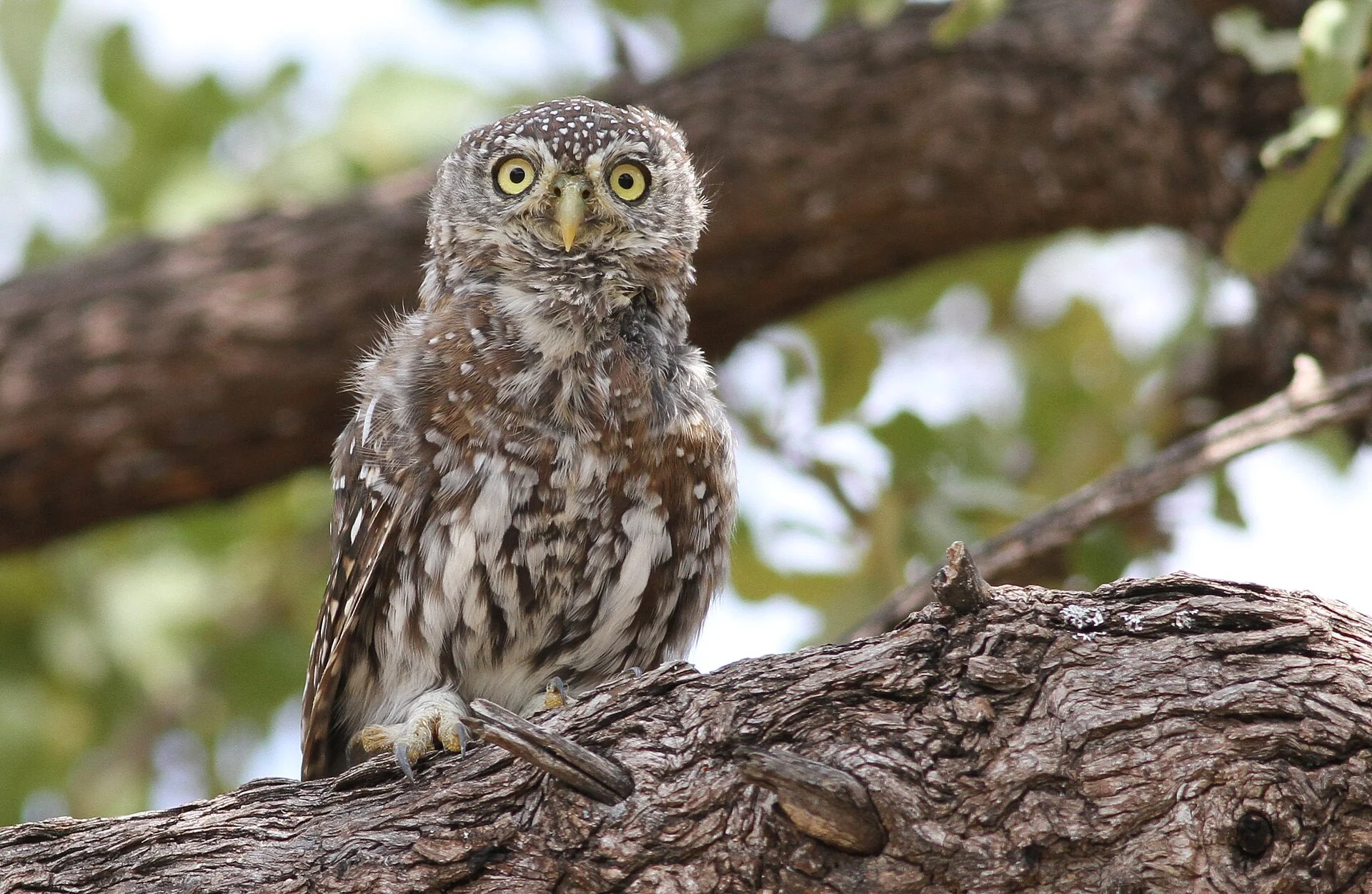
Pearl-spotted Owlet
This is the owl most visitors find first, because it is often awake by day. It is a small, round-headed owl, brown above with white spots, and it has 2 dark patches on the back of its head that look like a second pair of eyes. These false eyes are thought to deter predators and mobbing birds from behind: the owl equivalent of a teacher who can see what you are doing at the back of the class.
Listen for a long series of whistles that rise and get louder, ending in a few drawn-out notes. When you hear it in the day, look along the branches nearby: small birds often gather to mob an owlet, and their alarm calls will lead you to it. The mob does the hard work; you only have to follow the noise. SANParks lists the Pearl-spotted Owlet as resident at Letaba and regularly heard and seen around Orpen and Satara.
African Scops Owl
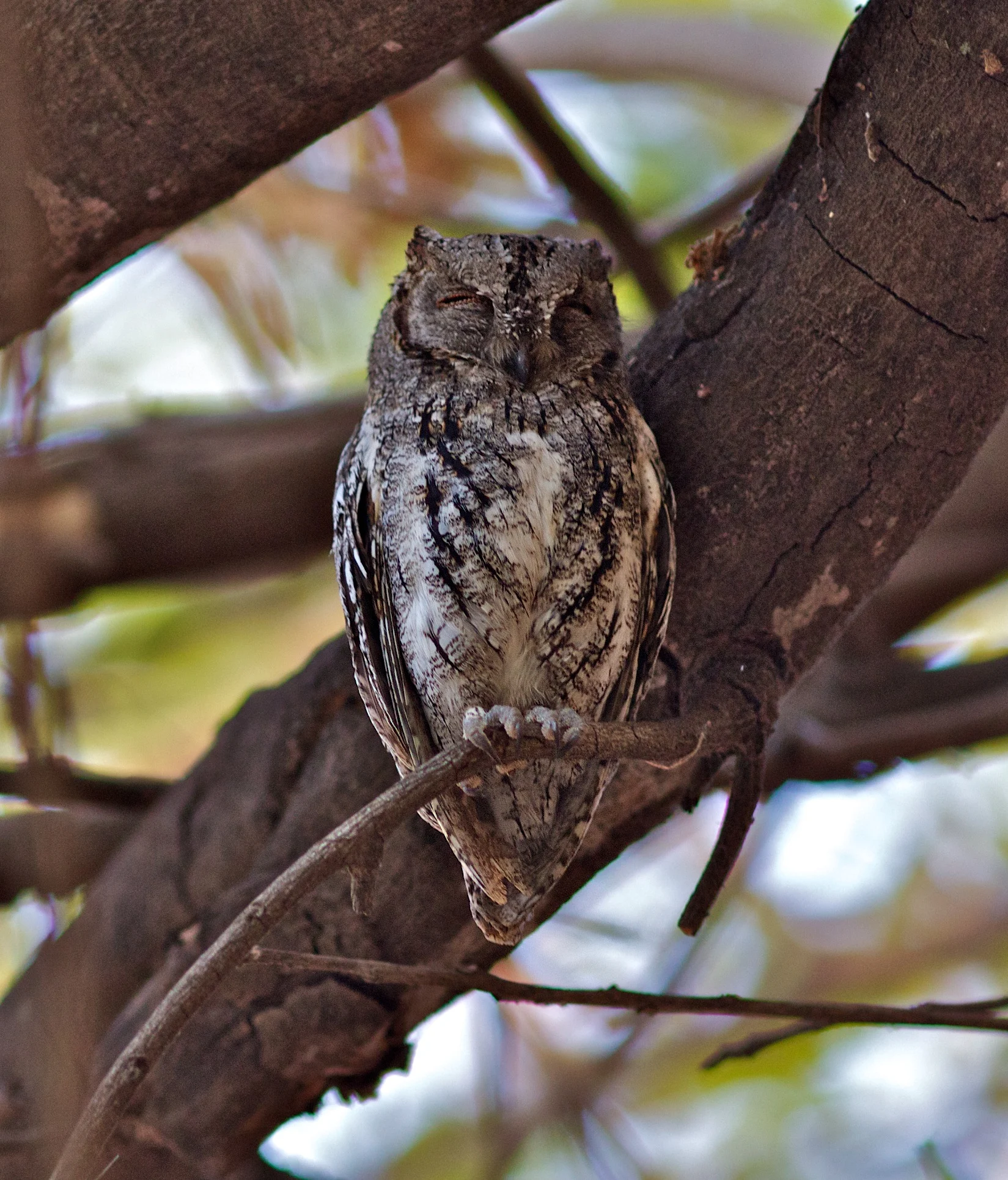
The scops is tiny, grey and streaked like tree bark, with small ear tufts it can raise when alarmed. By day it sits upright and still against a trunk or a branch fork, closes its eyes to slits and becomes, for all practical purposes, part of the tree. At night it gives a short, purring call, repeated every few seconds for hours, and it is one of the classic sounds of a bushveld camp, whether or not you were planning to sleep.
SANParks says the African Scops Owl roosts in the trees outside reception at Satara, is resident at Letaba and can be heard at Shingwedzi. Ask camp staff where the current roost is; once you know the tree, you can find the owl in seconds. Without that tip, you can stare at it for 10 minutes and see only bark.
Spotted Eagle-Owl
The commonest large owl in southern Africa, and the one you are most likely to see on a fence post, a road or a rooftop at dusk. It is grey-brown, finely barred below, with prominent ear tufts and yellow eyes. It adapts well to farms and towns as well as parks, and seems as happy on a chimney as on a dead tree.
At night, drive slowly or walk the camp fence with a torch, and check posts and low branches. SANParks lists it among the owls found on night drives and at dawn and dusk around Orpen.
Verreaux’s Eagle-Owl
Africa’s largest owl is pale grey with dark eyes and bright pink eyelids, the feature that confirms the identification. A huge, serious predator with pink eyeshadow is hard to mistake for anything else. Its call is a deep, slow grunting that carries a long way at night.
It likes big riverine trees. SANParks says it is regularly recorded along the river at Letaba, its grunting can be heard at night at Lower Sabie, and it is often seen in the large trees on the road approaching Shingwedzi. Scan the big trees along the river in the last hour of light and again first thing in the morning.
Barn Owl
The pale Barn Owl, with its white, heart-shaped face, often roosts in buildings, old trees and holes in banks, and it is not fussy about whose building. You may see it hunting over open ground or catch it in the headlights at dusk, a ghostly white shape that is gone before you can say “was that”. SANParks lists it at Satara and among the owls seen on night drives around Orpen.
How to find owls on your own
- Listen first. Learn the 5 calls before you go: a few minutes with a bird app is enough. Most owls are heard long before they are seen.
- Walk the camp at dusk. Owls start calling around sunset. Walk the perimeter fence and the big trees with a torch, and stop often to listen.
- Follow the mob. By day, scolding small birds often mean an owl is roosting nearby. Look where they are looking.
- Check for signs. White droppings and pellets under a tree show a regular roost. Owls are tidy sleepers and messy neighbours.
- Use light gently. Hold the torch beam to the side of the owl rather than in its face, keep it brief, and do not use playback in camps.
When to go
You can find these owls all year. Spring and early summer, roughly September to November, is a good time to hear them, because many owls call often in the breeding season and have a great deal to say about it. In the dry winter months the trees carry fewer leaves, which makes roosting owls easier to see by day, with fewer places left to hide.
The verdict
Start with the Pearl-spotted Owlet and the African Scops Owl, because both live in camp trees and call often. Ask staff at Satara or Letaba where the current roosts are, walk the camp at dusk with a torch, and listen for the calls. Then scan the big riverine trees at Letaba, Lower Sabie or Shingwedzi at first and last light for a Verreaux’s Eagle-Owl. You will see more owls in a week of camp walks than many visitors do on a single night drive, and you will not have to leave the camp to do it.
Where to stay
Places to stay in Kruger in the directory, with what each offers a birder:
| Place to stay | Where | For birders | From |
|---|---|---|---|
| Mopani Rest Camp | Mopani, Kruger National Park | Pioneer Dam hide, Shipandani sleep-over hide | R1,888 for 2, self-catering |
| Kruger Untamed Tshokwane River Camp | Southern-central Kruger | Seasonal walking camp, May to September; birding offered | R8,750 pp sharing (2027) |
| Plains Camp @ Rhino Walking Safaris | Concession near Skukuza, Kruger | Bookable birding safaris; a night on the sleep-out decks | R9,830 pp sharing, full board and activities |
Roost sites change and owls move. Facts were checked on 9 November 2026 with SANParks’ camp-by-camp birding notes for Kruger. Follow each camp’s rules on walking after dark, and stay inside the fence.
More from the Journal
 Woodpeckers of Southern Africa, Including the One That Doesn’t Need TreesSouthern Africa's woodpeckers, from the Cardinal in every bushveld tree to the Ground Woodpecker that lives on treeless mountain slopes and eats almost nothing but ants.
 Where to See a Taita Falcon: the Strijdom Tunnel, the Blyde Cliffs and the Batoka GorgeA stocky falcon smaller than a pigeon, a handful of cliffs and surveys that keep coming back empty. Where it still nests, how to look, and the 2 roosts beside its cliffs.
 Where to See a Southern Bald Ibis: the Breeding Cliffs, Dullstroom, Wakkerstroom and LesothoA red-capped grassland ibis that nests on cliffs over waterfalls and feeds on burnt veld and maize stubble. The colonies you can watch, the fields to scan, and where to stay.
The Pigeon Post
Every Thursday: 1 bird, 1 place to go and 1 place to stay, by email. Sign up and get our printable checklist of the 163 endemics of southern Africa.