
Bee-eaters of Southern Africa: Every Species, the Colonies and the Months
Southern Africa has 8 bee-eaters, from the resident White-fronted to the Southern Carmine, which nests in large colonies on the Zambezi. Which ones migrate, when the colonies are busy, and where to stay.
On the Savuti Plains in northern Botswana, Southern Carmine Bee-eaters regularly ride on the backs of Kori Bustards, treating a large walking bird as a mobile perch. The Atlas of Southern African Birds records it as a habit of the place, not a one-off. It is one of the odder sights in a family of 8 species in southern Africa, most of which nest in holes they dig in sand, which makes them some of the region’s most colourful excavators.
BirdLife South Africa’s 2026 checklist has 6 of them as regulars in South Africa: Blue-cheeked, European, Little, Southern Carmine, Swallow-tailed and White-fronted. Olive Bee-eater is on it as a vagrant, and Böhm’s Bee-eater, a bird of the Zambezi valley and Malawi, does not reach South Africa at all, so it is the one that requires a passport. The Atlas species accounts, written in the 1990s, are the base reference here for the seasons.
The 8 at a glance
| Bee-eater | When it is here | How it nests | A good place (source) |
|---|---|---|---|
| White-fronted | All year | Colonies in large sandbanks | Limpopo valley, Caprivi rivers (Atlas) |
| Little | All year | Pairs, in low banks or Aardvark burrows | Okavango Delta, Limpopo valley (Atlas) |
| Southern Carmine | August to March | Large dense colonies in sand cliffs | Northern Botswana, Caprivi, Zambezi (Atlas) |
| European | October to April | Small colonies in sandbanks | Zimbabwe and northern South Africa (Atlas) |
| Blue-cheeked | Mid-October to April | Breeds in Eurasia and North Africa | Okavango, Chobe, Zambezi, Kunene (Atlas) |
| Swallow-tailed | September to April in the west | Alone, not in colonies | Kalahari woodland, Orange River (Atlas) |
| Olive | November to April | Sandbanks or flat ground | Lower Kunene valley, middle Zambezi (Atlas) |
| Böhm’s | Not confirmed | Burrows in flat ground | Liwonde and Lengwe, Malawi (birdinfo.co.za) |
The residents
The White-fronted Bee-eater is the resident of the rivers. The Atlas says it shows no regular migration, needs large sandbanks to nest, and starts breeding in August, with a peak from September to November. Its centres of abundance are the Limpopo valley and the rivers of the Caprivi. It breeds in colonies, and at Londolozi on the Sand River, a ranger’s 2024 post describes pairs that often have 1 to 4 helpers of both sexes, usually from an earlier brood, feeding the chicks with the parents. Research summarised by San Diego Zoo, mostly from Kenya, found that about 60% of breeding pairs have 1 to 5 helpers, usually close relatives, and that each helper adds on average 0.44 young to the pair’s output, so the family help earns its keep.
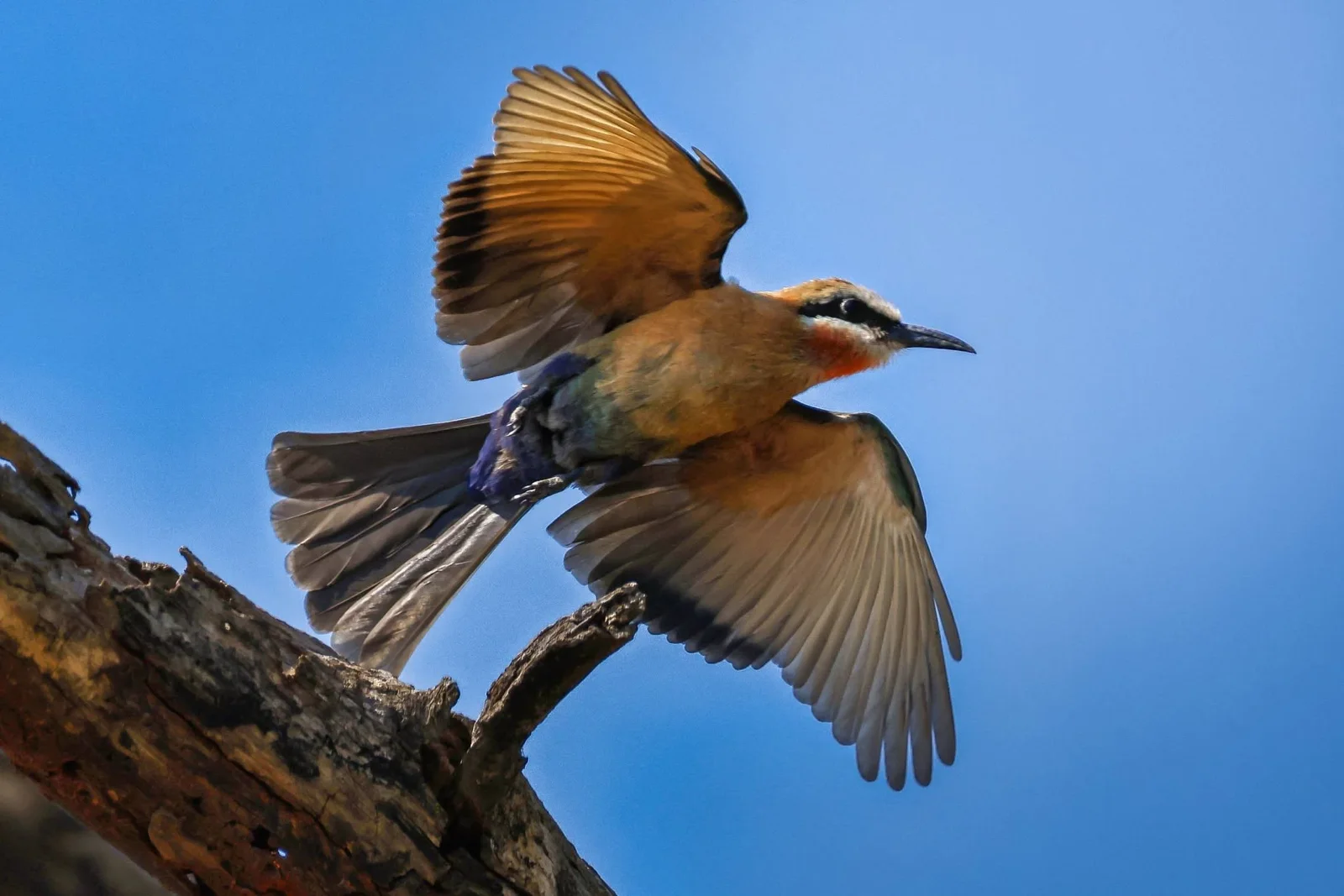
The Little Bee-eater is smaller, usually seen in pairs, and nests in low sandbanks or in Aardvark burrows, happy to let someone else do the digging. Eggs have been recorded from September to February, mostly September to November, and the Atlas found the highest densities in the Okavango Delta and the Limpopo River valley.
The summer visitors
The European Bee-eater comes in 2 populations. Most are non-breeding visitors from the Palearctic, which arrive mainly in October and leave in late March and April; the Atlas found the highest reporting rates in Zimbabwe and the old Transvaal. A smaller population of about 20,000 birds breeds in southern Africa itself, at scattered sites in the Cape, southern Namibia, the western Free State and the old southern Transvaal, then winters in central Africa. These local breeders use sandbanks, natural and man-made, lay mostly from October to December, and nest in small colonies of up to 20 pairs. The first breeding record for the region was near Beaufort West in 1886. The summer migrants guide covers the other birds that arrive with them.
The Blue-cheeked Bee-eater is a true migrant that breeds in Eurasia and North Africa. Its arrival is fast and synchronised across the region, as if the whole population had agreed a date, from mid-October with a peak in early November, and most leave in April. It prefers to hunt over or near water here, and large numbers gather in the Okavango Delta and on the Chobe, Kavango, Zambezi and Kunene rivers.
The Olive Bee-eater reaches its southern limit in north-western Namibia, mainly in the lower Kunene valley from November to April, and on the middle Zambezi from December to March. It lives in riverine woodland, hunts bees from a high perch in a dead tree, and digs its nest in near-vertical sandbanks or in open flat ground.
The colony nesters
The Southern Carmine Bee-eater makes a 3-stage migration, an itinerary with more legs than most safaris. The Atlas says birds reach the breeding grounds in the far north of the region in August and September, breed from August to January with egg-laying finished by November, fledge most young by early December, before the heaviest rains, and mostly leave in March. They nest in large, dense colonies, normally in tall sandy cliffs, though some of the largest Okavango colonies are on sandy flats. A Londolozi ranger’s January 2025 post describes the birds breeding along the Zambezi and in the Caprivi from August to November, then spreading south into South Africa in December.
On the Luangwa, Kaingo Camp shares a hide at a Southern Carmine Bee-eater colony that is open in September and October, and Luambe Horizons gives the same 2 months for the nesting colonies. The Southern Carmine Bee-eater colonies guide goes river by river.
The 2 specials
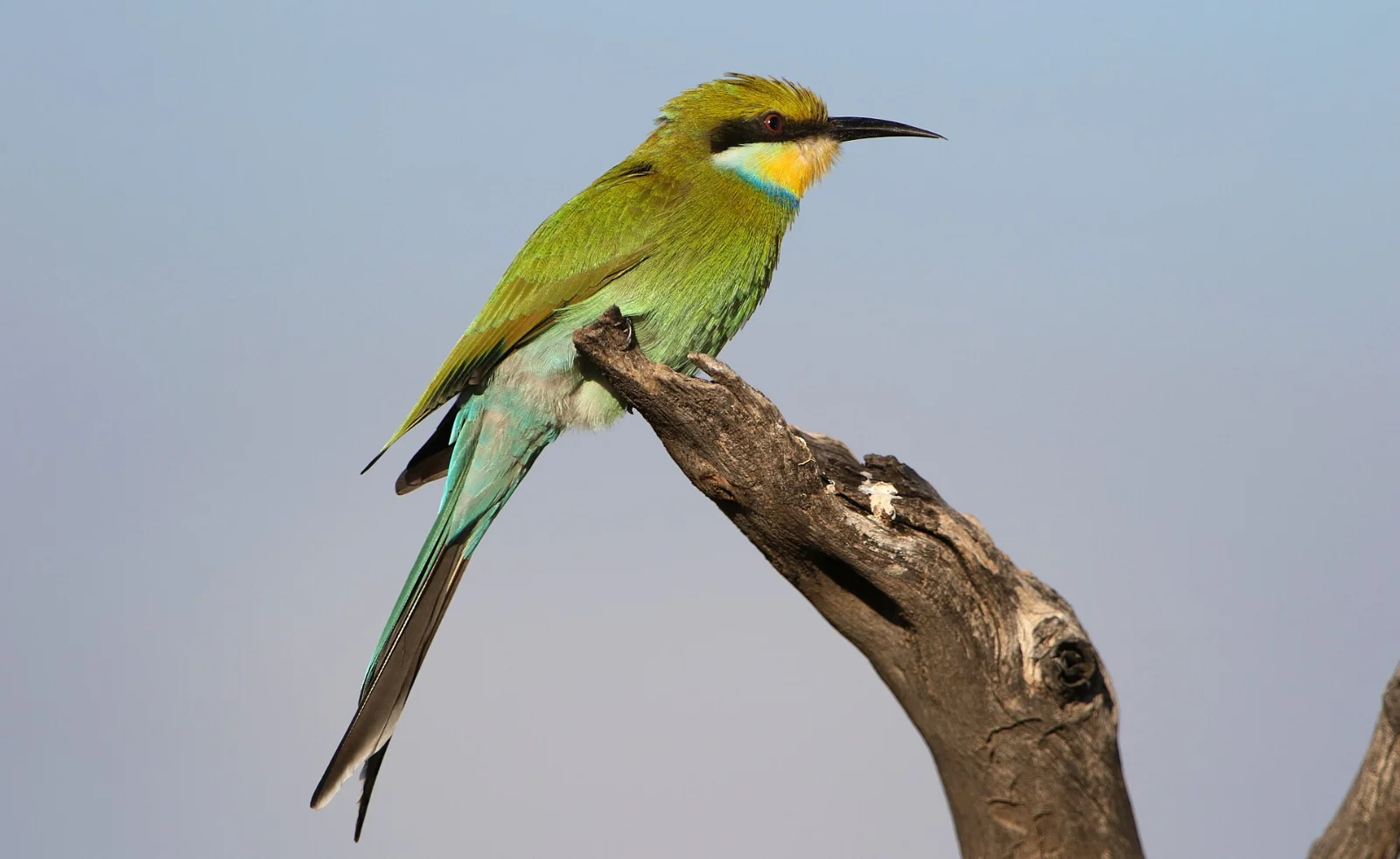
The Swallow-tailed Bee-eater is the dry-country one, and the loner of the family. The Atlas describes complex movements: an influx into the arid west in spring and summer, September to April, while in Zimbabwe it is mainly a dry-season visitor. It breeds alone rather than in colonies, is dominant in Kalahari woodland, and follows the band of riverine woodland along the Orange River. The photograph below was taken in the Kgalagadi in April; the Kgalagadi birding guide has the park’s camps.
Böhm’s Bee-eater has a very small range. A 2006 account on birdinfo.co.za puts the bulk of the population in Liwonde and Lengwe National Parks in Malawi, by permanent water, digging its nest cavities in flat or nearly flat ground, unlike most bee-eaters. Bees, wasps and ants make up most of its diet, with honeybees about a fifth of the insects it eats, so the family name still fits.
How they deal with stings
Bees and wasps sting, and bee-eaters deal with that on a perch before they eat. San Diego Zoo’s factsheet on the White-fronted Bee-eater sets out the routine: hold the bee behind the thorax, hit its head against the perch, shift the grip to the tip of the abdomen, and rub the tail end against the perch until the sting is crushed. It is a lot of admin for one bee. A Sabi Sabi ranger’s 2019 note describes the Little Bee-eater doing the same before it swallows, and the Londolozi post describes Southern Carmine Bee-eaters bashing bees on a perch before feeding them to their chicks.
When to go
For the colonies, September and October are the months on the Luangwa and the Zambezi. For the most species in one trip, go between November and March, when the whole cast is in: the residents, the Southern Carmine, the European and Blue-cheeked visitors and, in the west, the Swallow-tailed are all present. In winter the residents, White-fronted and Little, are the reliable ones, with the Swallow-tailed as a dry-season visitor in Zimbabwe.
Closer to Johannesburg and Pretoria, several places to stay name bee-eaters on their own lists. Makulu Birders House, near Rust de Winter, has a 240-species farm list that includes European and Little Bee-eaters, and Zaagkuilsdrift, on the Kgomo-Kgomo floodplain, names Blue-cheeked Bee-eater among the birds seen from its 3 hides. Wilge River Bush Camp names White-fronted Bee-eater on a river checklist of 409 species. In the Western Cape, where part of the local European Bee-eater population breeds, Barry House on Riverton near Robertson has the species on its 162-species farm list.
Where to stay
Places in the directory with hides at colonies, guided colony walks, or bee-eaters on their own lists:
| Place to stay | Where | For birders | From |
|---|---|---|---|
| Kaingo Camp | South Luangwa, Zambia | Own hides; Southern Carmine Bee-eater colony hide, September to October | Ask the lodge |
| Luambe Horizons | Luambe National Park, Zambia | Outings to Southern Carmine Bee-eater colonies; photographic hides | US$750 pp, fully inclusive (2027) |
| Kulandila Camp | South Luangwa, Zambia | Riverbank hide for nesting bee-eaters | Ask the lodge |
| Sungani Lodge | South Luangwa, Zambia | Seasonal photographic hide at a Southern Carmine Bee-eater colony | Ask the lodge |
| Zambezi Mubala Lodge | Zambezi Region, Namibia | Guided seasonal walk to a Southern Carmine Bee-eater colony | N$3,541 pp sharing B&B |
| Xaro Lodge | Okavango Panhandle, Botswana | Boat birding; spring best for Southern Carmine Bee-eaters | US$450 per room DB&B (2026) |
| Drotsky’s Cabins | Okavango Panhandle, Botswana | Boat trips; Southern Carmine Bee-eater, African Skimmer | Ask the lodge |
| Zaagkuilsdrift Bird Sanctuary & Lodge | Near Pienaarsrivier, Limpopo | BirdLife Recommended; 3 hides; Blue-cheeked Bee-eater | Ask the lodge |
| Makulu Birders House (WildsUitvlugt) | Rust de Winter, Limpopo | 240-species list with European and Little Bee-eaters | Ask the lodge |
| Wilge River Bush Camp | Near Bronkhorstspruit, Gauteng | BirdLife Recommended; 409-species list; White-fronted Bee-eater | Ask the lodge |
| Barry House on Riverton | Robertson, Western Cape | BirdLife Recommended; 162-species farm list; European Bee-eater | R5,200 per house, self-catering |
| Halala Africa Lodge | Near Windhoek, Namibia | Bird hide; names Swallow-tailed Bee-eater | N$2,100 per bungalow, self-catering |
Bee-eater seasons shift with the rains, and the Atlas seasons date from fieldwork in the 1980s and 1990s. Facts were checked on 14 November 2026 with the Atlas of Southern African Birds, BirdLife South Africa, ranger blogs from Londolozi and Sabi Sabi, San Diego Zoo Wildlife Alliance and the Birding Dispatch listings. Colony hides open only in the breeding season, so confirm dates with the camp.
More from the Journal
 Woodpeckers of Southern Africa, Including the One That Doesn’t Need TreesSouthern Africa's woodpeckers, from the Cardinal in every bushveld tree to the Ground Woodpecker that lives on treeless mountain slopes and eats almost nothing but ants.
 Where to See a Taita Falcon: the Strijdom Tunnel, the Blyde Cliffs and the Batoka GorgeA stocky falcon smaller than a pigeon, a handful of cliffs and surveys that keep coming back empty. Where it still nests, how to look, and the 2 roosts beside its cliffs.
 Where to See a Southern Bald Ibis: the Breeding Cliffs, Dullstroom, Wakkerstroom and LesothoA red-capped grassland ibis that nests on cliffs over waterfalls and feeds on burnt veld and maize stubble. The colonies you can watch, the fields to scan, and where to stay.
The Pigeon Post
Every Thursday: 1 bird, 1 place to go and 1 place to stay, by email. Sign up and get our printable checklist of the 163 endemics of southern Africa.