
Africa’s Hornbills and Where to See Them
From the hornbills of the bushveld and the Kalahari to the casqued forest giants and the 2 turkey-sized ground hornbills: where each one is easy, why the females wall themselves in, and where to stay.
Africa’s hornbills come in 3 sizes and 3 habitats. The small savanna hornbills live in dry woodland and often feed on the ground. The big casqued hornbills of the forests are fruit-eaters that travel the canopy in noisy flocks. The 2 ground hornbills, the size of turkeys, walk the grasslands in family groups, like a committee on a site inspection. A trip that covers savanna, forest and open country can find a dozen species.
Most of the tree-nesting species share 1 habit that sounds like a medieval punishment and is in fact parenting: the female seals herself into the nest hole. The Atlas of Southern African Birds describes the Southern Yellow-billed Hornbill’s females staying sealed in for several weeks, and the Silvery-cheeked Hornbill’s female remaining until the chick fledges. In the breeding season, that means fewer birds on view, because the females are bricked in.
At a glance
| Hornbill | Range | Where it is easy (source) | Stay |
|---|---|---|---|
| Southern Yellow-billed | Dry savannas of southern Africa | Kalahari, Limpopo, Kruger lowveld (Atlas) | Tswalu, Kruger area lodges |
| Bradfield’s | Northern Botswana, western Zimbabwe, northern Namibia | Hwange (BirdLife Zimbabwe) | The Hide |
| Monteiro’s | Namibia | Erongo Mountains (Birding Ecotours) | Erongo Rocks Farmhouse and Camping |
| Trumpeter | Kenya to the Eastern Cape | KwaZulu-Natal coast forests (Atlas) | Lidiko Lodge, Lodge Afrique |
| Silvery-cheeked | Ethiopia to Mozambique | Zimbabwe’s Eastern Highlands (Atlas) | Heaven Lodge, Aberfoyle Lodge |
| White-thighed | Central and West Africa to Uganda | Budongo’s Royal Mile (Briggs) | Nile Safari Lodge |
| Abyssinian Ground | Sahel to East Africa | Murchison Falls, The Gambia’s North Bank (listings) | Nile Safari Lodge, Morgan Kunda Lodge |
The savanna hornbills of southern Africa
The Atlas counts 6 small hornbills overlapping in southern Africa, and Marc Herremans’s account explains how they share the space, like flatmates with a very strict chore chart. The Red-billed Hornbill is commoner in mopane and tall acacia woodland, the Grey Hornbill is mainly a canopy feeder of riverine woodland and miombo, the Southern Yellow-billed takes the drier acacia savanna and bushveld, and Monteiro’s Hornbill occupies the most arid country and prefers to breed on cliffs. The Red-billed is absent from the open Kalahari but common in the Zambezi Valley; the Yellow-billed is the reverse.
Southern Yellow-billed Hornbill
A near-endemic of southern Africa’s dry savannas, and the hornbill most visitors see first. The Atlas gives major strongholds in the Kalahari, the Limpopo valley and the Kruger lowveld, with about 1 pair to every 20 ha recorded in the old Transvaal. It is more conspicuous in the dry season, when birds flock and come closer to houses and camps. Tswalu Kalahari Reserve in the southern Kalahari and any of the Kruger lodges in the best places to stay for birders in and around Kruger will have it on the doorstep, sometimes literally.
Crowned Hornbill
The Atlas notes that Crowned Hornbill replaces Bradfield’s in Zimbabwe’s miombo. GoBirding lists it with Trumpeter Hornbill from the canopy platform of the Dlinza Forest Aerial Boardwalk at Eshowe. In Zululand, the Bushwillow Collection arranges a specialist bird guide and names Crowned Hornbill with Crested Guineafowl and Martial Eagle.
Bradfield’s Hornbill
Bradfield’s is endemic to southern Africa and, in Herremans’s words, uncommon, localised and poorly known, which is a polite way of saying it keeps to itself. Its range covers southern Angola, northern Namibia, southern Zambia, northern Botswana and western Zimbabwe, centred on broad-leaved woodland on Kalahari sands. In the dry season, flocks of more than 50 have been seen in north-eastern Botswana and Hwange, and those flocks must be a large share of the world population. Its range in Zimbabwe has shrunk by 40% through logging of hardwoods. BirdLife Zimbabwe says Hwange probably holds the largest protected population of the species. In Hwange, The Hide has hides and names Bradfield’s Hornbill, Racket-tailed Roller and Arnot’s Chat. On the Chobe and in Namibia’s Zambezi Region it is a bird of the drier woodland, so it needs a drive rather than a boat.
Monteiro’s and Damara Red-billed Hornbills
Namibia has 2 hornbills of its own. Birding Ecotours groups in 2023 and 2025 found Monteiro’s Hornbill on walks around the granite koppies of the Erongo Mountains, with Rockrunner and Rosy-faced Lovebird, and Damara Red-billed Hornbill in the big camel thorns along the Omaruru riverbed. NACSO lists both Monteiro’s and Bradfield’s for the Waterberg Plateau, where, according to the Atlas, Bradfield’s keeps to the broad-leaved woodland near the summit and Monteiro’s to the acacia on the scree and around the base, a tidy upstairs-downstairs arrangement. In the Erongo, Erongo Rocks Farmhouse and Camping has a hide and names Monteiro’s Hornbill with Rosy-faced Lovebird and Hartlaub’s Spurfowl. Far in the north-west, Epupa Camp on the Kunene names Monteiro’s Hornbill with Rufous-tailed Palm Thrush and Angola Cave Chat. See the Namibia birding guide for the route.
The forest hornbills
Trumpeter Hornbill
The Trumpeter ranges from Kenya to the forests of the Eastern Cape. Tony Oatley’s Atlas account calls its wailing call so like a crying baby that a newcomer may believe there is a crèche nearby. It eats mainly fruit, especially wild figs, travels in pairs or groups of 5 or more, and gathers in flocks of up to 200 outside the breeding season. The Atlas found its highest reporting rate in the coastal forests of the east; it is common along the Zambezi tributaries and the Chobe east of Kavimba, and absent from the Okavango’s riverine forest.
In KwaZulu-Natal, Lidiko Lodge names Trumpeter Hornbill with Purple-crested Turaco and Woodland Kingfisher, and Lodge Afrique in iSimangaliso names it too. The Dlinza boardwalk at Eshowe, already mentioned for the Crowned, is a good canopy view, and puts you at eye level with the crying baby.
Silvery-cheeked Hornbill
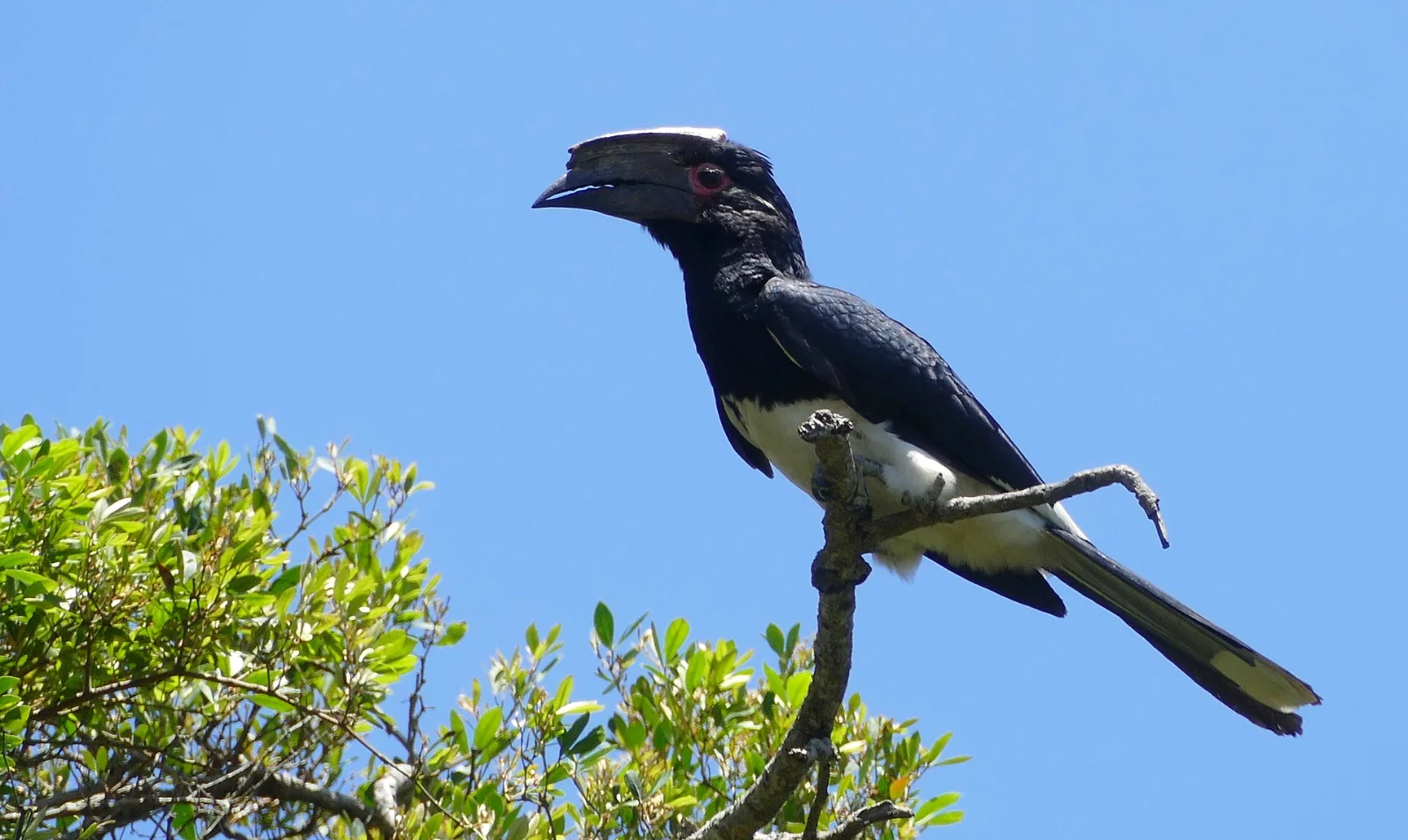
The largest tree-dwelling hornbill in southern Africa, nearly twice the weight of the Trumpeter, with a big pale casque that looks like a horn it never quite finished. In the region it lives mainly in the montane forests of the Zimbabwe and Mozambique border, where it is quite common and gathers in flocks of 20 or more at fruiting trees. Rob Harwin’s Atlas account warns that the regional population may not exceed a few hundred birds and that it has become scarce in the Honde Valley through forest loss. Its range continues north through East Africa to Ethiopia.
In Zimbabwe’s Eastern Highlands, Heaven Lodge names Chirinda Apalis, Swynnerton’s Robin and Gurney’s Sugarbird among its specials, and Aberfoyle Lodge in the Honde Valley has a guide, Morgan, who leads bird walks in the riverine forest. Neither names the hornbill, so ask what has been seen. See the Zimbabwe birding guide for the highland forests.
Uganda and Kenya
Forest hornbills are a reason to go to Uganda. Philip Briggs ranks Budongo’s Royal Mile, off the Masindi to Butiaba road, as probably the best place in East Africa for White-thighed Hornbill, and he counts 6 forest hornbills in Semliki National Park that are seldom seen elsewhere in the country. Nile Safari Lodge at Murchison Falls is the nearest listed base for Budongo, and Semliki Safari Lodge is in the Toro-Semliki Wildlife Reserve close to the park.
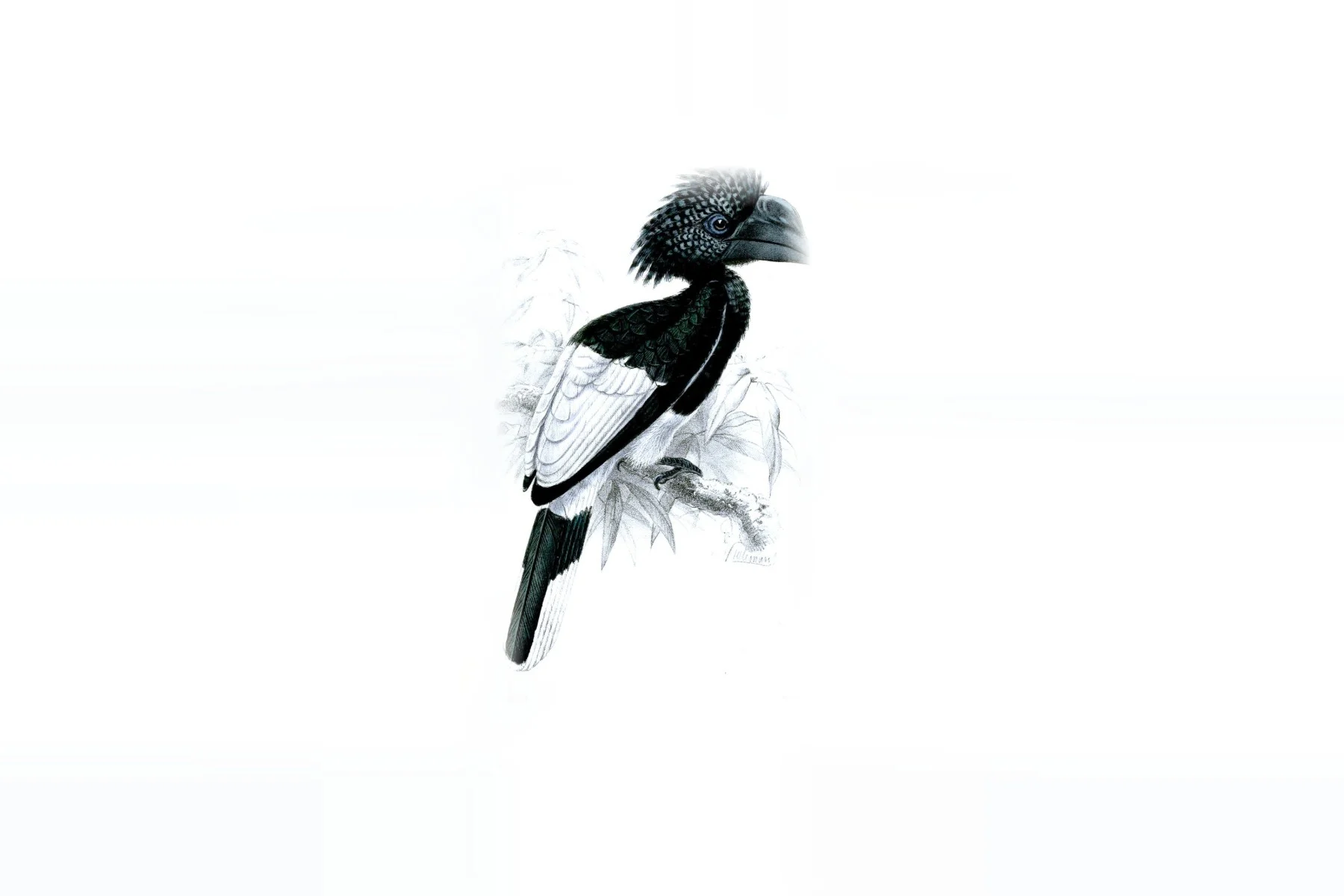
The Black-and-white-casqued Hornbill on this article’s header plate is the big forest hornbill of western Kenya and Uganda. At Kakamega Forest, Birdquest’s 2025 group heard it calling from the tall trees with Great Blue Turaco before both showed, the usual forest order of events: noise first, bird later. Kakamega costs US$50 a day to enter under the 2025 Kenya Wildlife Service schedule. For Uganda’s forests, Kibale Lodge near Fort Portal gives a list of 100 species.
At Lake Baringo, Birdquest added Jackson’s Hornbill in 2025, and in the Serengeti, Birding Ecotours found Tanzanian Red-billed Hornbill in 2024. Samatian Island is on the lake at Baringo, and Mbuzi Mawe Serena Camp is in the central Serengeti.
West Africa
The Gambia shows how different West Africa’s hornbills are. A Naturetrek group based at Mandina Lodge in December 2025 saw Western Red-billed, West African Pied and African Grey Hornbills on most days, which is about as reliable as hornbills get. The Bradt guide rates Brufut Woods, about 1 square km of coastal woodland, for African Pied Hornbill. See The Gambia birding guide.
The ground hornbills
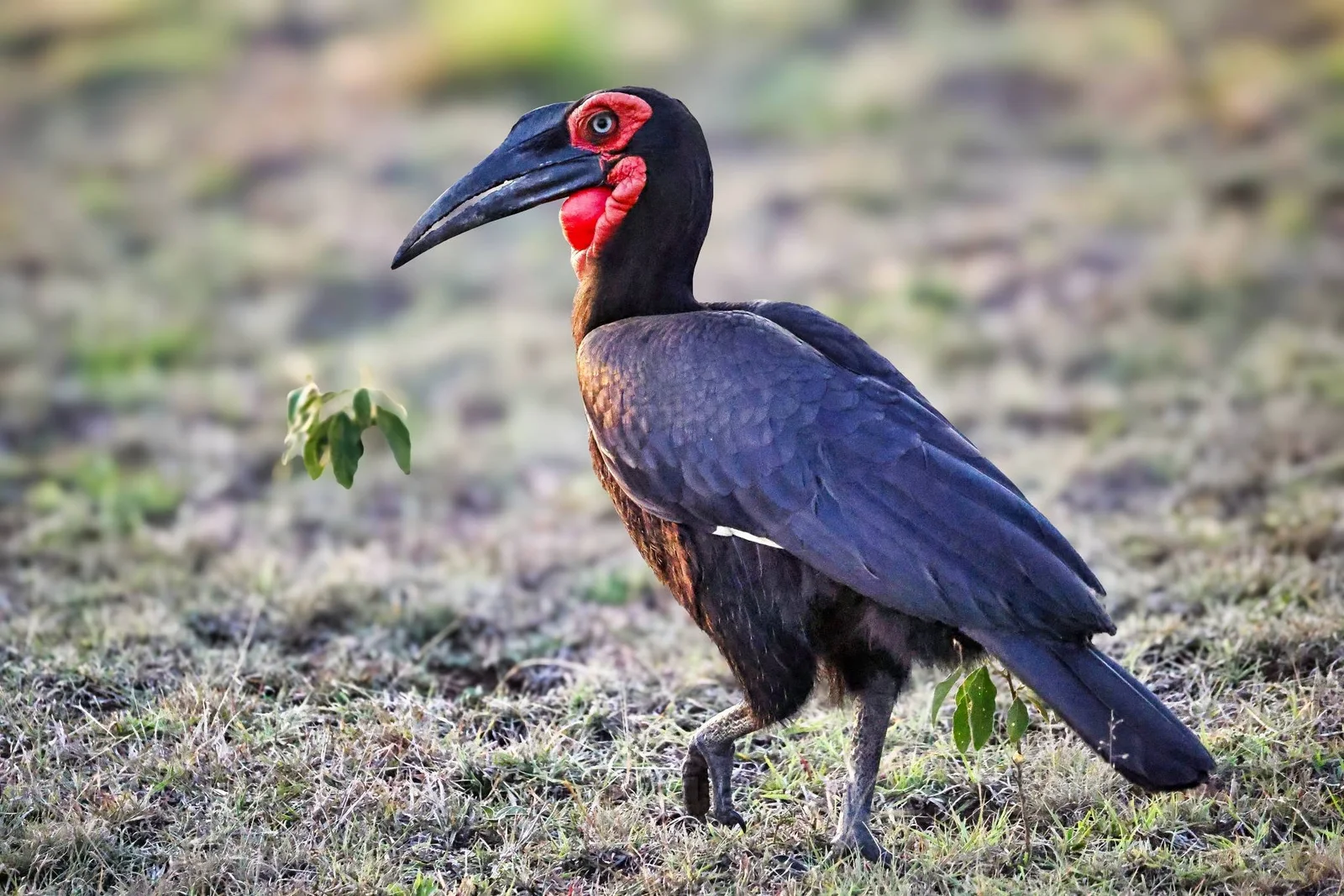
The 2 ground hornbills are the giants of the family, and they would rather walk. The Southern Ground Hornbill lives in groups that breed slowly, raising 1 chick at a time, and is now found mostly in large protected areas; the Southern Ground Hornbill guide covers where to find a group. Several lodges in the directory name it: Inyati Game Lodge in the Sabi Sand, Sabi Sabi Little Bush Camp with its own birding guides, Umlani Bushcamp in the Timbavati, Plains Camp inside Kruger, Mabula Game Lodge in Limpopo, Montusi Mountain Lodge in the Drakensberg foothills and GweGwe Beach Lodge on the Wild Coast.
North of the equator, the Abyssinian Ground Hornbill replaces it. In Uganda, Nile Safari Lodge names it with Shoebill and Grey Crowned Crane. In The Gambia, Morgan Kunda Lodge on the North Bank has hides and names Abyssinian Ground Hornbill with Beaudouin’s Snake Eagle and Bearded Barbet.
Finding hornbills
For the savanna species, look on the ground in open woodland in the dry months, when they flock and are easiest to see. For the forest hornbills, find a fruiting fig, the hornbill version of a buffet: the Atlas describes Trumpeters as seldom far from fruiting trees, and Silvery-cheeked flocks as wandering widely in search of figs, often with Trumpeters. In forest, listen first: the Atlas singles out the Trumpeter’s wailing call as carrying a considerable distance.
Where to stay
The places in this guide, with what each offers a birder:
| Place to stay | Where | For birders | From |
|---|---|---|---|
| Tswalu Kalahari Reserve | Southern Kalahari, Northern Cape | Southern Yellow-billed Hornbill, 264 species, private guide | R46,400 pp fully inclusive (Motse) |
| Bushwillow Collection | Kuleni Game Park, Zululand | Specialist bird guide, Crowned Hornbill, Crested Guineafowl | R6,000 for 2, 3-night package |
| The Hide | Hwange, Zimbabwe | Waterhole hide, Bradfield’s Hornbill, Racket-tailed Roller | US$467 pp fully inclusive (green season) |
| Erongo Rocks Farmhouse and Camping | Erongo Mountains, Namibia | Bird hide, Monteiro’s Hornbill, Hartlaub’s Spurfowl | Ask the lodge |
| Epupa Camp | Epupa Falls, Kunene River, Namibia | Monteiro’s Hornbill, Rufous-tailed Palm Thrush, Angola Cave Chat | N$260 pp camping |
| Lidiko Lodge | St Lucia, KwaZulu-Natal | Trumpeter Hornbill, Purple-crested Turaco | Ask the lodge |
| Lodge Afrique | St Lucia, iSimangaliso | Trumpeter Hornbill, birding tours booked at the desk | R2,665 per room B&B |
| Heaven Lodge | Chimanimani, Zimbabwe | Guided Early Bird Walk, Chirinda Apalis, Swynnerton’s Robin | US$12 pp camping |
| Aberfoyle Lodge | Honde Valley, Zimbabwe | Bird guide Morgan, forest bird walks | Ask the lodge |
| Nile Safari Lodge | Murchison Falls, Uganda | Specialist birding guide, Abyssinian Ground Hornbill, Shoebill | US$998 per banda full board (single) |
| Semliki Safari Lodge | Toro-Semliki Wildlife Reserve, Uganda | Close to Semliki National Park, nearly 500 species | Ask the lodge |
| Kibale Lodge | Near Fort Portal, Uganda | 100-species list, expert guide, Ross’s Turaco | US$990 pp fully inclusive |
| Samatian Island | Lake Baringo, Kenya | Guided bird walks to the cliffs, 470+ species | US$1,600 for the island, up to 4 |
| Mbuzi Mawe Serena Camp | Central Serengeti, Tanzania | Ornithologist on birding outings, Fischer’s Lovebird | US$601 per tent |
| Inyati Game Lodge | Sabi Sand, Greater Kruger | Southern Ground Hornbill, own checklist | R16,500 pp fully inclusive |
| Sabi Sabi Little Bush Camp | Sabi Sand, Greater Kruger | Own birding guides, Southern Ground Hornbill, 350 species | R32,900 pp fully inclusive |
| Umlani Bushcamp | Timbavati, Greater Kruger | Southern Ground Hornbill, African Scops Owl | R7,761 pp fully inclusive |
| Plains Camp @ Rhino Walking Safaris | Near Skukuza, southern Kruger | BirdLife Recommended, tailor-made birding safaris, Southern Ground Hornbill | R9,830 pp sharing FB |
| Mabula Game Lodge | Greater Mabula reserve, Limpopo | Southern Ground Hornbill | R5,576 pp sharing full board |
| Montusi Mountain Lodge | Near Bergville, Northern Drakensberg | BirdLife Recommended, feeders, Southern Ground Hornbill | R3,680 pp DB&B |
| GweGwe Beach Lodge | Mtentu, Wild Coast | Southern Ground Hornbill, Cape Vulture, 300+ species | R3,825 pp (SADC, selected dates) |
| Morgan Kunda Lodge | Jarjari, North Bank, The Gambia | Wetland viewing platform, local guides, Abyssinian Ground Hornbill | EUR 46 pp half board (5+ nights) |
Ranges and rates change, and forest hornbills wander with the fruit. Facts were checked on 13 November 2026 with the Atlas of Southern African Birds, BirdLife Zimbabwe, GoBirding, Philip Briggs via SafariBookings, Birdquest, Birding Ecotours, Naturetrek, Bradt and the Birding Dispatch listings. Confirm with the lodge what has been seen recently.
More from the Journal
 Woodpeckers of Southern Africa, Including the One That Doesn’t Need TreesSouthern Africa's woodpeckers, from the Cardinal in every bushveld tree to the Ground Woodpecker that lives on treeless mountain slopes and eats almost nothing but ants.
 Where to See a Taita Falcon: the Strijdom Tunnel, the Blyde Cliffs and the Batoka GorgeA stocky falcon smaller than a pigeon, a handful of cliffs and surveys that keep coming back empty. Where it still nests, how to look, and the 2 roosts beside its cliffs.
 Where to See a Southern Bald Ibis: the Breeding Cliffs, Dullstroom, Wakkerstroom and LesothoA red-capped grassland ibis that nests on cliffs over waterfalls and feeds on burnt veld and maize stubble. The colonies you can watch, the fields to scan, and where to stay.
The Pigeon Post
Every Thursday: 1 bird, 1 place to go and 1 place to stay, by email. Sign up and get our printable checklist of the 163 endemics of southern Africa.