
Southern Ground Hornbill: Where to See One
The world's largest hornbill now lives mostly in big protected areas. Where to find a group in South Africa, how to read the birds you see, and how your sighting can help them.
The Southern Ground Hornbill is a bird you hear before you see. Just before dawn, a family group calls together in a deep, rhythmic booming that carries for up to 5 km and is often mistaken for a lion. Then, an hour later, there they are: 3 or 4 big black birds walking through the grass, red faces shining, stabbing at anything that moves. Not quite the lion you were promised at 05:00, and a lot harder to find.
They are also in trouble. The species is Endangered in South Africa and now rarely seen outside large protected areas, so where you go counts for far more than when you go.
The short answer
Go to Kruger National Park or the private reserves on its western boundary, the Greater Kruger. SANParks says ground hornbills still live in Kruger and Mapungubwe national parks and have been reintroduced to Marakele. In Kruger, groups turn up throughout the park on roadsides and open ground, most often in the first hours after the gates open. Drive slowly, listen for the booming before sunrise, and check open grassland and burnt areas. If you see a group, record where and when, because researchers want those sightings.
At a glance
| Where | How likely | Notes |
|---|---|---|
| Kruger National Park | Good | Groups occur throughout the park |
| Greater Kruger private reserves | Good | Small territories; nest boxes in the Associated Private Nature Reserves |
| Mapungubwe National Park | Possible | SANParks lists it as a park where they still occur |
| Marakele National Park | Possible | Reintroduced birds, with wild birds also seen |
| Farmland outside protected areas | Rare | Most of the species’ range outside parks has been lost |
Know the bird
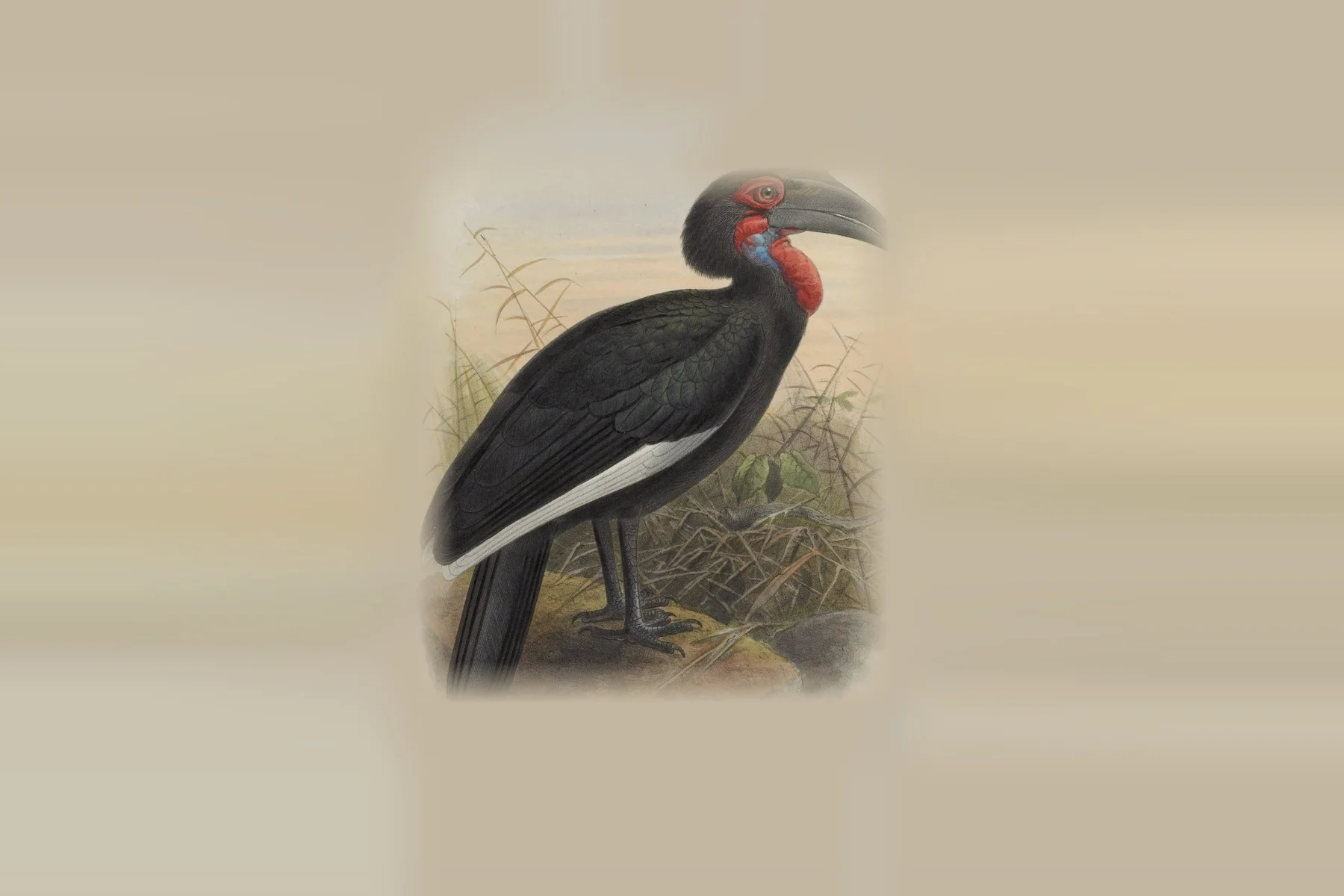
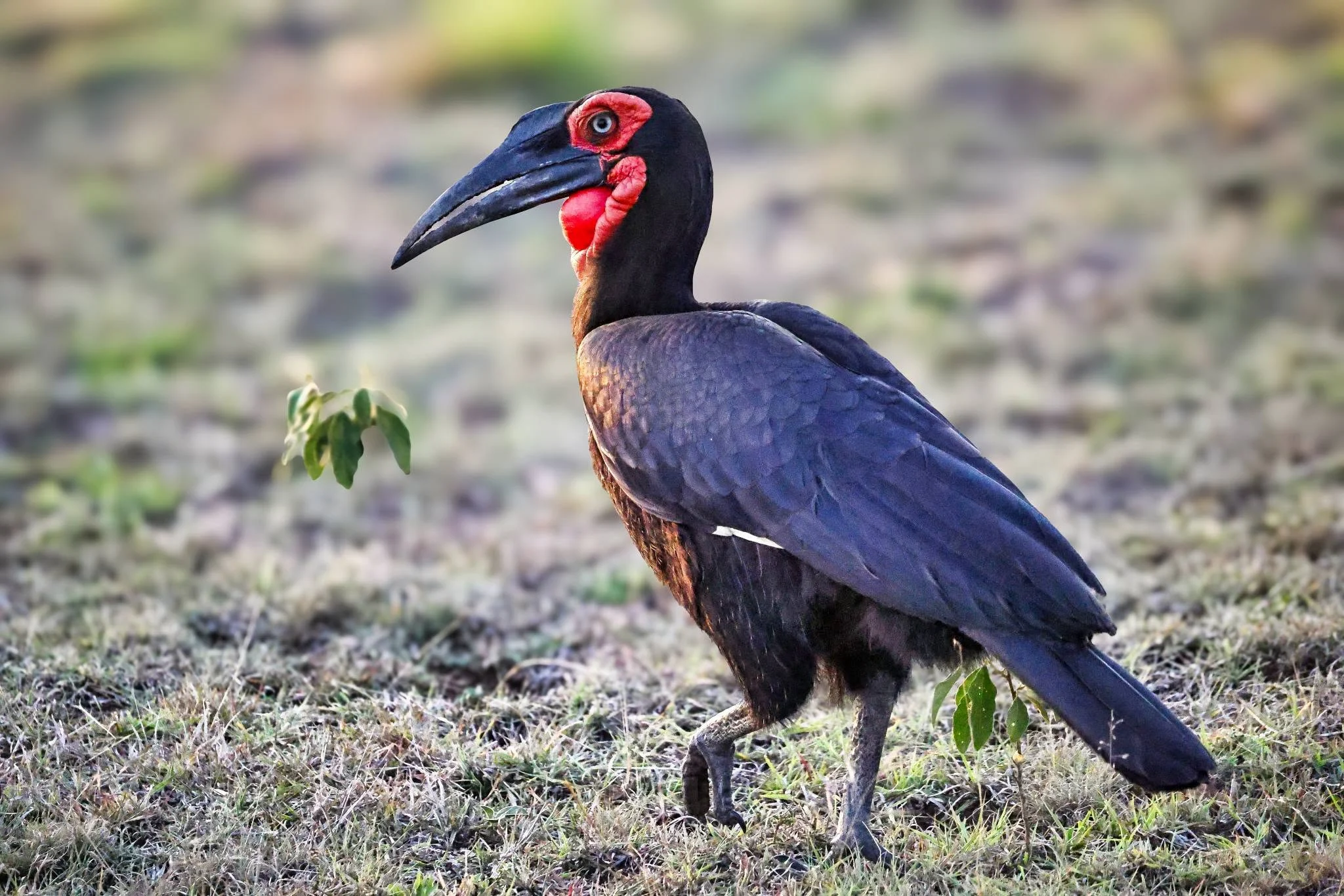
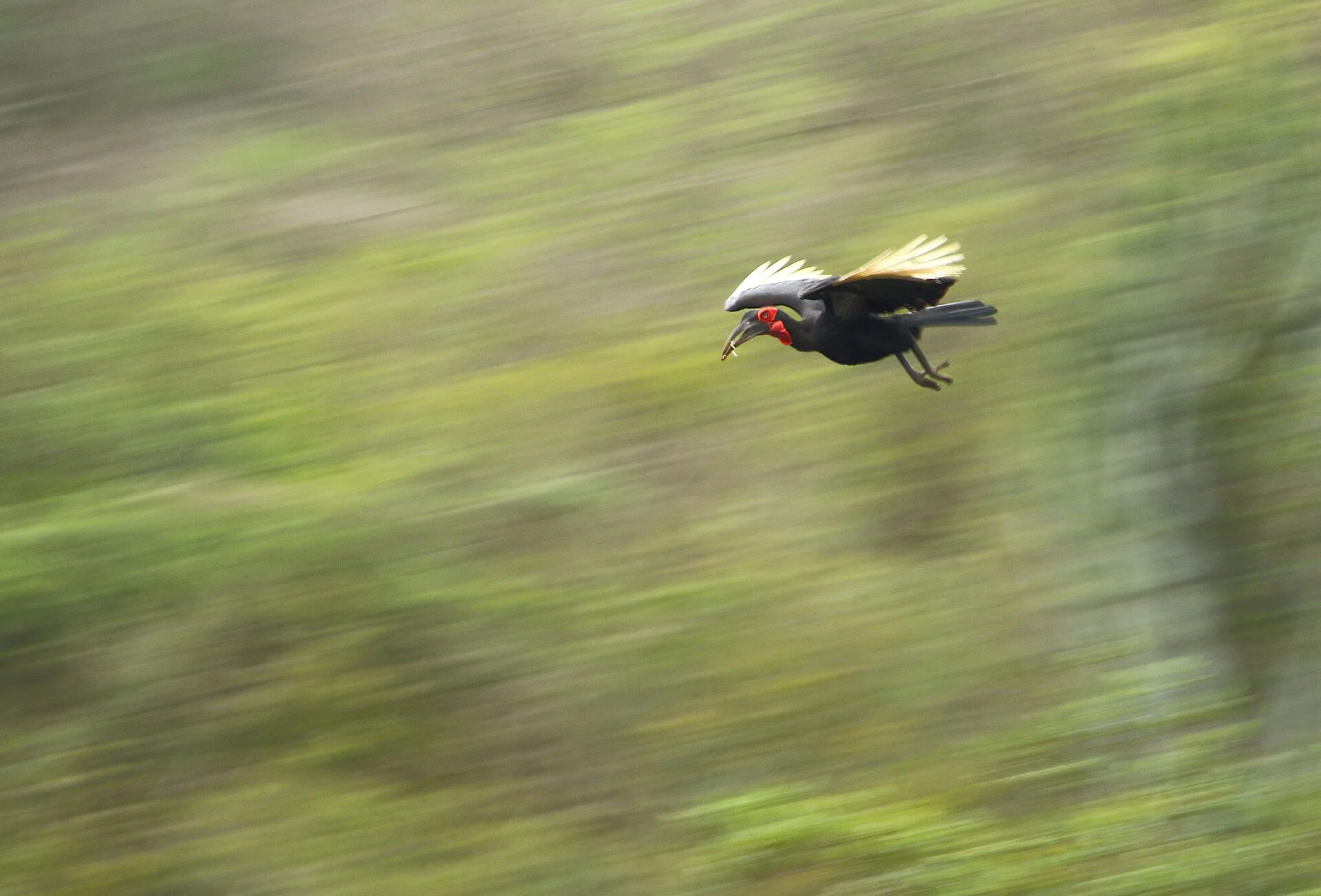
BirdLife South Africa calls the Southern Ground Hornbill the world’s largest hornbill: males weigh about 4.2 kg and females about 3.3 kg. It is entirely black except for white primary feathers, which show only in flight. Adults have bare red skin on the face and throat, and females (and some males) also have a patch of blue on the upper throat. The eyes are pale yellow with long, thick lashes, the kind people pay good money for.
You can age the birds you see, which is more than can be said for most people at a party. SANParks notes that adults have red faces, young birds have no red, and sub-adults show yellow facial skin. A group with a yellow-faced youngster has bred successfully, which is worth recording.
How a group works
Ground hornbills live in territorial groups, usually of 3 to 5 birds, though BirdLife South Africa records groups as large as 12. The core of each group is an alpha pair, and the other members are their offspring from earlier years, mostly males, which help defend the territory and feed the breeding female and chick. BirdLife says it is the largest bird in the world to breed cooperatively like this: a family business where the grown sons never quite move out.
Territories vary a great deal, from 6 to 10 km² in the private reserves next to Kruger to 200 km² on private farmland in the Limpopo Valley. That matters for visitors: in the Greater Kruger, a group’s whole range can be a few drives from your lodge.
They eat almost any small animal they can overpower, from grasshoppers, beetles and scorpions to snakes, tortoises, hares and frogs. BirdLife notes that they follow herds of antelope and come to fires to catch flushed prey, and that they never drink from open water, getting their moisture from their food. A scorpion, it turns out, is also a drink.
Why they are so rare
Breeding is extremely slow. The alpha female lays 2 eggs up to 14 days apart, and the second chick usually starves within a few days. BirdLife South Africa says that, at best, a group fledges 1 chick every 2 or 3 years, and more typically every 5 to 10 years. The young bird is fed by the group until it is about 2 years old, which is a long time to be handed lunch.
On top of that come the threats: loss of habitat, poisoned baits set for predators, lead from spent ammunition, electrocution at transformer boxes, and persecution when birds attack their own reflections in windows. BirdLife records one rural school losing 150 windows in a single morning. The species is globally Vulnerable and Endangered in South Africa, and BirdLife says it has lost 70 to 90% of its original range in some southern African countries.
The Mabula Ground Hornbill Project, BirdLife South Africa’s Species Guardian for the bird, rears the second chicks that would otherwise die and returns them to the wild through “bush schools”, where they learn from wild groups how to be a ground hornbill. It also puts up artificial nests, because some groups cannot find a big enough tree cavity to breed in.
Where to see them
Kruger National Park. This is the most reliable place in South Africa. SANParks says ground hornbills occur throughout the park and that around Orpen they are seen regularly and breed. Drive the open grassland and the edges of recent burns in the early morning. Our guide to the Big Six birds of Kruger covers the other large birds to look for on the same trip.
The Greater Kruger. In the Associated Private Nature Reserves on Kruger’s western boundary, a University of Cape Town and Mabula Ground Hornbill Project study has provided nest boxes to 28 groups to make up for a lack of natural nest cavities, and the population there has risen. With territories of only 6 to 10 km², a guide at a private lodge often knows exactly where the local group is, more or less like knowing the neighbours.
Mapungubwe and Marakele. SANParks lists Mapungubwe National Park, on the Limpopo, as a park where the species still lives. At Marakele in the Waterberg, birds were reintroduced, left the park and came back, as if they needed to see the alternatives first, and wild birds have also been seen there.
How to find a group
- Listen at dawn. The group’s booming chorus starts the day and carries up to 5 km. Note the direction and drive that way after the gates open.
- Scan open ground. Ground hornbills are the hornbills least reliant on trees, and they forage in grassland and on burnt ground where prey is easy to see.
- Watch the herds. They follow grazing animals to catch the insects and small animals that move ahead of them.
- Give them space. Stay in your car, switch off, and let the group walk past. They are easy to watch once they have accepted the vehicle as part of the scenery.
Report your sighting
Your sighting can help, and this is one case where the holiday snap does real work. SANParks asks visitors to report ground hornbills with the date and time, the exact location (for example, “11 km north of Satara on the tar road to Olifants”), the number of birds and their ages from the face colour, their condition, and a photo if you have one. The SANParks ground hornbill census page has the reporting link, and the Mabula Ground Hornbill Project also collects records.
When to go
Ground hornbills are resident and can be seen all year. The dry winter months, roughly May to September, make them easier to spot, because the grass is short and a big black bird has very little to hide behind. Breeding starts in spring, and the groups call most at dawn throughout the year.
The verdict
For a ground hornbill, go to Kruger or the Greater Kruger, be on the road at first light, and listen before you look. A private lodge guide in the Greater Kruger may know the local group’s territory to the hectare, and possibly its moods. Watch from the car, note the face colours, and report the group, because every record helps a bird that raises a chick once every few years at best.
Where to stay
Places to stay near the sites in this guide, with what each offers a birder:
| Place to stay | Where | For birders | From |
|---|---|---|---|
| Plains Camp @ Rhino Walking Safaris | Near Skukuza, southern Kruger | BirdLife Recommended, tailor-made birding safaris, Southern Ground Hornbill | R9,830 pp sharing FB |
| Umlani Bushcamp | Timbavati, Greater Kruger | Names Southern Ground Hornbill, African Scops Owl | R7,761 pp fully inclusive |
| RockFig Safari Lodge | Timbavati, Greater Kruger | Names Southern Ground Hornbill | Ask the lodge |
| Imagine Africa Luxury Tented Camp | Olifants West, Balule | Specialist birding safaris, Southern Ground Hornbill | Ask the lodge |
| Antares Bush Camp & Umgede Hide | Grietjie, Balule | BirdLife Recommended, low-level hide, guided birding outings | R7,800 for 1 to 2, exclusive use |
| Inyati Game Lodge | Sand River, Sabi Sand | Southern Ground Hornbill, Martial Eagle, own checklist | R16,500 pp fully inclusive |
| Sabi Sabi Little Bush Camp | Sabi Sand, Greater Kruger | Specialised birding guides, Southern Ground Hornbill | R32,900 pp fully inclusive |
| Tshugulu Lodge | Western Mapungubwe National Park | Park checklist of 447 species, Meves’s Starling | R1,798 a cottage for 2, self-catering |
| Vhembe Wilderness Camp | Eastern Mapungubwe, near the Limpopo | Park checklist of 447 species, Pel’s Fishing Owl | R1,080 per cabin (November 2026 listing) |
| Mazhou Camp Site | Western Mapungubwe National Park | Near the Maloutswa Pan hide | R404 a campsite for 2 |
| Mopane Bush Lodge | Mapesu reserve, next to Mapungubwe | BirdLife Recommended | Ask the lodge |
Status and population figures change. Facts were checked on 9 November 2026 with BirdLife South Africa, SANParks, the University of Cape Town FitzPatrick Institute and BirdLife International. Check current park rules and gate times directly with SANParks or your lodge.
More from the Journal
 Woodpeckers of Southern Africa, Including the One That Doesn’t Need TreesSouthern Africa's woodpeckers, from the Cardinal in every bushveld tree to the Ground Woodpecker that lives on treeless mountain slopes and eats almost nothing but ants.
 Where to See a Taita Falcon: the Strijdom Tunnel, the Blyde Cliffs and the Batoka GorgeA stocky falcon smaller than a pigeon, a handful of cliffs and surveys that keep coming back empty. Where it still nests, how to look, and the 2 roosts beside its cliffs.
 Where to See a Southern Bald Ibis: the Breeding Cliffs, Dullstroom, Wakkerstroom and LesothoA red-capped grassland ibis that nests on cliffs over waterfalls and feeds on burnt veld and maize stubble. The colonies you can watch, the fields to scan, and where to stay.
The Pigeon Post
Every Thursday: 1 bird, 1 place to go and 1 place to stay, by email. Sign up and get our printable checklist of the 163 endemics of southern Africa.