
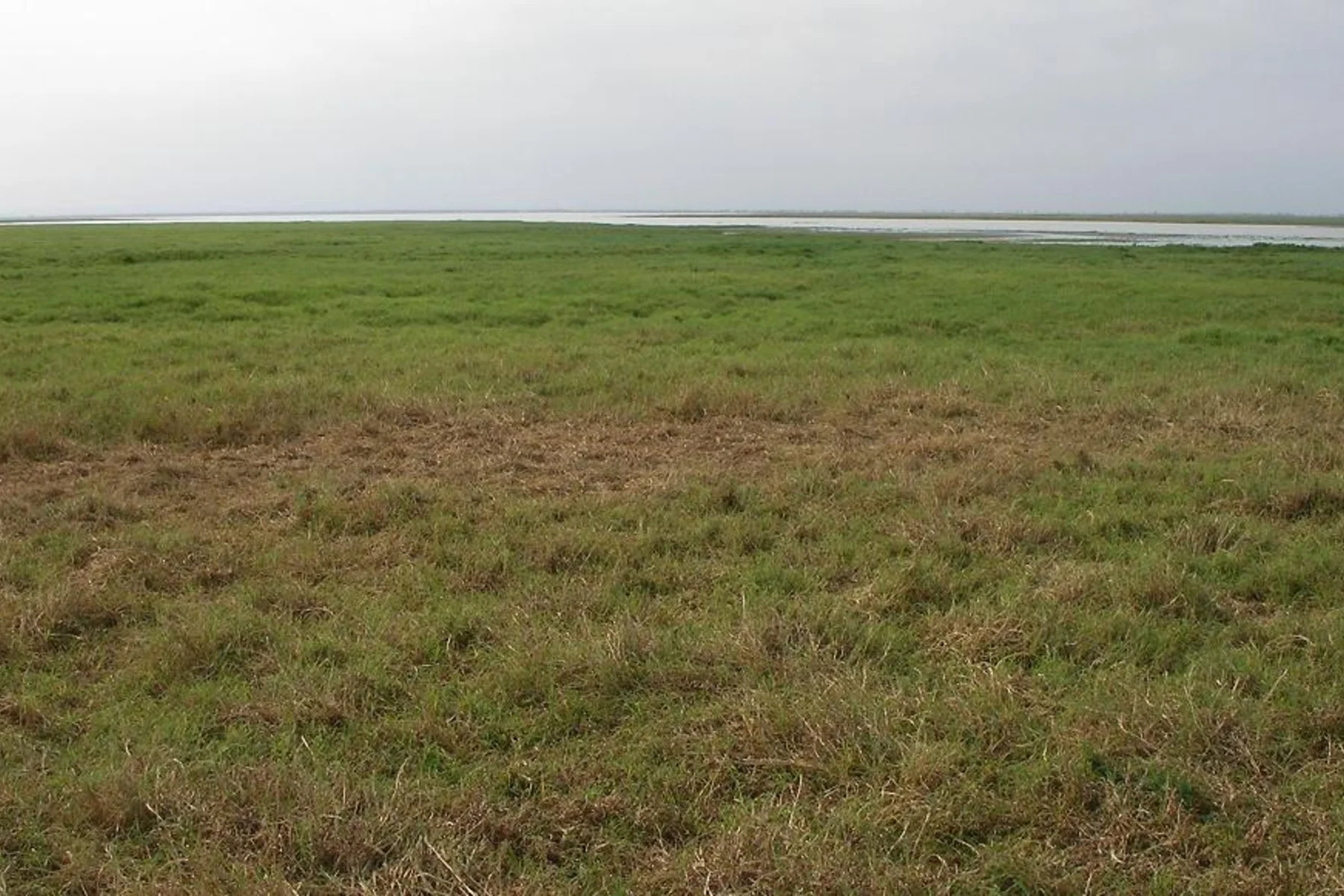
Gorongosa Birding: Lake Urema, the Floodplain and Mount Gorongosa’s Oriole
A floodplain lake with a stork and darter colony, Grey Crowned Cranes and skimmers, woodland specials on the entrance road, and a mountain with its own race of Green-headed Oriole. How to bird Gorongosa now.
On 14 April 2025, a boat team from Gorongosa National Park’s science department counted the waterbird colony on Lake Urema tree by tree and found 1,040 active nests of 9 species. Yellow-billed Storks had 535 of them and African Darters 349. It sounds like a lot until the earlier counts are set beside it: 3,502 nests in 2023 and 5,003 in 2014. The report puts the 70.3% fall down to late rains and a low lake, after an extremely dry 2024, and suggests that when the colony trees are not flooded, birds are less likely to nest in them, because the nests are easier for predators to reach. The African Openbills, which had 1,502 nests there in 2021, did not turn up at all.
That colony is a good introduction to Gorongosa. The birding here runs on water: how much falls, when, and where it ends up. Get the season right and the park has floodplain birds, woodland specials and, on the mountain next door, a race of Green-headed Oriole found nowhere else in southern Africa. For the rest of the country, from Panda to the Catapu forests, see the Mozambique birding guide.
The park and the mountain
Gorongosa National Park lies in Sofala Province, in central Mozambique, at the southern end of the Great Rift Valley; Wikivoyage gives it about 4,000 sq km of valley floor and the edges of the plateaus on either side. The rivers that drain into Lake Urema shape everything. Most of them run only in the rains, between November and April, and the year-round water comes off Mount Gorongosa, an isolated massif of about 1,863 m that receives about 2 m of rain a year and makes its own weather. The mountain waters the valley, and the valley feeds the birds.
The park’s history is a hard one. During Mozambique’s civil war, many of its large mammal populations fell by 90% or more. The birds came through it relatively unscathed, in Wikivoyage’s account, and the park’s own birds page records that 339 species were found within the park in 1965, not counting Mount Gorongosa or the surrounding areas. A bird checklist compiled for one of the park’s safari operations runs from Wattled Crane and Pel’s Fishing Owl to African Pitta, Böhm’s Bee-eater, African Broadbill and Green-headed Oriole.
Lake Urema and the floodplain
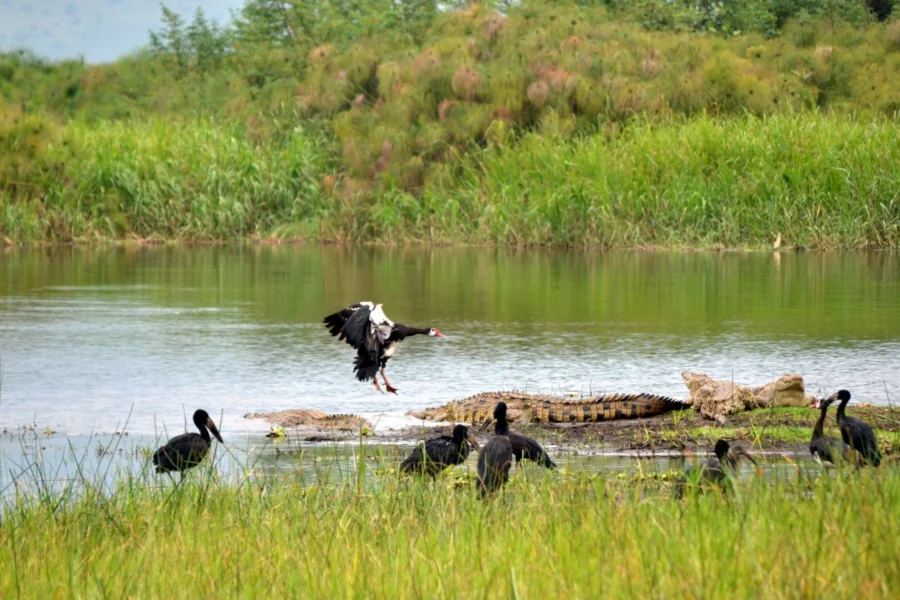
The floodplain is where the big birds are. Birding Ecotours’ group on its African Pitta tour of November and December 2021 drove from the woodland to the edge of Lake Urema and found Grey Crowned Cranes in stately pairs along the shore, Yellow-billed Storks and African Openbills in the water, Knob-billed Ducks among large flocks of White-faced Whistling Ducks, and distant Goliath Herons. Kittlitz’s Plover, Ruff, Little Stint and Marsh and Wood Sandpipers worked the mud. An evening drive to another part of the lake added Long-toed Lapwing, Collared Pratincole, Saddle-billed Stork, Great White Pelican and a large flock of African Skimmers that, in the report’s words, put on a show.
The park’s birds page calls Grey Crowned Crane a fairly common resident, and says the Gorongosa ecosystem and the Zambezi delta probably support the largest numbers of the species in southern Africa, which makes the floodplain wetlands of global importance. For the crane’s story elsewhere, see where to see a Grey Crowned Crane.
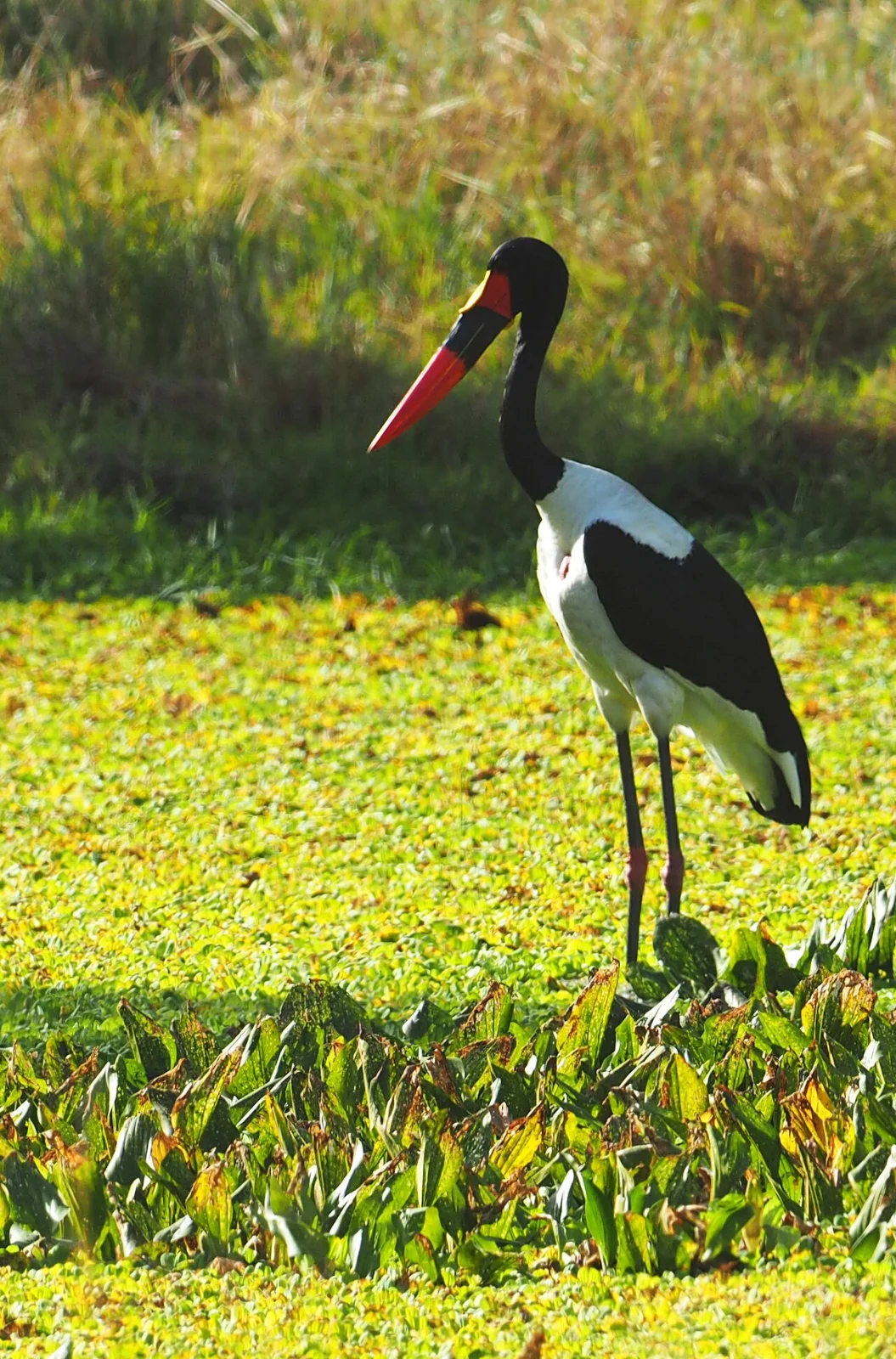
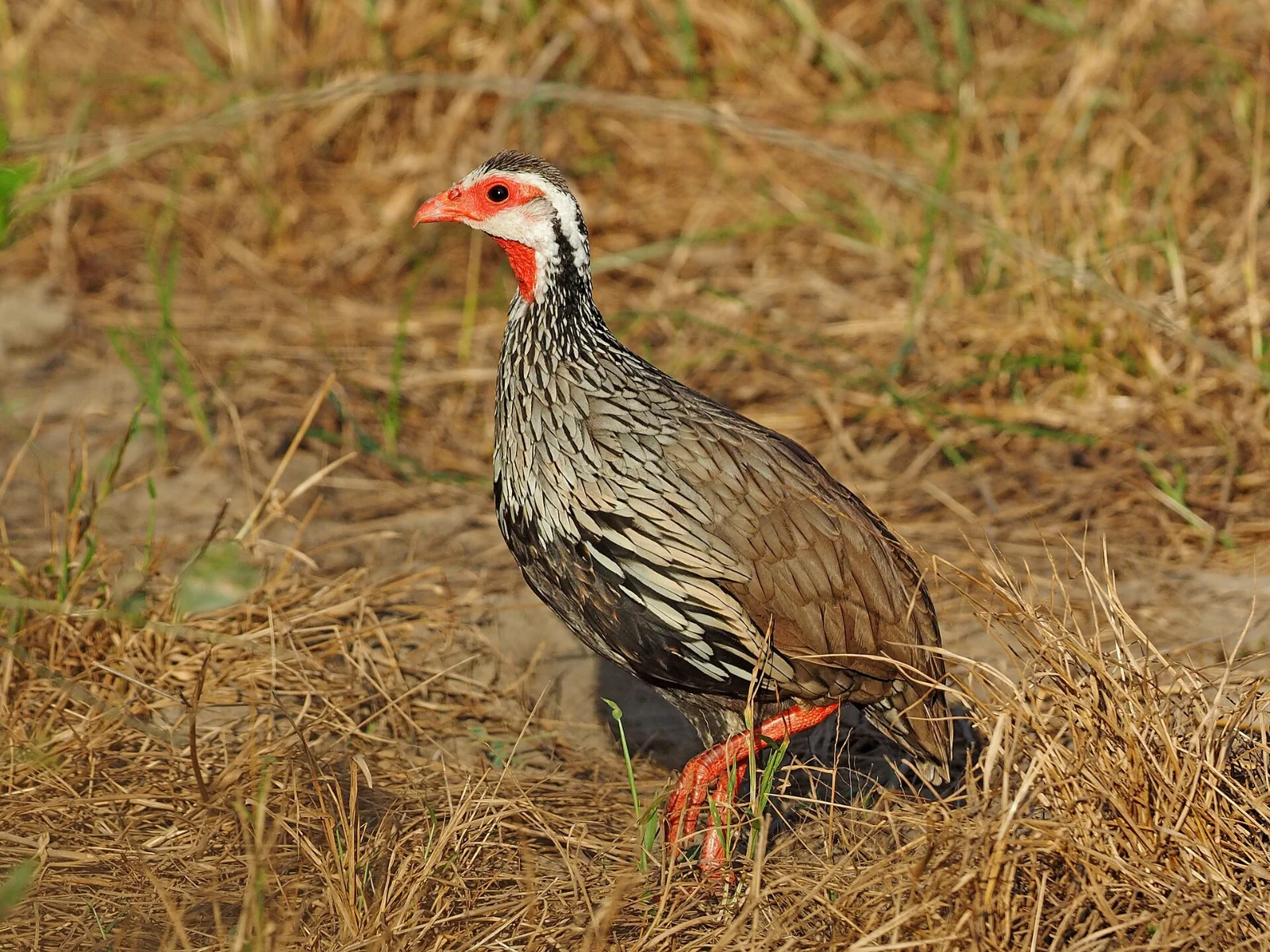
The open plains have their own list. The same morning drive found Red-necked Spurfowl, Black-bellied Bustard and Senegal Lapwing, and the raptors woke up as the day warmed: Hooded, White-backed, White-headed and Lappet-faced Vultures, Black-chested Snake Eagle, Bateleur and Booted Eagle, and a group of 4 Red-necked Falcons chasing each other at speed. A pair of Moustached Grass Warblers, a sought-after bird, was found in the same area. The group’s day list passed 130 species, which is what a floodplain in November will do for a person willing to start at dawn.
The 2025 colony report adds a few extras seen at the nests: a Palm-nut Vulture, an African Harrier-Hawk perching near active nests, which cannot have pleased the neighbours, and a Pink-backed Pelican flying over.
The woodland and the entrance road
Not all the good birds are on the water. Birding Ecotours’ 2021 group walked part of the entrance road before reaching the park, and found the scarce Speckle-throated Woodpecker, a bird the report calls difficult, along with Woodland Kingfisher, Greater Honeyguide, Grey-headed Bushshrike, African and Eurasian Golden Orioles, Pale Batis and White-breasted Cuckooshrike. Inside the park, the mixed woodland on the way to the floodplain produced Grey-headed Kingfisher, Bearded Woodpecker, Collared Palm Thrush, Brubru, Black Cuckooshrike, Grey Penduline Tit, Long-tailed Paradise Whydah and Red-headed Weaver.
Evenings were busy as well. The group had African Wood Owls calling around its camp, and its night drive found Square-tailed Nightjar, Water Thick-knee and Southern White-faced Owl, with Crested Guineafowl, Broad-billed Roller, Green-winged Pytilia and Red-throated Twinspot earlier that afternoon.
Mount Gorongosa and the Green-headed Oriole
For many southern African birders, the bird that makes Gorongosa a must is on the mountain, not in the park. The park’s birds page describes the Green-headed Oriole on Mount Gorongosa as a separate race, marked by a white panel on its wings that no other Green-headed Oriole has, living in old-growth rainforest near the top. Peter Ryan and Etienne Marais, writing in African Birdlife in September 2022, call it confined to Mount Gorongosa within the southern African region, though common in montane forests further north. The mountain lies north-west of the park, and reaching the forest where the oriole lives is, in their words, quite a hike, so the bird has placed itself at the top of the stairs.
Access has not always been possible. The same 2022 article says the mountain had been closed for several years because of local disputes, and advised birders to check with the park whether a visit could be arranged. The park’s activities page, updated in October 2026, now lists a full-day Mount Gorongosa excursion, with a drive up the mountain, a visit to the Gorongosa Coffee Project, where farmers plant shade-grown coffee to revive the rainforest, and a short hike to a waterfall, at US$200 per international visitor with a minimum of 4. Beside the oriole, the page advises birders to choose a private vehicle for more flexibility. Ask the park, before booking, whether the excursion reaches the oriole’s forest and how long the walk is.
When to go
The park’s activities run from 1 March to 15 December, and are subject to weather. Its birds page names November as the best month, when the migrants arrive and the resident birds are in breeding plumage, and says more than 150 species can be recorded in a day then. November is also when the 2021 group logged its 130-plus day. Morning drives start at 05:00 in November and December, so the early start is built in.
The lake follows its own calendar. The park’s boat safari on Lake Urema runs from March to May, depending on the water, and cannot be confirmed in advance; in 2025, the colony team could not launch its boat until April. A canoe trip on the Pungué River is the other water option. A visit in November suits the woodland birds and the migrants, and lines up with the start of the African Pitta season in the forests to the east; for that bird, see where to see an African Pitta.
Planning a visit
Self-driving is not currently allowed in the park, according to SafariFind’s July 2026 fee guide, and all game drives go with a licensed guide. The park’s shared guided drives take up to 10 guests at US$65 per international adult in the morning and US$70 in the afternoon, and a full-day drive is US$180 per person with a minimum of 4. For birders it also offers trips with its own birding guides, priced on request through the activities centre, and exclusive-use vehicles from US$650 a morning, which is the way to stop for every cisticola without a vote. SafariFind gives the daily conservation fee as 900 meticais for international adults and 600 for SADC residents; other 2026 guides quote different figures, so confirm the current fee with the park.
No Gorongosa place to stay is in the Birding Dispatch directory yet.
Activities, prices and access to Mount Gorongosa change. Facts were checked on 15 November 2026 with Gorongosa National Park’s activities and birds pages, the park’s April 2025 waterbird colony report, Birding Ecotours’ 2021 trip report, African Birdlife’s September 2022 Mozambique feature, Wikivoyage and SafariFind. Confirm activities, fees and mountain access with the park before you travel.
More from the Journal
 Namib-Naukluft and Sossusvlei for Birders: Dune Lark, Desert Raptors and the Naukluft SpecialsA lark that lives on the dunes and nowhere else, Lappet-faced Vultures nesting in the desert, coursers on the gravel plains and the northern specials around the Naukluft cliffs, in one of Africa's largest parks.
 Lake Baringo and Lake Bogoria Birding: The Owl Walks, the Cliffs and the FlamingosA local guide who knows where every nightjar and eagle-owl slept last night, thorn scrub full of hornbills, a Goliath Heron colony on a rock, and the flamingo lake next door that keeps rising.
 Akagera Birding: Rwanda’s Savanna, Lakes and Papyrus, and the Shoebill ChancesRed-faced Barbet in the southern woodland, Papyrus Gonolek and Carruthers's Cisticola in the swamps, a lake of hippos and lapwings, and a Shoebill that hides in the wetlands more than it shows.
The Pigeon Post
Every Thursday: 1 bird, 1 place to go and 1 place to stay, by email. Sign up and get our printable checklist of the 163 endemics of southern Africa.