
Erongo and Spitzkoppe Birding: Herero Chat, Rockrunner and Hartlaub’s Spurfowl
Namibia's escarpment specials live on 2 granite landmarks a short drive apart. Where recent groups found Herero Chat, Rockrunner, Hartlaub's Spurfowl and Rüppell's Parrot, where they missed, and where to stay.
Hartlaub’s Spurfowl spent the first 2 days of a Birding Ecotours tour in November 2025 calling from somewhere out of sight in the Erongo Mountains. On the group’s last morning, at a rocky outcrop, the birds started up as soon as the vehicle arrived, and at least 4 showed in the scope, distant but unmistakable. In February 2026, a WINGS group found a male and female duetting from the rocks almost immediately on its pre-breakfast search. Same bird, same mountains, 2 very different mornings. That is Erongo birding in short: the specials are here, and they keep their own appointments.
The Erongo Mountains and Spitzkoppe sit inland from Swakopmund, on the usual route from the coast towards Etosha. Together they hold most of the birds that make Namibia’s escarpment worth the drive: Herero Chat, Rockrunner, Hartlaub’s Spurfowl, Monteiro’s Hornbill, White-tailed Shrike, Carp’s Tit and Rosy-faced Lovebird, with Rüppell’s Parrot in the riverbeds nearby. For the whole country’s set, see the Namibia birding guide.
Spitzkoppe and the Herero Chat
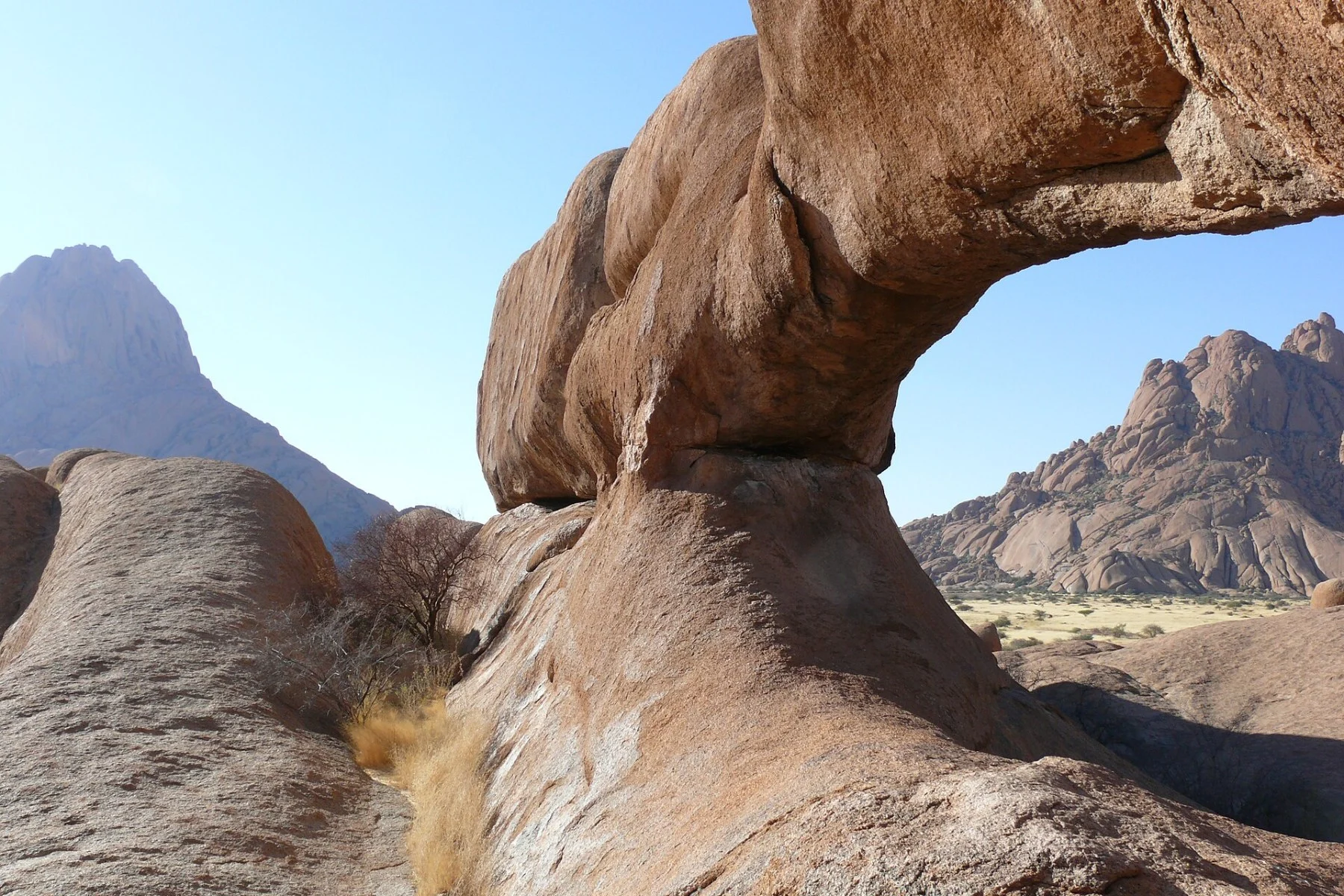
Spitzkoppe is a group of bald granite peaks between Usakos and Swakopmund, on the edge of the Namib. The granite is more than 120 million years old, and the highest outcrop rises to about 1,728 m above sea level, roughly 670 m above the flat desert floor around it. It has been called the Matterhorn of Namibia, which is generous to the Matterhorn. The area around the Great Spitzkoppe was declared the Gaingu Conservancy in 2003, and rock paintings survive around the foot of the main peak.
The bird to plan around is Herero Chat, and recent groups show how the odds swing. The WINGS group in February 2026 located Herero Chat quickly at Spitzkoppe, along with Layard’s Warbler, and added Klaas’s and Jacobin Cuckoos. The Birding Ecotours group in November 2025 searched thoroughly for a couple of hours and came up short, then tried again in the Erongo the next day, where the report calls the chat infrequent, and missed it in the heat.
The consolation prizes are good ones. That November group found Verreaux’s Eagle, Rock Kestrel, Peregrine Falcon, Pririt Batis, Black-chested Prinia, Layard’s Warbler, Dusky Sunbird and White-throated Canary around the peaks. The drive in pays too: on the road to Spitzkoppe it found Stark’s Lark in large numbers, Namaqua Sandgrouse, Karoo Chat, Yellow-bellied Eremomela and Great Sparrow, and earlier, in the Namib, a group of 5 Rüppell’s Korhaans standing beside the highway as if waiting for a lift. The WINGS group came through the Khan River valley instead, for a pair of Karoo Eremomelas and Karoo Long-billed Lark.
Go early. Both reports point the same way: the November miss came after a morning departure from Walvis Bay and a search that ran into the heat, and the second try in the Erongo was described as already quite hot. Herero Chat is a bird to look for at first light, with a second morning in hand.
The Erongo Mountains
The Erongo Mountains are the eroded remains of an ancient volcanic complex, rising in granite domes and boulder stacks to over 2,300 m, according to the WINGS narrative. The boulders are the point. Rockrunner, the near-endemic that bounds about them as if late for something, was the “nice showy bird” of the Birding Ecotours group’s first afternoon walk around the koppies, along with Swallow-tailed Bee-eater, Rosy-faced Lovebird, Monteiro’s Hornbill, White-tailed Shrike, Alpine Swift and Long-billed Crombec, with Rock Hyraxes scurrying over the rocks.
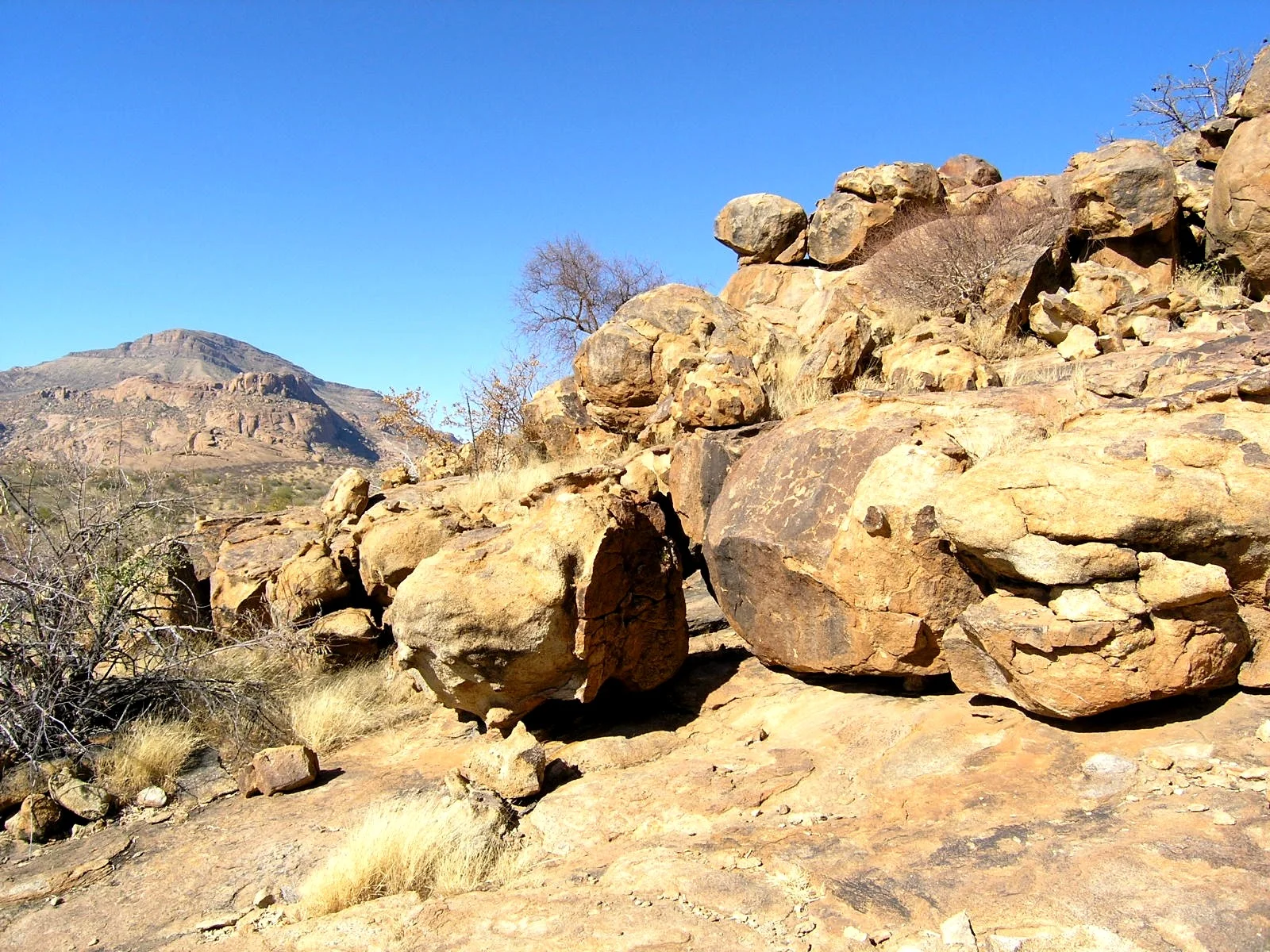
The bushveld below the koppies adds a long list. The same group’s morning walk produced Red-billed Spurfowl, Grey Go-away-bird, Bradfield’s Swift, Pearl-spotted Owlet, Common Scimitarbill, Crimson-breasted Shrike, Burnt-necked Eremomela, Barred Wren-Warbler, Chestnut-vented Warbler, Marico Flycatcher, Kalahari Scrub Robin and Marico Sunbird, with Carp’s Tit, Sabota Lark and Black-chested Snake Eagle later in the day. A lodge waterhole at lunch brought Black-faced Waxbill, Green-winged Pytilia, Shaft-tailed Whydah, Black-throated Canary and Lark-like Bunting down to drink, which is the most efficient birding a person can do with a fork in hand.
Evenings are worth staying up for. Both groups had Freckled Nightjars hawking over dinner; the November group watched Double-banded Sandgrouse come in to drink, and a single Black Rhinoceros, which nobody minded as an interruption. The WINGS group added a Barn Owl.
Hartlaub’s Spurfowl is the hard one. The Birding Ecotours report says it has proven tricky in the Erongo over the last couple of years, and its group heard only a distant bird on its first full morning. The answer, in both reports, was the same: be at a rocky outcrop at dawn, when the birds call. Plan 2 nights, not 1, so there are 2 dawns to try. The spurfowl appears to have read the itinerary and enjoys keeping the last morning interesting.
The Omaruru riverbed
On the way out towards Etosha, the dry Omaruru riverbed is where to look for Rüppell’s Parrot. The Birding Ecotours group walked under the huge camel thorns for a while before hearing the parrots, then needed a lot of repositioning before everyone had prolonged scope views of a bird feeding in the dense canopy. The same afternoon added Damara Red-billed Hornbill, Violet Wood Hoopoe, Bearded and Bennett’s Woodpeckers, Burchell’s Starling, Groundscraper Thrush and Red-billed Buffalo Weaver, and on the drive back Short-toed Rock Thrush and Purple Roller. The WINGS group, passing through Omaruru, logged large numbers of Bradfield’s Swifts overhead and only brief flight views of the parrot further on.
When to go and how long to stay
The 2 recent reports give 2 different seasons. The November 2025 group birded the area in the dry heat before the rains and found the specials except Herero Chat, with Hartlaub’s Spurfowl on the last chance. The February 2026 WINGS group met widespread and unusually early rains, which moved birds about and made a few nomads, Burchell’s Courser and Ludwig’s Bustard, impossible to find, yet it found Herero Chat and Hartlaub’s Spurfowl quickly. Neither month guarantees the chat. What both reports agree on is the shape of a visit: Spitzkoppe on the drive inland from the coast, then 2 nights in the Erongo, with the Omaruru riverbed on the way north.
If the chat is still missing, the Erongo itself is the second chance, and the escarpment stretches north beyond it. For the coastal leg before this one, see Walvis Bay birding; for the next stop, see Etosha for birders.
Choosing a base
The directory’s 2 Erongo listings both come with a hide, which suits birds that prefer to be waited for. Erongo Rocks Farmhouse and Camping, on the D2315 in the Erongo Mountains, has campsites and pre-pitched dome tents among the granite boulders of a nature farm, with a bird hide and marked trails, and names Rosy-faced Lovebird, Monteiro’s Hornbill and Hartlaub’s Spurfowl among its birds. It is self-catering, with 8 named campsites plus a pre-pitched tent for up to 2, and rock climbing for anyone who wants to see the Rockrunner’s view.
Hohenstein Lodge stands at the foot of the Hohenstein, 25 km from Usakos, in the Hohenstein Nature Reserve. Its bush hide looks over a bird bath 1 km from reception, on 1 of the reserve’s marked routes, and the lodge has feeders; its habitats run from granite outcrops to tree savanna, a dry riverbed and open plains. It has 14 rooms and family guest houses, and is dinner, bed and breakfast.
Where to stay
The places to stay in the Erongo Mountains, in the order they appear above:
| Place to stay | Where | For birders | From |
|---|---|---|---|
| Erongo Rocks Farmhouse and Camping | D2315, Erongo Mountains, Namibia | Bird hide, trails, Hartlaub’s Spurfowl, Monteiro’s Hornbill | Ask the lodge |
| Hohenstein Lodge | Foot of the Hohenstein, near Usakos, Namibia | Bush hide by a bird bath, feeders | N$2,300 pp sharing DB&B (Dec 2026 to Feb 2027) |
Access, conservancy rules and lodge details change. Facts were checked on 15 November 2026 with the Birding Ecotours November 2025 and WINGS February 2026 trip reports and each listing on Birding Dispatch. Confirm access to Spitzkoppe and the Erongo farms with your host before you travel.
More from the Journal
 Namib-Naukluft and Sossusvlei for Birders: Dune Lark, Desert Raptors and the Naukluft SpecialsA lark that lives on the dunes and nowhere else, Lappet-faced Vultures nesting in the desert, coursers on the gravel plains and the northern specials around the Naukluft cliffs, in one of Africa's largest parks.
 Lake Baringo and Lake Bogoria Birding: The Owl Walks, the Cliffs and the FlamingosA local guide who knows where every nightjar and eagle-owl slept last night, thorn scrub full of hornbills, a Goliath Heron colony on a rock, and the flamingo lake next door that keeps rising.
 Akagera Birding: Rwanda’s Savanna, Lakes and Papyrus, and the Shoebill ChancesRed-faced Barbet in the southern woodland, Papyrus Gonolek and Carruthers's Cisticola in the swamps, a lake of hippos and lapwings, and a Shoebill that hides in the wetlands more than it shows.
The Pigeon Post
Every Thursday: 1 bird, 1 place to go and 1 place to stay, by email. Sign up and get our printable checklist of the 163 endemics of southern Africa.