
December Birding in South Africa: The Migrants, Birding Big Day and the Holiday Crowds
December is when the last migrants arrive and the schools close. Where to bird over the holidays, from Kruger's rollers and kingfishers to the highveld's falcon roosts, and how to get round the crowds.
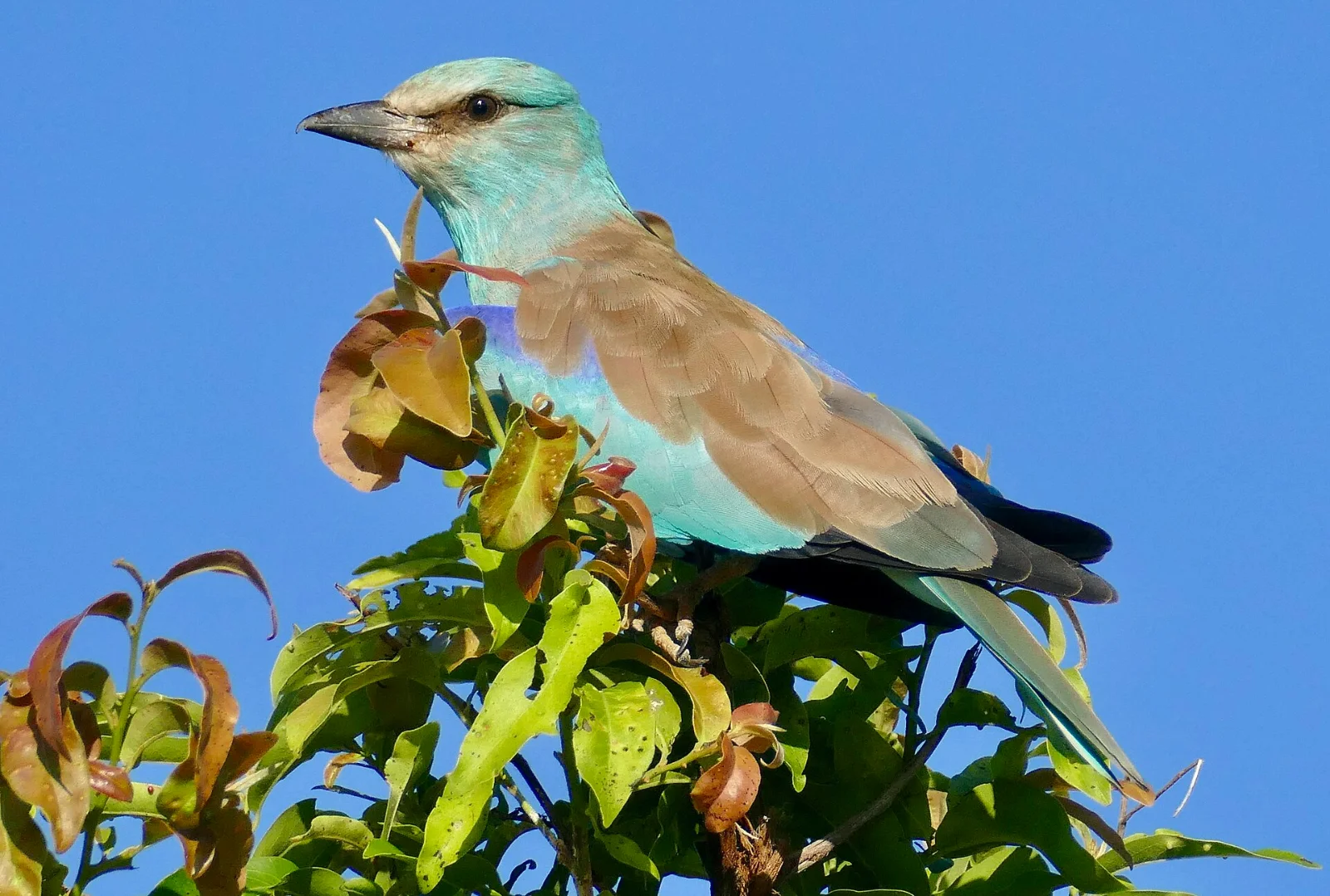
The European Roller is among the last birds of summer to turn up, fashionably late. A few reach the far north of southern Africa in October, but the Atlas of Southern African Birds says most arrive only in December and January, and in the southern half of the region they begin arriving in December. Numbers peak in February, and by March they are leaving fast. For a birder with a December break, that is the month in a sentence: the late migrants are arriving while the early ones are already breeding.
It is also the month the country goes on holiday, and a fair share of it heads for Kruger. Public schools close on 9 December 2026 and reopen on 13 January 2027, and SANParks says Kruger’s day-visitor quotas are mostly reached in the school holidays. This guide covers where the birds are in December and how to reach them without spending the morning in a queue.
Why December works
By December the summer visitors have had time to settle. The Woodland Kingfisher, an intra-African migrant, arrives in the first 2 weeks of November, according to P.A. Clancey’s Atlas account, and in the old Transvaal it breeds from November to March, peaking in December and January. Its trilling call is what draws attention to it. Amur Falcons reach most of southern Africa in early November and the far south about a month later, in early December. Our guide to summer migrants gives the arrival dates for the Palearctic visitors.
Rollers show the scale. Even in summer, the Atlas found Lilac-breasted Rollers 5 to 10 times more common than European Rollers in southern Africa, so the migrant takes some looking for, and the commoner cousin gets a great many second looks.
Birding Big Day on 5 December
BirdLife South Africa’s Birding Big Day falls on Saturday 5 December 2026. Teams try to record as many species as they can in 24 hours, inside a circle of 50 km radius (100 km across) or 6 km radius (12 km across). Teams in the 50 km category go into the provincial challenges automatically; 6 km teams have to email BirdLife to be entered. With the migrants in and the holidays not yet begun, the first Saturday of December is a good day to be in the field anyway, scoresheet or not. Our Birding Big Day guide explains how to register and plan a route.
Kruger and the Lowveld
In Kruger, the Pafuri region in the far north is described on its listing as the most biodiverse corner of the park. Pafuri Camp, on the Luvuvhu River in the Makuleke Contract Park, is BirdLife South Africa Recommended and lies inside the Kruger National Park and adjacent areas Important Bird Area. The specials on its GoBirding page include Pel’s Fishing Owl, Racket-tailed Roller, African Finfoot and Böhm’s Spinetail. Rates include 2 safari activities a day and start at R8,450 per person sharing a night for 2026/27, fully inclusive.
Further south, Mopani Rest Camp is the self-catering option with hides: the Pioneer Dam bird hide and the Shipandani sleep-over hide, for birders who would rather not leave at all. Bungalows start at R1,888 a night for 2, as listed in September 2026. Our Kruger birding guide covers the camps and roads in more detail.
In the private reserves of Greater Kruger, 2 listings name the summer migrants outright. Shumbalala Game Lodge, in the Thornybush near Hoedspruit, lists Woodland Kingfisher, European Bee-eater, Wahlberg’s Eagle, Steppe Buzzard and Amur Falcon as the summer birds to look for, and its rangers will tailor drives to birding. Chitwa Chitwa, in the Sabi Sand, describes its guides as expert birders, counts more than 300 species and names Woodland Kingfisher and European Roller among its summer migrants. It costs from R28,447 per person sharing a night in 2026, full board with drives and walks.
The highveld: falcons in the town trees
On the highveld the December spectacle is overhead at dusk. Amur Falcons, with Lesser Kestrels, gather at night in large roosts in tall trees, often in towns, as if the countryside were not big enough, and the Atlas says these roosts can number tens of thousands of birds. Their stronghold is the grassland of south-eastern Mpumalanga, western KwaZulu-Natal and the north-eastern Free State.
The journey behind them is among the longest of any raptor. After breeding in eastern Asia, Amur Falcons fly west across India, cross the Indian Ocean to East Africa and continue south. In January 2010 a team from South Africa and Germany fitted satellite tags to falcons at the Newcastle roost in KwaZulu-Natal; a female, the last of the tagged birds still transmitting, was back at Newcastle on 10 January 2013, same town, after a 14,500 km journey from her breeding grounds in northern China and Mongolia, having reached the coast of East Africa in late November. That year the Endangered Wildlife Trust’s annual roost count covered more than 50 roosts across South Africa.
For a highveld base, Greystone Lodge, between Dullstroom and Belfast in Mpumalanga, is BirdLife Recommended, publishes a recorded list of 94 species, and names European Roller with Secretarybird and breeding Blue Cranes. Chalets start at R1,200 a night on weekdays in 2026. Closer to Johannesburg, Thaba Eco Hotel on the Klipriviersberg is BirdLife Recommended, and the eco park reports European Roller and Lilac-breasted Roller in the adjoining nature reserve.
Zululand and the coast
For a holiday that mixes the beach with birding, St Lucia has the Woodland Kingfisher too, so nobody has to choose between a swim and a lifer (a species seen for the first time). Lidiko Lodge is a 16-room bed and breakfast set in a tropical garden that it markets to birders; birds are seen from the rooms and the breakfast deck, staff point guests to local guides and routes, and the birds it names include Purple-crested Turaco, Trumpeter Hornbill and Woodland Kingfisher.
Getting round the holiday crowds
Kruger limits day visitors at every gate. SANParks applies the quota all year but says it mostly reaches capacity on long weekends and during school holidays, and its December 2024 notice set out how the system works. Pre-booking secures a place within up to 80% of each gate’s day-visitor quota, for a non-refundable fee (R56 per adult in December 2024) on top of conservation fees or a Wild Card. Pre-booked visitors choose a time slot (05:30 to 08:00, 08:00 to 10:00, or 10:00 onwards) and lose their priority if they arrive late. Once the quota is reached, only pre-booked visitors are let in, while the rest queue for space as others leave. Overnight guests are not affected.
For birders, the practical answers follow from that. Stay inside the park, or in a lodge on a private reserve, rather than driving in for the day. In December the entrance gates open at 05:30 and close at 18:30, and SANParks lists camp gates opening from 04:30, so guests already in a camp can be on the road an hour before day visitors reach the gates. Book early: the school holidays start on 9 December, and Birding Big Day falls on the Saturday before.
Bird early, too, and rest through the heat of the day, as the birds sensibly do. Learn the summer calls before you go, from the Woodland Kingfisher’s trill to the Red-chested Cuckoo’s Piet-my-vrou.
Where to stay
The places in this guide, with what each offers a birder in December:
| Place to stay | Where | For birders | From |
|---|---|---|---|
| Pafuri Camp | Makuleke, northern Kruger | BirdLife Recommended, Important Bird Area, Racket-tailed Roller | R8,450 pp sharing, fully inclusive |
| Mopani Rest Camp | Kruger National Park | Pioneer Dam hide, Shipandani sleep-over hide | R1,888 a bungalow for 2, self-catering |
| Shumbalala Game Lodge | Thornybush, Greater Kruger | Summer migrants named, birding drives on request | Ask the lodge |
| Chitwa Chitwa | Sabi Sand, Greater Kruger | Bird guide on staff, Woodland Kingfisher, European Roller | R28,447 pp sharing, full board |
| Greystone Lodge | Between Dullstroom and Belfast | BirdLife Recommended, European Roller, breeding Blue Cranes | R1,200 a chalet, weekdays |
| Thaba Eco Hotel | Klipriviersberg, Johannesburg South | BirdLife Recommended, European Roller in the reserve | Ask the lodge |
| Lidiko Lodge | St Lucia, KwaZulu-Natal | Tropical garden, Woodland Kingfisher, Purple-crested Turaco | Ask the lodge |
Migration dates shift with rainfall and from year to year. Dates, quotas and gate times were checked with BirdLife South Africa, SANParks and the Department of Basic Education’s calendar on 14 November 2026; confirm them with SANParks before you travel.
More from the Journal
 Spring Birding in South Africa: September to November, the Arrivals, the Flowers and the BreedingThe first Red-chested Cuckoos call in September, bee-eaters land in October and Woodland Kingfishers arrive in early November. What arrives when, where the flowers are, and where to stay.
 January Birding in South Africa: Where to Go, What’s About, the Heat and the RainJanuary is high summer: bishops in scarlet, Woodland Kingfishers at their breeding peak and European Rollers still arriving. Where to go, and how to work around the heat and the holidays.
 Autumn Birding in South Africa: March to May, When the Migrants LeaveFrom March to May the summer visitors leave: rollers in March, swallows in early April, Woodland Kingfishers by night from mid-April. Who goes when, what replaces them, and where to bird.
The Pigeon Post
Every Thursday: 1 bird, 1 place to go and 1 place to stay, by email. Sign up and get our printable checklist of the 163 endemics of southern Africa.