
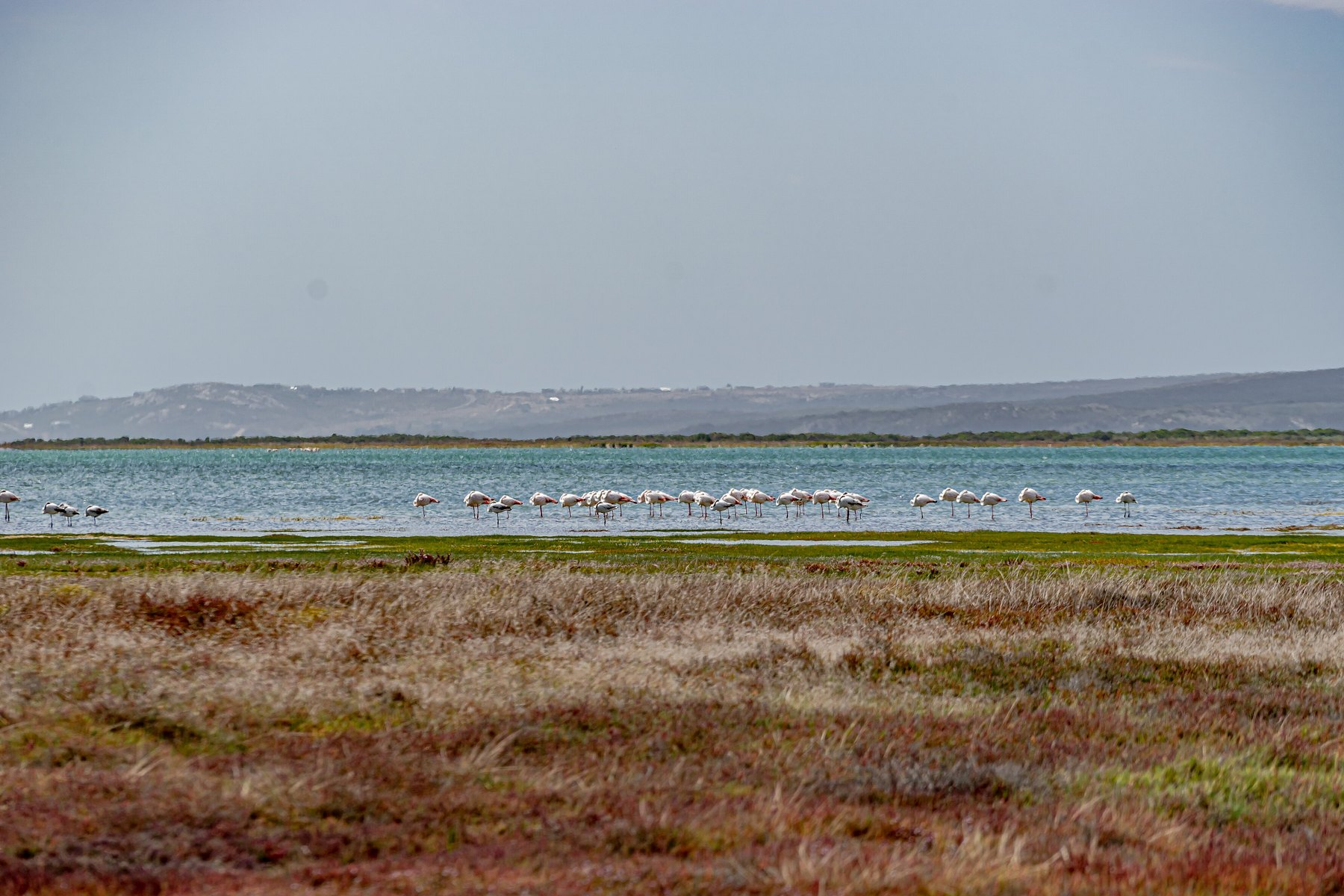
West Coast National Park and Langebaan: Birding the Lagoon and the Strandveld
The best birding day trip from Cape Town after the fynbos, if the tide agrees: Langebaan Lagoon's summer waders, the strandveld specials, Postberg in spring and tide timing.
West Coast National Park wraps around Langebaan Lagoon about 100 km north of Cape Town on the R27, and for a birder it is the natural second day after the fynbos. Peter Ryan of the FitzPatrick Institute wrote that the lagoon hosts the largest number of migrant shorebirds in South Africa, and BirdLife South Africa calls it a favourite with local birders because it draws national rarities every season, which keeps local birders coming back with their scopes and their hopes.
The waders are only half of it. The low coastal scrub around the lagoon, the strandveld, holds Black Harrier, Southern Black Korhaan and dry-country birds the fynbos sites lack. Everything depends on the tide: get it wrong and the birds are specks on a distant mudflat, and the birder is a speck in a hide, squinting.
The short answer
Leave Cape Town early, enter at the southern R27 gate and bird the strandveld from the car on the way in. Time your arrival at the Geelbek hide for the incoming tide after low water, which pushes the waders towards the hide, then drive up the eastern shore to Seeberg for the lookout and the second hide nearer high tide. Go between October and March for the Palearctic waders, or in August and September if you also want Postberg in flower. If you have a second day, add the Berg River estuary at Velddrif.
At a glance
| Target | Where (BirdLife SA, Peter Ryan) | Notes |
|---|---|---|
| Curlew Sandpiper, Little Stint | Geelbek hides | The bulk of the flocks; peak by October |
| Bar-tailed Godwit | Geelbek and Seeberg hides | Often at Seeberg in season |
| Red Knot, Terek Sandpiper | Geelbek hides | Scarce but turn up most years |
| Greater Sand Plover | Western shore of the lagoon; Kliphoek pans, Velddrif | Summer, not guaranteed |
| Black Harrier | Throughout; Atlantic viewpoint, Abrahamskraal, Seeberg | Endemic, endangered |
| Southern Black Korhaan | Seeberg lookout road | Calls early and late |
| Cape Penduline Tit | Seeberg hide boardwalk | Small and fast moving |
| Karoo Lark | Strandveld, Postberg | Also at Velddrif and Rocherpan |
The lagoon waders
BirdLife South Africa’s GoBirding guide, written by Mayur Prag of Birding Africa, describes 2 hides that run out onto the mudflats at Geelbek, at the southern end of the lagoon, and gives close views of the thousands of waders that arrive in spring. They start arriving in numbers in August and peak by October. Most are Curlew Sandpipers and Little Stints, often with Sanderlings. Mixed in are Marsh Sandpiper, Common Greenshank, Ruff, Ruddy Turnstone, Common Whimbrel and Bar-tailed Godwit, with Grey Plover and Eurasian Curlew standing out by size. SANParks says Curlew Sandpiper, Sanderling and Red Knot fly about 15,000 km from Russia each year, for a summer on the Langebaan mud.
The prizes hide among the common birds, which is where the scope and the patience come in. GoBirding lists Red Knot, Terek Sandpiper and Lesser Sand Plover as scarce birds that turn up most years, and Ryan’s site guide adds Greater Sand Plover on the western shore. A Birding Ecotours day trip in April 2021 found Terek Sandpiper at Geelbek, with many birds in near breeding plumage.
Expect Greater and Lesser Flamingos in large numbers, Pied Avocet and Caspian, Swift and Sandwich Terns, with Western Osprey in summer. Ryan notes that African Rails often feed along the marsh edge at Geelbek. Bring a scope. Really.
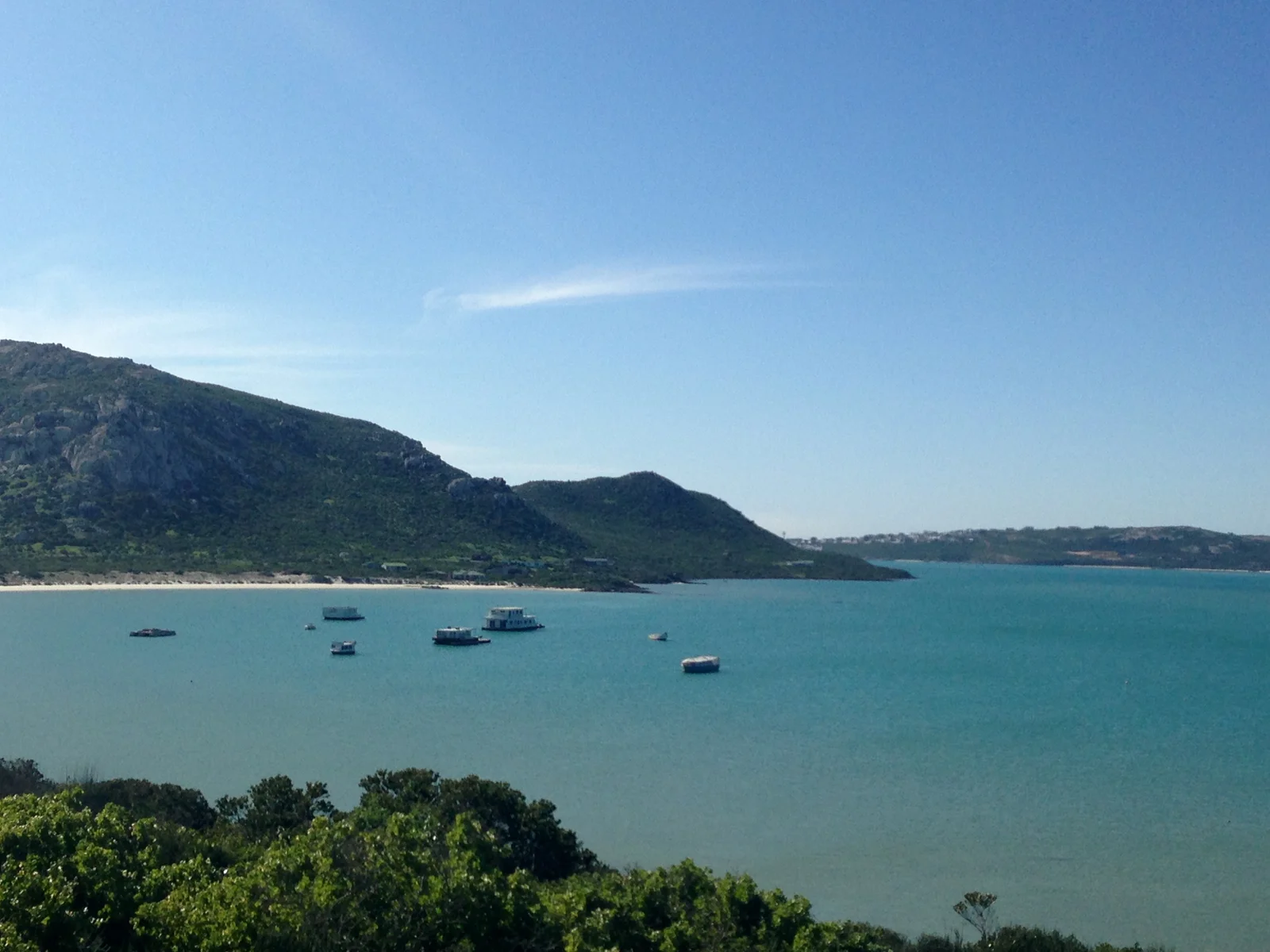
Tide timing at Geelbek and Seeberg
The lagoon is shallow, so the water’s edge moves a long way between tides, and that decides your day. The tide table is the most important field guide in the car. GoBirding says the incoming tide after low tide is often best at Geelbek, because the rising water pushes the birds towards the hides. Ryan’s guide is more precise: the main Geelbek hide works best at mid tide, Seeberg on the eastern shore is best around high tide, and at very high tide the smaller hides on the salt marsh west of Geelbek are the better choice. He calls that salt marsh the only place in the park where Chestnut-banded Plovers are common.
The plan, in one line: check the Langebaan tide table, reach Geelbek about 2 hours after low water, stay through mid tide, then drive round to Seeberg as the water peaks.
The strandveld specials
GoBirding says birding from the car works throughout the park, starting at the southern gate. Look for small groups of White-backed Mousebirds on the bush tops, among the common Karoo Scrub Robins and Bokmakieries. Check every covey of Cape Spurfowl crossing the road, because the scarcer Grey-winged Francolin is here too; Birding Ecotours found it near the Geelbek hide.
Cape Penduline Tit takes the most searching, and is in no mood to sit still. GoBirding says pairs split up to breed in spring, then gather in late summer into feeding groups of about 10 that move fast through the bushes. The short boardwalk to the Seeberg hide is the best spot for them.
Black Harrier is the bird most visitors want, and the one that makes them stop the car for every dark shape on the horizon. GoBirding calls it endangered, says it can turn up anywhere in the park, and recommends watching for its shape quartering low over the hills. The best places to scan are the Abrahamskraal waterhole hide, the valley behind the dunes from the Atlantic viewpoint, and the Seeberg lookout.
Southern Black Korhaan favours the open ground on the granite hill below the Seeberg lookout, and its harsh call carries around the viewpoint early and late in the day, which is how it gives itself away. Karoo Lark is listed for the strandveld and for Postberg. Ryan also places it, with Cape Penduline Tit and White-backed Mousebird, among the park’s strandveld birds.
Abrahamskraal, Seeberg and Tsaarsbank
SANParks lists 4 hides: 2 at Geelbek, 1 at the Abrahamskraal waterhole and 1 below the Seeberg viewpoint. Abrahamskraal, on the western side, overlooks fresh water, and GoBirding mentions African Rails and Black Crakes in the reeds early in the morning. Further north, the road ends at Tsaarsbank, where a stormy day can bring Cape Gannets and Sooty Shearwaters within scope range, a rare case of bad weather being good news. The Seeberg hide, on the eastern shore, gives close views of resident White-fronted Plovers, with Bar-tailed Godwits and both flamingos in season.
Postberg in flower season
Postberg, the peninsula at the northern end of the western shore, is only open during flower season. SANParks opened it from 1 August to 30 September in 2026. In 2025 SANParks gave Postberg hours of 09:00 to 17:00, with last vehicle entry at 16:30, which is shorter than the main park. GoBirding names Postberg for Karoo Lark and Grey Tit, and spring brings European Bee-eaters and displaying Cape Clapper Larks.
Entry in August and September is charged at the park’s higher flower-season rate, and the bigger cost is time. SANParks warns that gate queues on sunny days can be very long, and it recorded more than 23,000 visitors in August 2025. Come on a weekday, and let the weekend crowds have the daisies.
Velddrif and Rocherpan
The Berg River estuary at Velddrif, further up the R27, is the best add-on. GoBirding sends you to the Kuifkopvisvanger pans and the neighbouring Kliphoek Salt Pans, both reached through Kuifkopvisvanger reception. Entry is R50 per person, and it opens at 07:00. Kliphoek is one of the best places for close views of Chestnut-banded Plover, Red-necked Phalarope has become regular in recent summers, and Greater Sand Plover has been seen in summer among the high tide roosts. Here high tide is best, the reverse of Geelbek, just to keep everyone on their toes, because waders come off the river mudflats to roost on the pans.
Rocherpan Nature Reserve is a small CapeNature reserve about 180 km north of Cape Town, past Velddrif and Dwarskersbos. It has 4 hides on a pan that fills after winter rain but can be dry in some summers, so phone ahead before driving 180 km to look at dry ground. Its strandveld trail holds White-backed Mousebird, Cape Penduline Tit, Grey Tit and Karoo Lark, with Black Harrier at the northern end of the trail.
Fees, gates and where to stay
SANParks’ daily conservation fees for 1 November 2026 to 31 October 2027:
| Visitor | Other months, adult | Flower season (Aug and Sep), adult |
|---|---|---|
| South African | R85 | R127 |
| SADC national | R141 | R206 |
| International | R166 | R352 |
Children pay half: R43 and R63 for South Africans, R83 and R176 for international visitors. Wild Card holders pay no conservation fees, but cards are sold only at Geelbek or the Langebaan office, not at the gates.
Gates open at 07:00 all year. They close at 19:00 from September to March, with last entry at 18:30, and at 18:00 from April to August, with last entry at 17:30. SANParks warns that times may change without notice.
For a night near the lagoon, GoBirding recommends Duinepos Chalets, Darling Lodge Guest House and Strandkombuis. Rocherpan has 8 CapeNature cottages.
Places to stay in the directory near the park, with what each offers a birder:
| Place to stay | Where | For birders | From |
|---|---|---|---|
| !Khwa ttu | Yzerfontein, on the R27 | Hide on the Eland’s Trail, bird checklist | Ask the lodge |
| Darling Lodge Guest House | Darling | BirdLife Recommended, early breakfast on request | Ask the lodge |
| Quagga River Lodge | Berg River, near Velddrif | Free Berg estuary bird guide, 200+ species | Ask the lodge |
| Farr Out Guest House | Paternoster | Bottle feeders at the veranda, 225 species | R820 pp sharing, room only (expired winter 2026 rate) |
| Rocherpan Nature Reserve | North of Velddrif | Hides on the vlei, 183 species, strandveld trail | R1,430 per cabin for 2, self-catering (off peak) |
The catch
Wind is the first problem, and it does not care about your scope. A Birding Ecotours day trip in April 2021 hit one of the month’s windiest days, and the Cape Clapper Larks would not show. Wait for a calm morning if you can.
Distance is the second. At low tide the birds can be far out, so a scope is not optional, and an untimed visit can leave you looking at shimmer and calling it a godwit. Third, hide access can change. SANParks’ notices page carried no hide closures on 9 November 2026, but phone the park on +27 (0)22 772 2144 before a dedicated trip. In flower season, add the queues.
When to go
For waders, October to March: the Palearctic migrants build from August and peak by October. For Postberg, August and September, when the park is busiest and the fee is highest. The strandveld residents are present all year, and Rocherpan is best in spring and early summer, if the pan holds water.
The verdict
This is the best birding day trip from Cape Town for anyone who has done the fynbos, and it does not need a guide. Pick a calm day in November or December, check the tide, be at Geelbek about 2 hours after low water and at Seeberg for high tide, and drive the strandveld slowly in between for the harrier. If you can stay a night, give the Berg River pans the next morning’s high tide. Pair it with the fynbos endemics near Cape Town and the sunbirds of southern Africa.
Fees, gate times, Postberg dates and hide access change. Facts were checked on 9 November 2026 with BirdLife South Africa’s GoBirding guides to West Coast National Park, the Berg River estuary and Rocherpan, SANParks’ West Coast pages and 2026 to 2027 fee schedule, Peter Ryan’s south-western Cape site guide and a Birding Ecotours West Coast trip report. Confirm with SANParks before you go.
More from the Journal
 Namib-Naukluft and Sossusvlei for Birders: Dune Lark, Desert Raptors and the Naukluft SpecialsA lark that lives on the dunes and nowhere else, Lappet-faced Vultures nesting in the desert, coursers on the gravel plains and the northern specials around the Naukluft cliffs, in one of Africa's largest parks.
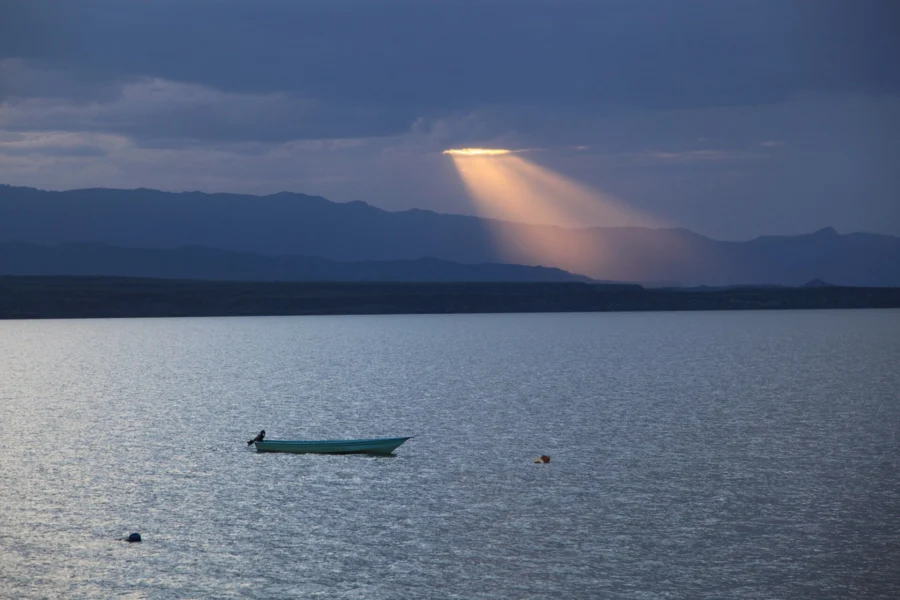 Lake Baringo and Lake Bogoria Birding: The Owl Walks, the Cliffs and the FlamingosA local guide who knows where every nightjar and eagle-owl slept last night, thorn scrub full of hornbills, a Goliath Heron colony on a rock, and the flamingo lake next door that keeps rising.
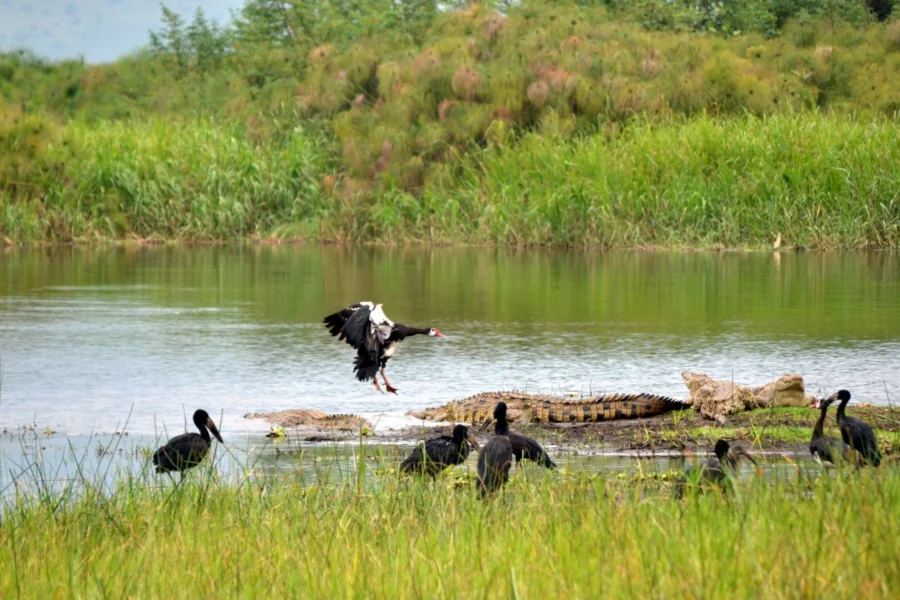 Akagera Birding: Rwanda’s Savanna, Lakes and Papyrus, and the Shoebill ChancesRed-faced Barbet in the southern woodland, Papyrus Gonolek and Carruthers's Cisticola in the swamps, a lake of hippos and lapwings, and a Shoebill that hides in the wetlands more than it shows.
The Pigeon Post
Every Thursday: 1 bird, 1 place to go and 1 place to stay, by email. Sign up and get our printable checklist of the 163 endemics of southern Africa.