
Where to See an African Skimmer: the Chobe, the Okavango Panhandle, the Zambezi and the Sandbars That Matter
A tern-like bird with a lower bill longer than the upper, which it drags through the water like a plough. The rivers, the sandbar months and the boats that find it.
In 2016 a pair of African Skimmers nested in South Africa, and the magazine African Birdlife ran it as the country’s first breeding record of the species in 73 years. That is a long gap between visits, even by the standards of a bird that keeps its own calendar. Anyone who wants to see a skimmer without waiting another 73 years should head north, to the big rivers of Botswana, Namibia, Zambia and Zimbabwe, where the bird is locally common and turns up on the sandbars every dry season.
Biodiversity Explorer, which draws on the Roberts handbook, puts the southern African strongholds in the Caprivi Strip, northern Botswana, northern Zimbabwe and central Mozambique. The bird needs large rivers and lakes with wide, exposed sandbars and islands, which it uses both for roosting and for breeding. No sandbar, no skimmer.
How it feeds, and why it is worth the trip
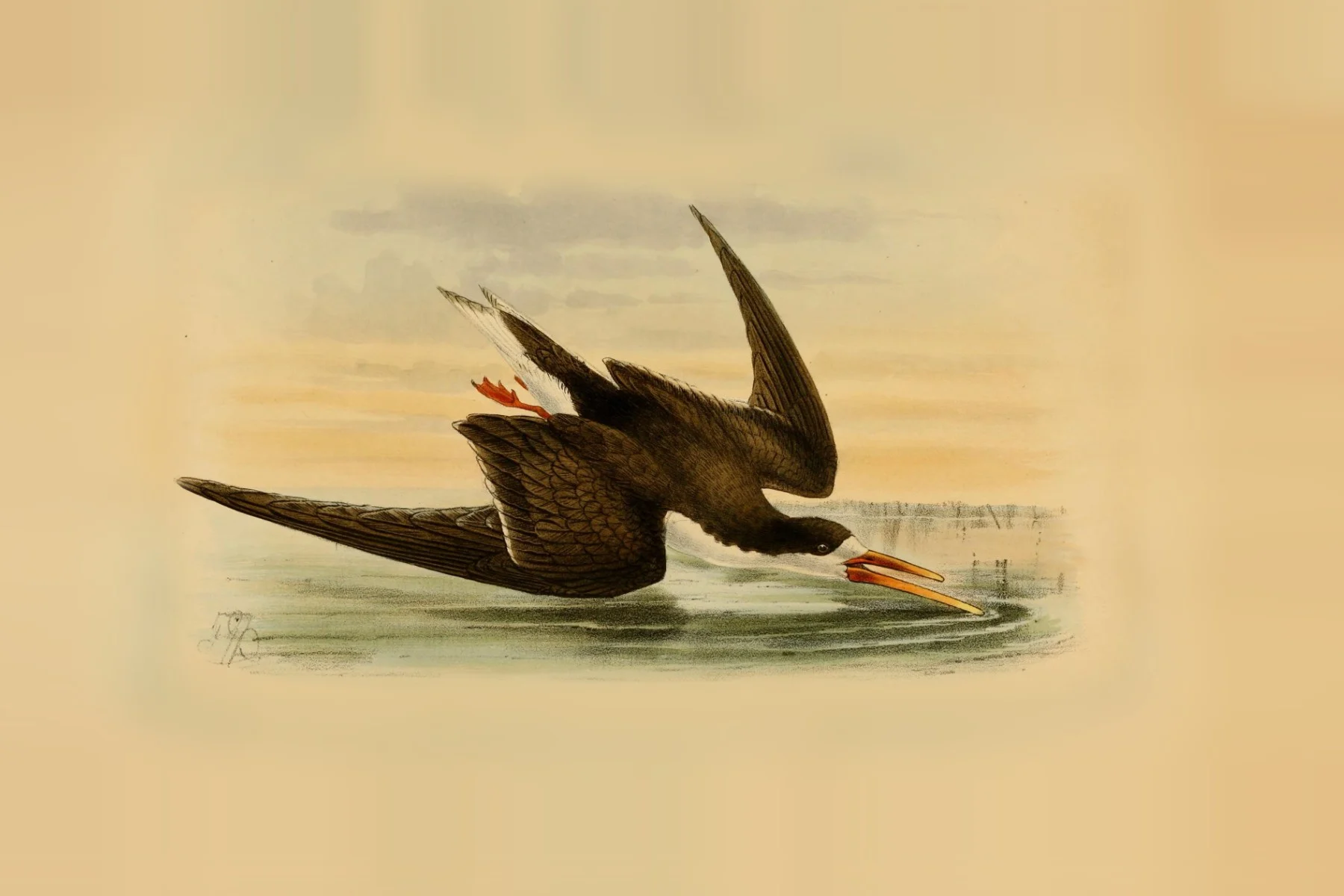
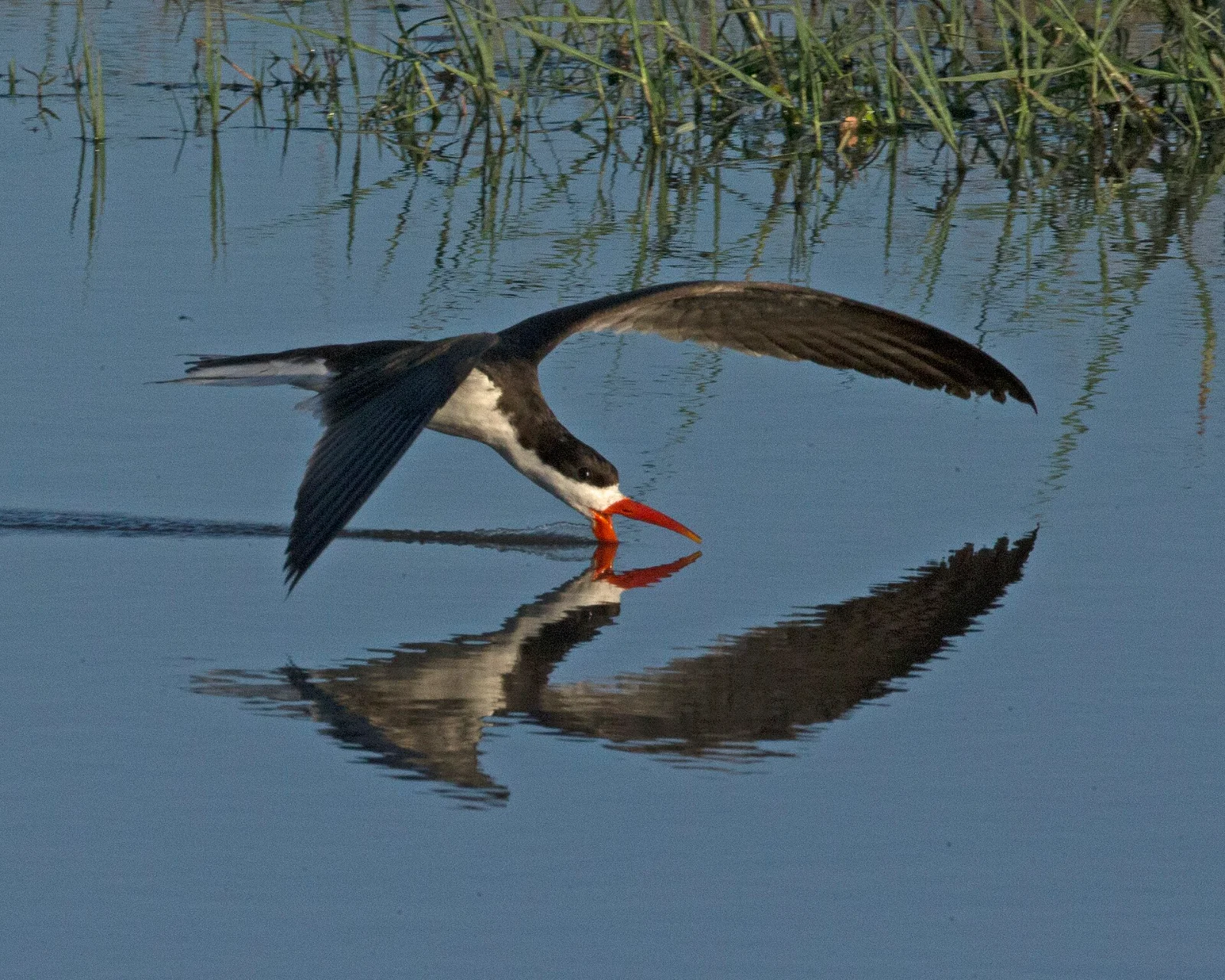
The skimmer is built around one odd idea. Its lower mandible is longer than the upper one, and it hunts by flying low over the water with that lower bill slicing through the surface. When the bill touches something, such as a small fish, the bird snaps it shut by reflex. Biodiversity Explorer lists the catch as small river fish, including silver robbers, tilapia, barbs and topminnows, and says the skimmer has powerful night vision and does most of its hunting after dark. When it has chicks to feed it has to work afternoons as well, which is when birders on a sunset cruise get the show.
Watch a skimmer feeding and it looks like a bird trying to draw a line on the river with its chin. It is easily the most memorable thing a waterbird does in the region, and it happens a few metres from a boat.
The sites at a glance
| Where | What the sources say | Best time | Where to stay |
|---|---|---|---|
| Okavango Panhandle, Botswana | About 30 seen in November 2023, some breeding on a sandbank | August to November | Xaro Lodge, Drotsky’s Cabins, Kashete Plains |
| Chobe River, Botswana and Namibia | Always present in good numbers on afternoon cruises | Dry season | Chobe River Camp (Namibian bank) |
| Zambezi, Namibia’s Zambezi Region | Breeding colonies on the sandbanks; allow a full day | From late August | None listed |
| Mana Pools, Zimbabwe | Favours the open sandbars for breeding | Dry season | None listed |
| Kafue River, Zambia | Named by a riverside lodge | Dry season | KaingU Safari Lodge |
| Kazinga Channel, Uganda | A big flock on a November 2025 cruise | Year round | Kyambura Gorge Lodge |
| Lake Naivasha, Kenya | On Crescent Island’s checklist | Year round | Fisheagle Cottage |
| Rufiji River, Tanzania | Named by a lodge with dawn cruises | Dry season | Selous River Camp |
When to go: follow the water level
The skimmer’s year runs on the river gauge. Biodiversity Explorer describes it as a partial intra-African breeding migrant that arrives in southern Africa from April to June, as the rivers start to fall and the sandbars appear, and moves north again from November to January, when the rivers rise and cover them. Eggs are laid mainly from August to October.
Pompie Burger, writing on birding Namibia’s Zambezi Region for Travel News Namibia in 2025, says the skimmers start breeding by late August, and advises birders who want the colonies to go early. A Field Guides tour that travelled the Okavango Panhandle from late October to mid-November 2023 counted about 30 skimmers along the river, some of them breeding on a sandbank. So the practical window for nesting birds is roughly late August to November, with the last weeks of the dry season the busiest. Burger notes that October to early January are also the hottest months of the year, so pack a hat with the telescope.
The nest is not much to look at. Biodiversity Explorer describes a deep scrape in damp sand close to the water line, usually after the pair has dug several trial scrapes and rejected them, as any house hunter would. A colony can hold up to 25 pairs, often sharing the sandbar with Collared Pratincoles, Pied Avocets or White-fronted Plovers. The 2 to 4 eggs hatch after about 20 to 22 days, and the chicks walk to the water within a day or 2. Adults have been seen carrying their young to safety in the bill.
Botswana: the Chobe and the Okavango Panhandle
On the Chobe River, Birding Ecotours’ northern Botswana itinerary says African Skimmers and African Fish Eagles are always present in good numbers on its afternoon cruises out of the Kasane area, alongside flocks of Collared Pratincoles and the bee-eater colonies. On the Namibian bank, Chobe River Camp, 4 km from the Ngoma border post, runs boat cruises of about 3 and 6 hours into the channels for the birdlife. Our Chobe River birding guide covers the boats, the park rules and the stays on both banks.
Further west, the Okavango Panhandle is the river at its narrowest and most channel-bound, and the sandbars are easy to reach by boat. Xaro Lodge, on an island near Shakawe, is reached by boat from its reception at Samochima, takes guests birding by boat and on island walks, and names African Skimmer with Pel’s Fishing Owl, White-backed Night Heron and the Southern Carmine Bee-eater. It charges from US$450 a room a night, dinner, bed and breakfast, in 2026. Drotsky’s Cabins, at Hauxa about 10 km south of Shakawe, has 10 timber chalets and 15 camping pitches beside the river, runs boat trips and names the skimmer among its birds. On the eastern side of the Panhandle, Kashete Plains Expedition and Campsite at Kauxwi publishes a bird checklist, books guided bird walks and takes guests out by boat or mokoro, and names African Skimmer too. The Okavango Delta birding guide has the rest of the delta.
The Zambezi: Namibia, Zimbabwe and Zambia
Pompie Burger puts the skimmer colonies on the Zambezi’s sandbanks in Namibia’s Zambezi Region near the top of the region’s sights, though he warns that they take an entire day to appreciate properly. A full day for a sandbar sounds excessive until the birds start feeding.
Downstream, BirdLife Zimbabwe’s guide to Mana Pools National Park says African Skimmers and White-fronted Plovers favour the open sandbars for breeding, while White-crowned Lapwings and Water Thick-knees line the edges of the banks and Collared Pratincoles fly over to roost on the islands. Our Mana Pools guide covers the walking rules and the camps.
On the Kafue River in Zambia, KaingU Safari Lodge names African Skimmer with African Finfoot and Pel’s Fishing Owl, runs boat trips and river cruises, and says its own guides are experienced birders.
East Africa: Kazinga, Naivasha and the Rufiji
The skimmer is not only a southern bird. On a Field Guides tour in November 2025, a 2-hour cruise on the Kazinga Channel in Uganda’s Queen Elizabeth National Park, with park rangers on board, passed a big flock of African Skimmers among Kittlitz’s Plovers, Great White and Pink-backed Pelicans and a Goliath Heron. A hippo charged the boat on the same trip, which is a reminder that the channel’s other residents are less relaxed than the skimmers. Kyambura Gorge Lodge, on the edge of the park, offers Kazinga Channel boat trips and has guides who lead birding in a reclaimed wetland.
In Kenya, Crescent Island Game Sanctuary on Lake Naivasha lists African Skimmer among the highlights of its own checklist, which recorded more than 135 species in a January 2026 survey. Its Fisheagle Cottage is self-catering, sleeps 4 and suggests walks and boat rides for birds. In Tanzania, Selous River Camp on the Rufiji River, just outside Nyerere National Park, names the skimmer and runs a dawn cruise timed for bird activity on the river.
Watching without swamping the nests
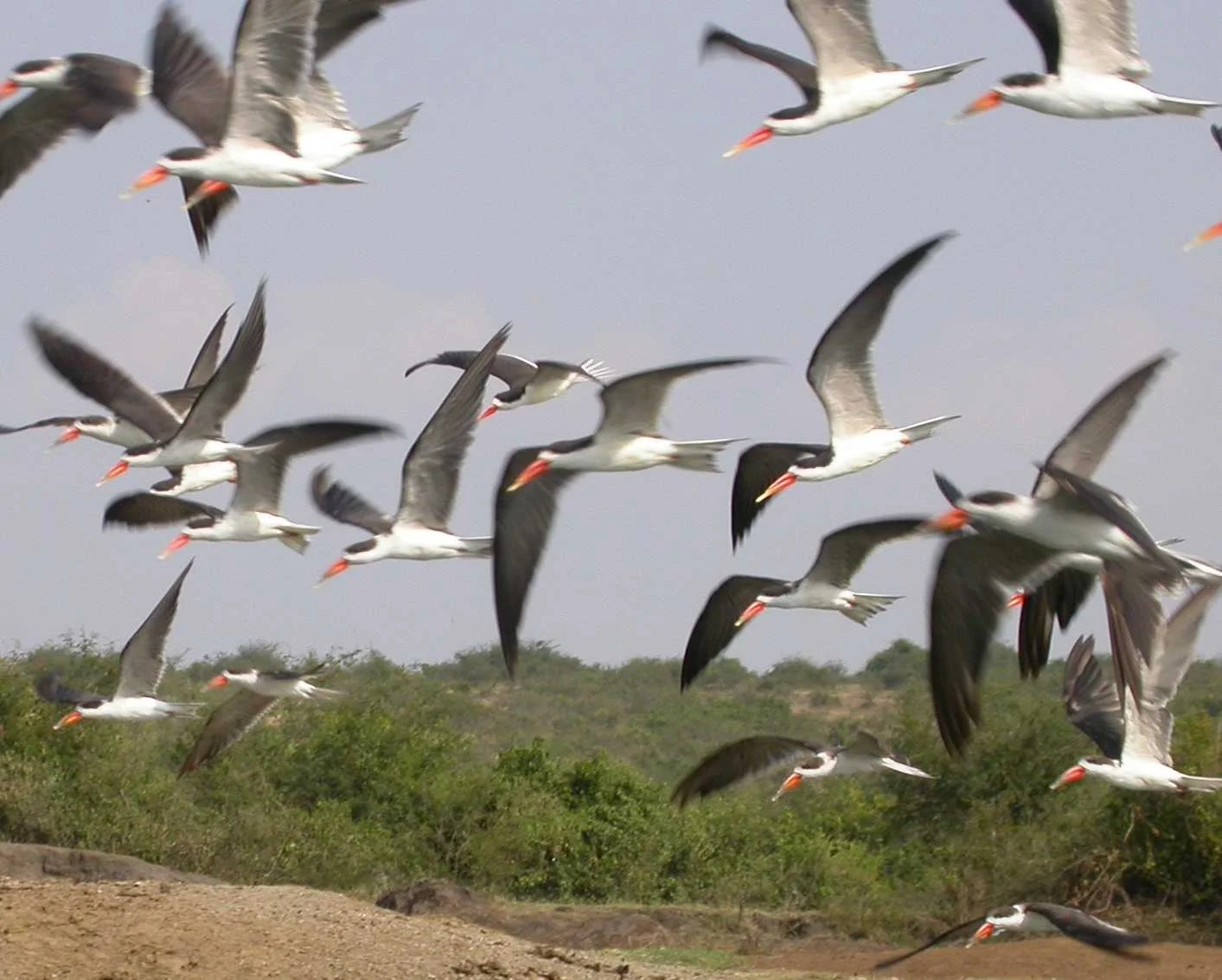
Biodiversity Explorer lists the African Skimmer as probably Endangered in southern Africa, and gives its threats as habitat loss, disturbance, the taking of eggs and chicks, and boats whose wake floods nests on low sandbars. That last one is in the birder’s own hands. On a boat near a colony, ask the skipper to slow down well before the sandbar and to keep a wide berth, and watch from the water rather than landing. If the adults lift off and start calling, the boat is too close.
Time the trip for the late afternoon, when feeding is most likely, and bring a telescope or steady binoculars for scanning the sandbars from a distance. Most of the birds will be standing still, facing the wind, looking like a row of terns that forgot to fold their bills away.
Where to stay
The places in this guide, from the Okavango to Lake Naivasha:
| Place to stay | Where | For birders | From |
|---|---|---|---|
| Xaro Lodge | Island near Shakawe, Okavango Panhandle, Botswana | Birding by boat, skimmer and Pel’s Fishing Owl named | US$450 a room, dinner, bed and breakfast (2026) |
| Drotsky’s Cabins | Hauxa, near Shakawe, Botswana | Boat trips, guided walks, skimmer named | Ask the lodge |
| Kashete Plains Expedition & Campsite | Kauxwi, eastern Panhandle, Botswana | Checklist, bookable bird walk, boat and mokoro | Ask the lodge |
| Chobe River Camp | Near Ngoma, Chobe River, Namibia | Boat cruises of 3 and 6 hours, birding drive | N$2,600 pp sharing, bed and breakfast |
| KaingU Safari Lodge | Kafue River, Zambia | Birding guides on staff, boat trips, skimmer named | Ask the lodge |
| Selous River Camp | Rufiji River, Nyerere National Park, Tanzania | Dawn cruise for birds, Selous checklist | Ask the lodge |
| Kyambura Gorge Lodge | Queen Elizabeth National Park, Uganda | Kazinga Channel boat trips, wetland birding | US$950 pp sharing, fully inclusive (2026 low season) |
| Fisheagle Cottage | Crescent Island, Lake Naivasha, Kenya | 135-species survey, bookable guides, boat rides | US$125 a night for up to 2, self-catering (2027 low season) |
Sandbars move with every flood and skimmers move with them, and rates change each season. Facts were checked on 15 November 2026 with Biodiversity Explorer, BirdLife Zimbabwe, Travel News Namibia, Birding Ecotours, Field Guides trip reports, African Birdlife and each place’s listing on Birding Dispatch.
More from the Journal
 Woodpeckers of Southern Africa, Including the One That Doesn’t Need TreesSouthern Africa's woodpeckers, from the Cardinal in every bushveld tree to the Ground Woodpecker that lives on treeless mountain slopes and eats almost nothing but ants.
 Where to See a Taita Falcon: the Strijdom Tunnel, the Blyde Cliffs and the Batoka GorgeA stocky falcon smaller than a pigeon, a handful of cliffs and surveys that keep coming back empty. Where it still nests, how to look, and the 2 roosts beside its cliffs.
 Where to See a Southern Bald Ibis: the Breeding Cliffs, Dullstroom, Wakkerstroom and LesothoA red-capped grassland ibis that nests on cliffs over waterfalls and feeds on burnt veld and maize stubble. The colonies you can watch, the fields to scan, and where to stay.
The Pigeon Post
Every Thursday: 1 bird, 1 place to go and 1 place to stay, by email. Sign up and get our printable checklist of the 163 endemics of southern Africa.