
Birding Etiquette and Playback: When to Use a Call, and When to Leave the Bird Alone
What BirdLife South Africa and the African Bird Club say about playback, nests, hides, lights and rarities, with a short field code for using a recorded call without harming the bird.
In October 2025 a Golden Pipit turned up in the Greater Kruger. SA Rare Bird News, the national rarities list run by Trevor Hardaker, reported it on Timbavati Private Game Reserve, then on 10 October on neighbouring Kapama, about 8.5 km away, and then back on Timbavati for the rest of the month, a pipit with no idea of the fuss it was causing. Every update carried the same note: access was strictly for people staying at the lodges, with no general access for day visitors.
That note is most of what birding etiquette comes down to: the bird first, the landowner second, other birders third, and your list last, however loudly the list objects. The rest is detail, and the detail matters most with the phone in every birder’s pocket that can play any bird’s song on demand.
The codes South African birders follow
Two codes cover birding in the region, and both, sensibly, start with the birds. BirdLife South Africa’s Birding Code of Ethics, a position statement from October 2019, asks birders to put the interests of the birds first at all times. That means no chasing or repeated flushing, keeping a proper distance from nests and colonies, using artificial light sparingly, getting permission before entering private property, keeping groups small, and thinking before sharing the location of a rare breeding bird, which can expose it to egg collectors and trade. It also asks birders to submit their records to atlas and citizen-science projects.
The African Bird Club’s Code of Practice for Birders, endorsed with its sister clubs for the Neotropics, the Orient and the Middle East, rests on 5 principles: the birds’ interests first, respect for habitats, respect for local laws and customs, care before releasing news of a rare bird, and being a good ambassador. It goes into more practical detail than BirdLife’s statement on playback, nests and light.
Playback: when it is fine, and when it isn’t
The 2 codes do not say quite the same thing. BirdLife South Africa recommends that playback be avoided to attract any species, in particular those rated Critically Endangered, Endangered, Vulnerable or Near Threatened, and especially in the breeding season, when a recording diverts territorial birds from feeding or protecting their young. The African Bird Club accepts that playback may be the only way to see some forest birds, and asks that it be used responsibly: never to draw a species near its nest, at the lowest volume that works, and briefly. Its own summary is “keep the volume down, and keep it short”, advice that would improve most phone calls too.
The David Sibley article that many birders still cite, “The Proper Use of Playback in Birding” (2011), explains why caution is sensible even though the evidence is thin. No research has shown harm at the population level, but one study of Black-capped Chickadees found that high-ranking males exposed to aggressive playback lost status with their mates and neighbours: outsung, in effect, by a recording. Sibley also points out that any harm is more likely where birding pressure is heavy, and that heavily visited parks often ban playback outright, a rule he says should be respected.
Taken together, the codes give a clear line. Leave the phone in your pocket near a nest, or where a bird is carrying food or nest material; for any threatened or Near Threatened species; for territorial birds in the breeding season; at a site that birders visit every day, or at a rarity a crowd is watching; where a reserve or landowner forbids it; and once the bird has been seen.
Where it can be reasonable, for a forest bird that will not otherwise show itself, Sibley’s method keeps the disturbance small. Play a snippet of less than 30 seconds, then pause for longer than you played, and stop after about 5 minutes. Keep the volume below that of the real bird. Ask the group first, say “playback” before each burst, and hold the phone up so nobody mistakes the recording for the bird. And, in the African Bird Club’s words, do not press a local guide to keep playing once the bird has been seen.
Lights, lasers and owls
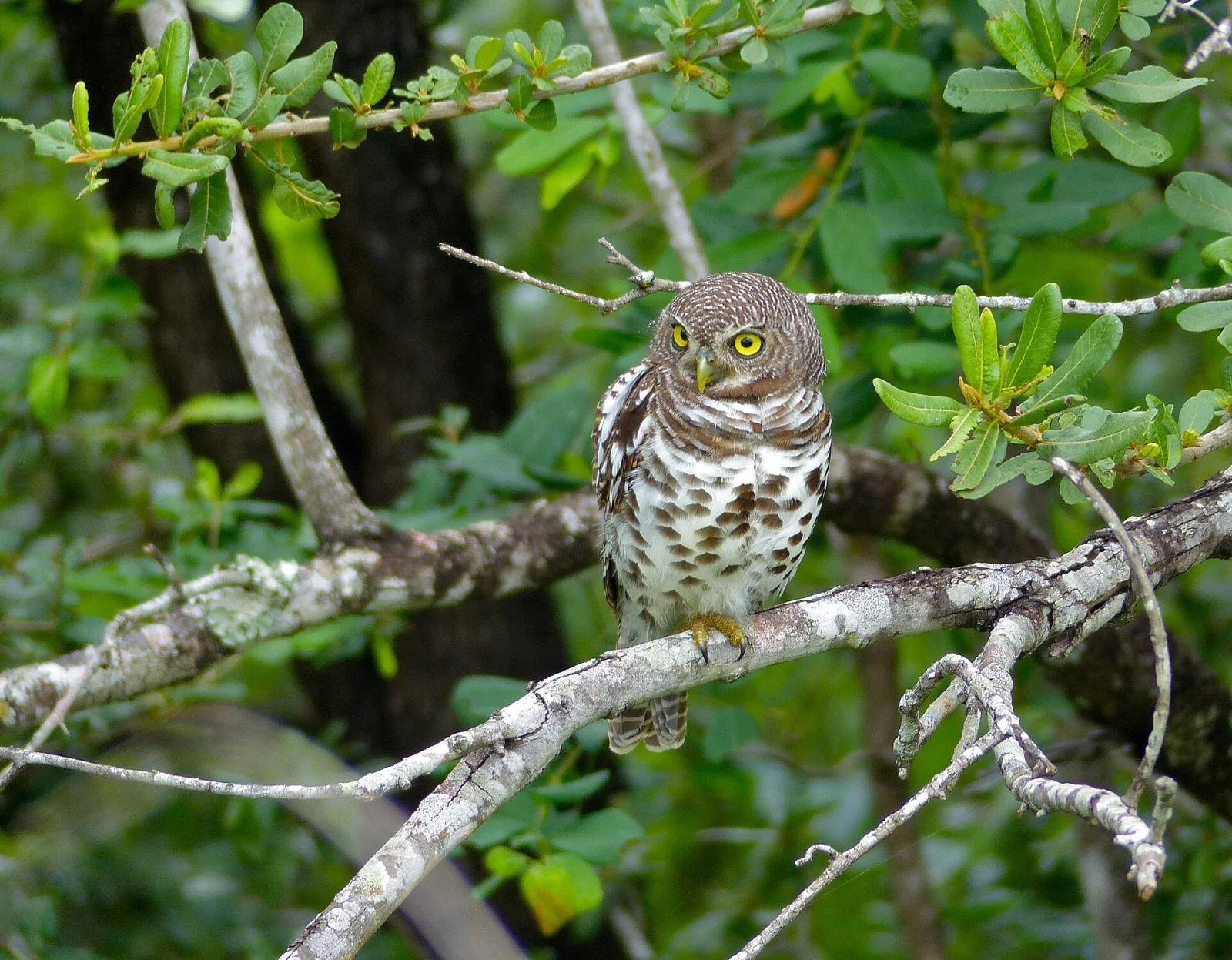
Night birding brings its own rules. BirdLife South Africa asks for artificial light to be used sparingly and with discretion in filming and photography. The African Bird Club adds that roosting birds should not be disturbed with flash, and that close flash or direct spotlighting of nocturnal species can impose a long period of recovery while their eyes readjust to the dark. Hold a torch beam to the edge of an owl or nightjar rather than full in its face, the courtesy anyone woken by a torch would want, and switch it off once everyone has seen the bird.
Green laser pointers are now common on guided walks. BirdLife’s rule is specific: the guide must never point the laser directly at the bird. Using it to show the group the general area is acceptable, but if the laser visibly changes the bird’s behaviour it should be switched off at once. The owls guide covers the species you can find at night without either.
Nests and roosts
The African Bird Club’s test for distance is simple: if a bird flies away or keeps giving alarm calls, you are too close. Do not move or flatten the vegetation around a nest, since it hides the nest from predators. Photography at the nest is discouraged unless it can be done from a distance with a long lens, and the club asks photographers not to harass a bird because they have not yet got the picture they wanted; the bird is not working to the photographer’s schedule. It also asks birders not to drive or “push” secretive species out of their preferred habitat for a better view.
BirdLife South Africa adds the step that follows: before you post a photo of a rare bird at its nest, consider who might read it. Revealing the location of rare breeding birds can expose them to egg collectors and other trade.
Hides
A hide only works if the birds cannot tell people are inside, so the etiquette is about noise and movement, the 2 things people do best. Walk up and go in without talking, keep voices low and phones on silent, and keep lenses, elbows and hats back from the viewing slot, where movement shows. Share the best window, and do not leave food scraps. If the hide has a logbook, add what you saw; it helps the next visitor and the reserve. The guide to places to stay with their own bird hide lists hides where you can sit for as long as you like.
Rarities and private land
The Golden Pipit shows how most rarities in South Africa are handled. SA Rare Bird News publishes the find, the place and the access terms, and the terms are the landowner’s. When they say lodge guests only, the answer is to book a night or let it go, which is harder than it sounds when the pipit is golden; when a farm opens its gate, follow the directions about where to park and walk.
BirdLife South Africa’s code asks for 2 more things. Before broadcasting a sighting, think about its effect on the landowner and on the bird. And before driving across the country for a twitch, consider the carbon cost of the trip, and offset it where you can by raising money for a local reserve or conservation project on the back of it. The African Bird Club asks that rare records also go to the BirdLife partner in the country concerned; in South Africa, BirdLife suggests submitting your records through the atlas apps described in the guide to birding apps and field guides.
A short field code
| Situation | What the codes ask |
|---|---|
| A bird near its nest | No playback; back off if it alarm-calls or flies |
| Threatened or Near Threatened species | Avoid playback, especially when breeding |
| A forest bird that will not show | Short, quiet snippets; stop once it is seen |
| Owls and nightjars at night | Light sparingly; no close flash or direct spotlight |
| A laser pointer | Point near the bird, never at it |
| A rarity on private land | Follow the access terms; ask permission first |
| A rare breeding bird | Think before sharing the location |
No places to stay are named in this guide; for birders who want a hide on the doorstep, the hide guide linked above has a full table.
Codes and reserve rules change, and many reserves set their own rules on playback, lights and hides. The codes quoted are BirdLife South Africa’s Birding Code of Ethics (October 2019) and the African Bird Club’s Code of Practice for Birders, both checked on 14 November 2026.
More from the Journal
 Do You Need a Spotting Scope? When a Scope Helps, What to Look For and Where It MattersA scope turns grey dots on a mudflat into Curlew Sandpipers and Red Knots. When it earns its place in the car, the features that matter, and why 60x fails at noon.
 Your First Birding Safari: What to Expect, From the 05:30 Gate to the Evening ListHow a birding safari day runs, what the guide does, why the vehicle stops for a brown bird when there is an elephant over there, and the other things first-timers find odd.
 How to Log Your Bird Sightings: eBird, BirdLasser or SABAP2?eBird wants short checklists with counts, BirdLasser wants the same bird logged again and again, and SABAP2 wants 2 hours in one square. What each is for, and how to feed all 3.
The Pigeon Post
Every Thursday: 1 bird, 1 place to go and 1 place to stay, by email. Sign up and get our printable checklist of the 163 endemics of southern Africa.