
Birding by Boat: the Chobe, the Okavango, the Kazinga Channel and the Estuaries
Some of Africa's best birds live where no road goes: on sandbars, in papyrus channels and under riverside branches. Where to bird by boat, how to choose the boat, and how to make it count.
On a Field Guides tour of Uganda in November 2025, the group left Entebbe by speedboat across an arm of Lake Victoria, switched to smaller canoes at the village of Mabamba, and paddled into the swamp channels to find a Shoebill. They found one standing beside the channel, and later it flew so low over one of the boats that Herbert Byaruhanga, one of the tour’s 2 guides, had to duck. Few birds make a guide duck. Fewer still can only be met by boat.
That is the case for birding from the water. A boat reaches the birds that live where no road goes: on midstream sandbars, deep in papyrus, under the branches that hang over a riverbank. It also lets a group sit still at the water’s edge for as long as the skipper allows, which on a good morning is most of what birding needs.
Why a boat finds what a vehicle misses
Birding Ecotours’ itinerary for northern Botswana is built around boat cruises, and its descriptions show why. On the Okavango, the morning cruise floats silently along the small channels for Luapula and Chirping Cisticolas, Greater and Lesser Swamp Warblers and the bee-eaters, and its main target is a Pel’s Fishing Owl at its daytime roost. An afternoon cruise visits a big heronry with African Spoonbill, Yellow-billed Stork, Great Egret and Saddle-billed Stork, while Giant, Pied, Malachite and Half-collared Kingfishers patrol the channels. On the Chobe, the same itinerary sends the boat to the Kasane Rapids, where the overhanging vegetation is the place for African Finfoot and the exposed rocks are the best place to look for Rock Pratincole.
Every one of those birds sits on a habitat edge that a car cannot reach: the channel margin, the roost tree over water, the rock in the rapids. A boat takes birders to the edge and lets them sit there.
The waters at a glance
| Where | Boat | What the sources say | Where to stay |
|---|---|---|---|
| Chobe River, Botswana and Namibia | Cruise boat | Long-toed and African Wattled Lapwings, Slaty Egret, skimmers | Chobe River Camp |
| Okavango Delta and Panhandle, Botswana | Motorboat or mokoro | Pel’s Fishing Owl at its day roost, heronries | Xaro Lodge, Kashete Plains |
| Mabamba Swamp, Uganda | Canoe | Shoebill in the papyrus channels | Mabamba Lodge |
| Kazinga Channel, Uganda | Ranger-escorted cruise | Skimmers, pelicans, Kittlitz’s Plover | Kyambura Gorge Lodge |
| Rufiji River, Tanzania | Dawn cruise | River birds, oxbow lakes | Selous River Camp |
| Kafue River, Zambia | Boat trips | African Finfoot, Pel’s Fishing Owl | KaingU Safari Lodge |
| St Lucia estuary, South Africa | Shallow-draft cruise boat | Storks, waders, terns, Mangrove Kingfisher | Makakatana Bay Lodge |
| Lake Naivasha, Kenya | Boat rides | Skimmer and pelicans on the island checklist | Fisheagle Cottage |
The Chobe
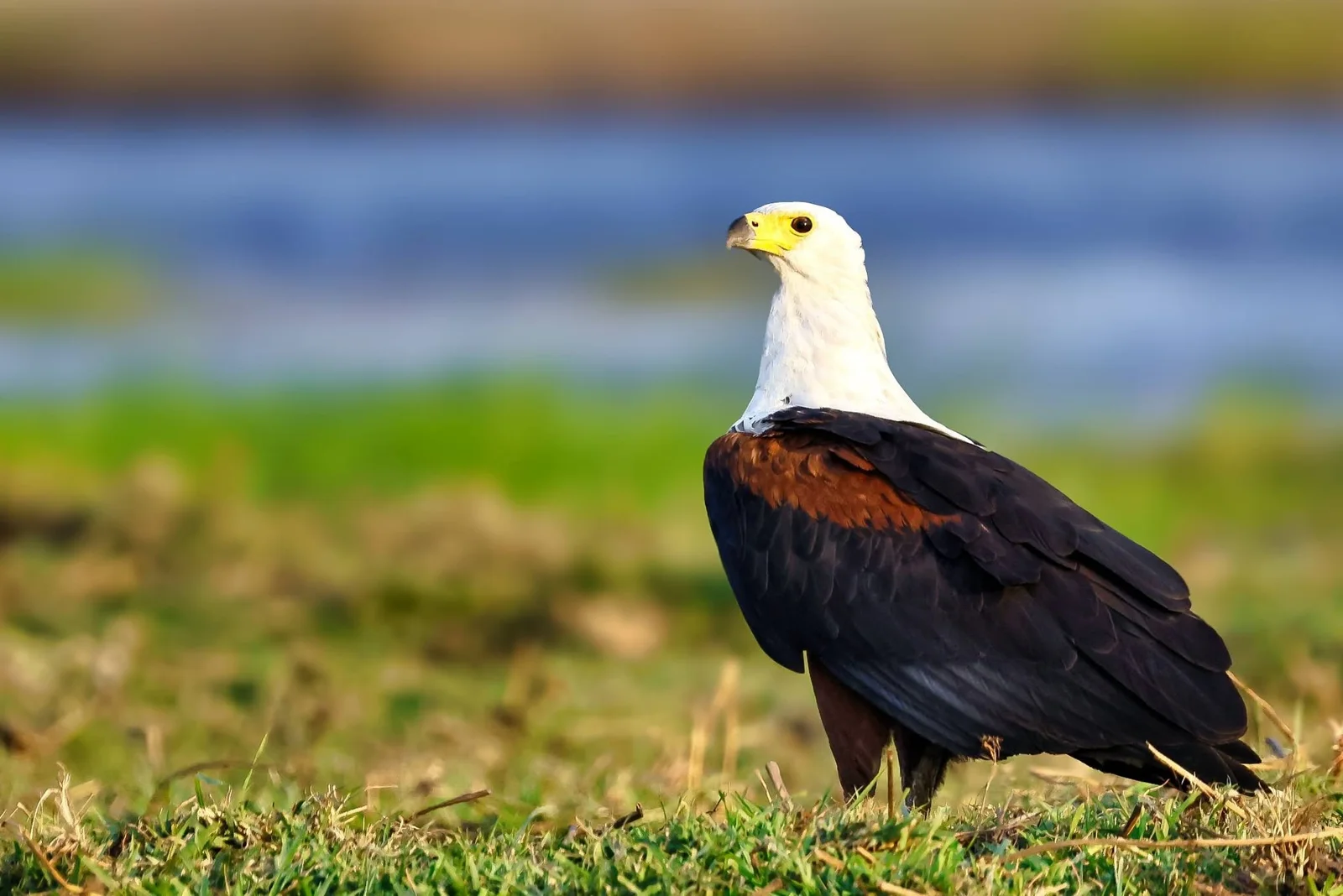
The Chobe is where many birders take their first birding boat trip, and Birding Ecotours explains the appeal. Exploring Chobe by boat, it says, is famous for Long-toed and African Wattled Lapwings, Rufous-bellied Heron, Goliath Heron and Slaty Egret, with Black Herons, African Openbills, Yellow-billed, Saddle-billed and Marabou Storks and African Spoonbills in good numbers, and Common Greenshank and Marsh, Wood and Common Sandpipers working the banks. African Skimmers and African Fish Eagles are always present in good numbers on the afternoon cruises. Elephants swim across to the islands in the same light, so non-birders on board rarely complain.
The itinerary also uses the boat as transport to places off the usual cruise route. Impalila Island, a Namibian island where Namibia meets Botswana, Zimbabwe and Zambia, has more than 450 species recorded, and the channels around it are searched by boat for White-backed Night Heron, Pel’s Fishing Owl and African Finfoot. The Kasai Channel, which links the Chobe with the Zambezi, holds Slaty Egret, Lesser Jacana, Allen’s Gallinule, African Pygmy Goose and Greater Painted-snipe.
On the Namibian bank, Chobe River Camp, 4 km from the Ngoma border post, runs boat cruises of about 3 and 6 hours into the channels for the birdlife. Our Chobe River birding guide covers the park rules and the other stays.
The Okavango: motorboat and mokoro
In the Okavango Panhandle the boat is often the way in as well as the way to the birds. Xaro Lodge, on an island near Shakawe, is reached by boat from its reception at Samochima, and its guides take guests birding by boat and on morning walks on the island. It names Pel’s Fishing Owl as a regular sighting, with African Skimmer, Lesser Jacana, African Pygmy Goose and Allen’s Gallinule, and says spring is the best season for Carmine Bee-eaters and nesting kingfishers. On the eastern bank, Kashete Plains Expedition and Campsite at Kauxwi offers birding by boat or by mokoro, the traditional dugout poled through the shallows, along with a guided bird walk on its trail.
The 2 craft suit different birding. A motorboat covers distance and reaches the main channel’s sandbars and roost trees; a mokoro, poled slowly, sits low in the water beside the reeds and the small birds in them, and the poler sets the pace.
Uganda: Mabamba, the Kazinga Channel and Lake Mburo
The Field Guides tour of November 2025 took 3 boat trips in Uganda, each for a different set of birds. At Mabamba, the canoes were the only way to the Shoebill, and on the same cruise the group added Black Crake, Long-toed Lapwing, Lesser Jacana and Blue-breasted Bee-eater. Mabamba Lodge, in Zziba village beside the swamp, runs boat trips to look for Shoebill with local wetland guides and charges from US$215 for a room with dinner, bed and breakfast (2025 rate). Our Shoebill guide compares the other sites.
On Lake Mburo, a boat cruise produced African Finfoot and White-backed Night Heron, the 2 birds that cruise is known for. And on the Kazinga Channel in Queen Elizabeth National Park, a 2-hour cruise with park rangers on board passed a big flock of African Skimmers, Kittlitz’s Plovers, Saddle-billed Stork, Great White and Pink-backed Pelicans and Goliath Heron. The same cruise produced a pair of White-fronted Bee-eaters, a species not known from Uganda, and the group’s photographs became the first documented record for the country. A hippo also charged the boat, so the cruise had something for everyone. Kyambura Gorge Lodge, on the edge of the park, offers Kazinga Channel boat trips and guided birding in a reclaimed wetland.
The estuaries: St Lucia
Boat birding is not only a big-river activity. On the St Lucia estuary in iSimangaliso Wetland Park, Shoreline Boat Safari runs 2-hour hippo, crocodile and birding cruises on a shallow-draft boat that takes up to 15 passengers and gives near 360 degree views, according to the park’s own listing. BirdLife South Africa’s GoBirding guide to the Eastern Shores says the estuary holds small numbers of Saddle-billed Stork with Yellow-billed and Woolly-necked Storks, that the mudflats should be scoured in summer for Ruff, Ruddy Turnstone, Grey Plover, Pied Avocet and both sand plovers, and that a large tern roost forms near the mouth. The localised Mangrove Kingfisher, mainly a winter visitor, can be seen in the mangroves near the mouth.
Makakatana Bay Lodge, on the shore of Lake St Lucia, has a resident birder who leads an early-morning wetlands outing, and lists eco-boat cruises and Narrows boat safaris among its activities.
How to bird from a boat
Choose the trip before the boat. A cruise sold for hippos and sundowners can still be good for birds, but a skipper who knows the group is birding will stop for a crake in the reeds rather than for the next elephant. Where a lodge has a birding guide, ask for them.
Go early or late. Birding Ecotours runs its Okavango cruises in the morning and its Chobe cruises in the afternoon, and Selous River Camp on the Rufiji times its dawn cruise for bird activity on the river. Midday on open water is bright, hot and quiet.
Keep the gear simple. A boat moves, so binoculars do more work than a telescope, and a camera is easier to handle with a fast shutter and the elbows braced on the knees. Sit where both banks can be scanned, keep a dry bag for optics, and be ready before the skipper slows down: the boat will rarely hold still for long.
Mind the wake. Biodiversity Explorer lists boats whose wake floods nests among the threats to the African Skimmer, which breeds on low sandbars in the dry season. Near a sandbar or a colony, ask the skipper to slow down early and keep well back; the African Skimmer guide has the months to watch.
Where to stay
Places in the directory that put guests on the water:
| Place to stay | Where | For birders | From |
|---|---|---|---|
| Chobe River Camp | Near Ngoma, Chobe River, Namibia | Boat cruises of 3 and 6 hours, birding drive | N$2,600 pp sharing, bed and breakfast |
| Xaro Lodge | Island near Shakawe, Okavango Panhandle, Botswana | Arrival and birding by boat, Pel’s Fishing Owl | US$450 a room, dinner, bed and breakfast (2026) |
| Kashete Plains Expedition & Campsite | Kauxwi, eastern Panhandle, Botswana | Boat and mokoro birding, checklist | Ask the lodge |
| KaingU Safari Lodge | Kafue River, Zambia | Boat trips, birding guides on staff | Ask the lodge |
| Selous River Camp | Rufiji River, Nyerere National Park, Tanzania | Dawn cruise timed for birds, oxbow lakes | Ask the lodge |
| Mabamba Lodge | Mabamba Swamp, Lake Victoria, Uganda | Shoebill boat trips, local wetland guides | US$215 a room, dinner, bed and breakfast (2025) |
| Kyambura Gorge Lodge | Queen Elizabeth National Park, Uganda | Kazinga Channel boat trips, wetland birding | US$950 pp sharing, fully inclusive (2026 low season) |
| Fisheagle Cottage | Crescent Island, Lake Naivasha, Kenya | Boat rides, bookable guides, 135-species survey | US$125 a night for up to 2, self-catering (2027 low season) |
| Makakatana Bay Lodge | Lake St Lucia, iSimangaliso, KwaZulu-Natal | Resident birder, eco-boat cruises | R10,880 pp sharing, fully inclusive (Nov 2026 to Dec 2027) |
Boat schedules depend on water levels and season, and rates change each year. Facts were checked on 15 November 2026 with Birding Ecotours, Field Guides, BirdLife South Africa’s GoBirding, iSimangaliso Wetland Park, Biodiversity Explorer and each place’s listing on Birding Dispatch.
More from the Journal
 Do You Need a Spotting Scope? When a Scope Helps, What to Look For and Where It MattersA scope turns grey dots on a mudflat into Curlew Sandpipers and Red Knots. When it earns its place in the car, the features that matter, and why 60x fails at noon.
 Your First Birding Safari: What to Expect, From the 05:30 Gate to the Evening ListHow a birding safari day runs, what the guide does, why the vehicle stops for a brown bird when there is an elephant over there, and the other things first-timers find odd.
 How to Log Your Bird Sightings: eBird, BirdLasser or SABAP2?eBird wants short checklists with counts, BirdLasser wants the same bird logged again and again, and SABAP2 wants 2 hours in one square. What each is for, and how to feed all 3.
The Pigeon Post
Every Thursday: 1 bird, 1 place to go and 1 place to stay, by email. Sign up and get our printable checklist of the 163 endemics of southern Africa.