
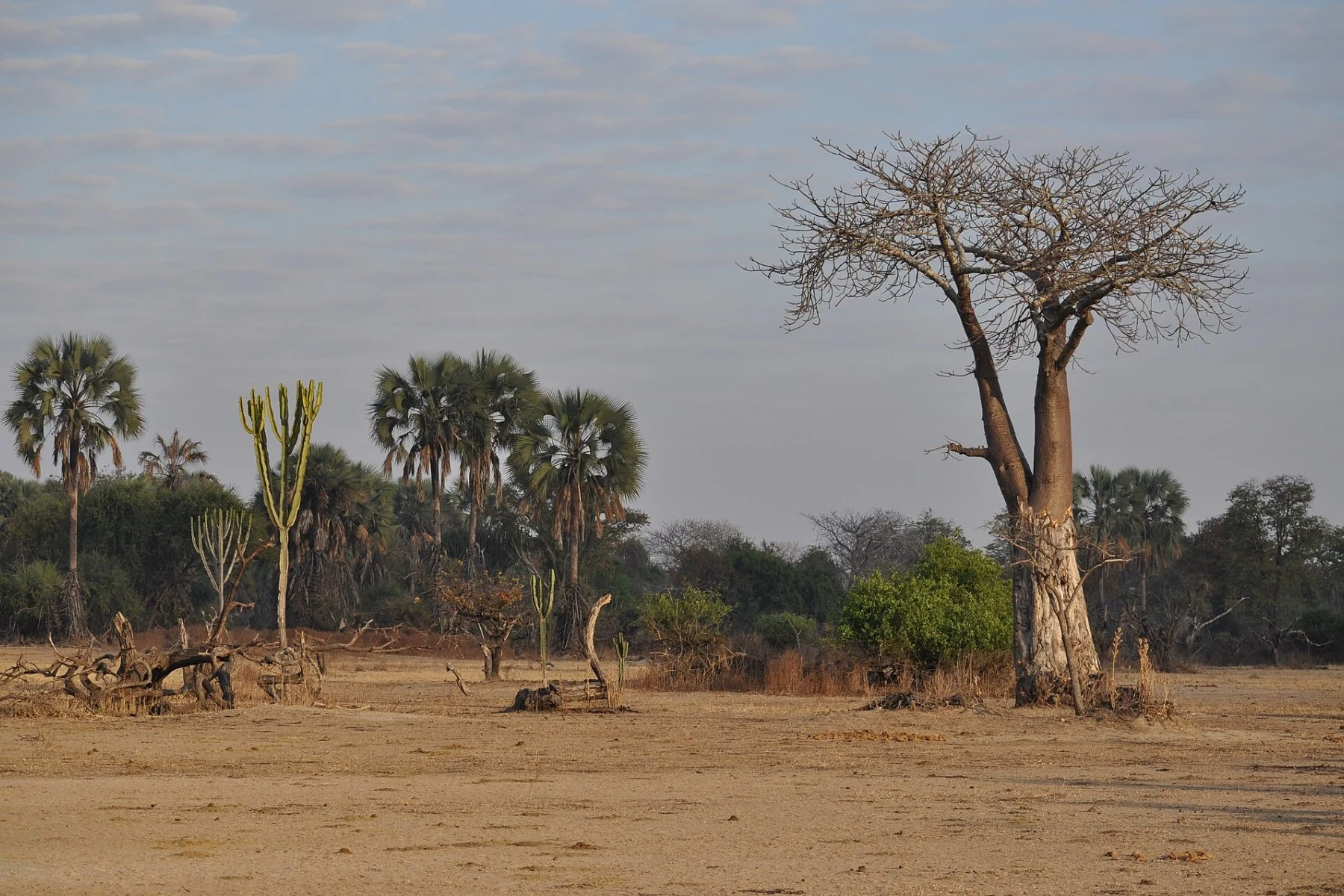
Liwonde Birding: The Shire River, Lilian’s Lovebird and Brown-breasted Barbet
Brown-breasted Barbets in the quinine trees, Lilian's Lovebirds in cathedral mopane, Pel's Fishing Owl across the river and boat trips on the Shire, with the 2 Mvuu stays in the directory.
Brown-breasted Barbet is a fussy bird about its trees, and Liwonde has the right ones. In African Birdlife’s July/August 2015 issue, Martin Benadie wrote that the quinine trees in the park’s riverine forest support a good population of this highly localised barbet, which makes Liwonde the only reliable site for it in Malawi. Wikipedia’s account of the park, citing BirdLife International’s Important Bird Area directory, adds that Liwonde is the only place in Malawi where both the barbet and Lilian’s Lovebird are found. For a birder, that settles the question of where to spend 2 or 3 nights in the south.
Liwonde National Park covers 548 km² on the Shire River in southern Malawi. Benadie gave it a list of about 350 of the 648 or so species recorded in Malawi; Wikipedia, citing the IBA directory, puts it at more than 380. African Parks has managed the park with Malawi’s Department of National Parks and Wildlife since 2015, and in 2018 it took on the neighbouring Mangochi Forest Reserve, which it says increased the area’s conservation footprint by 60%. Benadie had argued in 2015 that joining the 2 would be logical, so for once the map caught up with a birder’s wish list.
The Shire River
The Shire runs 402 km from Lake Malawi to the Zambezi, and more than 40 km of it, with its riparian strip on both banks, forms part of Liwonde, according to Benadie. It is up to a kilometre wide in places. He recommended arriving by boat from Liwonde town, a 30 km trip that introduces the local birds before the luggage has even reached a room.
From the water, Benadie listed Goliath Herons, Saddle-billed Storks, Spur-winged Lapwings, African Jacanas and African Openbills along the banks, with African Skimmers, Western Ospreys and flocks of Gull-billed and Whiskered Terns flying past and Blue-cheeked Bee-eaters hawking over the river. The riverside palms hold breeding colonies of White-breasted Cormorant, and the treetops can produce Red-necked Falcon, Dickinson’s Kestrel or Palm-nut Vulture. Birding Ecotours’ 16-day Malawi itinerary adds that waterbird numbers and species vary with the level of the Shire.
The river is also crowded in another way. Benadie put the hippo density on the Shire at an estimated 49 animals per kilometre, one of the highest in Africa, which is a good reason to let the boatman choose the line.
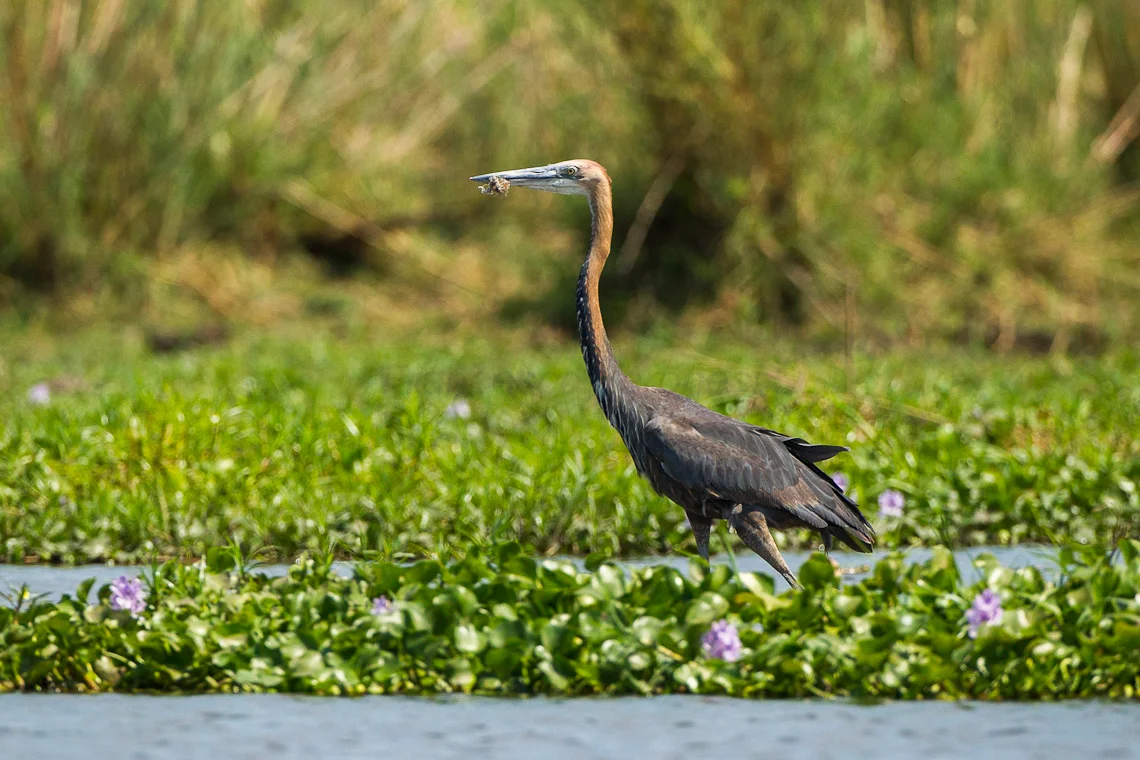
The riverine forest: barbets, flycatchers and the owl
The richest habitat for birds, in Benadie’s view, is the semi-deciduous riverine forest that runs in a band between 5 and 100 m wide along the Shire and its seasonal tributaries. He described it as easy to reach on the west bank of the Shire, opposite Mvuu Lodge. Besides the barbet, it holds his 2 Liwonde favourites: Livingstone’s Flycatcher, which moves in busy groups and is surprisingly common once its call is known, and Böhm’s Bee-eater, which is unusual in nesting in level ground rather than a bank.
The lower layers hold African Broadbill, Black-throated Wattle-eye, White-browed Robin-Chat, Bearded Scrub Robin, Collared Palm Thrush, Tambourine Dove and Eastern Nicator. Higher up, Benadie listed Green-backed Woodpecker, Brown-headed Parrot, Purple-crested Turaco, Trumpeter Hornbill, Green Malkoha, African Emerald Cuckoo and Western Banded Snake Eagle. White-backed Night Heron haunts the quiet tributaries under overhanging vegetation.
Pel’s Fishing Owl nests in this forest and is often seen at a daytime roost, Benadie wrote. Daniel Branch’s trip report from 3 February 2023 shows how that works in practice, and how it sometimes does not. His group crossed the river by boat with a ranger, and the morning produced Allen’s Gallinule, White-backed Night Heron, a Dwarf Bittern in the open and a pair of Brown-breasted Barbets before the ranger found the owl. It flushed onto the top of a palm, stayed for a matter of seconds, and was not seen again. He noted that high water in the wet season spreads the owls out and lowers the odds. For the techniques that help, see how to find Pel’s Fishing Owl.
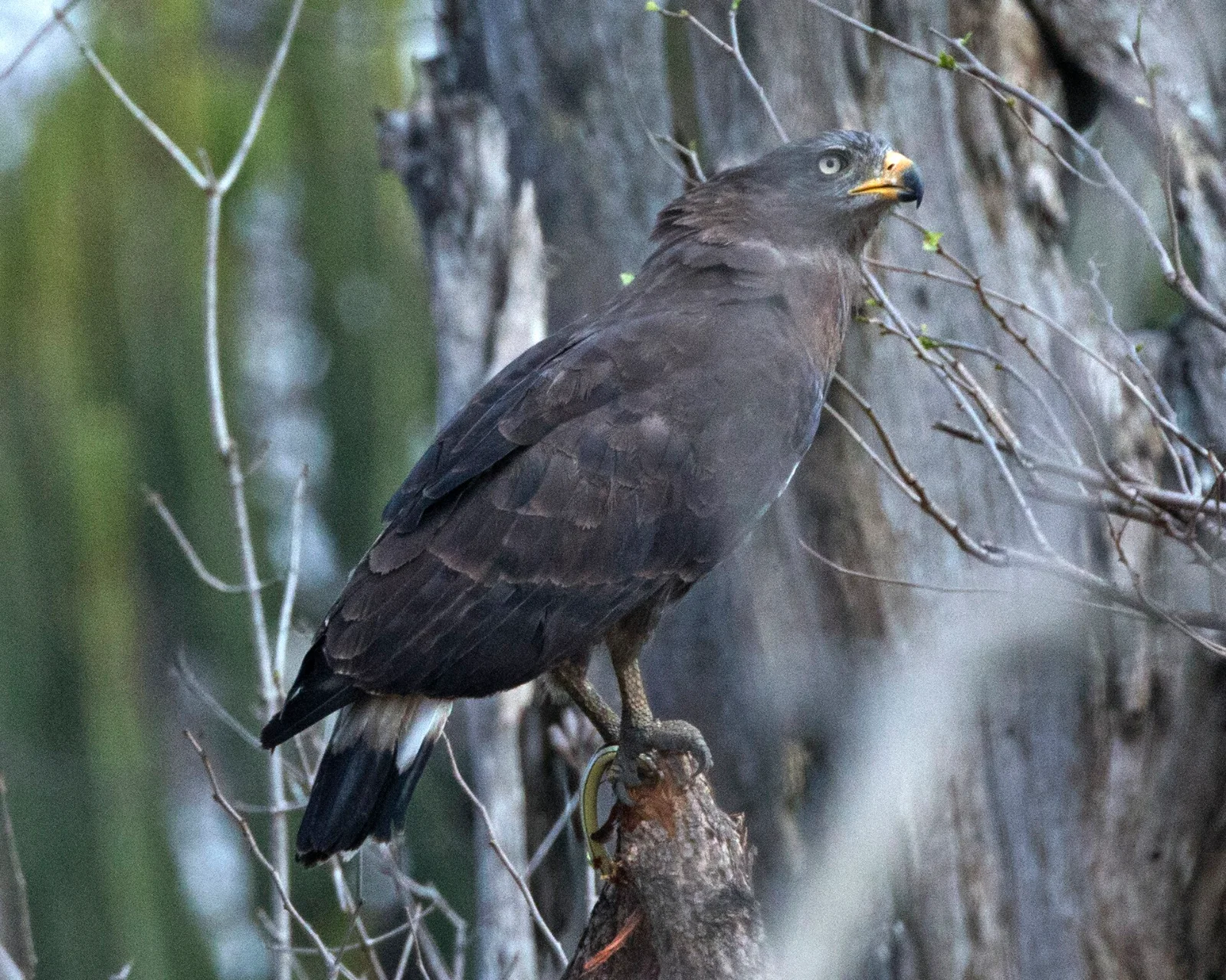
The mopane and Lilian’s Lovebird
Away from the river, the central and eastern parts of the park are what Benadie called cathedral-like mopane woodland, often hung with epiphytic orchids. Mopane covers about 70% of the park, and the most obvious birds in it are the chattering flocks of Lilian’s Lovebird, which he described as Near Threatened. It is one special that tends to announce itself before it arrives.
The same woodland holds Speckle-throated Woodpecker, Racket-tailed and Broad-billed Rollers, Meves’s Starling, Arnot’s Chat, Red-headed Weaver, Mosque Swallow, Southern Ground Hornbill, Stierling’s Wren-Warbler and Ayres’s Hawk-Eagle. Bird density is lower than in the riverine forest, and the birds tend to move in mixed foraging parties, so a quiet stretch of mopane can turn busy in a minute. Benadie also recorded small, noisy flocks of Grey-headed Parrots flying over in the early mornings, and elevated hides at several waterholes in the Rhino Sanctuary.
Branch’s afternoon drive deep into the park added Arnot’s Chat, Bateleur and Red-necked Spurfowl, and a short drive after sunset produced a Square-tailed Nightjar perched on the ground. Birding Ecotours sends birders to the mopane for Racket-tailed Roller, Speckle-throated Woodpecker and Arnot’s Chat, and to the open ilala palm savanna on the floodplain edges for Dickinson’s Kestrel.
The hills
The park is mostly flat at about 500 m, Benadie wrote, apart from 3 isolated groups of hills. Chiunguni in the south and Nyafulu in the east carry mixed miombo woodland, and the area around Chiunguni is good for African Barred Owlet, Orange-winged Pytilia, Shelley’s Sunbird and Green-capped Eremomela. Bat Hawks hunt there at dusk, and he recorded them nesting nearby.
When to go
Benadie gave Liwonde 2 distinct seasons. About 85% of the rain falls between December and March, temperatures can rise above 40 °C in November before the rains, and the winters are cool. Birding is better in the wet season, he wrote, but reaching every part of the park is harder then. Branch’s February visit found the high water that comes with it.
December has its own prize. Benadie listed an occasional African Pitta in the thickets, typically in December, a bird with a short and unpredictable season covered in where to see an African Pitta. Birding Ecotours runs its Malawi tour from 1 to 16 December 2027, with 2 nights at Liwonde, at US$10,950 per person sharing. Photographers have a different date to plan around: the Mvuu stays run an underground hide beside a water source from August to November.
Liwonde fits into a wider route through Zomba, Dzalanyama and Nyika; for the whole country, and the fuel shortages that shape any road trip, see the Malawi birding guide.
Where to stay
The 2 places to stay in Liwonde in the directory sit side by side on the river, run by Central African Wilderness Safaris. Mvuu Camp has riverside chalets and has been running since 1993; Mvuu Lodge is smaller, with Lagoon Chalets and a Retreat Suite where the Namagogodo Lagoon meets the Shire. Both run guided birding as an activity of its own, and both say several of their guides are used to working with photographers.
| Place to stay | Where | For birders | From |
|---|---|---|---|
| Mvuu Camp | Shire River, Liwonde National Park, Malawi | Bird guides, boat trips, underground hide August to November | US$305 pp a night, 3 meals (2026) |
| Mvuu Lodge | Namagogodo Lagoon, Liwonde National Park, Malawi | Bird guides, underground hide August to November | US$465 pp a night |
Park fees, lodge rates and the reach of the floods change from year to year. Facts were checked on 15 November 2026 with Martin Benadie’s 2015 African Birdlife feature, Daniel Branch’s February 2023 trip report, African Parks, Birding Ecotours and each listing on Birding Dispatch. Confirm park fees and boat schedules with your lodge before you travel.
More from the Journal
 Namib-Naukluft and Sossusvlei for Birders: Dune Lark, Desert Raptors and the Naukluft SpecialsA lark that lives on the dunes and nowhere else, Lappet-faced Vultures nesting in the desert, coursers on the gravel plains and the northern specials around the Naukluft cliffs, in one of Africa's largest parks.
 Lake Baringo and Lake Bogoria Birding: The Owl Walks, the Cliffs and the FlamingosA local guide who knows where every nightjar and eagle-owl slept last night, thorn scrub full of hornbills, a Goliath Heron colony on a rock, and the flamingo lake next door that keeps rising.
 Akagera Birding: Rwanda’s Savanna, Lakes and Papyrus, and the Shoebill ChancesRed-faced Barbet in the southern woodland, Papyrus Gonolek and Carruthers's Cisticola in the swamps, a lake of hippos and lapwings, and a Shoebill that hides in the wetlands more than it shows.
The Pigeon Post
Every Thursday: 1 bird, 1 place to go and 1 place to stay, by email. Sign up and get our printable checklist of the 163 endemics of southern Africa.